The bot did not panic.
It did not hesitate.
It did exactly what the system told it to do — and it still lost money.
That is the part most traders miss.
When people search “why AI trading bots lose money crypto,” the real question is not whether the AI is smart enough. The real question is why a trading system that looked fine in testing starts failing once it meets real crypto market conditions.
The loss usually begins before the bot looks broken.
It begins when the market stops behaving the way the system expects.
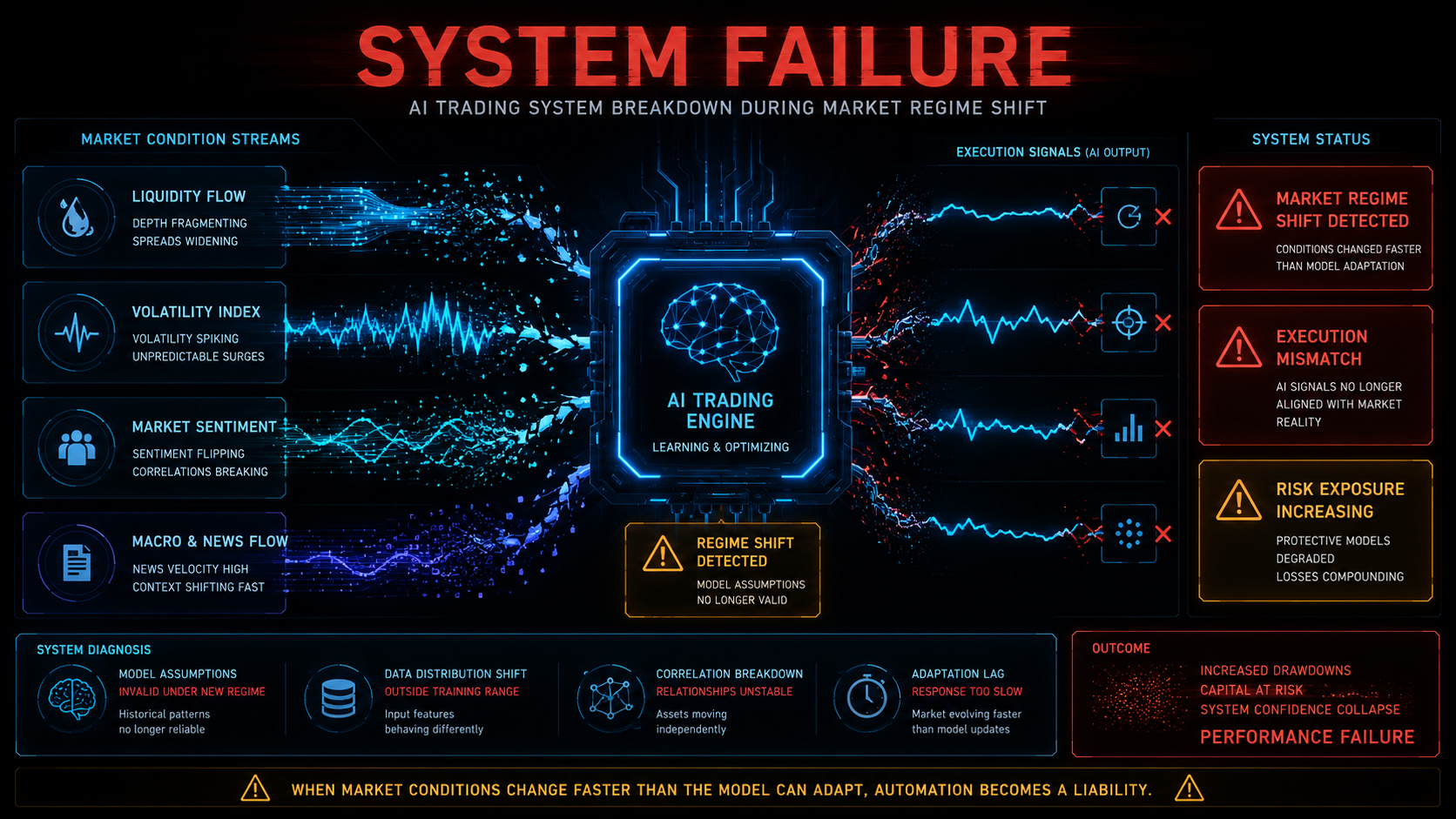
The System Did Not Break. The Market Environment Changed.
Most traders think a losing bot means bad code, weak AI, or poor prediction.
That is often the wrong diagnosis.
A trading bot can still be following its rules correctly while the market environment underneath those rules has already changed. The trigger still appears. The system still enters. The dashboard still looks normal. But the conditions that once made those entries profitable are no longer there.
A system may perform well during clean trend continuation.
The same system may start bleeding when the market rotates into range noise, stop-hunt conditions, fake breakouts, or leverage-driven volatility expansion.
That is why the first problem is not “AI failure.”
It is market mismatch.
This is also why automation itself should never be treated as the edge. If you want the execution layer separated from the strategy layer, read Crypto Automated Trading: Automation Is Not a Trading Plan.
Real Crypto Markets Shift Regimes Faster Than Most Systems Adapt
A trading system is usually built around repeatable assumptions.
Breakouts continue.
Momentum expands.
Pullbacks hold.
Structure remains clean long enough to execute.
Crypto does not promise any of that.
It rotates between:
- trend expansion
- range compression
- liquidity sweeps
- volatility spikes
- liquidation cascades
- unstable reaction phases
A bot does not lose money because the math suddenly disappears.
It loses money because the market regime changes while the system keeps behaving as if nothing changed.
Yesterday’s clean breakout becomes today’s exit liquidity.
Yesterday’s orderly pullback becomes today’s failed reclaim.
Yesterday’s continuation signal becomes today’s late entry trap.
The bot still sees a valid trigger.
The market no longer rewards it the same way.
The Same Signal Stops Meaning the Same Thing
This is where many live systems quietly die.
A breakout above resistance can mean genuine continuation.
It can also mean a temporary sweep into trapped participation.
A reclaim of a prior level can mean bullish acceptance.
It can also mean a short-lived recovery before another failure.
A momentum candle can mean expansion.
It can also mean late traders rushing into the most crowded part of the move.
The system sees the event.
It often does not understand the intent behind the event.
That is the hidden problem. The bot is not reading “truth.” It is reading a set of visible conditions and responding to them mechanically. In stable structure, that can work. In liquidity-driven structure, that same behavior becomes fragile.
The market is not targeting you personally. It is targeting crowded liquidity.
That applies to bots too.
Structure Failure Usually Appears Before Full System Failure
The most dangerous losing systems do not collapse all at once.
They deteriorate.
The first clue is usually structural degradation.
Levels stop holding cleanly.
Breakouts wick and close back inside the range.
Continuation loses follow-through.
Pullbacks deepen beyond what the strategy was designed for.
Reaction quality gets worse even though the signal still looks valid.
This is the point where many traders blame the bot, when the better diagnosis is simpler:
The structure that supported the system is no longer present.
The bot did not suddenly become stupid.
It kept executing a logic set that no longer fit the chart condition.
Execution Without Context Is Where Bots Start Bleeding
A trading bot is good at detection.
It is not automatically good at judgment.
It can detect:
- price crossing a level
- an indicator condition
- a volatility threshold
- a momentum confirmation
- a rule-based trigger
But real market survival depends on context:
Was the breakout early or late?
Did the move happen at a meaningful boundary or in the middle of noise?
Is volatility expanding from clean structure or exploding inside disorder?
Is the signal appearing in open space or directly into overhead liquidity?
If the system cannot distinguish those differences, it starts trading “events” rather than “tradable conditions.”
That is how the setup keeps looking correct while the PnL keeps getting worse.
Repetition Turns a Weak Environment Into a Damage Cycle
A human trader can repeat a mistake.
A bot can industrialize it.
When the regime has already turned hostile, repeated execution becomes the real account killer. The bot may continue taking the same type of setup again and again because, on paper, the condition still qualifies. But if the environment has already shifted, repeated entries do not create discipline. They create structured loss.
That is why overtrading is not only an emotional human problem.
It can also become a system problem.
If the bot keeps trading inside weak ranges, failed expansions, or unstable volatility, it is not “staying active.” It is compounding exposure inside a market condition that should have been filtered out.
This behavior pattern connects directly with Overtrading Crypto: Why Fast Traders Lose Before the Setup Appears.
Leverage Exposes the Weakness Much Faster
A weak system can sometimes survive in spot markets longer than traders expect.
Leverage removes that cushion.
Under leverage, small structural mistakes become expensive very quickly.
A slightly late entry becomes a narrower safety margin.
A deeper pullback becomes liquidation pressure.
A wider invalidation distance becomes oversized exposure if size is not reduced.
A normal volatility event becomes a forced exit instead of a manageable drawdown.
This is why bot losses often look sudden in crypto futures.
The weakness did not start at liquidation.
It started earlier, when the system entered a condition it was not designed to survive under leverage.
For the leverage mechanics behind that failure, read How Does Leverage Work in Crypto Futures Trading? Liquidation Explained.
Position Size Often Breaks Before Prediction Does
Many traders obsess over whether the bot can predict the next move.
That is often not where the first real failure happens.
A system may still have usable direction logic and still lose money because the risk layer no longer fits the environment. When volatility expands, invalidation distance changes. When invalidation distance changes, position size should adapt. If size stays too aggressive while the environment gets less forgiving, the account damage arrives before the strategy looks obviously broken.
This is why many live systems fail through exposure before they fail through signal quality.
The prediction layer may still be partly right.
The size layer is already wrong.
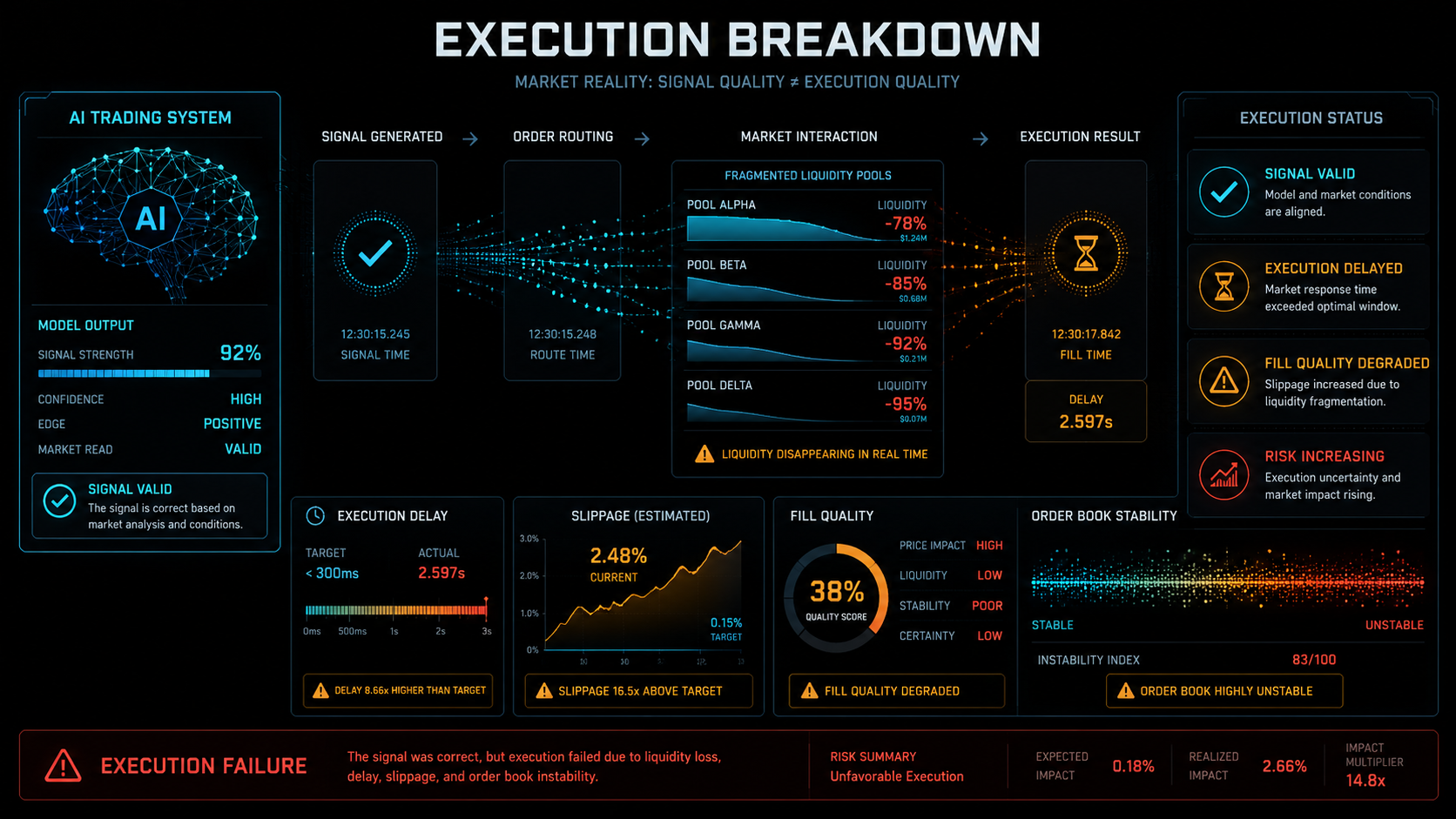
For that exact risk layer, use Crypto Position Size Calculator: How to Define Risk Before Entry. When market conditions deteriorate, the position size usually needs to change before the system is allowed to keep trading.
Backtests Hide the Live Conditions That Actually Hurt Bots
Backtests can make a weak system look stable because they often flatten the part that hurts most in live trading.
They may not fully capture:
- slippage spikes
- unstable spreads
- clustered volatility
- abrupt liquidity withdrawal
- repeated failed continuation
- execution during regime transition
A backtest can show that a rule worked in old data.
It cannot guarantee that the current market is still offering the same structure.
That is why traders say, “The bot worked in testing.”
It probably did.
The real market is where the environment starts arguing back.
Why AI Trading Bots Lose Money in Crypto
The answer is not that AI is fake.
The answer is that trading systems fail when real market environments stop matching their assumptions.
They lose because:
- structure degrades
- liquidity changes the meaning of the signal
- volatility expands beyond the model’s comfort zone
- leverage amplifies small structural mistakes
- repeated execution continues after the environment has turned bad
- position size no longer fits the real risk
The bot keeps doing its job.
That is exactly why the damage continues.
The problem is not that the AI stopped working.
The problem is that the market stopped offering the environment the system needed.
Final Rule
A trading system does not truly fail when it takes a losing trade.
It fails when it keeps trading after the environment that supported it is gone.
No structure match, no trade.
No clean liquidity condition, no trade.
No regime fit, no execution.
That is the real answer to why AI trading bots lose money in crypto.