The bot did not stop.
That was the problem.
The first loss was manageable.
The second loss looked normal.
The third loss should have paused the system.
But the bot kept running.
It kept scanning.
It kept entering.
It kept treating a damaged session like a normal market.
That is why an AI trading bot kill switch matters. The danger is not only that the bot enters a bad trade. The real danger is that the bot keeps trading after the environment has already turned against the system.
A trader may freeze after a bad loss.
A bot does not.
It continues until the rule tells it to stop.
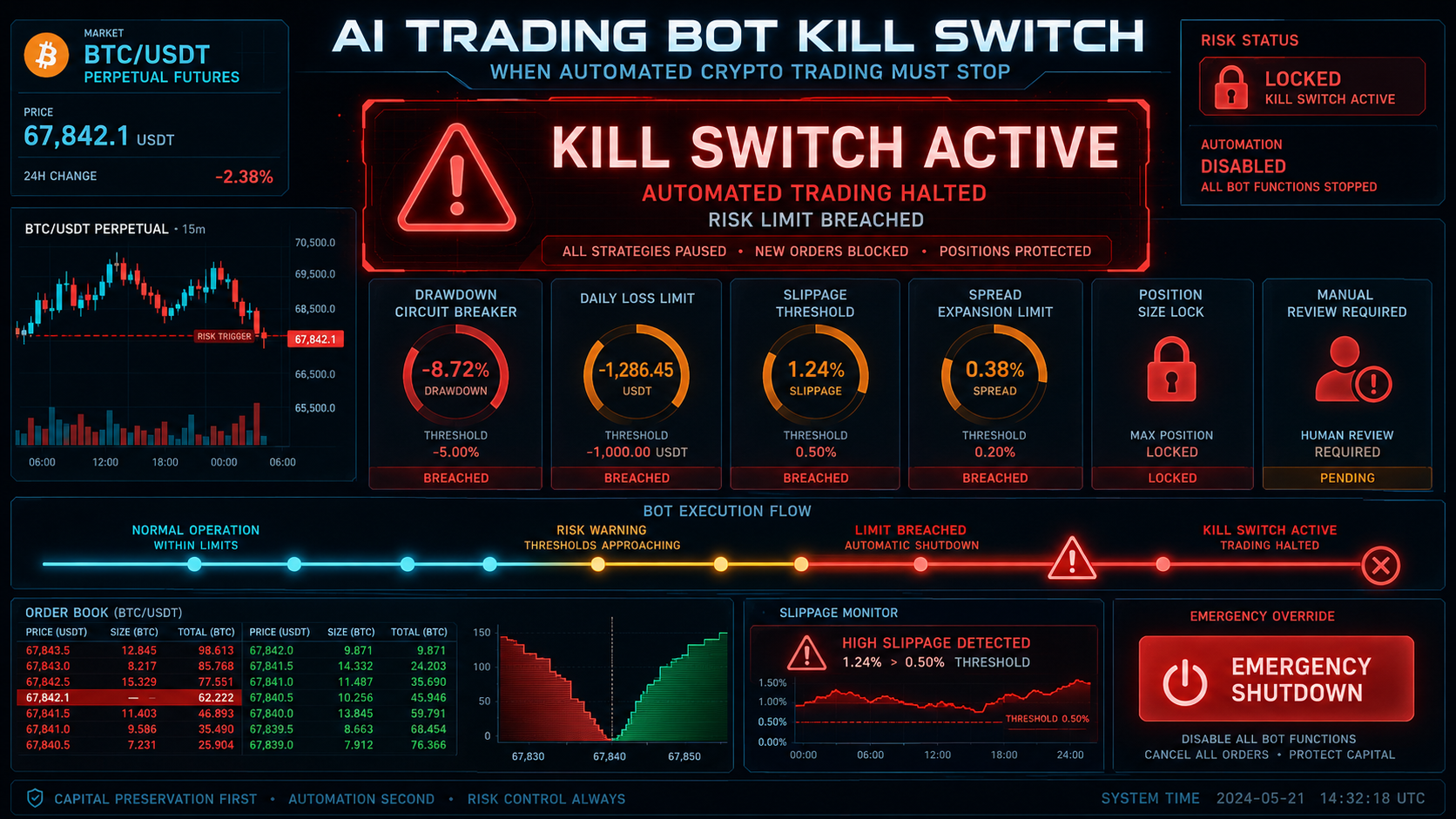
A Kill Switch Is Not a Panic Button
An AI trading bot kill switch is not something added after the account is already damaged.
It belongs inside the system before the first live trade.
A real kill switch defines when automated trading must stop. It does not ask whether the next setup looks attractive. It does not wait for the trader to feel uncomfortable. It does not allow the bot to recover losses by increasing activity.
It shuts down execution when predefined damage limits are reached.
That matters because automated crypto trading can fail quietly at first. The dashboard still updates. The rules still trigger. The system still looks controlled. But the account may already be inside a hostile session where slippage is worse, volatility is unstable, and the same setup is failing repeatedly.
The bot does not know that the session has changed unless the kill switch is already written.
That is the difference between automation and control.
This is why crypto automated trading is not a trading plan. Automation can execute instructions, but the shutdown logic must exist before the system is allowed to run.
A stop loss controls one position.
A kill switch controls the operating permission of the entire bot.
A stop loss says where one trade is invalid. A kill switch says when the system itself is no longer allowed to execute. That difference matters because automated trading damage usually does not come from one isolated loss. It comes from repeated execution after the market environment has changed.
The First Shutdown Trigger Is Drawdown Behavior
Drawdown is not only a number.
It is a signal that the system may no longer fit the market.
One losing trade does not always prove that the bot is broken. But repeated losses in the same structure are different. They show that the market may no longer be rewarding the system’s logic.
A drawdown circuit breaker should activate when the account moves from normal variance into pattern failure.
The difference matters.
Normal variance looks like mixed results.
System failure looks like repeated damage from the same condition.
The same breakout keeps failing.
The same momentum trigger keeps entering late.
The same stop area keeps getting hit.
The same slippage pattern keeps damaging fills.
The same session keeps producing worse-than-tested outcomes.
At that point, the bot should not continue looking for the next trade.
It should stop.
The market is not targeting your bot personally. It is targeting crowded liquidity. If the bot keeps firing where other systems are also entering, the next signal may not be opportunity. It may be another liquidity event.
The Drawdown Circuit Breaker Must Have Levels
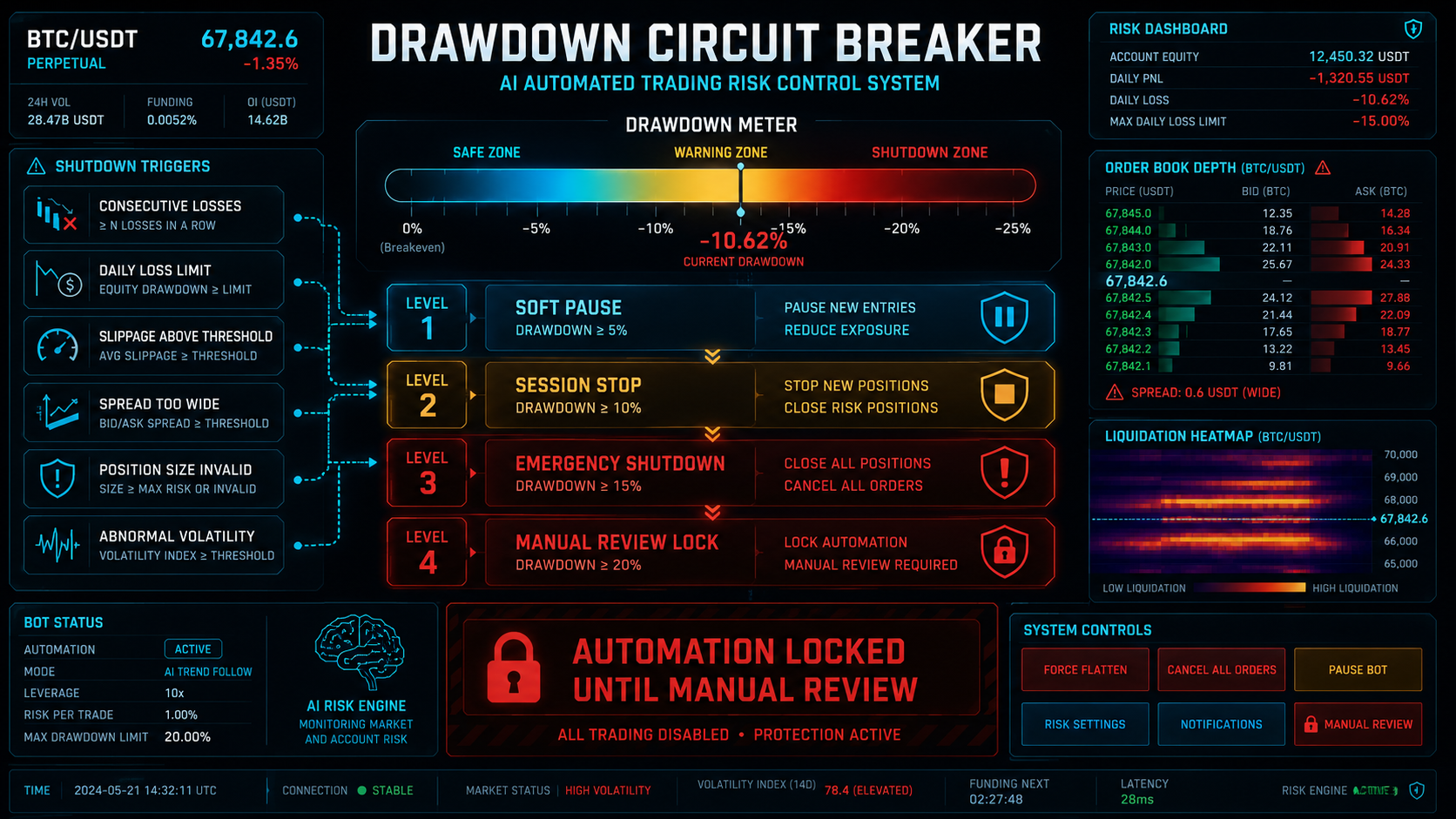
A serious AI trading bot kill switch should not rely on one final emergency stop.
It should use circuit breaker levels.
Level one is a soft pause.
This activates after early warning damage. The bot stops opening new trades for a short review window. Existing positions are managed according to the system rules, but new exposure is blocked. The purpose is to prevent the bot from instantly repeating the same setup after the first warning signs appear.
Level two is a session stop.
This activates when daily drawdown, maximum trade count, or consecutive loss limits are reached. The bot is not allowed to open new trades for the rest of the session. A bad day needs a hard ending.
Level three is an emergency shutdown.
This activates when live conditions become structurally unsafe. Spread expansion, abnormal slippage, liquidity gaps, platform delay, liquidation-driven volatility, or position-size mismatch should be able to shut down the bot immediately.
Level four is manual review lock.
This means the bot cannot restart automatically. A human review must confirm whether the system still fits the current market environment.
Without these layers, the bot can keep trading because it is technically allowed to trade.
That is not discipline.
That is permission without protection.
Slippage Can Trigger the Kill Switch Before Drawdown Explodes
Most traders only think about shutting down after losses.
That is late.
A stronger system can stop before the loss expands by watching execution quality.
If live fills are consistently worse than expected, the bot is already trading a different version of the setup. The signal may still be valid, but the execution is damaged. A clean backtest entry becomes a late live fill. A planned stop becomes less reliable. A small edge becomes too thin to survive.
This is where a kill switch should monitor slippage.
If slippage exceeds the tested range, the bot pauses.
If spread expands beyond the allowed threshold, the bot pauses.
If order book depth becomes too thin near the entry level, the bot pauses.
If partial fills become frequent, the bot pauses.
The system should not wait for the account to bleed before recognizing that execution quality has changed.
For the execution-damage layer, read crypto trading bot slippage. A kill switch must treat bad fills as risk, not as a minor inconvenience.
A Kill Switch Must Stop the Bot When Position Size No Longer Fits
Position size is not fixed just because the bot is active.
It depends on the distance between entry, invalidation, volatility, and maximum acceptable loss.
When market conditions change, position size can become unsafe even if the signal still looks valid.
If volatility expands, the invalidation distance changes.
If slippage worsens, the real entry changes.
If spread widens, the cost of execution changes.
If liquidation distance shrinks, the margin for error changes.
A bot that keeps using the same exposure after these conditions change is not controlling risk. It is using old sizing logic inside a new environment.
That is why the kill switch needs a risk-size lock.
If the calculated position size exceeds the maximum allowed risk, execution must stop. If the required stop distance is too wide for the account risk limit, execution must stop. If the bot cannot define maximum loss before entry, execution must stop.
Before live deployment, the maximum account risk should be defined with the Maximum Risk Calculator. The bot should not be allowed to trade size until the maximum loss, invalidation distance, and live execution conditions still fit the account.
The Kill Switch Should Activate Before the Trader Starts Hoping
The most dangerous moment in automated trading is not the first loss.
It is the moment after the trader starts hoping the bot will recover.
That is when weak systems keep running.
The trader watches the dashboard. Another setup appears. The bot enters. The loss is not large enough to feel catastrophic yet, so the system is allowed to continue. Then the next trade repeats the same weakness.
This is how automated damage builds.
The trader thinks the bot is looking for recovery.
The system is only following permission.
A kill switch removes that permission.
It blocks the bot from using the next trade to repair the previous loss. It prevents the system from increasing exposure after damage. It stops the session from becoming a recovery loop.
Smart Money does not need to know your personal settings.
It only needs the obvious zones where many traders and systems keep trying to recover at the same time.
That is where urgency becomes liquidity.
Red Flags That the Bot Needs a Kill Switch Immediately
The first red flag is repeated losses from the same setup type.
If the bot keeps losing on similar breakouts, similar reclaims, or similar momentum entries, the issue is no longer one bad trade. The market environment may no longer support the system.
The second red flag is worse live fills than tested fills.
If the bot’s entries are consistently worse than expected, the real strategy is not the same as the backtest.
The third red flag is rising trade frequency during bad conditions.
A bot should usually become quieter when market quality declines. If it becomes more active during spread expansion, volatility spikes, or range noise, the system is converting danger into exposure.
The fourth red flag is position size remaining unchanged while volatility expands.
That means risk is no longer adapting to the environment.
The fifth red flag is manual override after losses.
If the trader keeps restarting, loosening, or increasing the bot after damage, the kill switch is not strict enough.
No-Run Rules for an AI Trading Bot Kill Switch
Do not let the bot run after the daily loss limit is reached.
Do not let the bot run after the maximum consecutive loss limit is reached.
Do not let the bot run when slippage exceeds the tested range.
Do not let the bot run when spread is wider than the strategy can absorb.
Do not let the bot run when order book depth is too thin near the planned entry.
Do not let the bot run when position size no longer fits the defined maximum risk.
Do not let the bot run when volatility changes the invalidation distance beyond the system’s tested condition.
Do not let the bot restart automatically after emergency shutdown.
Do not let the bot trade because the next setup looks like a recovery opportunity.
A kill switch is not there to make the bot smarter.
It is there to stop the bot when the system is no longer safe enough to execute.
The Kill Switch Must Be Hard, Not Emotional
A soft warning is not enough.
If the rule can be ignored during stress, it is not a kill switch. It is only a suggestion.
A real AI trading bot kill switch must be hard-coded into the operating rules. The bot should not ask for permission to continue after the circuit breaker triggers. The trader should not be able to casually override it because the next candle looks attractive.
The shutdown condition must mean shutdown.
Daily loss limit hit: stop.
Slippage threshold exceeded: stop.
Spread beyond limit: stop.
Position size invalid: stop.
Emergency volatility detected: stop.
Manual review required: stop.
The market will always offer another candle.
That does not mean the account should offer another trade.
The Kill Switch Protects the System From the Wrong Market
Most traders think the kill switch protects them from bad entries.
That is only part of it.
The stronger role is protecting the system from the wrong market.
A bot may work in clean trend structure and fail during liquidity sweeps. It may work in normal volatility and fail during liquidation cascades. It may work when spreads are stable and fail when execution quality degrades.
The kill switch is the boundary between valid environment and invalid environment.
That is why it belongs inside the same logic as market regime failure. The issue is not always the bot itself. The issue is that the bot keeps operating after the market stops matching its assumptions. That is the core mechanism behind why AI trading bots lose money in crypto.
The bot does not need to be wrong forever.
It only needs to keep trading after its edge is gone.
That is enough.
Final Rule: The Best Bot Is the One That Knows When to Stop
An AI trading bot kill switch is not a weakness.
It is the part of the system that admits the market can change faster than the strategy can adapt.
A bot without a kill switch can keep trading through drawdown, slippage, spread expansion, volatility spikes, and position-size distortion. It can turn a bad session into a damaged account because no rule forced it to stop.
A serious automated system needs hard shutdown logic.
No drawdown control, no live deployment.
No slippage threshold, no execution permission.
No position-size lock, no exposure.
No manual review after emergency shutdown, no restart.
No kill switch, no real automation control.
The strongest automated trading system is not the one that trades the most.
It is the one that knows when the market no longer deserves execution.