The bot entered exactly where the backtest said it should.
The live fill was worse.
Not a little worse.
Worse enough to change the entire trade.
The signal was still valid.
The strategy still triggered.
The dashboard still looked professional.
But the entry was no longer the same entry.
That is the hidden damage behind crypto trading bot slippage. It does not always look dramatic on one trade. It shows up slowly, inside fills that are slightly worse, exits that are slightly late, spreads that widen at the wrong moment, and order books that vanish exactly when the bot needs liquidity.
It feels like the market knows where your bot is entering.
It does not need to know your bot.
It only needs the obvious zone where thousands of similar systems are trying to execute at the same time.
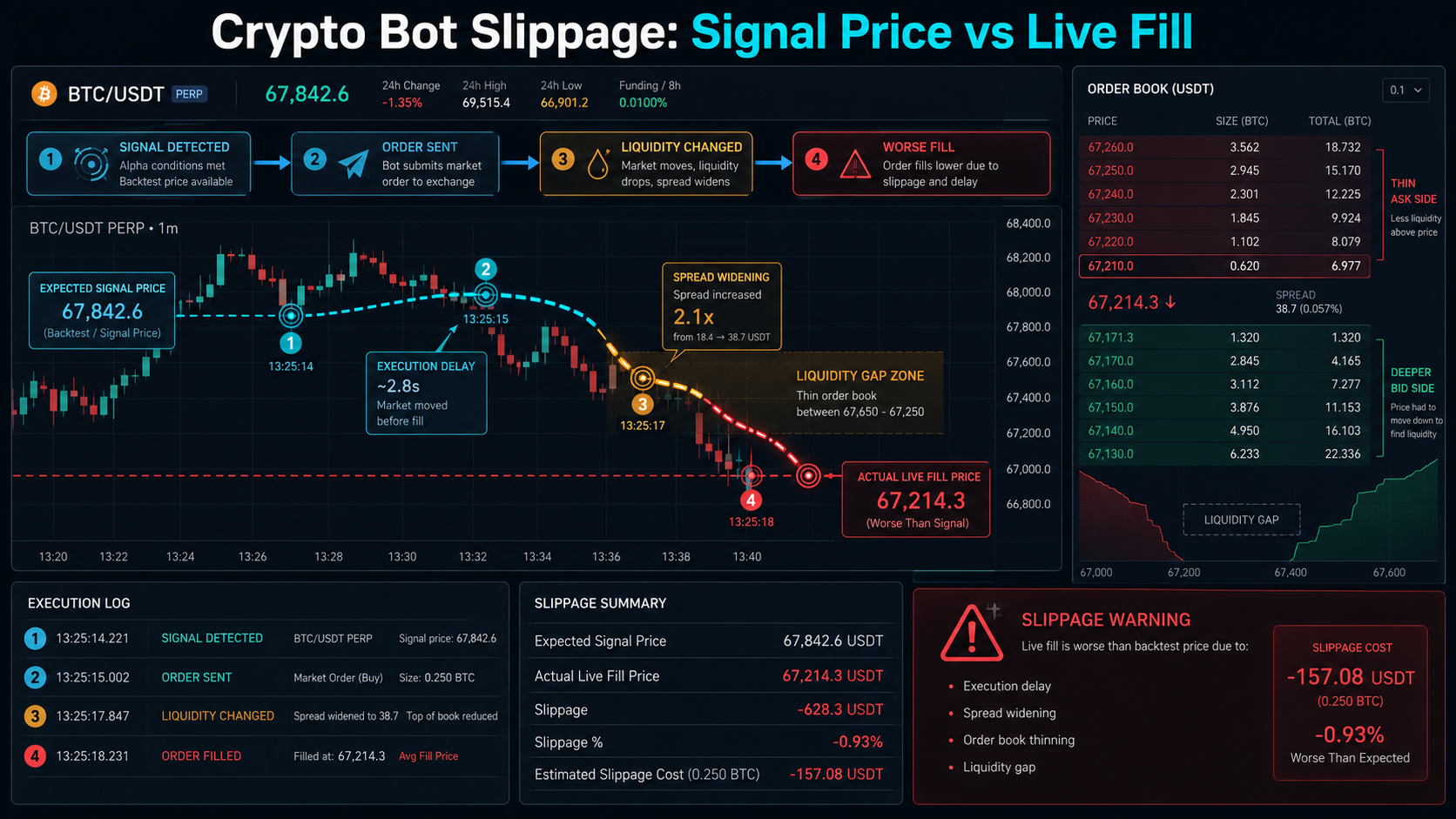
Slippage Is Not a Small Detail. It Changes the Trade.
Most traders treat slippage like a fee.
That is too simple.
A fee is visible. Slippage is structural.
It changes where the trade actually begins.
In a backtest, the bot may appear to enter near the signal price. The breakout triggers. The condition passes. The system records the entry. Everything looks clean.
In live crypto trading, the signal does not freeze the market.
Price keeps moving.
Liquidity keeps changing.
The spread can widen.
The order book can thin out.
The fill can happen at a worse level.
That means the bot is not trading the same setup shown in the backtest.
The backtest measured a clean entry.
The live market delivered a damaged entry.
That difference matters because crypto bots often rely on speed, small edges, and repeated execution. If the bot expects a small profit window, even a small fill distortion can destroy the edge before the trade has time to work.
This is why automation should never be treated as a trading plan by itself. A bot can execute faster than a human, but faster execution becomes dangerous when the system has no slippage limit, spread filter, or shutdown rule. That execution-control layer is explained in Crypto Automated Trading: Automation Is Not a Trading Plan.
The Backtest Entry Is Clean Because Nobody Is Competing With It
Backtests are quiet.
Live markets are not.
In a backtest, the bot does not compete against other traders for the same liquidity. It does not fight a moving order book. It does not wait behind other orders. It does not hit a thin book during a volatility spike. It does not discover that the best price disappeared before the order arrived.
The entry looks clean because the test environment is not resisting the system.
Live crypto trading does resist.
When price moves fast, the top of the order book can change before the bot receives the fill. A market order may eat through several levels. A limit order may not fill at all. A partial fill may leave the bot exposed with incomplete size. The system may record a trade, but the live position no longer matches the tested assumption.
That is where the damage begins.
The bot did not make a wrong prediction.
It received a worse trade than the backtest promised.
Slippage Turns Good Signals Into Late Entries
A signal can be correct and still become untradable after slippage.
This is the part traders miss.
A breakout signal may appear near a clean level. In the backtest, the bot enters close enough to structure. In live trading, price may already have moved by the time the order fills. The entry is now farther from invalidation and closer to the crowded part of the move.
The setup did not disappear.
The risk changed.
A clean entry near structure becomes a late entry after slippage. A tight edge becomes compressed. A normal pullback becomes more dangerous. The bot now needs immediate continuation to survive.
That is fragile.
The market does not have to reverse violently to damage the trade. It only needs to pause, wick, or retrace after the bot receives a poor fill.
That is why slippage is more than execution cost.
It changes the trade’s location.
Liquidity Disappears When Bots Need It Most
Crypto liquidity is not constant.
It often looks available when the market is calm and disappears when the move becomes important.
That is the trap.
A bot may work well during smooth conditions. Then volatility expands, the order book thins, and the same order size suddenly moves through worse levels. The system still fires because the signal is active, but the live market no longer provides the same execution quality.
This is where the situation starts to feel unfair.
The bot enters during the breakout, but the fill is worse.
The bot exits during the reversal, but the exit slips.
The bot tries to protect the trade, but the stop executes lower than expected.
The bot repeats the same logic because the rule still allows it.
The market is not targeting the bot personally.
It is targeting crowded liquidity.
When many traders and automated systems chase the same visible breakout, the same reclaim, or the same momentum candle, they concentrate demand in one area. Stronger participants do not need your personal order. They only need the obvious zone where retail systems are forced to execute.
The Worst Slippage Happens Around the Most Obvious Moves
Slippage is usually worst when traders feel most confident.
The candle is large.
The breakout is obvious.
Momentum looks clean.
The move feels urgent.
That is exactly when the order book can become unstable.
Late buyers rush in. Stops trigger. Liquidation pressure expands. Market orders hit thin liquidity. The bot sees confirmation and executes into the same zone where everyone else is trying to get filled.
The signal looks strong.
The fill quality becomes weak.
This is why some bots perform well during calm backtests but fail during live crypto volatility. The system is not only testing direction. It is testing whether the market can fill the order without destroying the edge.
That live-market failure mechanism connects directly with Why AI Trading Bots Lose Money in Crypto Markets: The Real Failure Mechanisms. Slippage is one of the ways market regime, liquidity behavior, and execution conditions turn a working system into a losing one.
Slippage Damages Three Parts of the Trade
Slippage does not only affect entry.
It damages the full trade structure.
The first damage is entry slippage.
The bot enters worse than expected. The position starts farther from the ideal decision area, and the trade immediately needs more continuation to justify the risk.
The second damage is stop slippage.
When price moves quickly against the position, the exit may happen beyond the planned stop area. The trader thinks risk was defined, but the live fill expands the real loss.
The third damage is target slippage.
A profitable exit may fill worse than expected or only partially fill. The backtest records a clean profit. The live market gives less.
That is how the system loses edge from both sides.
Losses become larger than tested.
Wins become smaller than tested.
The equity curve changes without the signal logic changing.
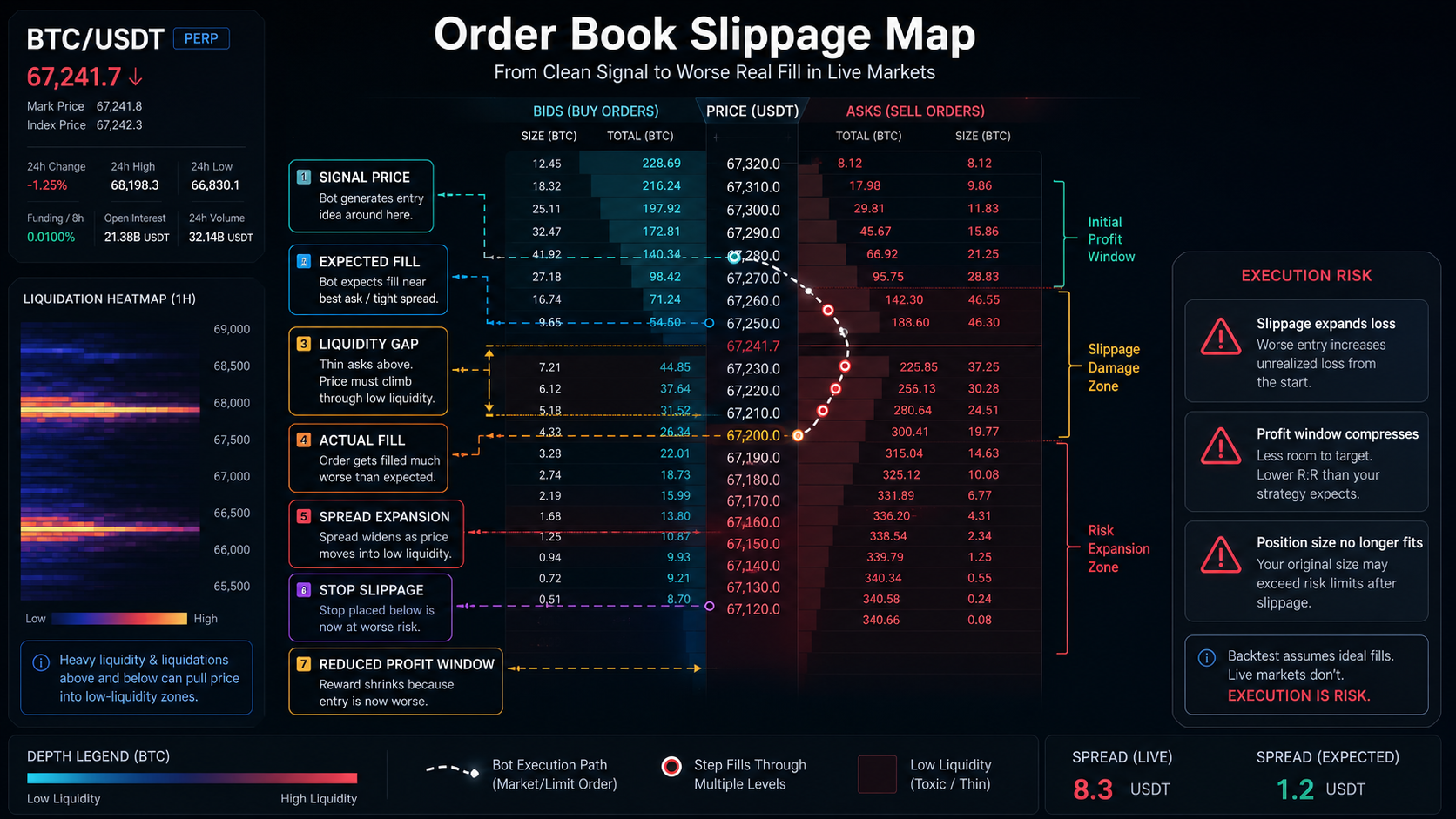
Position Size Becomes Wrong After Slippage
Slippage also breaks position sizing.
A position size is usually calculated from account risk and invalidation distance. But if the live fill is worse than the expected entry, the distance to invalidation changes. The planned risk is no longer the real risk.
This matters most in leveraged crypto trading.
A worse entry can move the position closer to liquidation pressure. A wider spread can reduce the usable risk window. A stop that fills worse than planned can turn a controlled loss into a larger loss than the system expected.
The trade may still look small.
The real exposure has changed.
That is why slippage should be included before position size is trusted. If a bot sizes based on backtest fills while live fills are worse, the system is not controlling risk. It is controlling a cleaner version of the trade that no longer exists.
This execution problem connects directly with the crypto position size calculator. Position size should reflect real fill quality, invalidation distance, volatility, and maximum loss before the bot is allowed to execute size.
Red Flags That Slippage Is Breaking the Bot
The first red flag is that live entries are consistently worse than the backtest assumption.
One bad fill can happen.
Repeated worse fills mean the system is not modeling the real market.
The second red flag is that profitable trades are smaller live than they were in testing.
If the bot still wins but the profit per trade shrinks, execution cost may be eating the edge.
The third red flag is that stop losses are larger live than expected.
If exits slip during volatility, the system may not be respecting the actual risk boundary.
The fourth red flag is that performance collapses during fast moves.
A strategy that only works when the market is calm may not be ready for crypto deployment.
The fifth red flag is that the bot trades more during unstable conditions.
If spread widens, liquidity thins, and the bot becomes more active instead of more selective, the system is converting poor conditions into repeated exposure.
That is not discipline.
That is automated damage.
No-Execution Rules for Crypto Bot Slippage
A serious crypto trading bot needs execution rejection rules.
Do not execute when spread is wider than the tested range.
Do not execute when order book depth is too thin near the entry level.
Do not execute when the expected fill would move the trade away from the decision area.
Do not execute when volatility expands beyond the system’s tested condition.
Do not execute when slippage on recent trades exceeds the maximum allowed threshold.
Do not execute when the setup only works if the bot receives a perfect fill.
Do not execute when the market is moving faster than the system can confirm and place the order.
These rules matter because a bot should not only know when a signal appears.
It should know when the signal is no longer tradable after execution cost.
Final Rule: The Signal Is Not the Trade. The Fill Is the Trade.
Crypto trading bot slippage is dangerous because it lives between the signal and the real position.
The backtest shows the signal.
The live market gives the fill.
Those are not the same thing.
A bot can be correct on direction and still lose money if the fill is poor enough. It can catch the right move and still damage the account if the entry is late, the stop slips, or the target fills worse than tested.
That is why the real question is not only whether the bot can find trades.
The real question is whether the bot can refuse trades when execution quality is damaged.
No clean fill, no trade.
No stable spread, no trade.
No usable order book depth, no trade.
No slippage limit, no live deployment.
A backtest can make the system look smart.
Live slippage shows whether the system can survive reality.