The system opened another trade while you were not watching.
It did not panic.
It did not hesitate.
It did exactly what you allowed it to do.
That was the problem.
Crypto automated trading does not become dangerous because it is fast. It becomes dangerous when speed is attached to weak rules, loose limits, and no shutdown control. A bot can keep executing long after a human trader would have stopped, questioned the setup, or walked away from the screen.
The loss often starts before the trade opens.
It starts when the trader gives automation permission without defining the limits first.
A bot does not know your account pressure.
It does not know that you already had a bad day.
It does not know that three losses in a row changed your judgment.
It only follows the settings.
If the settings are incomplete, automation does not protect you.
It repeats the weakness faster.
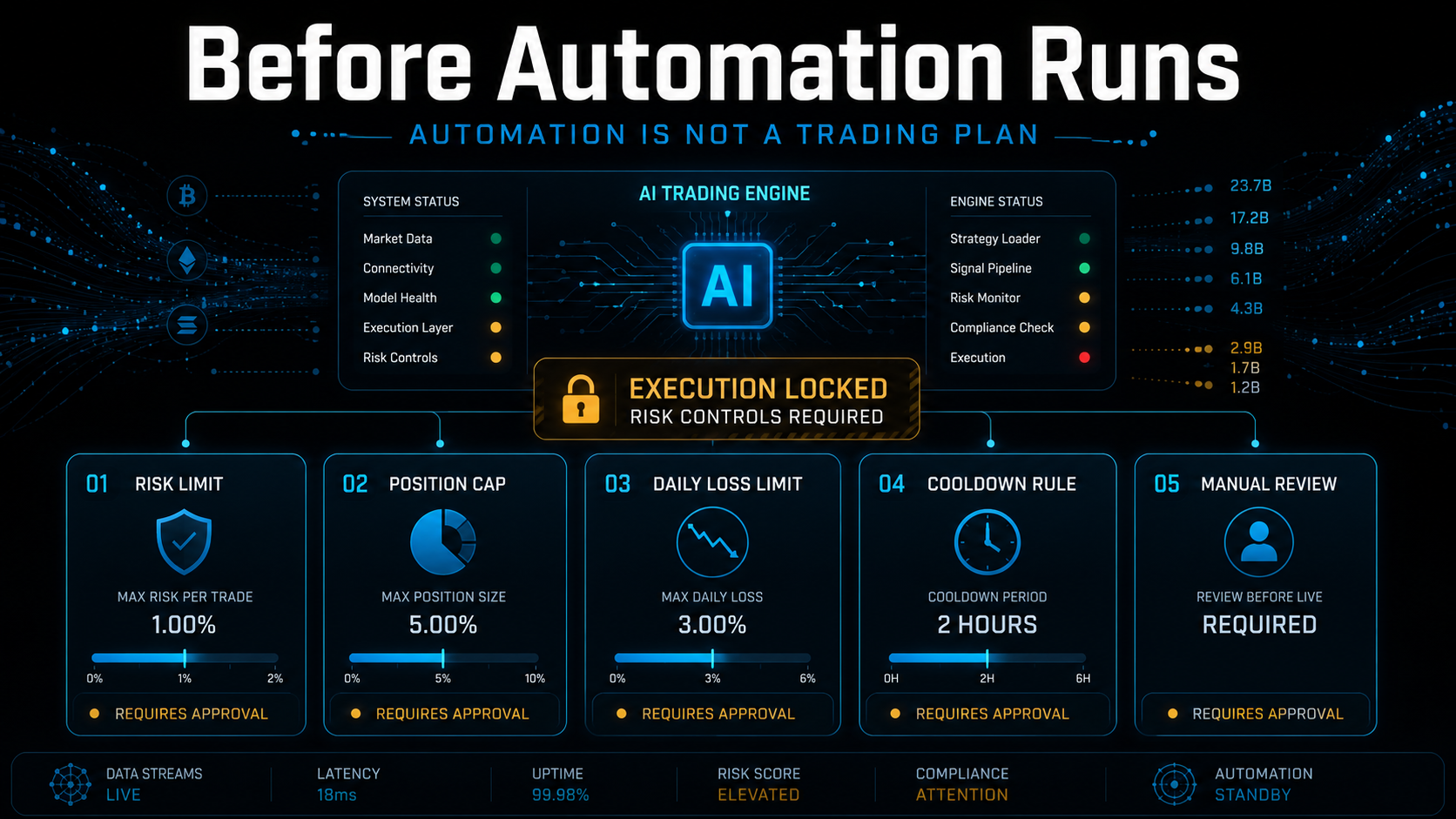
Automation Is an Executor, Not a Trading Plan
Crypto automated trading is an execution layer.
It can scan faster than you.
It can react faster than you.
It can repeat instructions without emotion.
It can follow a schedule, monitor conditions, and remove some hesitation from the process.
But it cannot turn unfinished thinking into a complete trading plan.
That is where many beginners get trapped. They treat automation as if it will create discipline for them. They expect the system to know when to continue, when to reduce exposure, when to pause, and when the account needs protection.
That is backwards.
The plan must exist before automation begins.
The limits must exist before execution begins.
The pause rules must exist before the first loss appears.
A system can execute faster than a trader.
It cannot decide whether the trader gave it safe rules.
For a closer breakdown of what a bot actually does before execution, read AI Crypto Trading Bot: What It Really Does Before You Let It Trade.
The Settings Are the Strategy
Most traders focus on the bot.
They should focus on the settings.
The bot is not the edge by itself. The settings decide whether automation behaves like a controlled assistant or an uncontrolled trigger.
A serious automated setup should define the maximum loss per trade before it can open exposure.
It should define the maximum position size before the first order is placed.
It should define the maximum number of trades per session.
It should define what happens after consecutive losses.
It should define when a human review is required.
It should define when the system must stop.
Without those settings, automation is not a plan.
It is a machine with permission.
That permission can be useful when the rules are strict. It can be dangerous when the rules are emotional, loose, or built around hope.
The most important question is not:
Can the system trade?
The better question is:
What is the system forbidden to do?
A Bot Does Not Know When You Are Already Losing Control
A human trader feels pressure after a loss.
A bot does not.
A human trader may hesitate after several bad trades.
A bot does not.
A human trader may feel that the session is becoming unstable.
A bot does not care unless the rule already exists.
This is why automated trading can become dangerous after the first few losses. The account may be in a damaged state, but the system keeps operating as if nothing changed.
The trader sees another entry.
The system sees another allowed action.
The account sees more exposure.
That difference matters.
A clean automated plan needs hard session rules:
Stop after the daily loss limit is hit.
Stop after a fixed number of losing trades.
Stop when execution cost becomes too high.
Stop when position size cannot stay within the risk limit.
Stop when human review is required.
These rules should not be added after the account is already damaged.
They should be built before the system is allowed to run.
Risk Limits Must Be Hard, Not Emotional
A risk limit is not a suggestion.
It is a hard boundary.
Many traders set a limit, then raise it after the first loss. They reduce discipline exactly when discipline matters most. Automation can make that mistake worse because it removes the friction between decision and execution.
A weak manual trader can still stop for a moment.
A weak automated setup does not stop unless it has been forced to stop.
The risk limit should control the system before the system controls the account.
That means the maximum loss per trade must be defined.
The maximum loss per day must be defined.
The maximum position size must be defined.
The maximum number of trades must be defined.
The cooldown period after a loss must be defined.
Manual review must be required when the system reaches a risk boundary.
Before any automated setup is trusted, connect this step with Crypto Position Size Calculator: How to Define Risk Before Entry.
Position size should not be based on confidence.
It should not increase because recent trades were winners.
It should not expand because the trader wants to recover faster.
It should obey the risk limit.
If the position only feels safe because the system is fast, the setup is not ready.
The Dangerous Settings Beginners Ignore
The first dangerous setting is unlimited trading.
If the system can keep opening trades all day, it can turn a normal weak session into serious account damage.
The second dangerous setting is no daily loss limit.
Without a daily loss limit, the system can continue after the account is already in a bad state.
The third dangerous setting is no position cap.
If the system is allowed to increase size too freely, one bad cycle can erase many small wins.
The fourth dangerous setting is no cooldown rule.
After a loss, the next trade is usually more dangerous because the trader wants recovery and the system still has permission.
The fifth dangerous setting is no manual review.
Some conditions should require the trader to stop and check the setup manually before more exposure is allowed.
The sixth dangerous setting is recovery mode.
Recovery mode sounds helpful. In reality, it often turns loss pressure into larger exposure. The market does not owe the account a recovery trade.
A bot that becomes more aggressive after losses is not protecting you.
It is repeating the emotional mistake most traders make manually.
Constant Activity Is a Warning
Many traders trust automated trading because it looks busy.
The dashboard updates.
The system keeps scanning.
The trades keep appearing.
The account feels active.
Activity feels like opportunity.
That feeling is dangerous.
Constant activity may mean the system is not filtering enough. It may be treating every movement as a reason to trade. It may be opening exposure because the rules are too loose.
This is the automated version of overtrading.
The chart moves.
The trader feels pressure.
The next trade looks like a chance to recover.
The trader clicks.
Automation can repeat that same behavior without emotion and without fatigue.
That does not make it professional.
It makes the mistake faster.
For the manual version of this problem, read Overtrading Crypto: Why Fast Traders Lose Before the Setup Appears.
A serious automated system should spend a lot of time doing nothing.
No trade is not failure.
No trade may be the risk filter working.
No-Run Rules Before You Turn Automation On
Do not turn on automation without a maximum loss per trade.
If the system does not know how much it is allowed to lose, it should not be allowed to trade.
Do not turn on automation without a daily loss limit.
A bad day should have a hard ending.
Do not turn on automation without a position cap.
Size should not expand just because the system is active.
Do not turn on automation without a cooldown rule.
After losses, the system should slow down, not become more aggressive.
Do not turn on automation without a maximum trade count.
More trades can mean more cost, more exposure, and more repeated mistakes.
Do not turn on automation without manual review conditions.
Some situations should force the trader back into control.
Do not turn on automation if the only plan is to adjust it later.
That usually means the real plan does not exist yet.
Backtests Can Hide Live Risk
Backtest results can look clean.
Live trading is different.
A backtest may not fully show execution cost.
It may not show real slippage.
It may not show hesitation.
It may not show platform delay.
It may not show how the account feels after several losses.
It may not show what happens when the trader changes settings during pressure.
That is why a good-looking test result is not enough.
The system still needs risk locks.
It still needs position caps.
It still needs daily loss limits.
It still needs a cooldown rule.
It still needs a shutdown rule.
A backtest can show that a rule worked in old data.
It does not prove that the trader is safe giving the system full permission today.
The live account needs protection before execution, not after damage.
Automation and Leverage Can Make Small Errors Larger
Leverage does not make automation smarter.
It makes mistakes more expensive.
When automated trading is connected to leveraged positions, the account can become fragile quickly. One oversized position, one repeated entry cycle, or one missing stop condition can create damage before the trader returns to the screen.
The system may still be doing exactly what it was allowed to do.
That is why leverage should require stricter rules:
Smaller position cap.
Lower daily loss limit.
Fewer trades per session.
Stronger cooldown after losses.
Manual review before size increases.
Hard stop after abnormal loss.
If these limits are missing, automation can make a small trading error larger than the trader expected.
For a deeper risk-control framework, read How to Avoid Crypto Liquidation Before the Trade Turns Against You.
Automation should not touch leverage unless the loss boundary is already defined.
Risk Shutdown Is More Important Than Entry Speed
Most traders ask how fast the system can enter.
The better question is how fast the system can stop.
The strongest automated rule is often not an entry rule.
It is the shutdown rule.
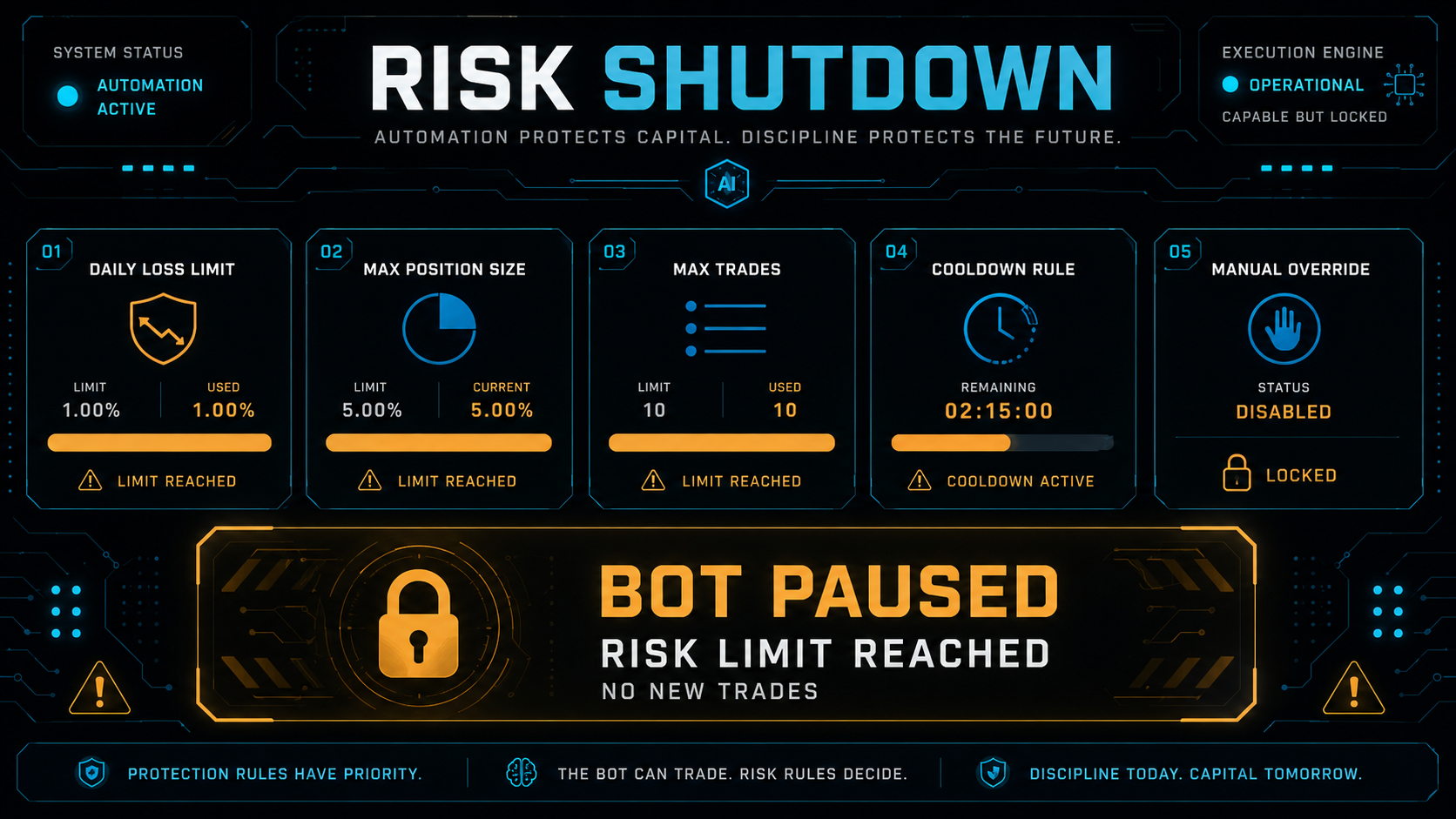
A shutdown rule protects the account when conditions are no longer safe. It prevents the system from continuing after the session is damaged. It stops repeated exposure when the rules are no longer working.
A serious automated setup should pause when:
The daily loss limit is reached.
The maximum trade count is reached.
The position cap is hit.
The cooldown rule is triggered.
Manual review is required.
Execution cost becomes too high.
The system behavior becomes abnormal.
Without shutdown rules, automation becomes a machine that keeps going because it can.
That is not discipline.
That is permission without control.
Where Crypto Automated Trading Becomes Useful
Crypto automated trading is not useless.
It becomes useful when the rules are already strict.
It can help enforce a daily loss limit.
It can prevent oversized trades.
It can reduce emotional clicking.
It can pause after a losing sequence.
It can limit trade count.
It can force cooldown periods.
It can block exposure when risk settings are not complete.
That is the correct role.
Automation should be a guardrail, not a fantasy.
It should not replace thinking.
It should enforce the limits that thinking already created.
The best automated system is not the one that trades all the time.
It is the one that refuses to trade when the account should be protected.
The Control Checklist Before Automation Runs
Before crypto automated trading is allowed to run, the system should pass a control checklist.
Maximum loss per trade is defined.
Daily loss limit is defined.
Position cap is defined.
Maximum trades per session is defined.
Cooldown rule is active.
Manual review conditions are active.
Leverage rules are restricted.
Shutdown rules are active.
Execution cost is considered.
Recovery mode is disabled.
If any of these controls are missing, automation should wait.
The system is not ready because it can execute.
It is ready only when it can stop.
Final Rule: Build the Plan Before the System
Do not automate what you cannot control manually.
If the risk limit is unclear, automation should wait.
If position size is not capped, automation should wait.
If there is no daily loss limit, automation should wait.
If there is no cooldown rule, automation should wait.
If there is no manual review condition, automation should wait.
If the system can keep trading after damage, automation should not run.
The plan comes first.
The system comes second.
Crypto automated trading is not the shortcut around discipline.
It is the amplifier of whatever discipline already exists.
If the rules are vague, automation repeats confusion.
If the rules are emotional, automation repeats overtrading.
If the rules are strict, limited, and controlled, automation can become useful.
The edge is not that the system trades for you.
The edge is that it stops you from giving weak rules unlimited permission.
Before any automated setup is allowed to run, define the maximum acceptable loss with the Maximum Risk Calculator.