Most traders do not get liquidated because the market is impossible to read.
They get liquidated because the position cannot survive normal market movement.
The entry is late. The leverage is too high. The stop is undefined. The position size is larger than the trader can emotionally or financially handle.
By the time liquidation happens, the real mistake has already been made.
This guide is not about removing risk from crypto trading. That is impossible. It is about reducing liquidation risk before entering a trade by defining structure, invalidation, margin pressure, and maximum loss.
A trader cannot control the next candle.
But a trader can control whether the next trade has a risk plan before leverage is used.
What Liquidation Means in Crypto Trading
Liquidation happens when a leveraged crypto position is force-closed by the exchange because the trader no longer has enough margin to keep the position open.
In simple terms, liquidation is the point where the position can no longer survive.
It is not the same as choosing to exit a trade. It is not a planned stop. It is not a strategic decision.
It is a forced close.
That is why liquidation is dangerous for beginners. It removes control from the trader.
Instead of deciding where the trade idea is wrong, the trader allows the exchange to decide when the position can no longer continue.
This is the wrong way to manage risk.
A trader should know the failure point before the exchange forces one.
Why Crypto Traders Get Liquidated
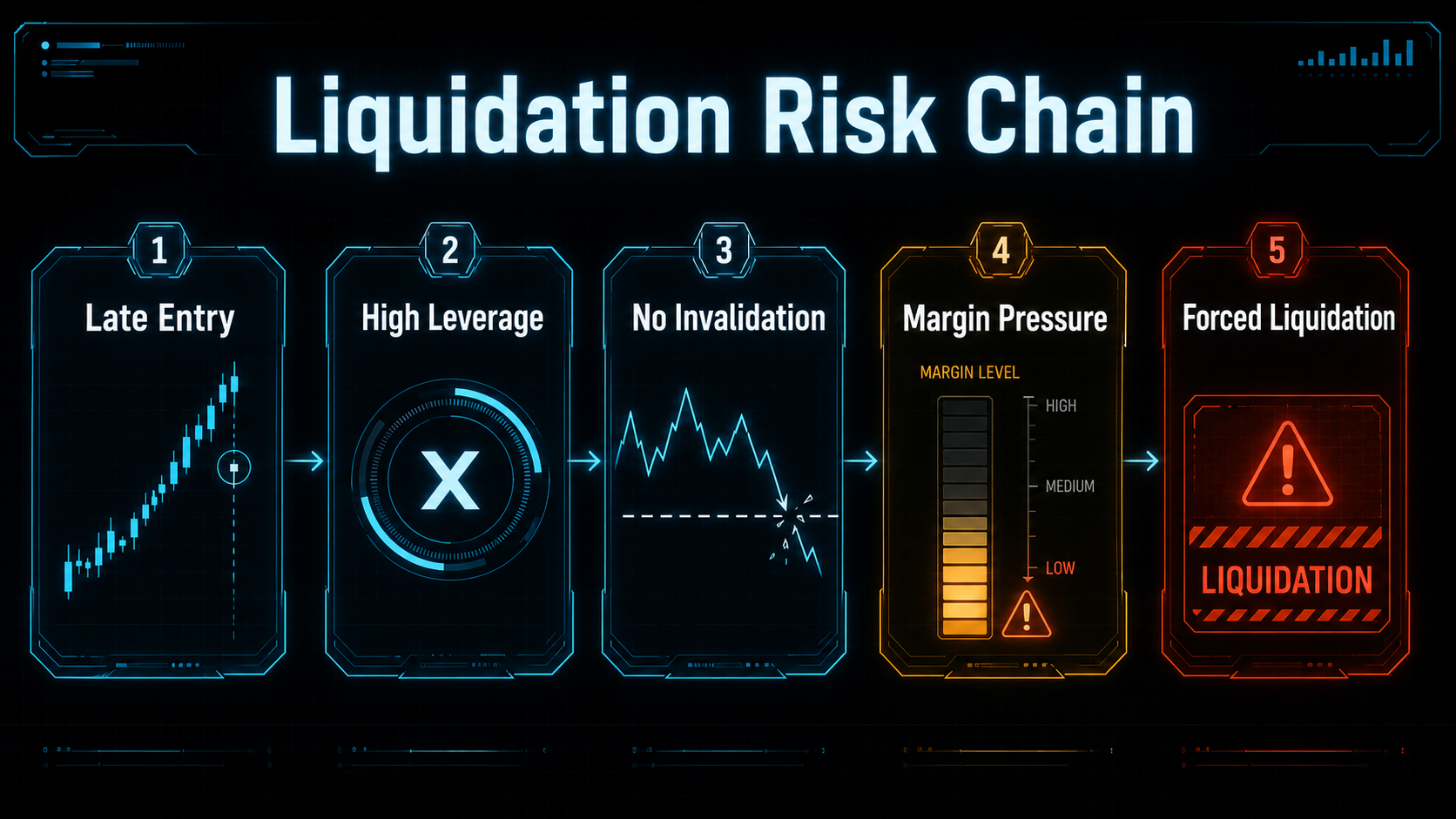
Most liquidation events are not caused by one single mistake.
They usually come from a chain of weak decisions.
A trader sees a fast candle. The trader enters late. The trader adds leverage. The trader does not define invalidation. The market pulls back. The position cannot handle the movement. Liquidation risk increases.
This chain can happen quickly, especially in Bitcoin, Ethereum, and other highly volatile crypto markets.
The most common reasons traders get liquidated are:
- using too much leverage
- entering after price already moved
- trading without a stop or invalidation level
- using position size that is too large
- adding to a losing position without a plan
- confusing a fast move with a clean setup
- revenge trading after a loss
- holding because of hope instead of structure
None of these problems are solved by a better prediction.
They are solved before entry.
Leverage Reduces Your Room for Error
Leverage is not only a tool for increasing position size.
It also reduces the distance between your entry and serious danger.
The higher the leverage, the less room price needs to move against your position before liquidation becomes a real threat.
This is why beginners should stop asking:
“How much leverage should I use?”
A better question is:
“How much room does this trade need to breathe?”
If the trade needs normal volatility to develop, but your leverage gives the position almost no room, the trade is fragile from the start.
A fragile trade does not need a market crash to fail.
It only needs a normal pullback.
The Difference Between a Stop Loss and Liquidation
A stop loss is a planned exit.
Liquidation is a forced exit.
That difference matters.
A stop loss should be based on the point where the trade idea is no longer valid. This point is called invalidation.
Liquidation is based on margin requirements. It does not care whether your market idea was logical. It only cares whether the account has enough margin to support the leveraged position.
A beginner should never treat liquidation as the risk plan.
The risk plan should come first.
The liquidation price should be far enough away that the trader is not relying on forced closure as the exit.
If your liquidation price is close to normal market noise, the position is too aggressive.
To understand why liquidation is not the same as a planned exit, read Crypto Liquidation vs Stop Loss. That article explains why a stop loss is part of the trader’s plan, while liquidation is the platform taking control away.
Define Invalidation Before Entry
The most important question before entering a leveraged crypto trade is:
“What price behavior proves this trade idea wrong?”
That is your invalidation.
Invalidation is not the same as fear. It is not the same as being uncomfortable. It is the structural point where the reason for the trade no longer exists.
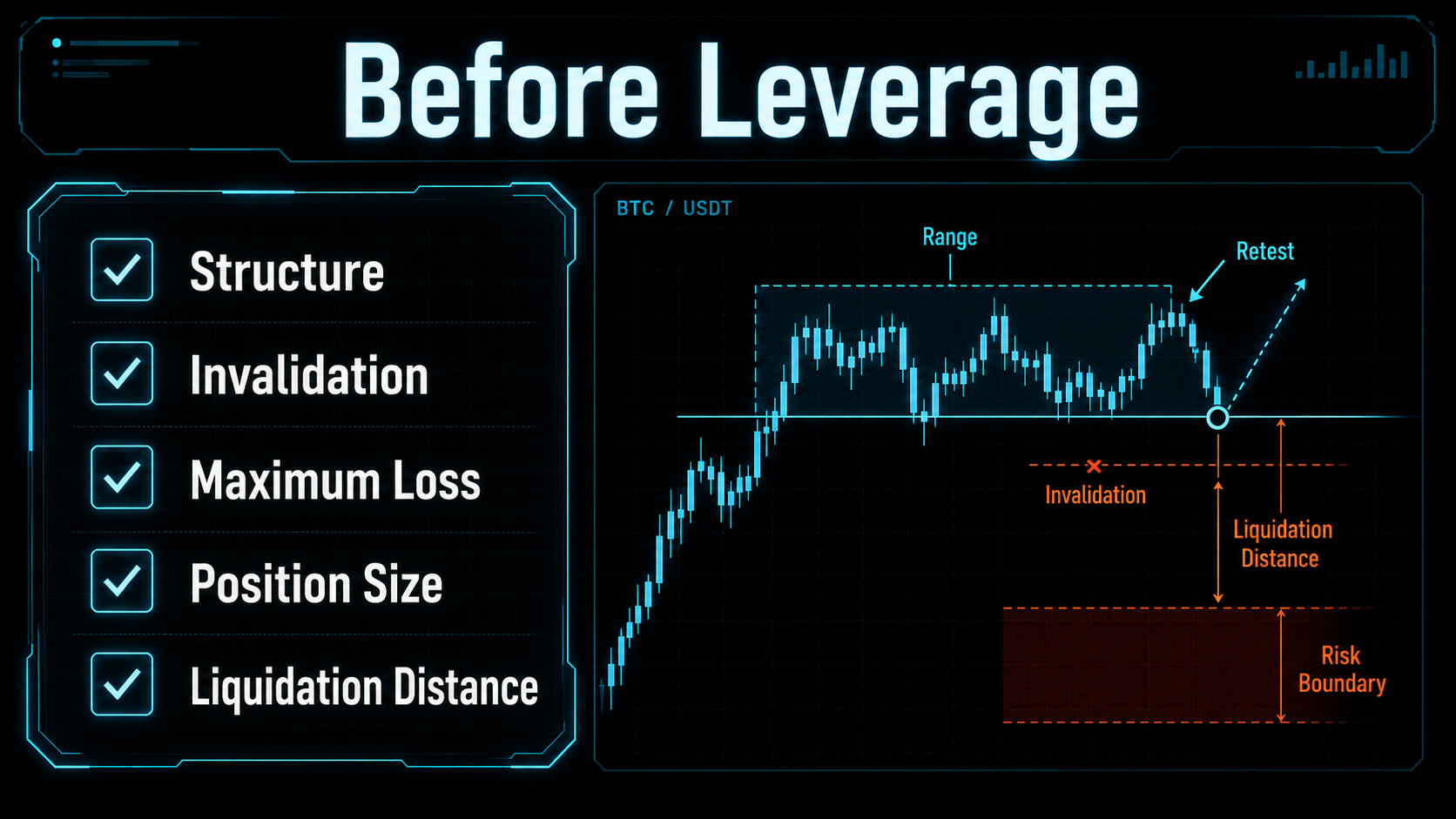
For example, if a trader enters because price is holding above a range boundary, then a clean move back inside the range may weaken the setup.
If a trader enters because of a retest, then a failed retest may be the warning.
If a trader enters only because a candle moved quickly, there may be no structure at all.
That is the problem.
No invalidation means no clear trade failure point.
No failure point means the trader may keep holding until the exchange closes the position.
Position Size Comes Before Leverage
A trader can use low leverage and still take too much risk if the position size is too large.
Position size is the amount of exposure taken in the trade.
Before thinking about leverage, define maximum loss.
Ask:
- How much can this trade lose if it fails?
- Is that loss acceptable before entering?
- Does the position size match the invalidation level?
- Is the trade still manageable if price moves against it first?
If the position size is too large, the trader becomes emotional faster.
A small pullback feels like a major threat. A normal retest feels like a disaster. A minor loss becomes pressure to react.
That pressure often leads to overtrading or revenge trading.
Liquidation risk is not only technical. It is also emotional.
The larger the position compared with the trader’s risk tolerance, the more likely the trader is to make a bad decision.
Do Not Chase Fast Candles With Leverage
Many liquidation events begin with a fast candle.
Price moves sharply. The move looks obvious. The trader feels late. The trader enters anyway.
This is one of the most dangerous moments in crypto trading.
A fast candle does not automatically mean a clean setup.
Sometimes it is a breakout. Sometimes it is a liquidity sweep. Sometimes it is a trap. Sometimes it is only noise.
The question is not whether price moved.
The question is what price does after the move.
Does it hold the new structure? Does it retest the boundary? Does it reject back into the range? Does it trap late buyers or late sellers?
Leverage should not be added before those questions are answered.
The candle is not the setup.
The reaction is the test.
A Simple Liquidation Risk Filter
Before entering a leveraged crypto trade, use this filter:
- Is there a clear structure?
- Is there a defined invalidation level?
- Is the maximum loss known?
- Is the position size acceptable?
- Is the liquidation price far enough away from normal volatility?
- Is the entry based on reaction, not emotion?
- Would the trade still make sense without leverage?
If any of these answers are unclear, the trade is not ready.
This does not guarantee safety.
It simply prevents the trader from entering a futures position with undefined risk.
In crypto trading, undefined risk is where liquidation often begins.
How the Phantom Box Protocol Helps
The Phantom Box Protocol is not a liquidation prevention tool.
It is not a signal system.
It is a structure-first filter designed to reduce bad entries before execution.
For liquidation risk, the logic is simple:
Before using leverage, the trader should identify the structure.
Before entering, the trader should define the invalidation.
Before sizing the position, the trader should know the maximum risk.
Before reacting to a fast candle, the trader should wait for market reaction.
This is why the Phantom Box Protocol focuses on range, boundary, reaction, invalidation, and risk.
It does not try to predict every move.
It tries to stop the trader from entering when the trade has no structure.
No structure, no trade.
No invalidation, no trade.
No defined risk, no execution.
Final Checklist Before Your Next Leveraged Trade
Before your next crypto trade, slow down.
Do not ask first whether the trade can make money.
Ask whether the trade can survive being wrong.
Use this checklist:
- What is the reason for the trade?
- Where is the structure?
- What price action invalidates the idea?
- What is the maximum loss?
- What is the position size?
- Where is the liquidation price?
- Is the entry late?
- Is leverage being used because the setup is clean, or because the trader feels pressure?
- Is this trade planned, or is it emotional compensation after a loss?
If these questions are not answered, the trade is not ready.
Avoiding liquidation is not about finding the perfect direction.
It is about refusing to enter positions that have no risk boundary.
In crypto trading, leverage should come after structure.
Never before it.