The backtest looked safe.
The live market was not.
The entries were clean.
The exits looked controlled.
The equity curve moved like the system had finally found something stable.
Then the bot went live.
The same logic started bleeding money.
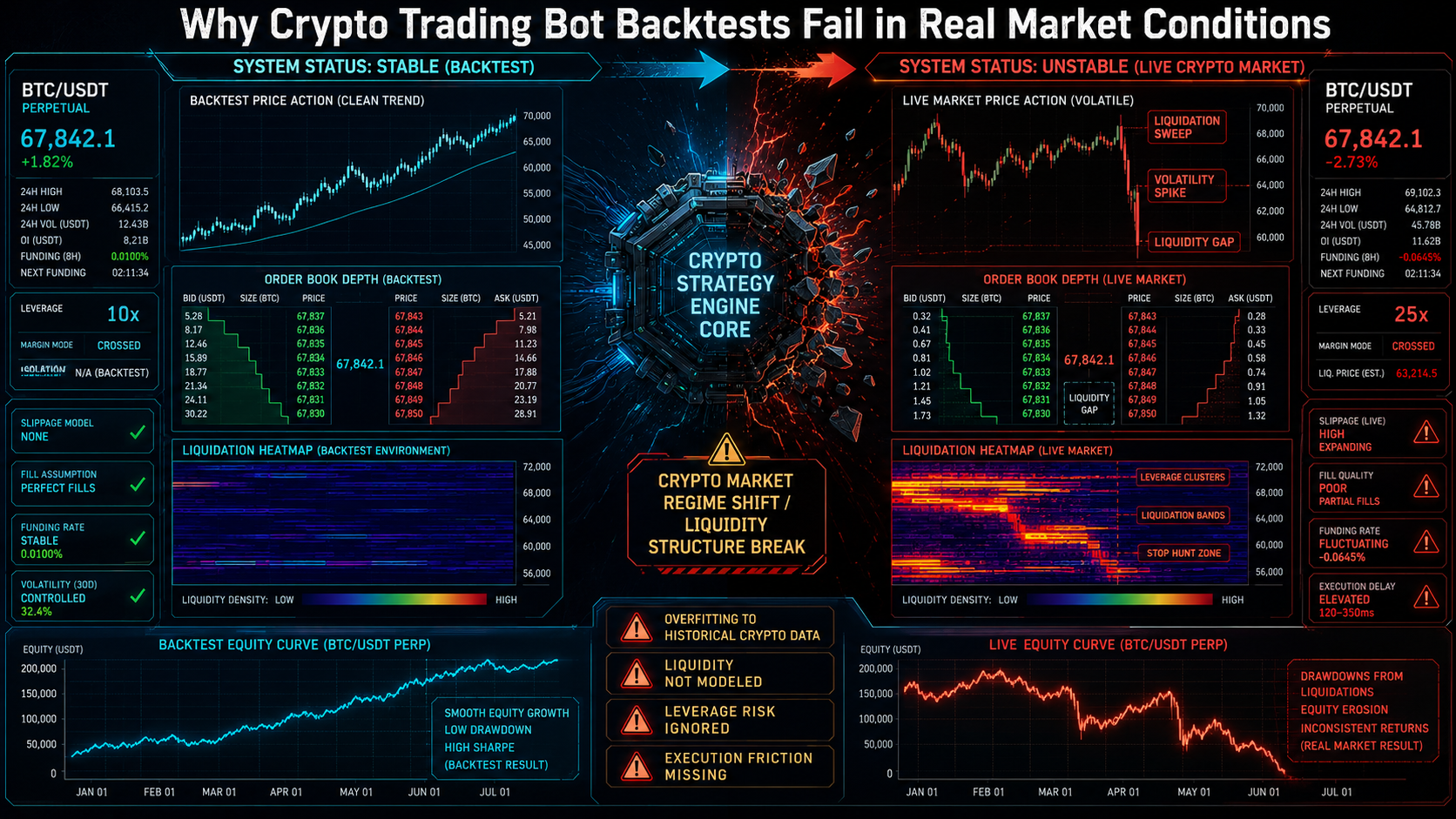
That is the part most traders miss when they trust AI trading bot backtesting in crypto. The problem is not always that the AI is useless. The problem is that the backtest removes the exact damage that real crypto markets create.
The system did not break in the test.
It broke when simulation met execution.
The Backtest Looked Safe Because the Market Was Simplified
A backtest gives the bot a clean world.
In that world, price candles already exist. The data is complete. The system knows exactly where the signal appeared. The entry is recorded with perfect timing. The exit is calculated without panic, delay, or liquidity shock.
That world is useful.
But it is not live crypto trading.
Live crypto markets do not give the bot a clean historical path. They give it moving liquidity, changing spreads, delayed fills, sudden volatility, funding shifts, leverage pressure, and order-book gaps that appear exactly when the system needs precision.
That is why AI trading bot backtesting in crypto can look better than the system really is.
The backtest shows what the strategy would have done in a clean historical model.
The live market shows what happens when execution starts charging a cost.
This is also why automation cannot replace a trading plan. A bot can execute quickly, but speed does not fix missing limits, weak shutdown rules, or incomplete risk controls. For that execution layer, read Crypto Automated Trading: Automation Is Not a Trading Plan.
Backtests Hide the Execution Cost That Eats Small Edges
The first failure is usually not prediction.
It is execution cost.
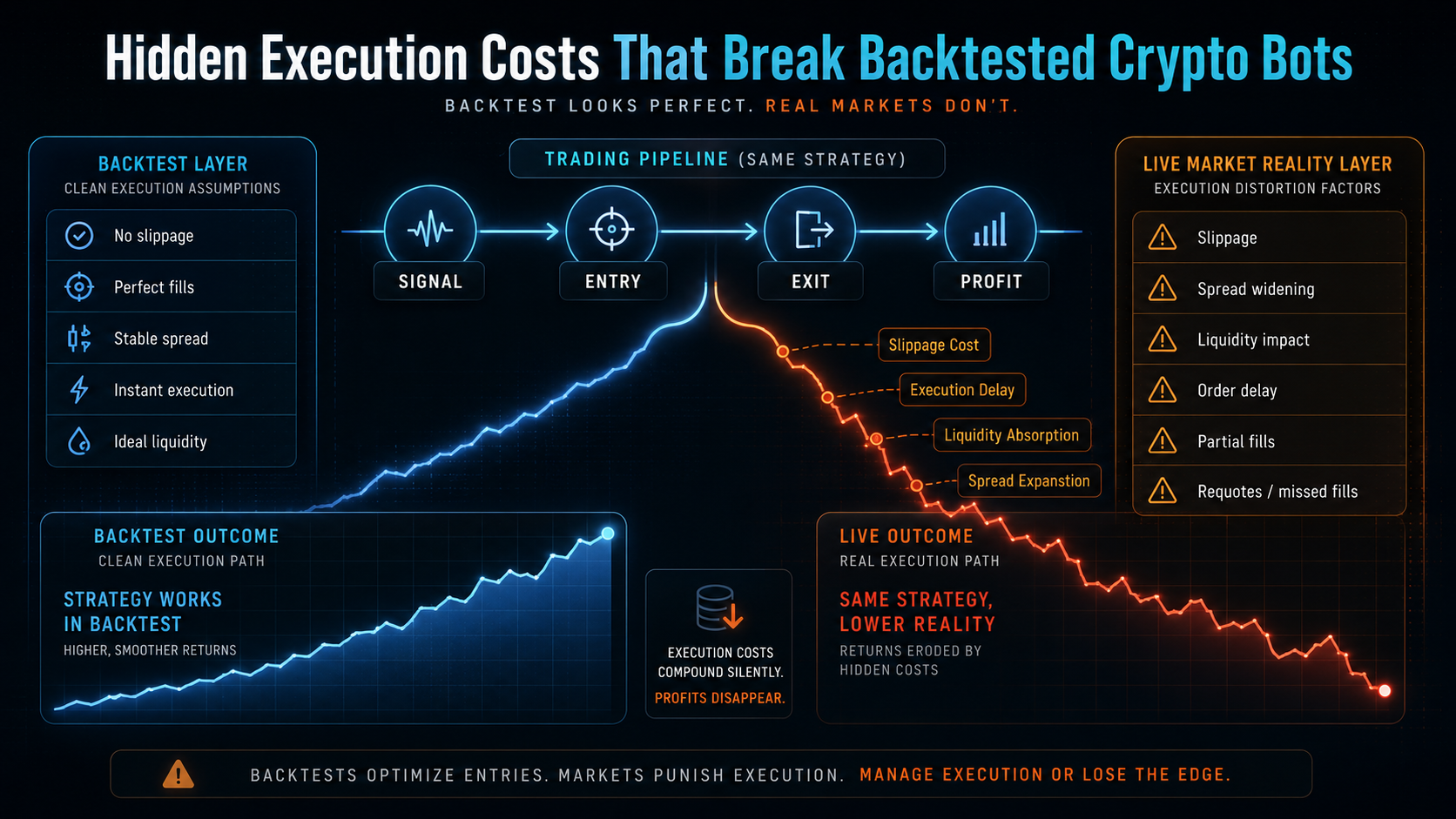
A backtest may assume that the bot enters near the signal price. It may assume that the exit is available when the strategy says it should be available. It may assume that spread stays small, liquidity stays stable, and the order fills without friction.
Live crypto does not behave that cleanly.
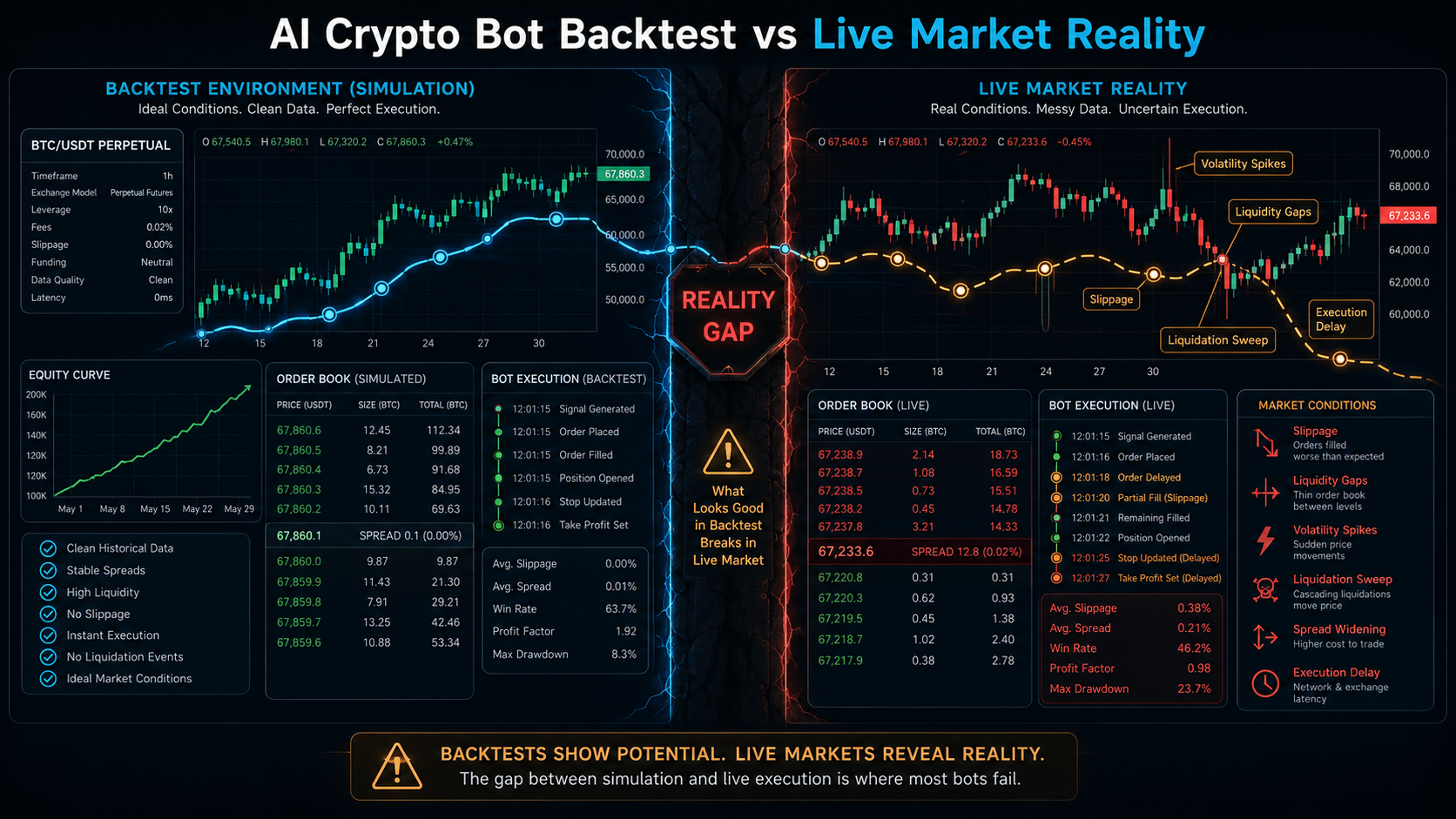
The bot may detect the signal, send the order, and still receive a worse fill. The candle may move during routing. The spread may widen during volatility. Liquidity may disappear from the order book. A passive order may not fill. A market order may fill, but at a worse price than the backtest ever assumed.
The strategy still triggers.
The trade quality gets worse.
That difference matters most when the system depends on small repeated edges. If a bot earns only a thin margin per trade in backtesting, slippage and spread can erase the entire advantage in live execution.
A clean backtest does not prove that the strategy has edge.
It may only prove that the test ignored enough friction to make the edge look alive.
Perfect Entries Do Not Exist in Live Crypto
Backtests often make entries look sharper than they really are.
The system appears to enter at the close of a signal candle. It appears to catch the breakout before the move expands. It appears to exit before the candle reverses. It appears controlled because the historical chart has already finished printing.
Live execution is different.
The signal appears after price has moved enough to trigger it. The bot processes the condition after detection. The order reaches the market after that. The fill happens after routing, liquidity matching, and execution delay.
That delay may be small.
But in fast crypto markets, small delay changes structure.
A few ticks worse on entry can make the stop practically closer. A slightly worse exit can erase the planned reward. A wider spread can turn a high-frequency strategy from profitable to negative. A delayed fill can move the trade from clean location into late participation.
That is how a strategy that looks disciplined in testing becomes fragile in real time.
The backtest shows the signal.
The live market tests whether the signal can still survive after execution damage.
Overfitting Makes the Bot Look Smarter Than It Is
A strong backtest can also be a trap.
Overfitting happens when the system becomes too optimized for old market behavior. The parameters fit the past too closely. The filters are adjusted until the old chart looks cleaner. Weak market periods are avoided by design. The strategy becomes excellent at explaining history but weak at surviving new conditions.
That is dangerous in crypto because market regimes shift quickly.
A bot can be tuned to one phase of BTC/USDT behavior and then struggle when the market changes from clean trend expansion into liquidity sweeps. A system can look stable during historical range conditions and then fail when volatility expands. A strategy can appear intelligent because it was trained or tuned around the exact environment that already passed.
The live market does not owe the system a repeat of that environment.
This is where many traders misunderstand AI.
The bot did not suddenly become stupid.
It was never tested against enough conditions to prove robustness.
That failure mechanism connects directly with Why AI Trading Bots Lose Money in Crypto Markets: The Real Failure Mechanisms. When market regime, liquidity behavior, and execution conditions change, the system can keep working mechanically while losing structurally.
Paper Trading Still Does Not Recreate Full Live Pressure
Paper trading is better than blind backtesting.
But it still does not fully recreate live risk.
Paper trading can show whether the system behaves in real time. It can show whether signals appear when expected. It can show whether the bot fires too often, waits too long, or behaves strangely during volatile conditions.
But it still misses one important layer:
Real capital pressure.
When real money is involved, traders interfere differently. They pause systems after losses. They restart bots too early. They change settings after drawdown. They widen risk because the backtest looked strong. They increase size because paper trading felt safe.
That behavior is not part of the backtest.
But it becomes part of the live system.
A bot does not trade in isolation. It trades inside the trader’s permission structure. If the trader changes settings under pressure, the system that was tested is no longer the system being traded.
The backtest may be clean.
The deployment becomes contaminated.
Regime Shift Is Where Backtests Start Losing Meaning
A backtest can cover old market data.
It cannot guarantee that the current market still belongs to the same regime.
Crypto rotates through different conditions:
Trend expansion.
Sideways compression.
Liquidity sweeps.
Failed breakout phases.
Liquidation cascades.
Post-news volatility.
Thin order-book movement.
A breakout bot may look strong during clean expansion and then bleed during chop. A mean-reversion bot may work inside a stable range and then fail during directional movement. A scalping model may survive normal volatility but break when spread, slippage, and liquidation pressure expand at the same time.
The same rules keep executing.
The environment stops supporting them.
That is why backtesting should not be read as proof. It should be read as a first filter. The harder test is whether the system can recognize when its original environment no longer exists.
The market is not targeting the bot personally.
It is targeting crowded liquidity.
When many systems respond to the same obvious breakout, reclaim, or momentum trigger, those entries can become part of the liquidity structure stronger participants use. A backtest may show the candle. Live trading reveals the crowd.
Position Size Breaks Before the Strategy Looks Broken
Many traders focus on whether the bot is still finding entries.
That is not always the first failure point.
The earlier failure often appears in position size.
When volatility expands, the valid invalidation distance changes. When invalidation distance changes, position size must change. If the backtest assumes a stable risk model while live volatility expands, the same trade size becomes more dangerous than it looked in simulation.
This is how a system keeps taking valid trades while the account becomes fragile.
The signal may still work sometimes.
The exposure no longer fits the environment.
A bot that uses the same size across different volatility states is not stable. It is pretending that all market conditions carry the same risk. They do not.
A clean backtest may hide that mistake because historical fills, controlled assumptions, and simplified execution make the risk look smaller than it becomes live.
That is why Crypto Position Size Calculator: How to Define Risk Before Entry belongs in this process. The bot should not move from backtest to live trading until position size still fits real volatility, real invalidation distance, and real execution friction.
What to Check Before Trusting an AI Crypto Bot Backtest
A backtest should not be permission to trade full size.
It should be a stress-test candidate.
The system needs to survive more than one clean historical curve. It needs to show what happens when costs are included, when liquidity changes, when volatility expands, when spread widens, and when the market moves from one regime into another.
The check is not whether the backtest looks profitable.
The check is whether the profit survives damage.
Fees must be included.
Slippage must be modeled.
Spread must be tested under volatility.
Position size must adapt to invalidation distance.
Drawdown must be studied, not ignored.
Multiple market regimes must be tested.
Paper trading must be compared with micro-size live execution.
Shutdown rules must exist before deployment.
A bot that only works with perfect fills is not ready.
A system that only works in one clean regime is not ready.
A strategy that collapses when slippage is added did not have enough edge.
Final Rule: A Backtest Is Not Permission to Trade Full Size
AI trading bot backtesting in crypto is useful.
But it is not the live market.
It cannot fully recreate slippage, liquidity gaps, sudden volatility, funding shifts, liquidation sweeps, execution delay, or the trader’s behavior under real account pressure.
That is why a clean backtest should never be treated as proof that the bot is ready for full live deployment.
The backtest may show potential.
Live execution reveals survival.
No slippage modeling, no real edge.
No liquidity modeling, no reliability.
No regime testing, no deployment confidence.
No position-size stress test, no full-size permission.
A backtest is not the finish line.
It is where the real risk questions begin.