The trade did not look reckless.
The chart had structure. Price reacted near a level. The trader had a direction, an entry, and enough confidence to open the position.
The mistake was hidden in the size.
The account was not damaged because the trader was completely wrong about the market. It was damaged because the position was too large for the distance to invalidation.
A normal pullback became a large loss.
A basic retest became emotional pressure.
The trader stopped managing the setup and started managing the pain.
That is why position size matters.
A crypto position size calculator is not only a convenience tool. It is a way to force the trade through risk before the order is placed. The calculator cannot predict the market, but it can expose whether the trade idea fits the account.
A serious crypto trade should define the maximum account risk before position size is chosen.
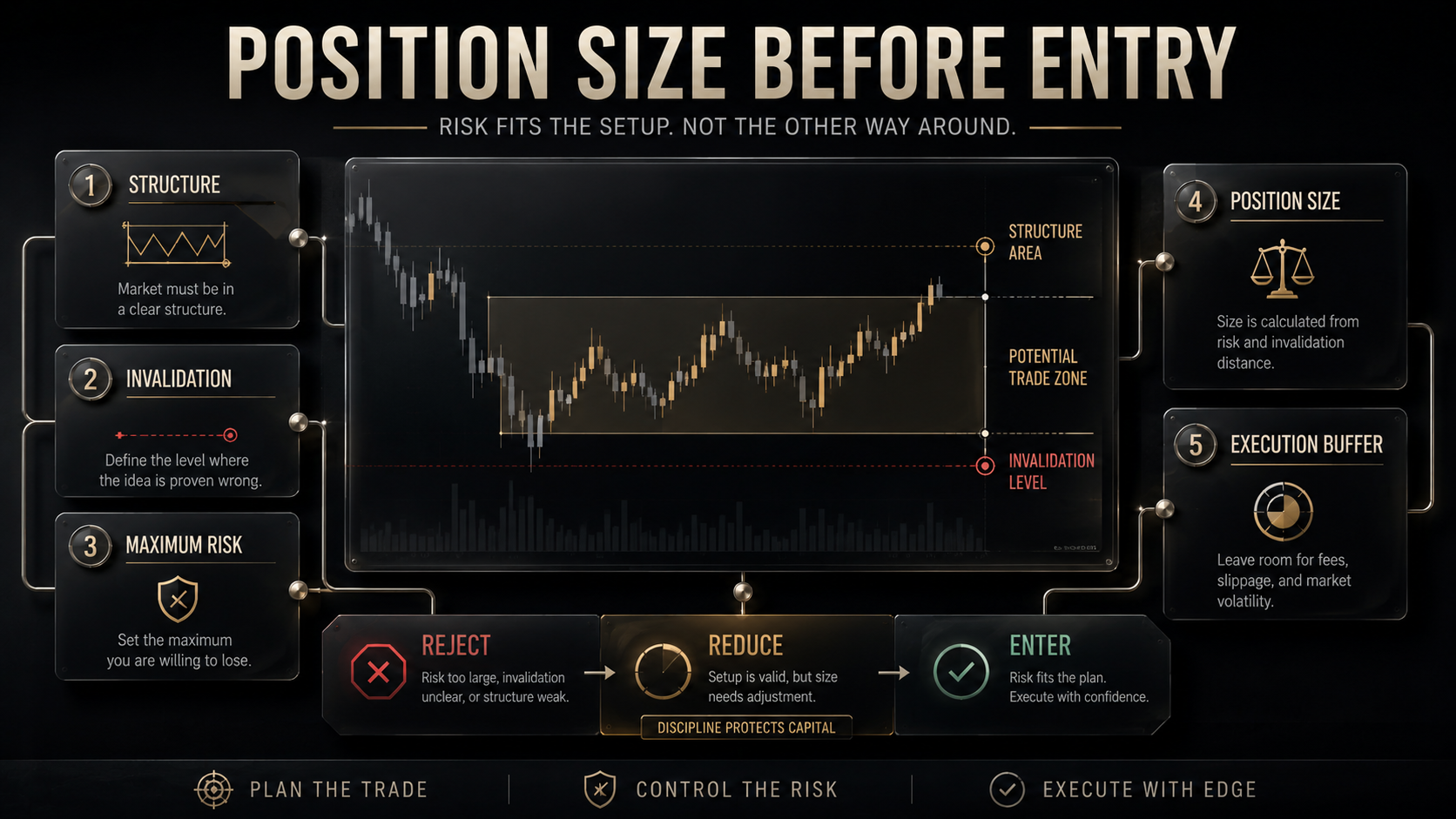
The correct order is simple:
Structure first.
Invalidation second.
Maximum risk third.
Position size fourth.
Entry last.
If the trader skips that order, the position size is usually chosen by emotion.
This article is for educational purposes only. It does not provide financial advice, trading signals, or guaranteed trading results.
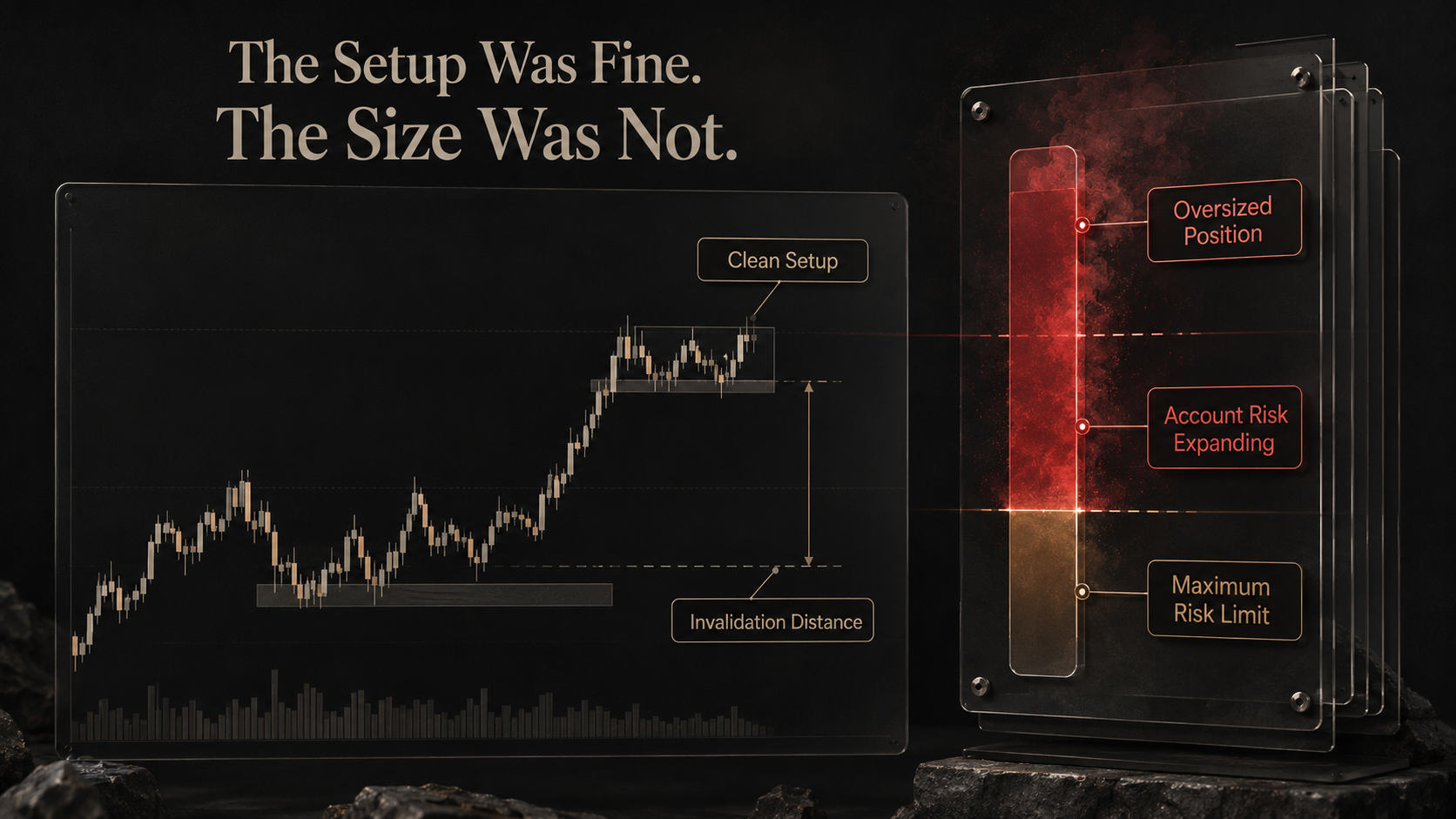
The Loss Starts Before the Candle Moves
Most traders think the loss starts when price moves against them.
In reality, many losses start before entry.
The trader chooses a position size that does not match the structure. The entry is opened. Only after price pulls back does the mistake become visible.
The market did not suddenly become dangerous.
The trade was oversized from the beginning.
This is common in crypto because price moves fast and leverage is easy to access. A trader sees a setup, feels confident, and increases size before calculating the real risk.
That creates a hidden problem.
The trader may think the position is small because the margin used is small. But margin is not the same as risk. In futures trading, a position can look affordable at entry while still being too large for the account once invalidation distance is considered.
The account does not care how confident the trader felt.
It only cares how much is lost if the idea fails.
That amount should be known before the order is opened.
Position Size Is Not Confidence
A larger position often comes from confidence.
The trader sees a breakout, reaction, reclaim, or support bounce and feels that the setup is stronger than usual. The trade looks clear, so the size increases.
That is where risk becomes emotional.
Position size should not be based on how convincing the candle looks. It should be based on account size, maximum risk, and distance to invalidation.
A clean setup can still deserve small size if the invalidation distance is wide.
A weaker setup may deserve no trade at all.
The correct size is not the size that makes the trade exciting. It is the size that keeps the loss acceptable if the idea fails.
This is why a crypto position size calculator is useful. It removes the emotional part of sizing. The trader defines the account, risk percentage, entry, and invalidation. The calculator then shows what size fits the risk.
The number may be smaller than the trader wants.
That is the point.
The calculator protects the account from confidence.
Maximum Risk Comes Before Position Size
Before position size is calculated, the maximum account risk should be fixed.
This is the amount the trader is willing to lose if the trade idea fails.
Without that number, position size becomes random. The trader may think they are taking a normal trade, but the account may actually be exposed to a much larger loss than expected.
A maximum risk calculator helps turn account balance and risk percentage into a clear dollar amount.
For example, if the account balance is $1,000 and the risk limit is 1%, the maximum risk per trade is $10.
That $10 becomes the boundary.
The trade must fit inside it.
The position size is not chosen first. It is calculated after the account risk is defined.
Use the calculator here: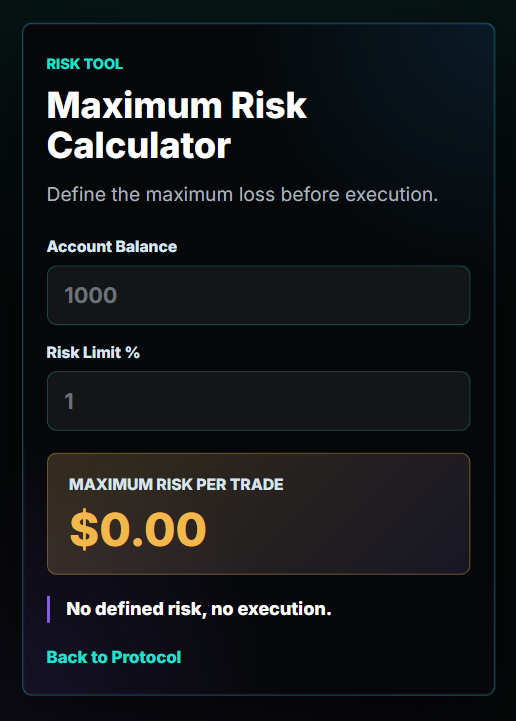
Open the Maximum Risk Calculator
Invalidation Comes Before the Calculator Can Finish the Job
A maximum risk number is only the first part.
To calculate actual position size, the trade still needs invalidation.
Invalidation is the place where the trade idea is no longer valid. It is not a random stop. It is not the liquidation price. It is not the place where the trader becomes uncomfortable.
It is the structure level where the idea is proven wrong.
If a trade depends on BTC holding above a reclaimed range, losing that reclaim may invalidate the idea. If a trade depends on a breakout holding above a boundary, falling back into the range may invalidate it. If a trade depends on a reaction from support, losing that reaction area may invalidate it.
Only after that level is defined can position size be calculated.
Without invalidation, the trader is only deciding how much exposure feels comfortable. That is not risk management. That is estimation under emotion.
A calculator is strongest when the trade already has a clear structure.
Structure creates invalidation.
Invalidation creates risk distance.
Risk distance creates position size.
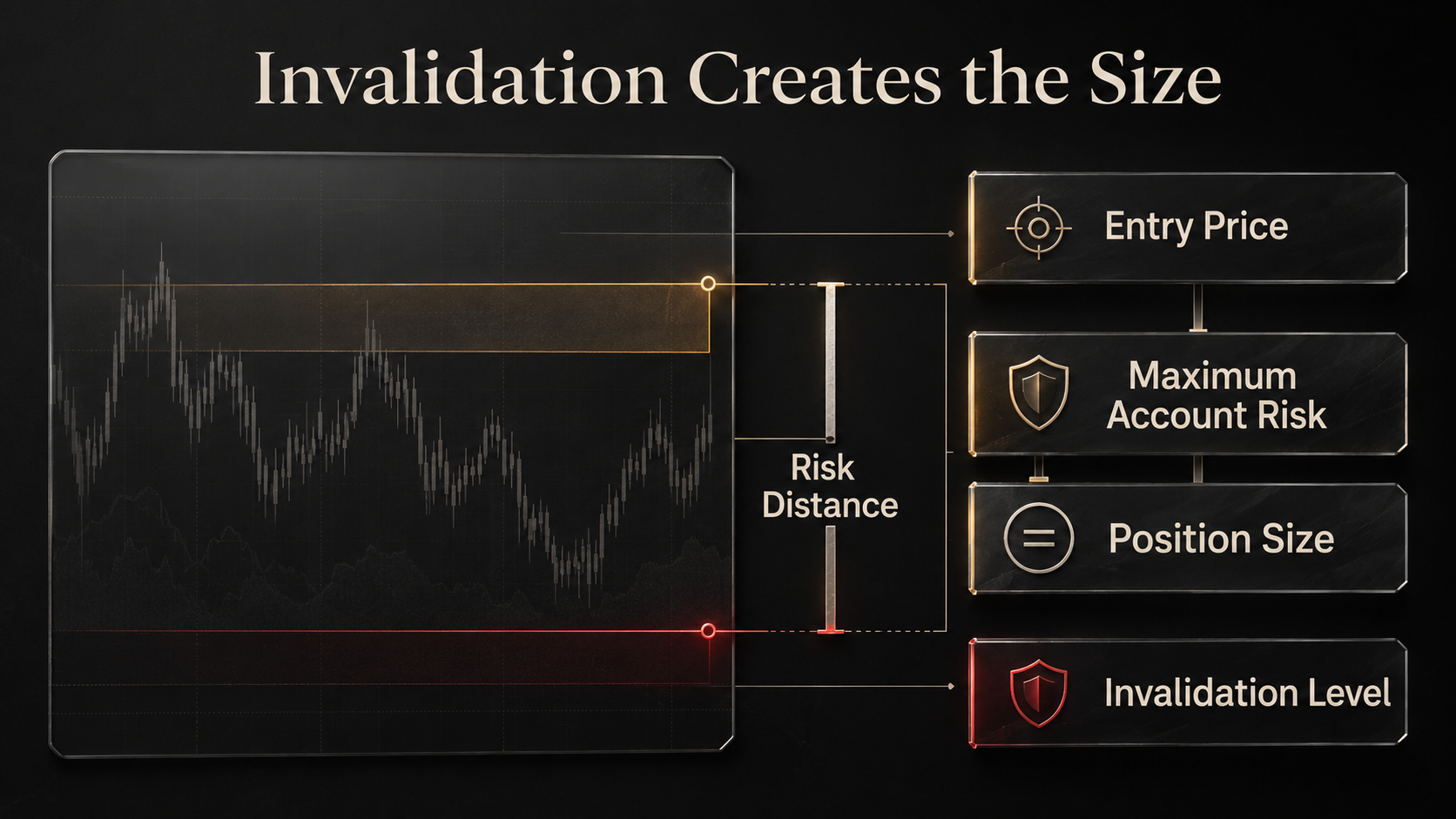
The Distance to Invalidation Changes Everything
Two trades can use the same account risk and still require very different position sizes.
The difference is distance.
A trade with a tight invalidation distance can use a larger position while risking the same amount. A trade with a wide invalidation distance needs a smaller position.
This is where many traders make mistakes.
They use the same position size on every setup, even when the invalidation distance changes. That means each trade does not carry the same risk. Some trades quietly risk much more than expected.
A fixed position size is not the same as fixed risk.
A trader who always opens the same size is not controlling risk if the stop distance keeps changing.
If leverage makes this sizing mistake more dangerous, read Why Leverage Makes Small Crypto Mistakes Expensive. That article explains why small margin, oversized exposure, unclear invalidation, and close liquidation distance can turn a normal pullback into account pressure.
A position size calculator solves this by adjusting size to the structure.
If invalidation is close, the calculated size may be larger.
If invalidation is far, the calculated size becomes smaller.
The account risk stays consistent.
That is the real purpose of position sizing.
It makes different trade setups comparable.
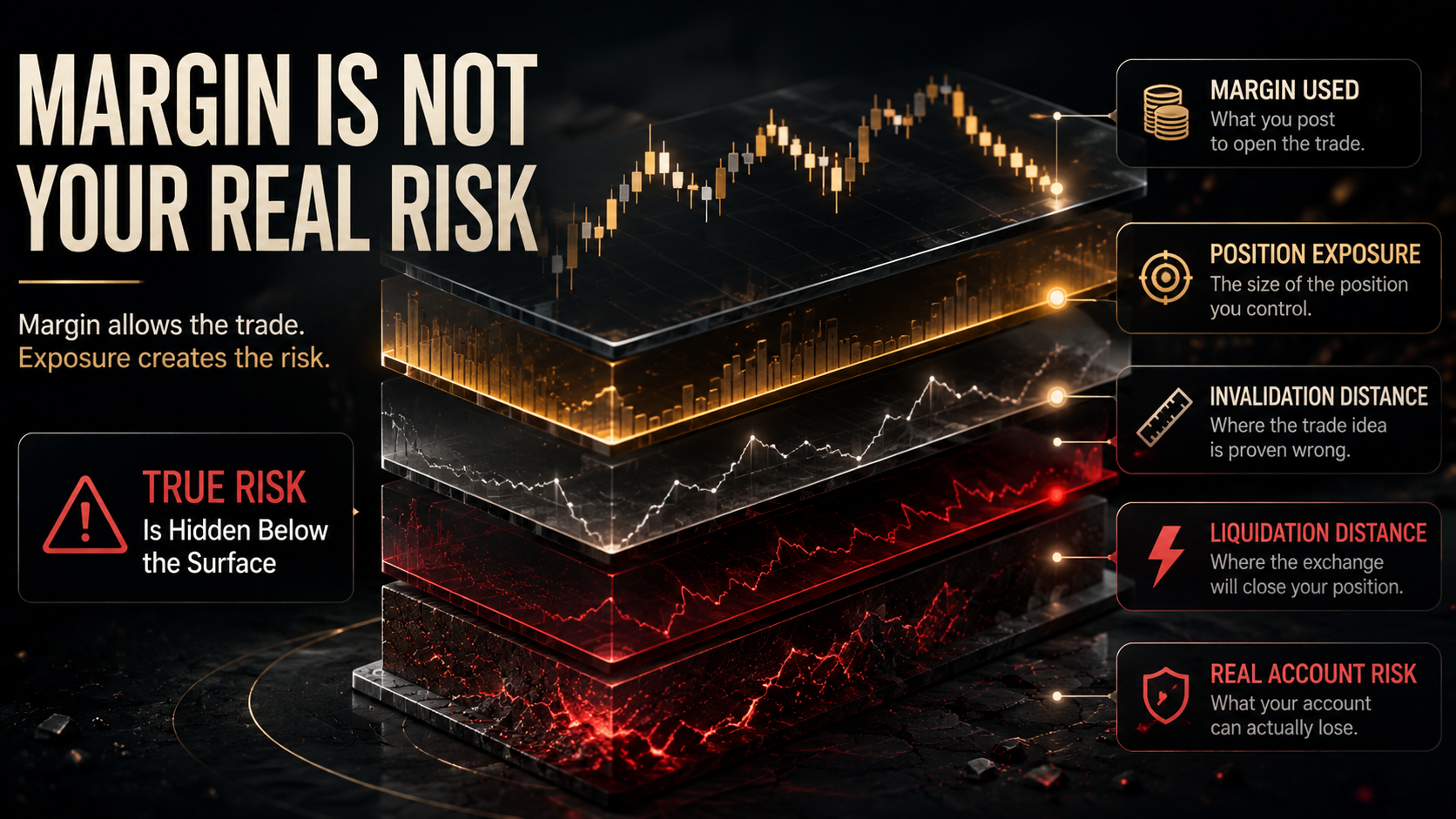
Margin Is Not the Same as Risk
This mistake is common in futures.
A trader sees that only a small amount of margin is required to open the position. The trade feels affordable. The platform allows the size. The order goes through.
But the real risk is not the margin used.
The real risk is how much the account loses if price reaches invalidation or liquidation.
Leverage can make a position look smaller than it really is. The margin posted may be limited, but the exposure can be much larger. That is why traders sometimes feel safe at entry and then feel trapped after a small move against them.
Margin is what allows the position to exist.
Risk is what the position can cost.
Those are different things.
A position size calculator helps separate them. It forces the trader to think in account loss, not just order size or margin requirement.
In futures trading, this matters even more because liquidation can become a forced exit if size and leverage are not controlled.
To separate a planned exit from forced liquidation, read Crypto Liquidation vs Stop Loss. That article explains why a stop loss is part of the trader’s plan, while liquidation is the platform taking control away.
A Simple Position Size Example
The calculator logic is simple.
The trader defines the account size.
The trader defines the maximum amount they are willing to risk.
The trader defines entry and invalidation.
Then position size is calculated from that risk distance.
For example, a trader with a $5,000 account decides to risk 1% on a trade. The maximum loss is $50.
If the entry is $70,000 and invalidation is $69,500, the risk distance is $500 per BTC.
The position size must be small enough that a $500 move equals about $50 of account loss.
That would be 0.10 BTC before considering fees, slippage, and exchange details.
The important part is not the exact example.
The important part is the order.
Maximum loss first.
Invalidation second.
Position size third.
Entry last.
Most oversized trades happen because this order is reversed.
Fees and Slippage Still Matter
A calculator gives structure, but it does not remove real market costs.
Crypto trades can include fees, funding, spread, and slippage. These costs are more important for short-term trades and scalping because the target movement may be small.
A position size that looks safe on paper may become less clean after fees and execution differences.
This is why the calculated number should not be treated as permission to use the maximum possible size. It is a reference point.
The trader still needs room for real execution.
A professional approach usually leaves buffer.
The trade should not depend on perfect fills, perfect exits, or zero slippage.
If the calculated size only works under perfect conditions, the setup is too tight.
Risk control should survive imperfect execution.
If fees, slippage, and one oversized loss keep destroying small wins, read Realistic Win Rate for BTC Scalping Strategies. That article breaks down why high accuracy still loses money when execution costs and one large loss overpower many small wins.
Oversized Trades Change Behavior
Oversized trades do not only affect the account.
They affect the trader.
When size is too large, every candle feels important. A normal pullback becomes personal. A small delay creates stress. The trader begins watching unrealized PnL instead of structure.
This is how trade management breaks.
The original plan becomes harder to follow because the position is too emotionally heavy.
The trader may close early.
The trader may move the stop.
The trader may add size to defend the idea.
The trader may refuse to exit because the loss feels too large.
The problem is not psychology alone.
The psychology problem started because the size was wrong.
A properly sized trade gives the trader room to follow the plan.
An oversized trade turns the plan into a negotiation.
A Better Position Sizing Sequence
A better crypto position sizing process is simple.
Start with the structure.
Define invalidation.
Set maximum account risk.
Calculate position size.
Check fees, slippage, and liquidation distance.
Enter only if the size still makes sense.
This sequence stops the trader from building the trade around emotion.
The setup may look strong, but size does not increase because the candle is impressive. The size increases only if the risk distance allows it and the account risk stays controlled.
The setup may look exciting, but the trade is rejected if invalidation is unclear.
The setup may look clean, but the position is reduced if liquidation sits too close.
This is how a position size calculator becomes more than a tool.
It becomes a filter.
It blocks trades that look good but cannot be sized safely.
The Final Rule for Crypto Position Sizing
The trade is not ready because the chart looks clean.
It is ready only when the risk can be sized.
A trader who knows the entry but not invalidation does not have a complete trade. A trader who knows the direction but not maximum loss is still exposed. A trader who opens size before calculating risk is letting emotion choose the account damage.
A crypto position size calculator does not predict the market.
It does something more practical.
It tells the trader whether the trade idea fits the account.
If the size is too large, the trade is reduced.
If invalidation is unclear, the trade is rejected.
If liquidation is too close, leverage is adjusted or the trade is skipped.
The goal is not to make every trade bigger.
The goal is to make every loss survivable.
In crypto trading, the position size is not a detail after the setup.
It is part of the setup.