The Multiplier Lie: Leverage is Not Just Borrowed Money
When retail traders enter the world of crypto futures, they are typically sold a very seductive lie. The standard definition tells you that leverage is simply a multiplier. You are told that with 10x leverage, a $1,000 account controls a $10,000 position. If the price goes up 10%, you double your money.
While the basic arithmetic is true, framing leverage purely as a profit multiplier is a psychological trap designed to obscure the underlying mechanics of the market.
In a Perpetual Swap environment, leverage is not actually “borrowed money.” You are not borrowing physical Bitcoin. Instead, you are borrowing risk. You are entering into a highly volatile mathematical contract where the exchange uses your initial capital not as an investment, but as Collateral. Understanding the difference between investing and posting collateral is the first step to surviving the futures market.
The True Mechanics: Initial Margin and Maintenance Margin
To understand how leverage actively works against you, you must look at the two numbers that actually control your fate: Initial Margin and Maintenance Margin.
When you open a leveraged position, the funds you commit are your Initial Margin. This is simply the entry ticket.
However, the exchange’s true safety net is the Maintenance Margin. If the market moves against your position, your unrealized losses are subtracted directly from your Initial Margin. The moment your remaining equity drops below the Maintenance Margin threshold, you lose control of your account.
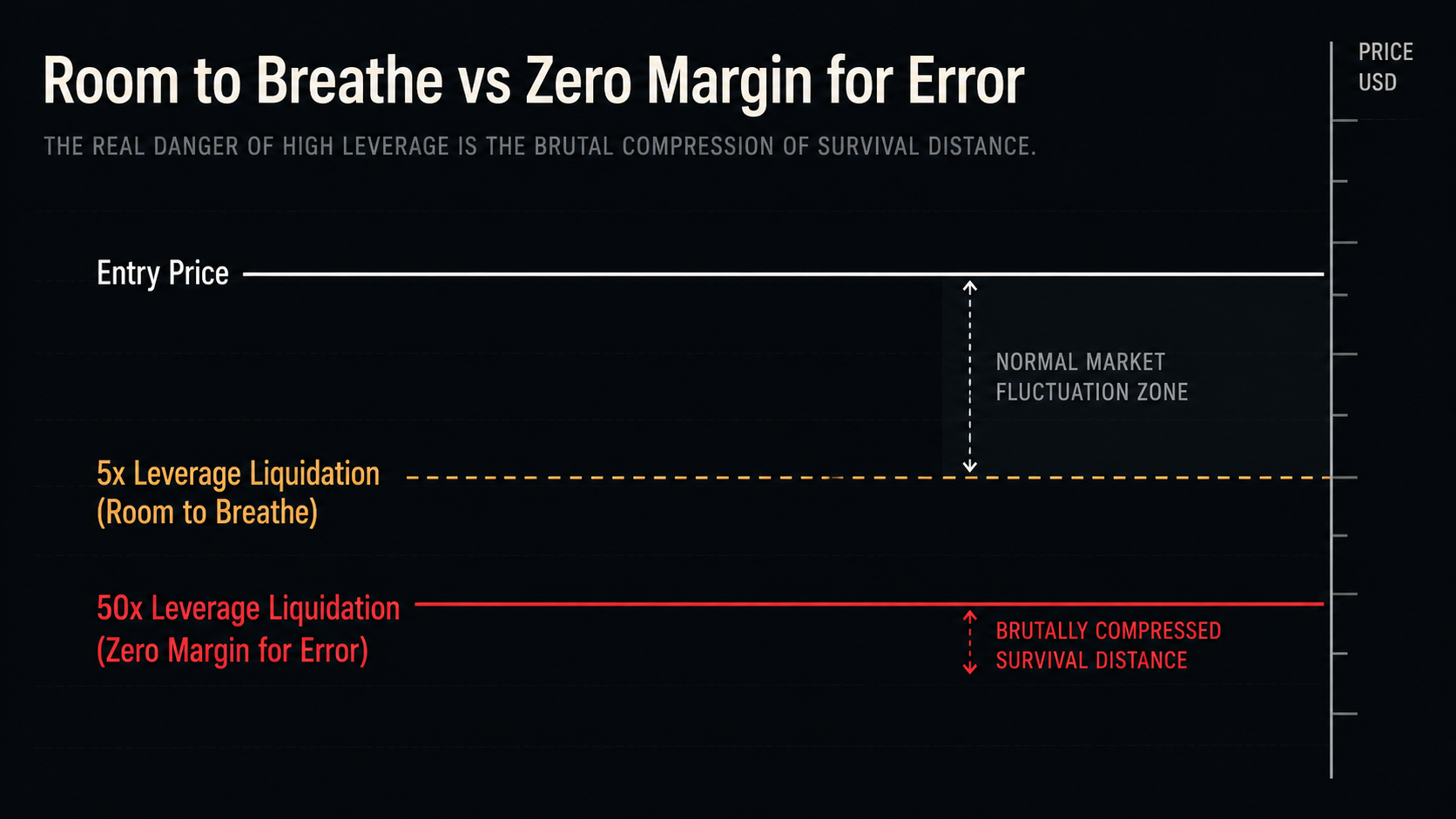
Here is the brutal reality of leverage: it shrinks your margin for error exponentially. Without leverage, a 5% drop in Bitcoin is a minor annoyance. With 20x leverage, a 5% drop completely wipes out your required Maintenance Margin. You have mathematically stripped yourself of the ability to survive normal market volatility.
If margin, collateral, and liquidation distance still feel unclear, read How Much Can You Lose Trading Crypto With Leverage?. That article explains why margin is not the full risk, and how position size, slippage, liquidation distance, and cross margin expose hidden account damage.
The Liquidation Engine: The Exchange’s Apex Predator
What happens when you hit that Maintenance Margin? You meet the Liquidation Engine.
Retail traders often view liquidation as a simple “stop loss” enforced by the exchange. It is not. It is an aggressive, automated protocol designed to protect the exchange’s liquidity pool, not your portfolio.
When triggered, the Liquidation Engine seizes your collateral and automatically executes a Market Order to close your position. Because it uses a market order during moments of extreme volatility, you suffer massive Slippage. You are forced to buy or sell at the worst possible micro-second in the market, often resulting in the loss of your entire margin balance. The exchange takes its liquidation fee, and you are left with zero.
To understand why liquidation is not the same as a planned exit, read Crypto Liquidation vs Stop Loss. That article breaks down why a stop loss is voluntary, while liquidation is the platform taking control away from you.
The Hunt: Why High Leverage Makes You a Target
Understanding leverage mathematically is only half the battle. You must also understand how Smart Money views your leverage.
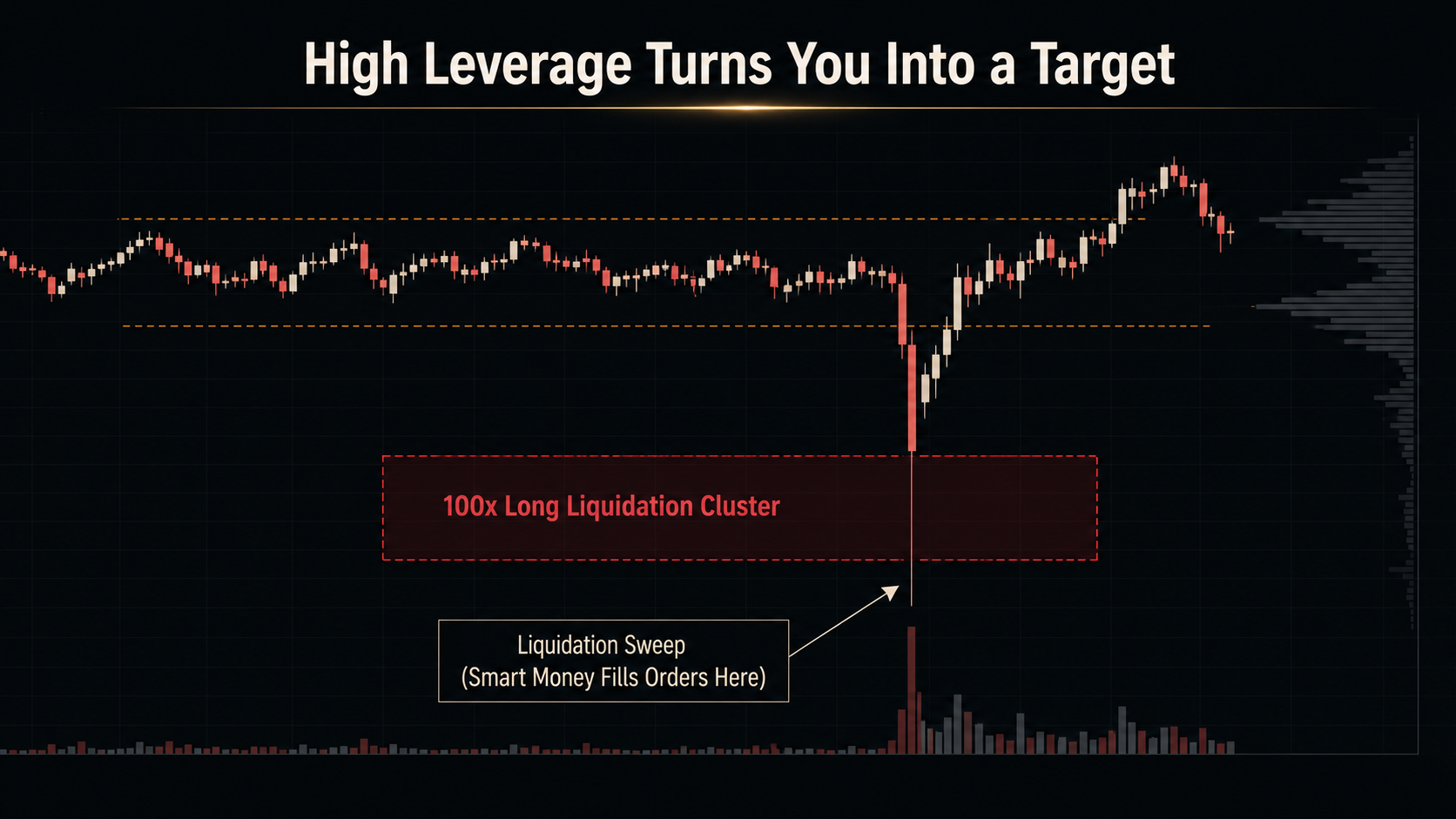
Because exchanges publicly report Open Interest and leverage ratios, institutional algorithms know exactly where retail traders are heavily leveraged. High leverage creates dense, predictable clusters of liquidation points just a few percentage points away from the current price.
To Smart Money, your high-leverage liquidation point is guaranteed, forced liquidity.
If institutions need to buy a massive amount of Bitcoin, they will intentionally apply short-term selling pressure to push the price down into those high-leverage liquidation clusters. This is known as a Liquidation Sweep.
The moment the price hits your Liquidation Price, your forced sell order is triggered. The institution acts as the buyer, absorbing your liquidated assets at a discount. They used your high leverage as a magnet to fill their own orders.
The Professional Paradigm: Leverage as a Capital Efficiency Tool
The reason 90% of retail traders lose money with leverage is that they use it to trade bigger than their account size allows. They use it out of greed and impatience.
Professional traders and algorithms do not use leverage to increase their position size beyond their risk parameters. They use it strictly for Capital Efficiency.
A professional who wants to take a $10,000 position in Bitcoin will use 10x leverage to only tie up $1,000 of their capital, leaving the other $9,000 safely stored in cold wallets or deployed in yield-generating protocols. Their Stop Loss is calculated meticulously based on structural market depth, placed far above their mathematical liquidation price.
For the broader difference between borrowed margin exposure and futures contract risk, read Crypto Margin Trading vs Crypto Futures Trading. That page explains why margin trading bleeds through borrowing costs, while futures trading fails through funding, mark price, and liquidation clusters.
Until you shift your mindset from “How much can I multiply my profits?” to “How tight is my threshold for ruin?”, the mechanics of crypto futures leverage will continue to function exactly as designed: transferring wealth from the impatient retail trader to the highly capitalized institutional machine.