Adding margin to an existing crypto futures position usually does not change its entry price. It adds collateral behind the same position rather than buying or selling more contracts. As long as the position quantity stays unchanged, the average entry price will normally stay unchanged too.
What may change is the position’s effective leverage, available margin and estimated liquidation price. Exact behavior depends on the exchange, margin mode and contract type, so the platform’s position details remain the final reference.
Quick Answer
Adding margin and adding to a position are two different actions:
- Adding margin transfers more collateral to support the existing position.
- Adding to the position executes another order and increases the position quantity.
The first normally leaves the entry price unchanged. The second can create a new weighted average because more contracts were traded at another price.
A Simple Example
Assume you hold a BTCUSDT long position with these values:
| Item | Before adding margin |
|---|---|
| Position value | $1,000 |
| Position quantity | Unchanged |
| Average entry price | $100 |
| Isolated margin | $100 |
| Effective leverage | 10x |
You add another $50 of margin without placing a new order.
| Item | After adding margin |
|---|---|
| Position value | $1,000 |
| Position quantity | Unchanged |
| Average entry price | $100 |
| Isolated margin | $150 |
| Approximate effective leverage | 6.67x |
The entry price stays at $100 because no additional contracts were bought. The extra $50 changes the collateral supporting the position, not the price at which the position was opened.
This is a simplified teaching example. Fees, unrealized PnL and exchange-specific formulas are excluded.
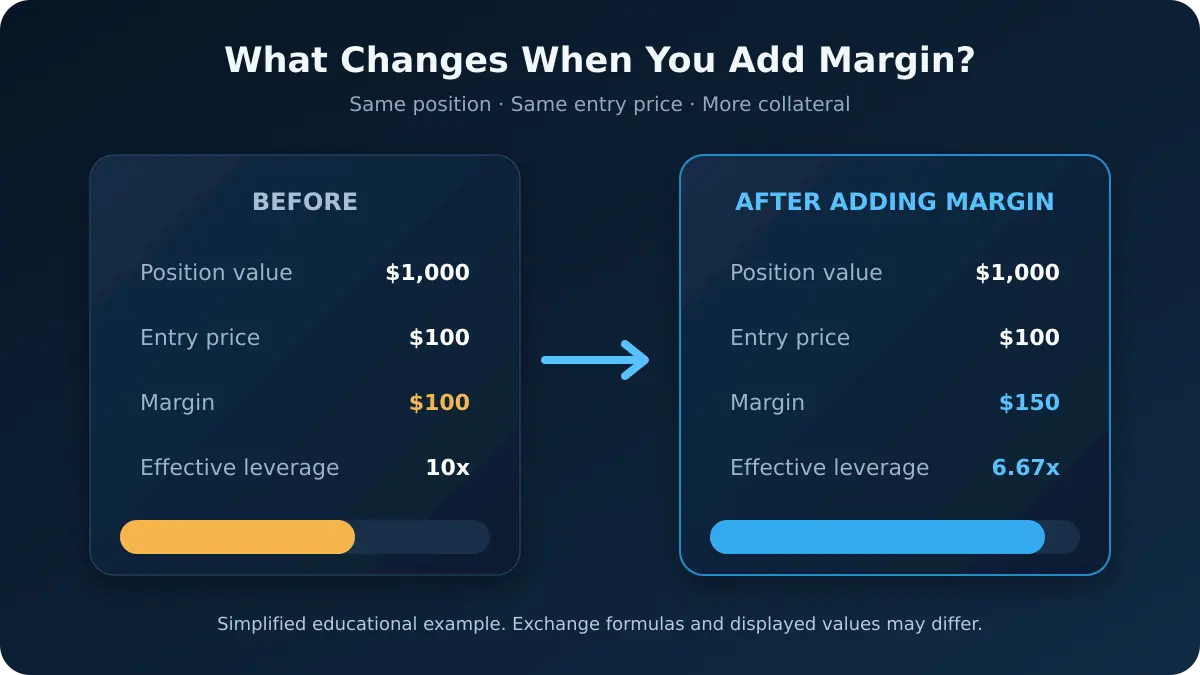
What Changes When You Add Margin?
Position Margin Increases
The amount of collateral assigned to the position increases. In isolated mode, this normally gives the position more room before reaching the maintenance-margin threshold.
Effective Leverage Decreases
Effective leverage can be understood with a simplified relationship:
Effective leverage ≈ Position value ÷ Position margin
If position value remains $1,000 while margin rises from $100 to $150, effective leverage falls from approximately 10x to 6.67x.
The platform may still display the originally selected 10x setting. Exchanges can distinguish between selected leverage and the current exposure-to-margin ratio.
The Liquidation Buffer May Increase
Adding margin to an isolated position commonly moves the estimated liquidation price farther from the mark price. The added collateral gives the position more room before its equity reaches the liquidation requirement.
For a long position, the estimated liquidation price will usually move lower. For a short position, it will usually move higher. The exact amount depends on maintenance margin, fees, risk tiers and the exchange’s liquidation formula.
Adding margin can reduce liquidation risk, but a large adverse move can still exhaust the buffer.
What Usually Does Not Change?
If no new order is filled and no position quantity is changed, adding margin generally does not change:
- Position quantity
- Position direction
- Average entry price
- Total market exposure
- Unrealized PnL caused by the current price move
The position is the same size and was entered at the same trade prices. Only the collateral supporting it has changed.
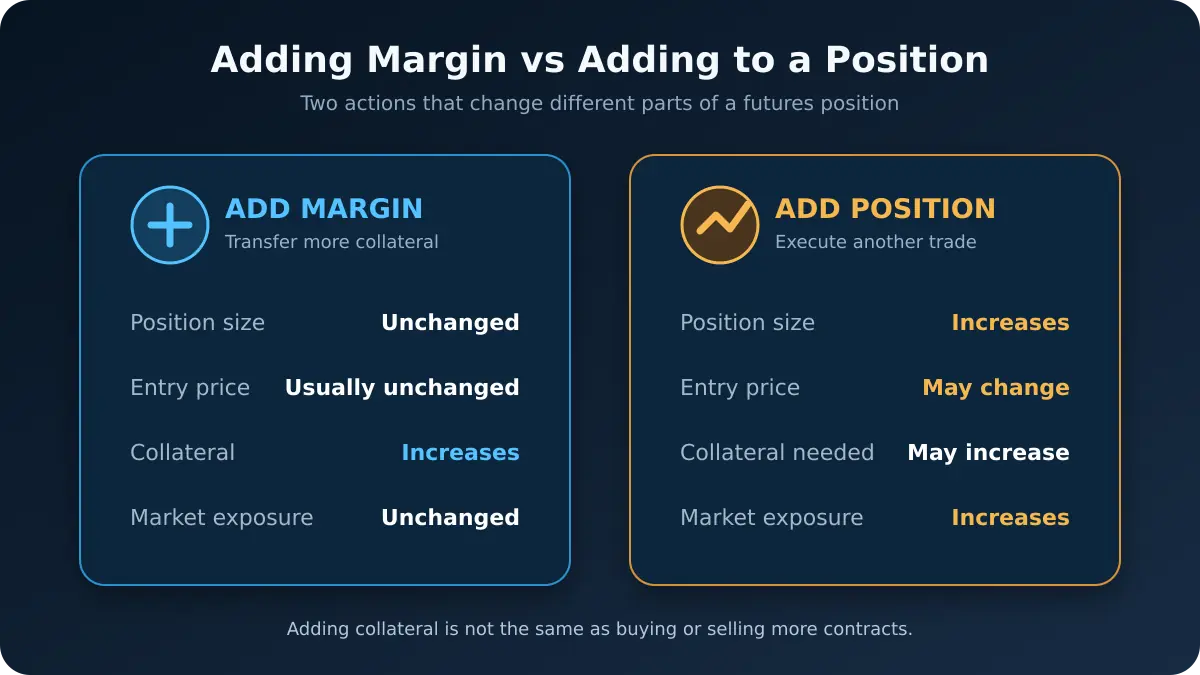
Adding Margin vs Averaging Down
This is where many beginners become confused. The two actions can both move the estimated liquidation price, but they do so through different mechanisms.
| Action | Adds collateral? | Changes position size? | Changes average entry? | Changes exposure? |
|---|---|---|---|---|
| Add margin | Yes | No | Usually no | No |
| Average down | Usually yes through a new trade | Yes | Usually yes | Yes |
Suppose you opened one unit at $100 and later bought one more unit at $80. For a simple linear contract, the weighted average entry would become:
($100 × 1 + $80 × 1) ÷ 2 = $90
The entry price changes because a second trade increased the quantity at a different execution price. This is averaging down, not merely adding margin.
Averaging down also increases exposure, the amount affected by further adverse movement, trading fees and possibly funding costs. A lower average entry does not automatically mean lower total risk.
Why the Entry Price Might Appear to Change Anyway
If you added margin and then noticed a different displayed entry price, check for another event before assuming the margin transfer caused it.
Another Order Was Filled
A limit order, conditional order or partially filled order may have increased the position. A new fill at a different price can change the weighted average entry.
The Position Was Partially Closed and Reopened
Closing part of a position and opening new exposure can affect the values shown in position history. Review executions rather than relying only on the current position panel.
The Contract Uses Settlement-Based Accounting
Some products calculate or reset displayed values differently. Bybit, for example, states that the average entry price of its USDC perpetual contract is a weighted average during the current settlement cycle and that the mark price at settlement becomes the new average entry price.
That is a contract settlement rule, not evidence that adding collateral itself changed the trade price.
You Are Looking at Break-Even Price
Entry price and break-even price are not always the same. A break-even figure may account for trading fees, funding or other platform-specific assumptions. Confirm which label the interface is displaying.
How to Verify What Happened
Use this short checklist:
- Open the position’s trade or execution history.
- Check whether any additional order was filled.
- Compare the position quantity before and after the change.
- Confirm whether the displayed number is entry price or break-even price.
- Check the margin mode and contract type.
- Review the exchange’s official entry-price and margin documentation.
If quantity did not change and no settlement event occurred, a margin addition would not normally create a new weighted average price.
Common Mistakes
Treating the Add Margin Button as a Buy Button
The Add Margin control transfers collateral; it does not automatically execute a larger order.
Expecting Added Margin to Increase Profit
Extra collateral does not increase the number of contracts. With unchanged size, it does not increase the PnL produced by a given price move.
Assuming a More Distant Liquidation Price Fixes the Trade
A wider buffer gives the position more room but also places more collateral at risk. It does not guarantee recovery.
Confusing Selected and Effective Leverage
The selected setting may remain displayed even after added margin reduces effective leverage.
Frequently Asked Questions
Does adding margin lower my average entry price?
Usually no. Lowering the average entry price normally requires adding to the position through a new executed order at a different price.
Does adding margin increase position size?
No, not by itself. Position size changes when an order is filled or when the contract’s position quantity otherwise changes.
Does adding margin change liquidation price?
It commonly changes the estimated liquidation price in isolated margin mode by increasing the collateral buffer. The exact result depends on the exchange’s formula.
Does adding margin reduce leverage?
It can reduce effective leverage when position value remains unchanged and collateral increases. The selected leverage number shown by the platform may remain unchanged.
Final Takeaway
Adding margin usually changes the financial support behind a crypto futures position—not the trade that created the position. If position quantity remains unchanged, the average entry price normally remains unchanged. Effective leverage and estimated liquidation price may change because the position now has more collateral.
If the entry price changes, look for an additional fill, a partial close and reopen, a settlement event or confusion between entry and break-even prices. Always verify the execution history and the rules for the specific contract before drawing a conclusion.
Official Sources
This article is for educational purposes only and does not provide investment, legal, tax or financial advice. Crypto derivatives involve substantial risk, including the possibility of liquidation.