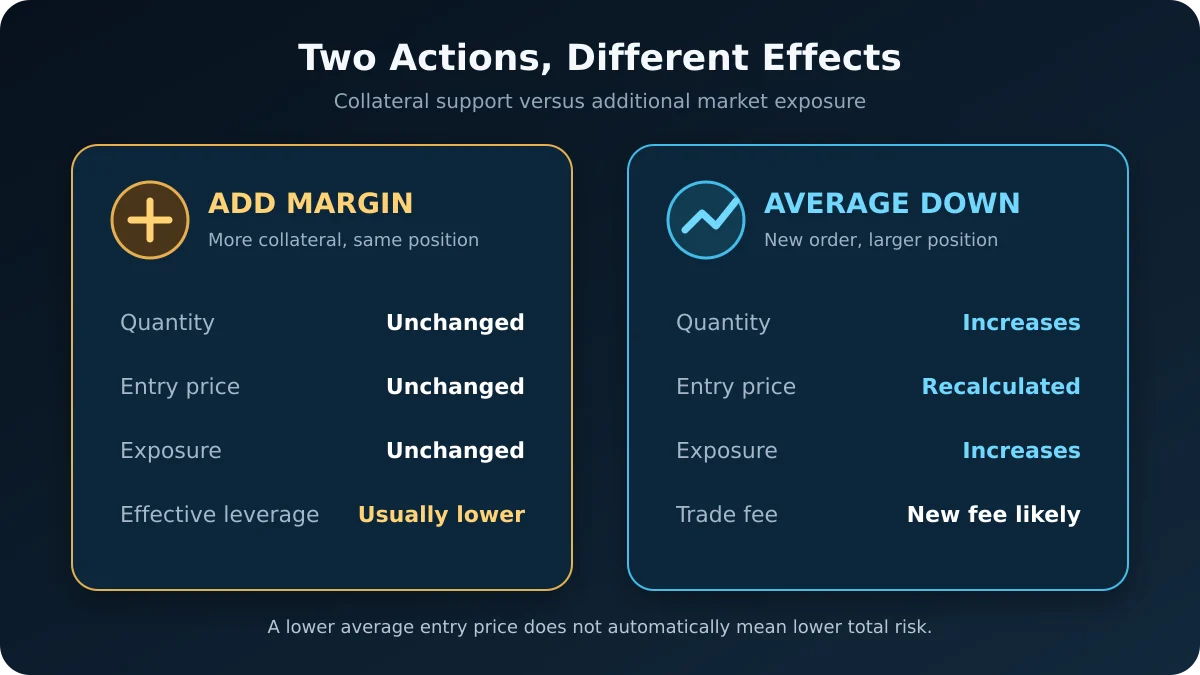
Adding margin and averaging down are not the same action. Adding margin puts more collateral behind an existing futures position without increasing its quantity. Averaging down opens additional exposure at a lower price, increasing position size and changing the weighted average entry price.
Both actions may move the estimated liquidation price, but they change the trade in fundamentally different ways. One changes the position’s financial buffer; the other changes the position itself.
Quick Answer
- Adding margin: more collateral, same position size, usually the same entry price and lower effective leverage.
- Averaging down: more contracts, larger exposure, a new weighted average entry price and potentially larger losses if the market keeps moving against the position.
Adding margin can give an isolated position more room before liquidation. Averaging down can move the average entry closer to the current market price, but it also increases the amount exposed to future price movements.
Adding Margin vs Averaging Down at a Glance
| Effect | Add Margin | Average Down |
|---|---|---|
| Position quantity | Unchanged | Increases |
| Average entry price | Usually unchanged | Usually changes |
| Market exposure | Unchanged | Increases |
| Position collateral | Increases | May increase through the new order |
| Effective leverage | Usually decreases | Depends on added size and margin |
| Liquidation price | Often moves farther away | May move, but risk also grows |
| Trading fees | No new execution fee | New order usually creates a fee |
| Funding exposure | Usually unchanged if position value is unchanged | Usually increases with position value |
A Simple Numerical Example
Assume a trader holds a long position in a linear futures contract:
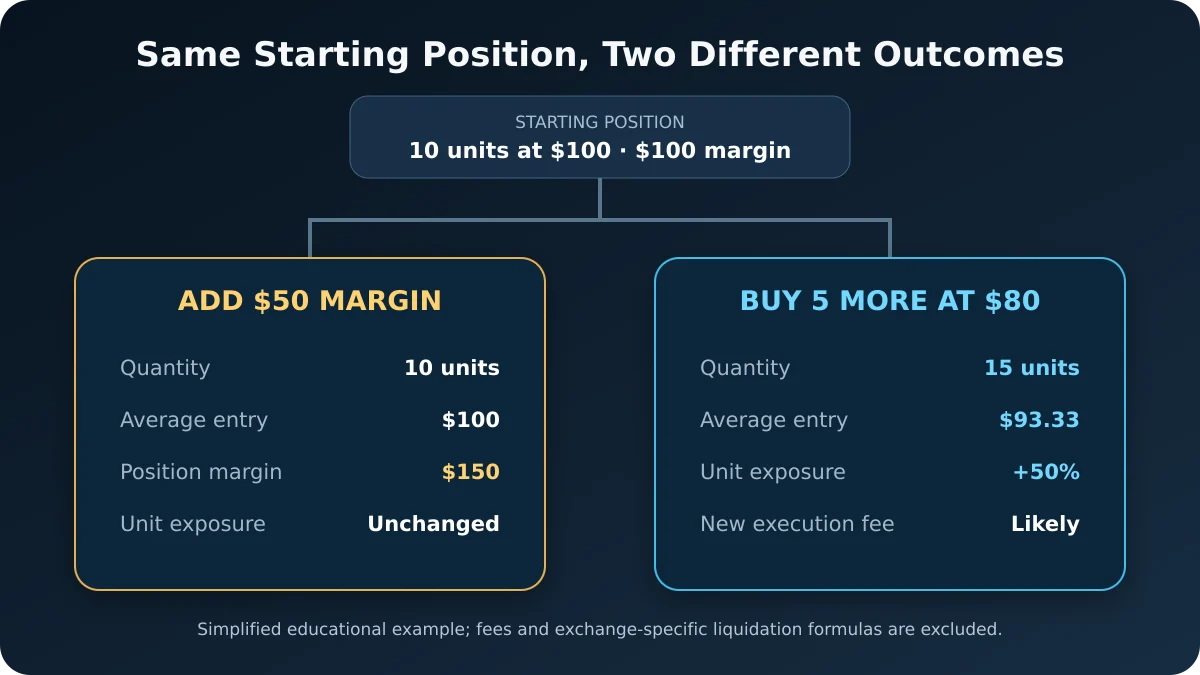
- Position quantity: 10 units
- Average entry price: $100
- Original position value at entry: $1,000
- Position margin: $100
- Simplified effective leverage: 10x
- Current market price: $80
This is a teaching example. It excludes fees, funding, maintenance-margin tiers and exchange-specific calculations.
Scenario A: Add $50 of Margin
The trader transfers another $50 of collateral to the position but does not place a new order.
After the transfer:
- Position quantity remains 10 units.
- Average entry price remains $100.
- Position margin increases from $100 to $150.
- Market exposure does not increase.
- Effective leverage decreases because more collateral supports the same position.
Using the original $1,000 entry value for a simplified comparison:
Effective leverage ≈ $1,000 ÷ $150 = 6.67x
The exchange’s live leverage figure may use current position value or another platform-specific formula. The important point is that the position did not become larger.
Scenario B: Buy 5 More Units at $80
Instead of transferring collateral, the trader executes another order for 5 units at $80.
The new weighted average entry price is:
[(10 × $100) + (5 × $80)] ÷ 15 = $93.33
After averaging down:
- Position quantity increases from 10 to 15 units.
- Average entry price falls from $100 to approximately $93.33.
- Exposure to future price movements increases by 50% in unit terms.
- A new execution fee may be charged.
- Future funding amounts may increase because the position value is larger.
The market now needs a smaller recovery to reach the new entry price, but every additional adverse price move affects 15 units instead of 10.
Why the Two Actions Produce Different Results
Adding Margin Changes the Collateral
Margin is the capital supporting a leveraged position. When extra margin is assigned without a new trade, the position quantity and its execution history remain the same.
On isolated-margin positions, added collateral commonly reduces effective leverage and increases the distance to the liquidation threshold. Bybit’s Auto-Margin Replenishment documentation, for example, shows position value remaining unchanged while initial margin increases and effective leverage falls.
This does not erase an unrealized loss. It simply gives the existing position a larger buffer.
Averaging Down Changes the Position
Averaging down requires another filled order. The new contracts become part of the position, so the platform recalculates the average entry price according to the contract type.
For a linear USDT-settled contract, a simplified weighted-average formula is:
Average entry price = Total contract value ÷ Total quantity
Inverse contracts may use a different formula. Certain settlement-based products may also reset displayed entry values at settlement, so the exact platform rules matter.
Does Averaging Down Reduce Liquidation Risk?
Not automatically.
A lower average entry price can look safer because the break-even level moves closer to the current market price. However, the additional order increases exposure. Whether the estimated liquidation price improves depends on how much size and margin are added, the selected leverage, maintenance-margin requirements, fees and the exchange’s calculation method.
If a trader adds position size without adding enough supporting collateral, effective leverage can stay high or increase. A continued adverse move may then create a larger unrealized loss than before.
Consider the example above. Before averaging down, each additional $1 decline affects 10 units. After averaging down, each $1 decline affects 15 units. The entry price is lower, but the position loses value faster in dollar terms if the market continues falling.
Does Adding Margin Make the Trade Safe?
No. Added margin can move the liquidation estimate farther away, but the extra collateral is also exposed to the position.
If the market continues moving against the trade, the position can still be liquidated. Automatic margin features can also draw from the available account balance until their platform-specific limit is reached. This may protect the position temporarily while putting more account funds at risk.
Adding margin should therefore be understood as a change in collateral allocation, not a guarantee against liquidation.
What Happens to Entry Price?
Entry price is one of the clearest ways to distinguish the two actions:
- Transferring margin without a fill normally does not change entry price.
- Executing an additional order at a different price normally changes the weighted average entry.
- Executing at exactly the same price may leave the numerical average unchanged even though position size increases.
- Contract settlement rules can sometimes reset or alter the displayed average entry price.
If the entry price changes after you believe you only added margin, check the execution history. A limit order, conditional order or partially filled order may have added to the position at the same time.
For a more focused explanation, see Does Adding Margin Change Your Entry Price?.
Fees and Funding Are Different Too
Adding collateral alone does not execute a trade, so it normally does not create a new maker or taker fee. Averaging down requires a new fill, which normally creates an execution fee.
Funding is generally linked to position value rather than the amount of margin assigned. If adding margin leaves position value unchanged, funding exposure usually remains unchanged. If averaging down increases position value, the funding amount can increase even if the funding rate stays the same.
For the underlying calculation, see Is Funding Fee Calculated on Margin or Position Size?.
Isolated Margin vs Cross Margin
The distinction is easiest to see in isolated mode because the collateral assigned to the position is separated from the rest of the account.
In cross margin, available account equity may already support multiple positions. Transferring funds or opening another trade can affect account-level margin ratios in ways that are less obvious. One position’s loss, profit or additional exposure may influence the liquidation risk of another position.
Always check:
- Whether the position uses isolated or cross margin.
- Whether a new order was actually filled.
- Whether position quantity changed.
- Whether the displayed value is entry price or break-even price.
- Whether the exchange uses risk tiers or settlement-based accounting.
Common Beginner Mistakes
Thinking a Lower Entry Price Means a Smaller Position
Averaging down lowers the weighted average only by adding more exposure. The total position is larger, not smaller.
Comparing Only the Liquidation Price
Liquidation price is important, but it does not show the complete risk. Position size, account equity, fees, funding and the loss at a planned exit also matter.
Ignoring the New Order Fee
Adding margin is a collateral transfer. Averaging down is a trade, so the additional fill may create a maker or taker fee.
Assuming Added Margin Recovers a Loss
Extra collateral does not change the current market price or remove unrealized PnL. It changes how much capital supports the position.
Averaging Down Without a Maximum Risk Limit
Repeatedly increasing a losing position can turn a controlled trade into a much larger exposure. A lower average entry does not cap the possible loss.
Frequently Asked Questions
Is adding margin the same as buying more?
No. Adding margin transfers collateral to support the existing position. Buying more executes another order and increases position quantity.
Does averaging down always lower the entry price?
For a long position, buying additional quantity below the existing average entry usually lowers the weighted average. For a short position, adding quantity above the existing average can raise the average entry. Contract-specific formulas still apply.
Which action moves the liquidation price farther away?
Adding margin to an isolated position commonly increases the liquidation buffer. Averaging down may also change the liquidation estimate, but it simultaneously increases exposure. The final result depends on the platform’s formula and the size-to-margin relationship.
Does adding margin increase profit if the market recovers?
No, not by itself. With unchanged position quantity, the PnL produced by a given price move normally remains the same.
Does averaging down increase funding fees?
It can. If the additional order increases total position value, the funding payment or receipt may increase because funding is commonly calculated from position value.
Final Takeaway
Adding margin strengthens the collateral buffer behind the same position. Averaging down increases the position and recalculates the average entry price. Although both actions can change the estimated liquidation price, they do not create the same risk.
Before taking either action, compare position quantity, market exposure, effective leverage, available balance and the loss that would occur if the market continues moving against the trade. A lower displayed entry price is not proof that total risk has decreased.
Official Sources
This article is for educational purposes only and does not provide investment, legal, tax or financial advice. Crypto derivatives involve substantial risk, including the possibility of liquidation.