The candle is moving.
That is exactly why you should be suspicious.
Most crypto scalping tips tell you how to enter faster, how to catch small moves, or how to react when the chart becomes active. That is the retail version of scalping.
It sounds useful.
It is also how many fast traders donate their accounts to the market.
The uncomfortable truth is simple: the market does not need to predict you personally. It only needs to predict where impatient scalpers will click.
A fast candle appears. A visible level breaks. A small pullback forms. The chart feels alive. The trader clicks.
Then price stalls, sweeps the stop, or reverses just enough to destroy the position before moving again.
That is not always bad luck.
Often, it is crowded behavior.
Crypto scalping is not a speed contest. It is a filtering game. The trader who survives is not the one who clicks every move. The trader who survives is the one who knows which fast moves are designed to pull retail traders in.
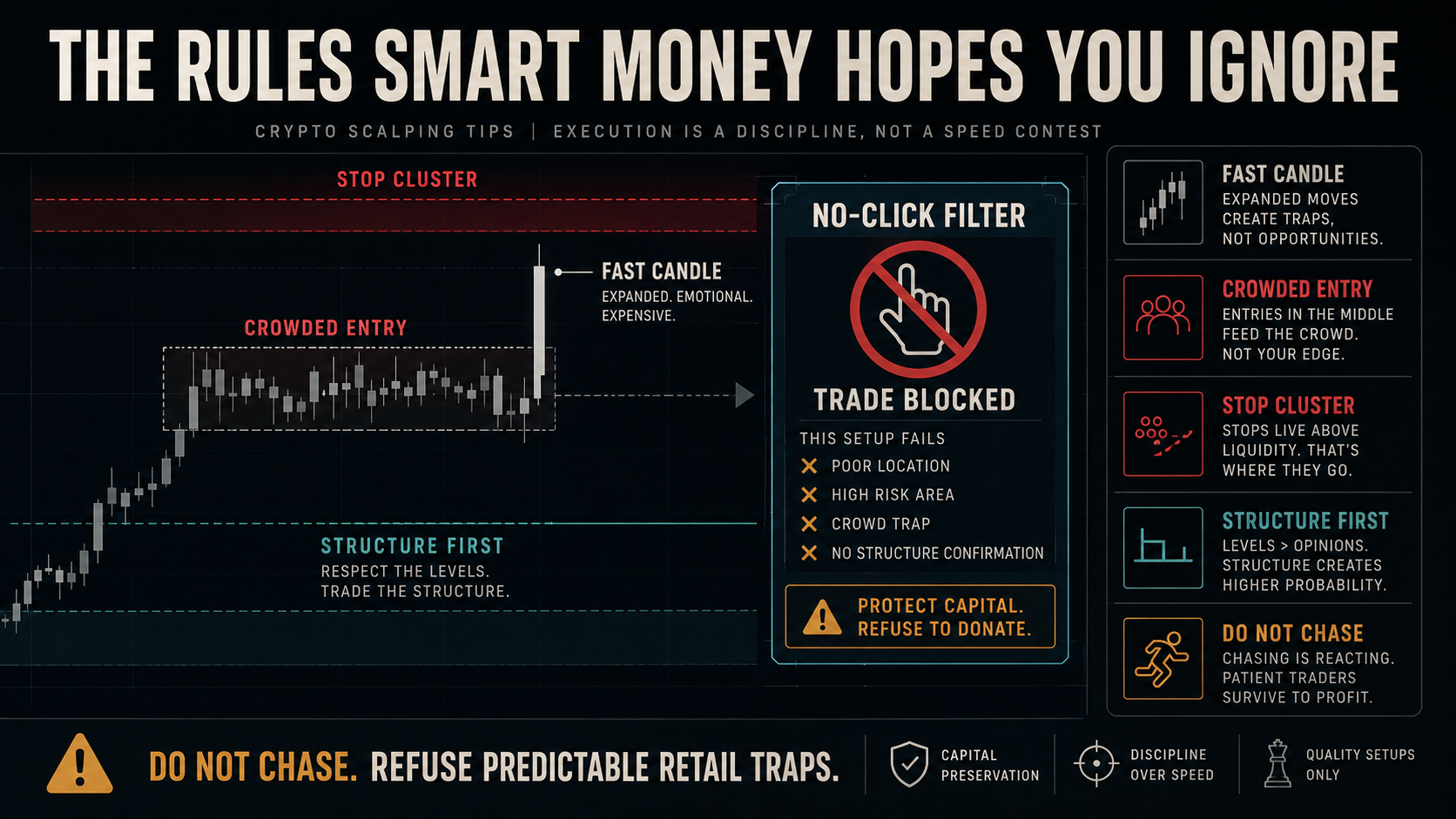
Most Crypto Scalping Tips Are Too Soft
Most advice given to scalpers is too weak to protect an account.
You hear things like:
Use a stop loss. Manage your risk. Wait for confirmation. Do not overtrade. Follow the trend.
Those statements are not wrong.
They are just too vague to help during a live candle.
When BTC or ETH starts moving quickly, the trader does not need motivational advice. The trader needs a hard rule that says:
Do not click here.
A useful crypto scalping tip must be specific enough to stop a bad trade before it opens.
If the candle has already expanded away from the decision area, the setup is weaker.
If the level only wicks and does not hold, the setup is weaker.
If the trade only works when price continues immediately, the setup is weaker.
If fees and slippage are larger than the realistic scalp target, the setup is not a trade.
It is a donation to the exchange.
Tip 1: Do Not Scalp the Middle of the Range
The middle of a range is where bad scalps hide.
Price moves just enough to look active, but not enough to offer clean structure. The trader sees movement, but there is no meaningful decision area.
That is dangerous.
A range has boundaries. The edges matter more than the middle because the edges show where price is being accepted, rejected, swept, or reclaimed.
The middle gives less information.
It is where traders invent setups because they are bored.
If price is not near a meaningful boundary, prior reaction zone, liquidity sweep, or reclaim area, there is usually no clean reason to scalp.
The no-click rule is simple:
If the chart cannot answer where the trade idea is wrong, the trade is skipped.
A scalp without structure is not a fast trade.
It is a guess with a timer.
Tip 2: Never Chase the Candle That Already Expanded
The most dangerous candle is often the one that looks safest.
It is large. It is clean. It looks decisive. It gives the trader emotional comfort.
That comfort is expensive.
By the time the candle looks obvious, the clean entry may already be gone. The distance to invalidation becomes wider. The stop area becomes more vulnerable. The reward becomes smaller because part of the move has already happened.
This is how fast traders enter late while still feeling disciplined.
They tell themselves they waited for confirmation.
But what they actually waited for was emotional safety.
If this pattern keeps showing up in your trades, read Why Do I Always Enter Late in Crypto Trading. That article explains how lagging confirmation and FOMO push traders into the move after the best risk location has disappeared.
A good scalp does not begin when the candle becomes obvious.
It begins when structure, reaction, invalidation, and risk are already clear before the candle pulls the crowd in.
Tip 3: Treat Breakouts as Traps Until They Hold
A breakout is not proof.
A breakout is an event.
The question is what happens after it.
Many scalpers see price break a visible level and immediately assume continuation. That is exactly where the trap begins. Visible levels attract orders. Above obvious resistance, breakout buyers appear. Below obvious support, stop-loss orders gather.
The market does not need to target you personally.
It only needs to move into the same area where retail traders are predictable.
A clean breakout should hold beyond the level. If price wicks through the level and closes back inside the range, the breakout has not been accepted.
That is not confirmation.
That is a warning.
If the breakout reverses right after late traders enter, the setup may have become exit liquidity. For a deeper breakdown of that trap, read BTC Scalping Strategy. That page explains why late BTC scalps often fail around false breakouts, weak boundary reactions, and poor invalidation.
The rule is simple:
A level break is not enough.
The level must be accepted, reclaimed, or rejected with structure.
Tip 4: Count Fees and Slippage Before You Count Profit
Crypto scalping looks attractive because the target feels small and achievable.
But small targets are fragile.
Every scalp has hidden drag:
Taker fees. Spread. Slippage. Bad fills. Overtrading cost. Execution delay.
A trade that looks profitable before costs can become weak after costs.
This is why many scalpers feel like they are winning all day while the account still bleeds. They count gross wins. The market counts net results.
If the expected profit is small, fees and slippage matter more.
If the trader enters late, slippage matters more.
If the trader takes too many trades, fees compound.
If the trader uses market orders during fast movement, execution cost can erase the edge.
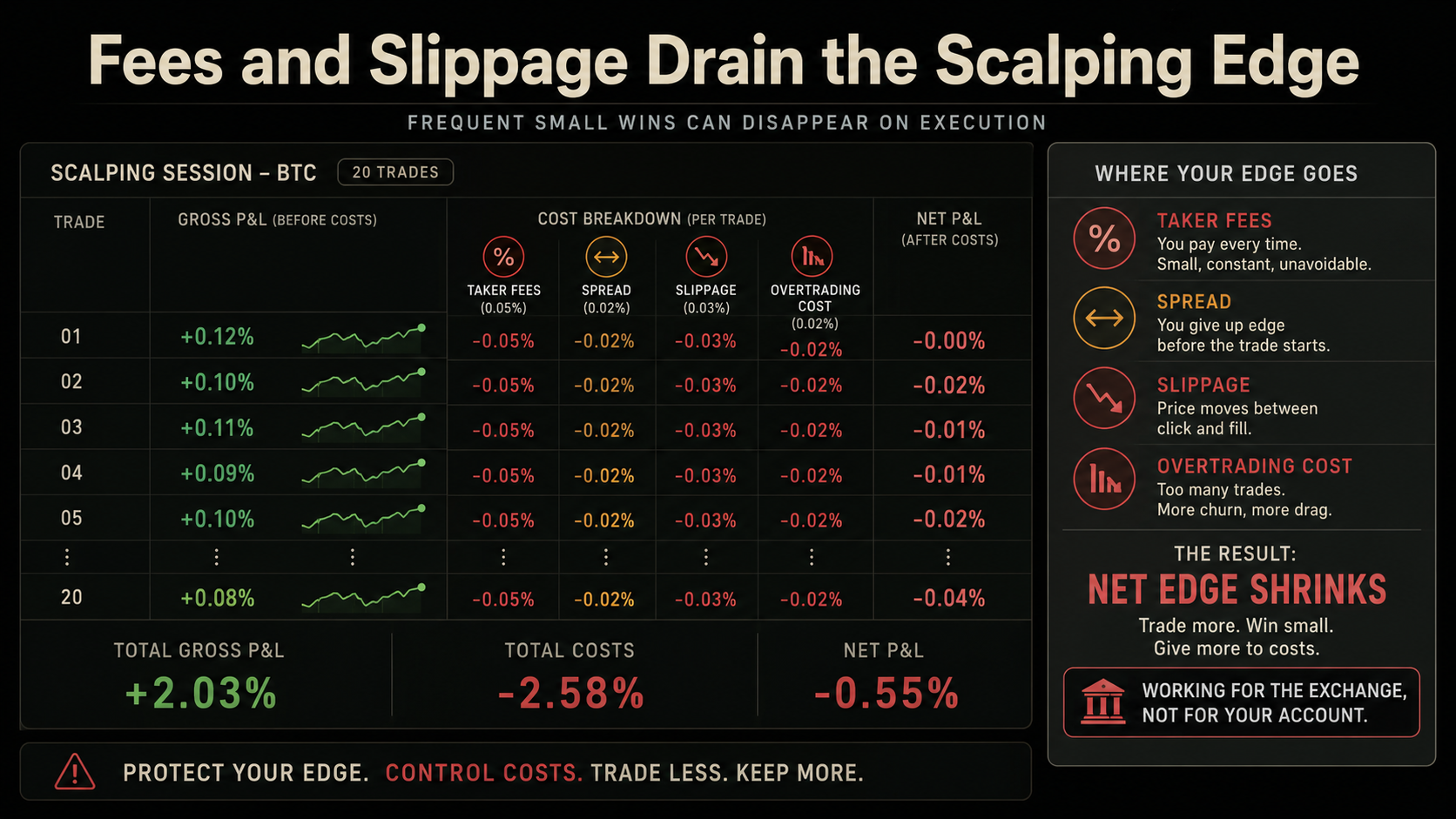
If frequent small wins still leave the account red, read Realistic Win Rate for BTC Scalping Strategies. That article explains why high accuracy still loses money when one oversized loss, fees, and slippage destroy the account.
A scalp is not judged by whether it wins.
It is judged by whether the win is large enough to survive the cost of execution.
Tip 5: Your Stop Is Not Hidden
Retail traders often place stops in the same obvious locations.
Below the clean support line. Above the clean resistance line. Under the breakout candle. Below the last wick. At the exact place the textbook suggests.
That may feel disciplined.
It may also create a visible liquidity pool.
If thousands of traders use the same structure, their stop-loss orders cluster in similar zones. The market does not need your individual stop. It only needs the obvious zone where stops are stacked.
This is why a trader can be right about direction and still lose money.
The stop gets swept first.
Then price moves in the original direction.
The problem is not always the trade idea.
Sometimes the problem is where invalidation was placed.
If the trade direction was right but the stop was taken before price moved, read Why Do I Get Stopped Out Before the Price Moves. That article explains how obvious stop-loss zones can become liquidity pools before the real move begins.
The rule:
Do not place a stop where the crowd is most predictable.
Invalidation should be structural, not emotional.
Tip 6: If the Setup Needs Immediate Continuation, Skip It
A weak scalp usually has one dangerous condition:
It only works if price moves immediately.
That means there is no room for normal market noise.
No room for a small pullback.
No room for a spread shift.
No room for hesitation.
No room for imperfect execution.
If the setup collapses the moment price pauses, it is not a strong scalp. It is a fragile entry built on urgency.
A clean scalp should still make sense if price breathes.
That does not mean the trade needs a wide stop. It means the trade must be built around a structure that explains where the idea is wrong.
If the trade only survives under perfect conditions, the trade is not ready.
Tip 7: Fewer Trades Usually Beat More Clicks
Crypto scalping creates the illusion that more activity means more opportunity.
That is not true.
More clicks can mean more fees. More entries can mean more emotional decisions. More trades can mean more exposure to bad fills. More setups can mean lower selectivity.
Scalping does not reward the trader who reacts to every candle.
It rewards the trader who can reject weak candles quickly.
The best scalp of the day may not come from trading more.
It may come from refusing ten bad trades before one clean setup appears.
This is why a professional scalper can trade less and still perform better than the trader who clicks all day.
The difference is not speed.
The difference is selection.
Tip 8: Position Size Must Obey the Setup
A fast scalp can still damage the account if size is wrong.
The setup defines invalidation.
Invalidation defines distance.
Distance defines position size.
If the trader chooses size first, the trade becomes emotional.
If the trader chooses leverage first, the trade becomes fragile.
If the trader chooses position size based on confidence, the loss can become larger than the setup deserves.
A strong crypto scalping strategy does not ask:
How much can I make if this works?
It asks:
How much does this trade cost if I am wrong?
Before choosing size, use the Maximum Risk Calculator to define the maximum acceptable loss before the trade is opened.
No defined risk, no execution.
Final Rule: Scalping Is Filtering, Not Speed
The rules Smart Money hopes you ignore are not complicated.
Do not scalp the middle of the range. Do not chase the candle that already expanded. Do not trust a breakout until it holds. Do not ignore fees and slippage. Do not place your stop where the crowd places theirs. Do not enter a trade that needs immediate continuation. Do not mistake more clicks for more edge. Do not size the trade before the risk is defined.
Crypto scalping does not punish slow traders.
It punishes predictable traders.
The market does not need to know your name. It only needs to know that traders like you enter late, chase fast candles, place stops in obvious zones, and overtrade when the chart becomes active.
That is enough.
The edge is not in clicking faster.
The edge is in refusing the traps before the candle makes them look safe.