A 5-minute crypto scalping strategy should not start on the 5-minute chart.
That is where many traders make the first mistake.
They open the 5-minute chart, see a fast candle, draw a quick level, and start looking for an entry before they understand where price is inside the larger structure.
The chart looks active.
The setup feels close.
The mouse feels ready.
But the trade may already be weak.
A serious 5-minute crypto scalping strategy starts one layer higher. The 5-minute chart is only the execution layer. The 1-hour chart is the context layer.
If the 1-hour chart is unclear, the 5-minute chart usually gives more noise, not more opportunity.
The goal is not to predict every small move.
The goal is to remove weak trades before execution.
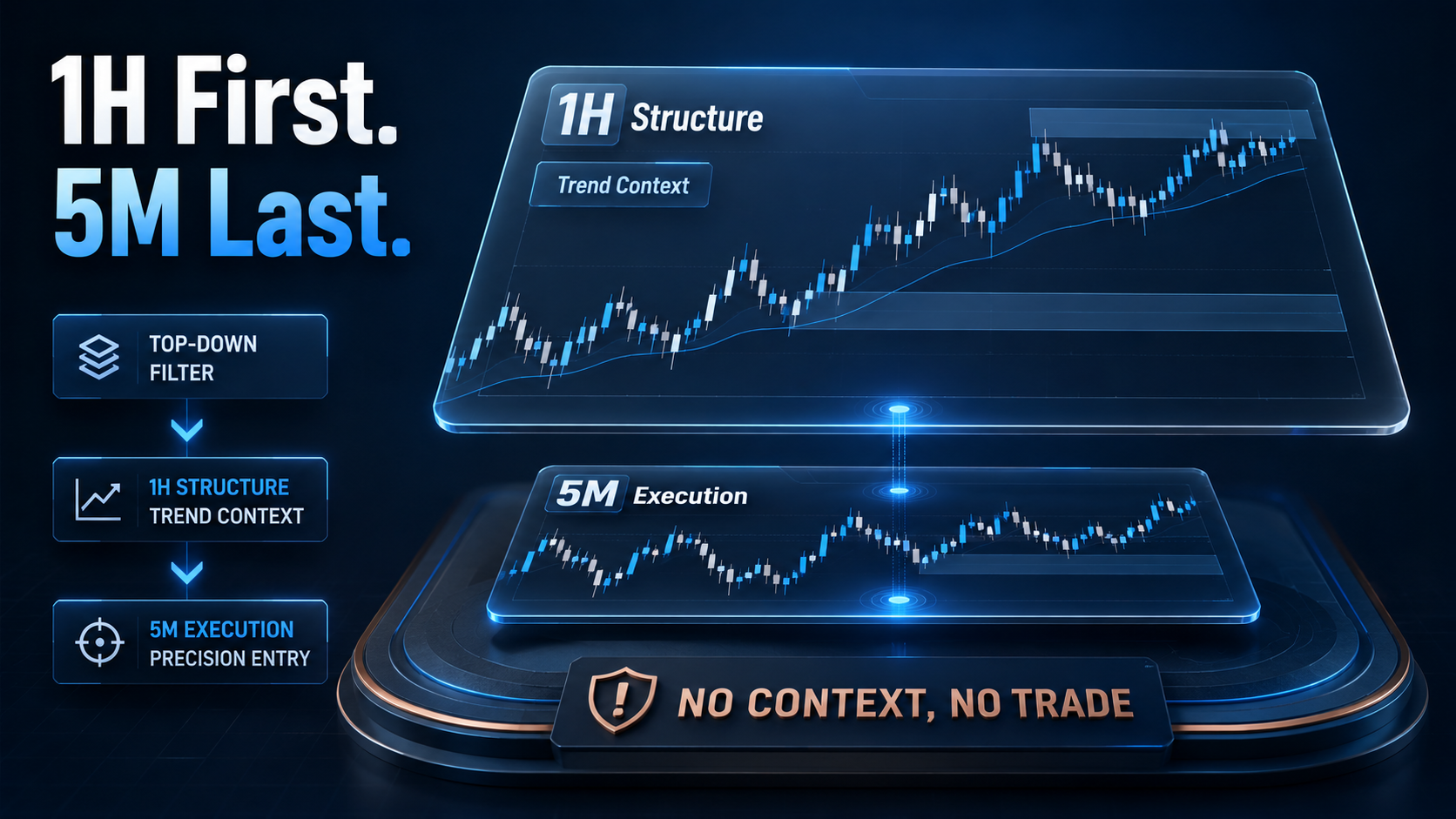
Start With the 1-Hour Chart, Not the 5-Minute Chart
Before looking for any 5-minute scalp, the first question is simple:
What is the 1-hour chart doing?
If the 1-hour chart is making lower highs and lower lows, the market is in a downtrend. In that condition, a 5-minute long setup should not be treated as a normal opportunity.
It may only be a small bounce inside a larger bearish structure.
That does not mean price cannot move upward for a few candles.
It means the trader should not confuse a lower-timeframe bounce with a real structural change.
If the 1-hour chart is clearly bearish, the 5-minute chart must prove much more before any long idea is considered.
If it cannot prove that, the trade is skipped.
The same logic applies in reverse.
If the 1-hour chart is clearly pushing upward, a random 5-minute short from the middle of the move is usually not a clean scalp. It may only be a reaction against the larger pressure.
The 5-minute chart should refine execution.
It should not fight the higher-timeframe structure without evidence.
Why This Strategy Does Not Use Indicator Crossovers
This framework is built on price action.
Not moving average crossovers.
Not RSI overbought or oversold signals.
Not a colored indicator telling the trader when to click.
Those tools can look clean after the move has already happened. On lower timeframes, that delay can be expensive because the entry window may already be gone by the time the indicator looks obvious.
A 5-minute crypto scalping strategy needs to answer questions that indicators often hide:
Where is the structure?
Who was trapped?
Was liquidity taken?
Did price reclaim the level?
Did the market structure shift?
Where is the invalidation?
If those questions are unclear, an indicator signal does not fix the trade.
It only makes the trader feel more comfortable entering a weak setup.
The Price Action Model: Sweep, Shift, Execute
A cleaner 5-minute crypto scalp usually needs three layers.
First, the 1-hour chart gives context.
Second, price moves into a meaningful area.
Third, the 5-minute chart shows price action evidence.
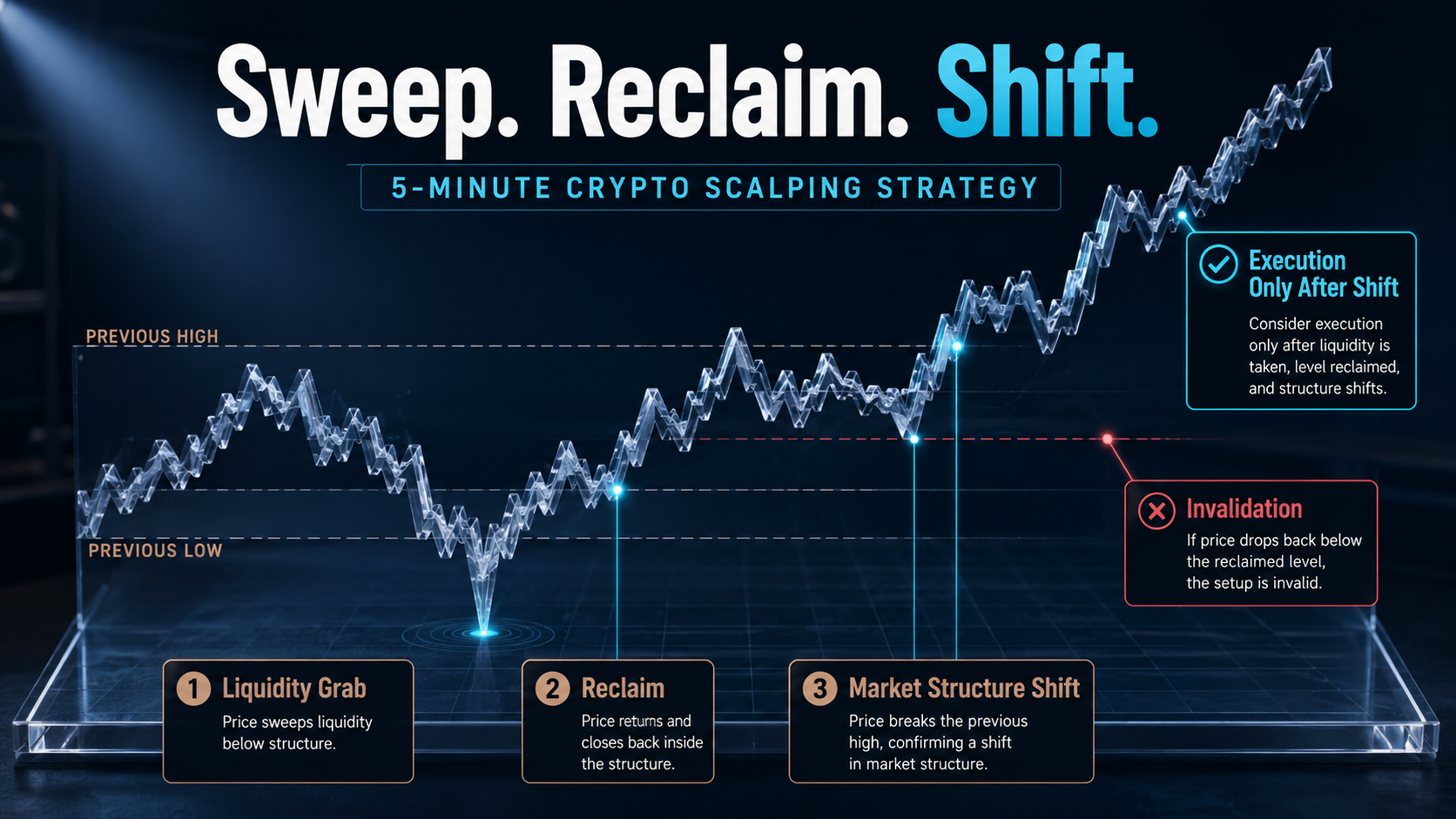
The two most important price action events are:
Liquidity grab. Market structure shift.
A liquidity grab happens when price pushes beyond a visible high or low, attracts breakout traders or triggers resting orders, and then fails to continue.
A market structure shift happens when price breaks the short-term structure that was controlling the move.
Neither one is useful alone.
A wick through a level is not enough.
A single strong candle is not enough.
A 5-minute setup becomes cleaner when liquidity is taken, price returns back into structure, and then the short-term structure shifts in the new direction.
That is the difference between chasing movement and waiting for evidence.
Red Flag 1: The 1-Hour Trend Is Against the 5-Minute Idea
The first no-click condition is higher-timeframe conflict.
If the 1-hour chart is in a clear downtrend, the trader should not search aggressively for 5-minute long entries.
A lower-timeframe bounce may look tradable, but it is still moving against the larger structure.
The red flag is not that price moves upward.
The red flag is that the upward move has not changed the larger structure.
For example, price may bounce from a local low on the 5-minute chart, but the 1-hour chart may still be below a prior breakdown area. The bounce is then happening inside bearish context.
That is not a clean long setup.
Before a long idea becomes valid in that environment, the market should show stronger evidence: a liquidity sweep, a reclaim, and a market structure shift that actually changes the local condition.
If that evidence is missing, the trade is skipped.
No higher-timeframe support means no lower-timeframe execution.
Red Flag 2: Price Grabs Liquidity but Does Not Reclaim the Level
The second no-click condition is a failed liquidity grab.
Many traders see a wick beyond a high or low and immediately assume reversal.
That is too early.
A liquidity grab only shows that price took a level.
It does not prove that price has reversed.
For the setup to become stronger, price needs to return back into structure and show acceptance. If price sweeps a low but cannot reclaim the previous range, the sweep may only be continuation pressure.
If price sweeps a high but stays above the area without failing, there may be no rejection.
The mistake is treating the wick itself as the trade.
A wick is an event.
A reclaim is evidence.
A structure shift is confirmation that the local condition has changed.
If price grabs liquidity but does not reclaim the level, the trade is skipped.
No reclaim means no execution.
Red Flag 3: The Setup Appears During a High-Impact News Window
The third no-click condition is timing risk around major scheduled news.
A 5-minute setup can look perfect before a major economic release. Then the release hits, spreads widen, candles expand, and the previous structure becomes less reliable.
For crypto traders, high-impact macro events can still matter because Bitcoin and major crypto pairs often react to broader risk conditions.
If a major event such as CPI, a central bank decision, or another high-impact release is scheduled within the next 30 minutes, a 5-minute scalp can become structurally unreliable.
This is not about predicting the news.
It is about refusing poor execution conditions.
During these windows, price can move through levels without clean respect. Liquidity can disappear. The candle can travel far beyond the planned invalidation area before the trader reacts.
A clean-looking setup before the release can become a completely different trade after the release.
If the market is entering a high-impact news window, the trade is skipped.
No stable execution environment means no 5-minute scalp.

The Actual 5-Minute Crypto Scalping Framework
Once the weak conditions are removed, the strategy becomes simple.
The trade must pass five filters:
1-hour structure. Decision area. Liquidity event. Market structure shift. Invalidation distance.
If one filter is missing, the setup is incomplete.
Step 1: Define the 1-Hour Bias
The 1-hour chart does not need to predict the exact scalp.
It only needs to define the environment.
Ask:
Is price making higher highs and higher lows?
Is price making lower highs and lower lows?
Is price trapped inside a range?
Is price near a major boundary?
Is the market pushing into a prior reaction zone?
If the 1-hour chart is clean, the 5-minute chart has context.
If the 1-hour chart is messy, the 5-minute chart should be treated carefully.
The 5-minute chart is not allowed to invent direction by itself.
Step 2: Mark the 5-Minute Decision Area
A decision area is where the trade idea can be judged.
It may be a prior high, prior low, range boundary, sweep area, reclaim level, or reaction zone.
The exact label matters less than the function.
The area must help answer this question:
Where is the trade wrong?
If the area cannot define invalidation, it is not useful for execution.
A setup in the middle of a range is usually weaker than a setup near a clear boundary.
The trader should not chase a candle just because it is moving.
The trader should wait for price to reach a place where the trade can be tested.
Step 3: Wait for Liquidity to Be Taken
A 5-minute scalp becomes more meaningful when price first takes a visible level.
This can be a sweep above a short-term high or below a short-term low.
The purpose is not to enter during the sweep.
The purpose is to see whether the sweep fails.
If price takes liquidity and continues cleanly, there may be no reversal setup.
If price takes liquidity and returns back into structure, the setup becomes more interesting.
The key is patience.
The trader is not trying to catch the wick.
The trader is waiting to see whether the wick becomes a failed move.
Step 4: Require a Market Structure Shift
After the liquidity grab, the 5-minute chart should show a market structure shift.
That means the local structure that controlled the move is broken.
For a potential long setup, price should stop making lower lows and begin breaking the short-term lower-high structure.
For a potential short setup, price should stop making higher highs and begin breaking the short-term higher-low structure.
This shift does not guarantee the trade.
It only gives the setup a reason to continue.
Without the shift, the trader is guessing.
With the shift, the trader has evidence that the local condition may have changed.
Step 5: Check Invalidation Before Position Size
A 5-minute setup can still be rejected after the structure shift.
The reason is distance.
If the entry is too far from the invalidation point, the trade becomes inefficient.
The setup may look correct, but the risk distance may be too wide.
That means the position size must shrink.
If the size cannot shrink enough while still fitting the plan, the trade is skipped.
The trader should not force a large position onto a wide invalidation distance.
The 5-minute chart is slower than the 1-minute chart, but the same rule applies:
Distance defines size.
Size does not define distance.
Where the Maximum Risk Calculator Fits
Before execution, the maximum loss should already be defined.
The order should be:
Account balance. Risk percentage. Maximum loss. Invalidation distance. Position size. Execution.
Not the other way around.
Use the calculator before choosing position size:
Open the Maximum Risk Calculator
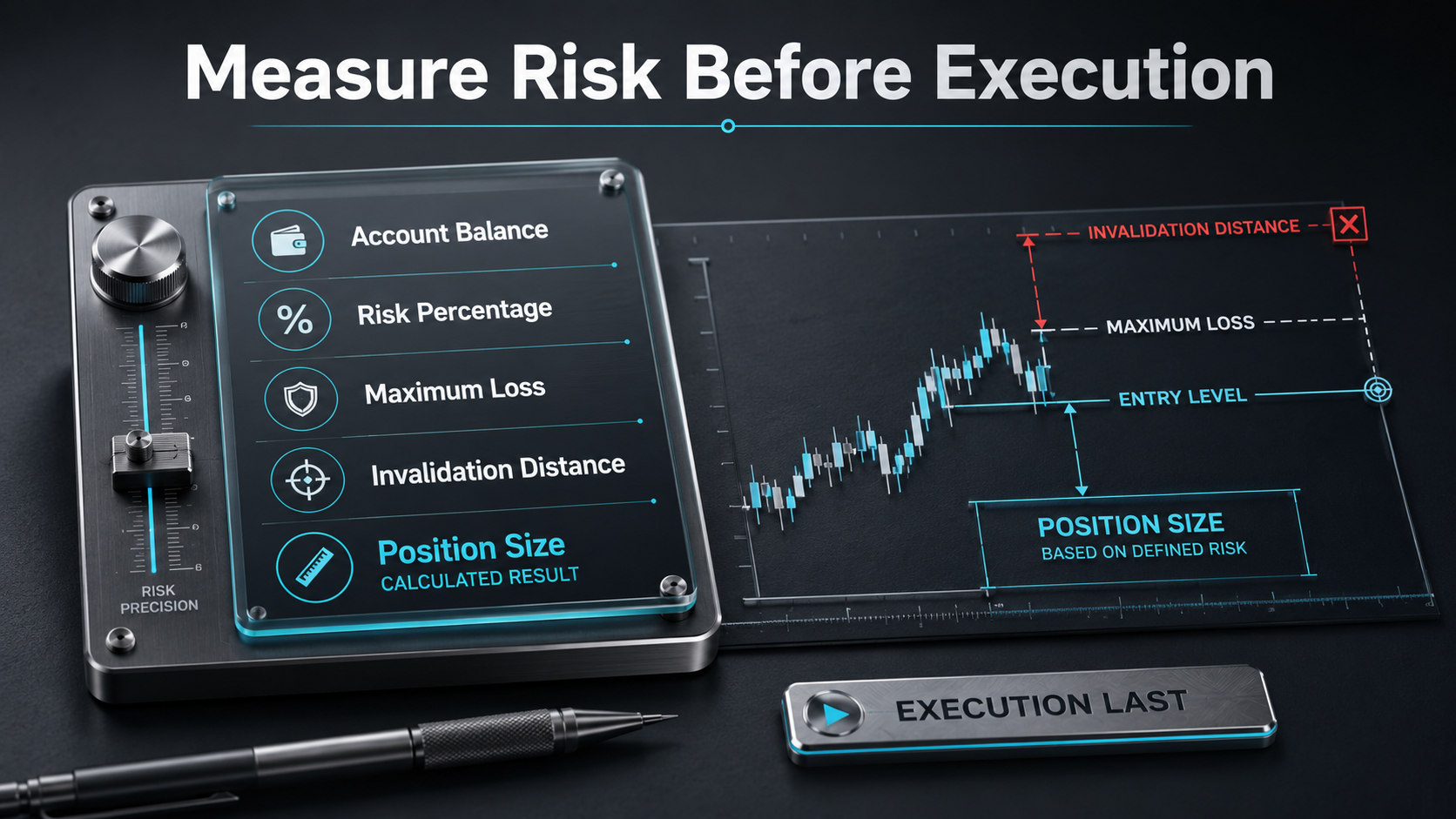
If the invalidation distance does not fit the maximum loss, the trade is skipped.
If the position size only works by ignoring the distance to invalidation, the trade is skipped.
If the trade needs oversized exposure to feel worth taking, the setup is not clean enough.
The calculator does not create the setup.
It decides whether the setup is still acceptable after the structure is defined.
What Makes the 5-Minute Strategy Different From the 1-Minute Strategy
The 1-minute chart punishes speed.
The 5-minute chart punishes false confidence.
Because the candles are larger, the setup can look more stable. The trader may feel that there is more time to think. But the larger candle also means the invalidation distance can become wider.
That changes the position size.
A 5-minute scalp usually gives more structure than a 1-minute scalp, but it also requires more patience.
The trader should not enter just because the chart is slower.
Slower does not mean safer.
Cleaner structure is what matters.
For faster execution filters, read:
1-Minute Crypto Scalping Strategy: Red Flags Before Fast Entries
For the broader scalping framework, read:
Why Crypto Scalping Entries Fail After the Fast Candle
Final Checklist Before a 5-Minute Crypto Scalp
Before entering a 5-minute crypto scalp, check:
Is the 1-hour structure clear?
Is the trade aligned with the higher-timeframe condition?
Is price near a meaningful decision area?
Has liquidity actually been taken?
Did price reclaim the level after the sweep?
Has a market structure shift appeared?
Is invalidation clearly tied to the structure?
Does the position size fit the invalidation distance?
Is there a high-impact news event within the next 30 minutes?
Would this trade still make sense if the previous trade was a loss?
If the answer is unclear, the trade is skipped.
If several answers are unclear, there is no setup.
There is only movement.
Final Rule: The 5-Minute Chart Is Execution, Not Permission
The 5-minute chart does not give permission by itself.
It only helps execute a trade idea that already has context.
If the 1-hour chart is against the idea, do not click.
If the liquidity grab does not reclaim, do not click.
If the structure does not shift, do not click.
If the invalidation distance is too wide, do not click.
If high-impact news is about to hit, do not click.
A strong 5-minute crypto scalping strategy is not built around indicators.
It is built around context, price action, and refusal.
The edge is not in seeing more candles.
The edge is knowing which candles do not deserve your money.