You waited for confirmation.
The breakout candle closed.
Momentum looked strong.
Every reason to hesitate disappeared at the same time.
You clicked.
Then the candle stalled.
The next move did not continue. Price slipped back through the level, your stop became exposed, and the setup that looked safest became the worst entry on the chart.
You were not necessarily wrong about direction.
You were wrong about whether the trade was still executable.
That is the purpose of a crypto scalping entry checklist.
It is not a list of indicators that gives permission to trade. It is a filtering system designed to answer three questions before the order opens:
Enter, wait or skip?
A valid market direction does not automatically create a valid entry.
The structure can be correct while the location is wrong.
The location can be correct while the trigger is missing.
The trigger can appear after the entry has already become too late.
The entire setup can look clean while the invalidation distance makes the position unacceptable.
A scalping checklist separates those problems before account risk becomes real.
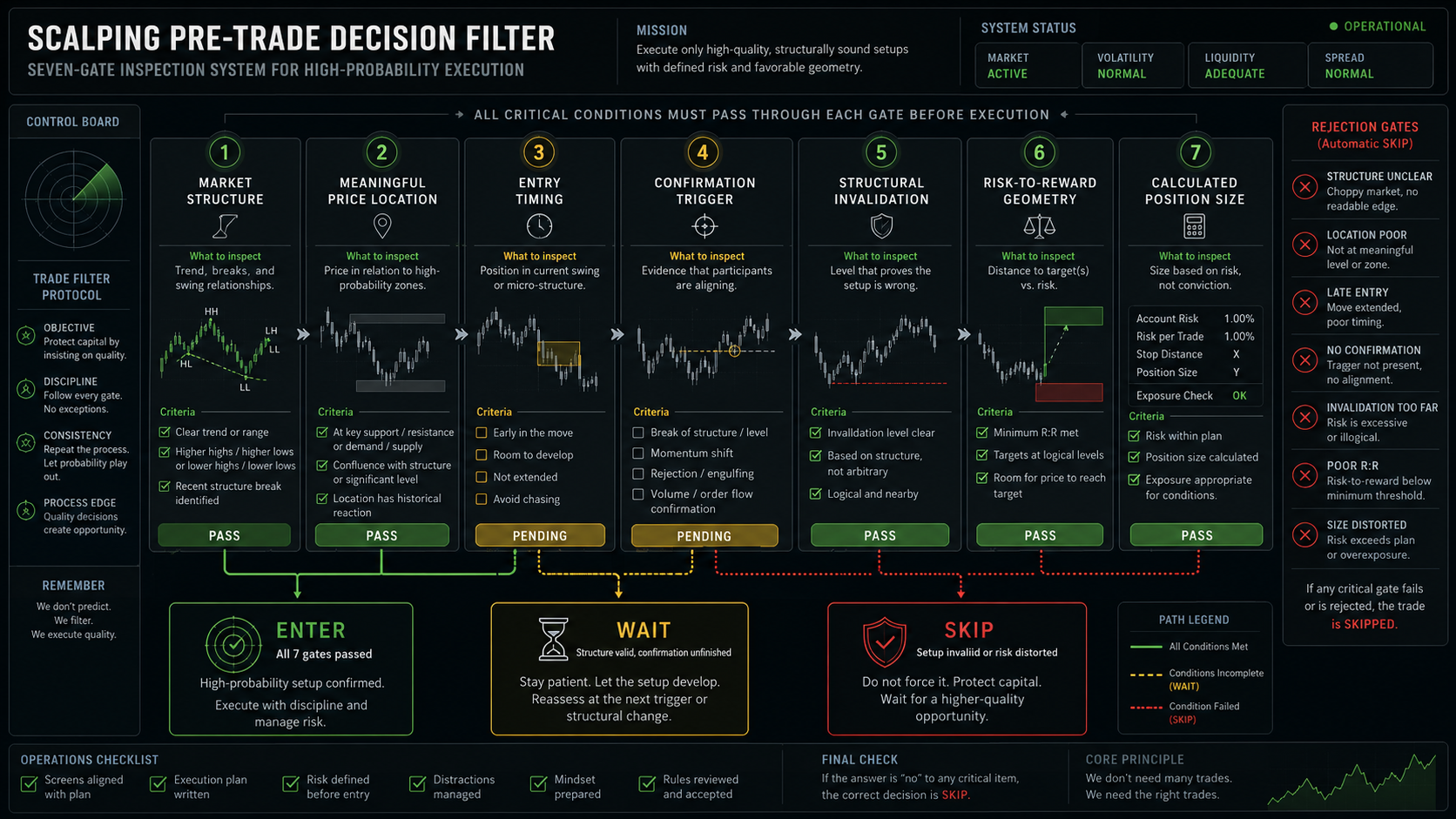
The Seven-Check Crypto Scalping Entry Checklist
Before clicking Buy or Sell, answer these seven questions:
- Is the market structure clear?
- Is price at a meaningful location?
- Has the entry already become too late?
- Is there an actual entry trigger?
- Where is the invalidation level?
- Is the remaining reward worth the risk and execution cost?
- Has the position size been calculated from the risk?
The decision is not always Enter.
Sometimes the correct output is Wait.
Sometimes it is Skip.
That is not failure.
Rejecting an incomplete trade is the checklist working correctly.
Enter, Wait and Skip Are Different Decisions
Many traders use only two states:
- Trade.
- Do not trade.
That is too crude for fast markets.
A useful pre-trade process needs three states.
Enter
Enter means the critical conditions are already present:
- The larger structure is understandable.
- Price is at a relevant decision area.
- The entry has not become stretched.
- The required reaction has appeared.
- Invalidation is clear.
- The remaining target justifies the risk.
- Position size fits the maximum loss limit.
Enter does not mean the trade is guaranteed to win.
It means the setup is complete enough to execute according to the plan.
Wait
Wait means the trade idea may still be valid, but the evidence is incomplete.
Examples include:
- Price is approaching the boundary but has not tested it.
- The candle is still open.
- A breakout occurred but has not held or retested.
- A liquidity sweep appeared but the level has not been reclaimed.
- Structure is clean, but the entry candle has already expanded.
- A pullback could restore an acceptable risk distance.
Waiting preserves the setup without paying for unfinished information.
Skip
Skip means the trade should be rejected, not delayed.
Examples include:
- There is no clear structure.
- Price is trapped in the middle of a range.
- The original entry area has already passed.
- The invalidation condition cannot be defined.
- The required stop distance is larger than the plan allows.
- The realistic target is blocked by nearby structure.
- The trade only works if price continues immediately.
A skipped trade should not remain mentally open.
Once the setup is structurally unacceptable, stop negotiating with it.
Check 1 — Is the Market Structure Clear?
A scalp should not begin with a candle.
It should begin with context.
Before looking for an entry, identify whether price is:
- Trending;
- Compressing inside a range;
- Testing a range boundary;
- Reclaiming a lost level;
- Retesting a breakout;
- Rotating without a clear direction.
The execution chart can make every small movement look important.
That is why context should be checked on a higher timeframe first.
A five-minute candle may look strongly bullish while price is moving directly into one-hour resistance. A one-minute reversal may look convincing while the larger market is still trapped in the center of a range.
The lower timeframe tells you what price is doing now.
The higher timeframe tells you where that movement is happening.
For a complete top-down execution process, read 5-Minute Crypto Scalping Strategy: The Top-Down Filter You Need Before Executing.
Structure Pass
The structure passes when you can describe it in one sentence:
Price is compressing beneath resistance.
Price swept the range low and reclaimed the boundary.
Price broke above the range and is retesting the former resistance.
Price is making lower highs beneath a defined supply zone.
Structure Fail
The structure fails when the explanation sounds like this:
It looks as though it might move.
The last candle is strong.
RSI is rising.
BTC has been quiet for a while.
I think volatility is about to appear.
Those statements describe expectation.
They do not describe structure.
Decision
- Enter: The structure and direction of the setup are clear.
- Wait: Structure is forming, but the relevant boundary has not been tested.
- Skip: The chart contains chaotic wicks, unclear boundaries or random movement.
Check 2 — Is Price at a Meaningful Location?
Correct direction is not enough.
Location determines whether the entry has a logical boundary, realistic target and usable invalidation.
Meaningful locations can include:
- The edge of a defined range;
- A previous swing high or low;
- A reclaimed support or resistance level;
- A breakout retest;
- A liquidity sweep followed by a reclaim;
- A higher-timeframe reaction zone;
- A clear compression boundary.
The middle of a range is usually not a meaningful location.
Price can move rapidly in the middle and still provide no useful information about acceptance, rejection or structural failure.
The candle may look active.
The location is still weak.
A useful question is:
Why should the trade begin here instead of ten candles earlier or ten candles later?
If the answer is only “because momentum appeared,” the location has not been defined.
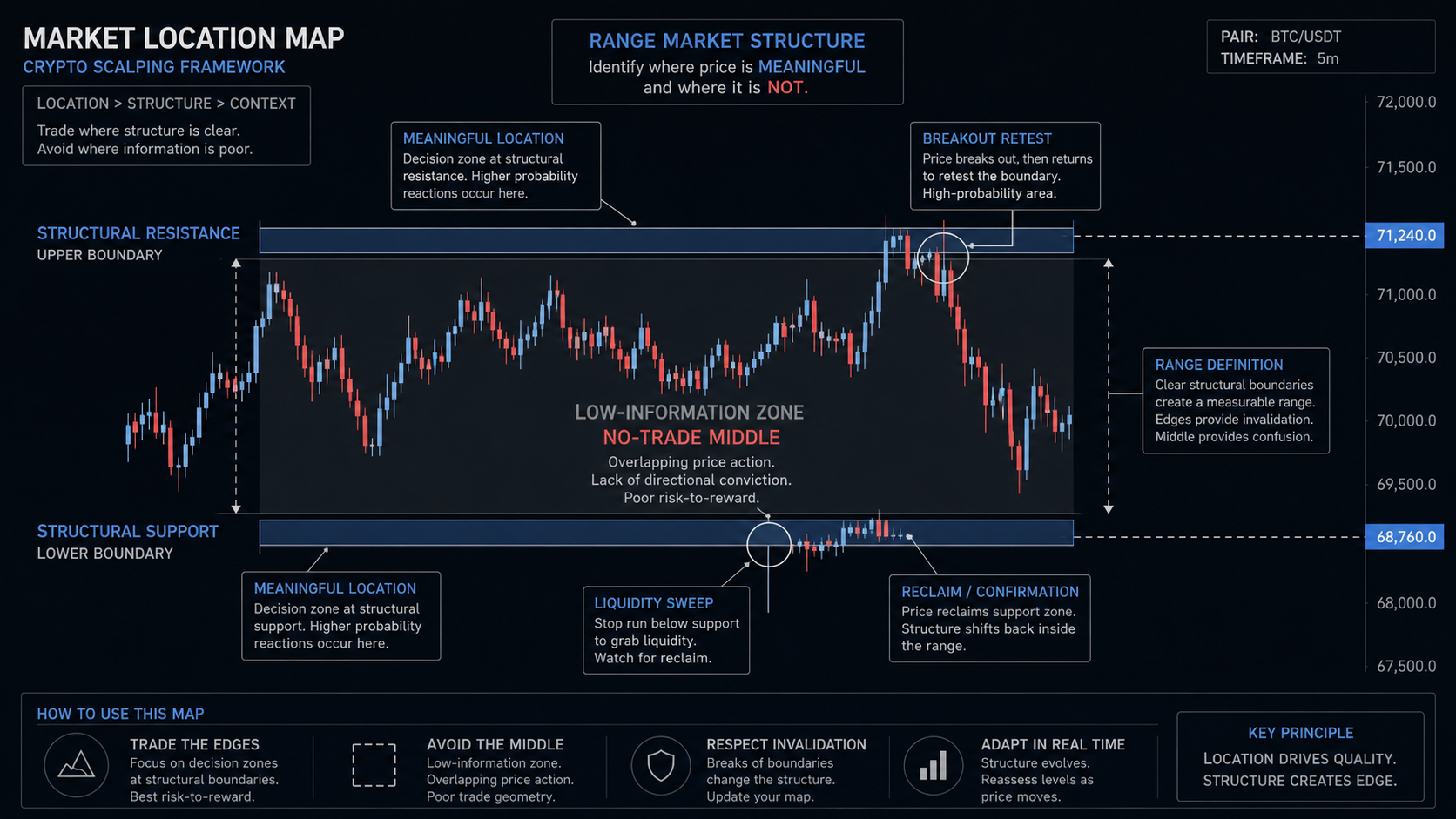
Location Pass
The entry sits close enough to a structural boundary that:
- The reason for entering is visible;
- The failure condition can be measured;
- The next obstacle is identifiable;
- The trade does not require an arbitrary stop.
Location Fail
The entry sits:
- In the middle of a large range;
- Directly beneath resistance for a long;
- Directly above support for a short;
- Far away from the level that created the setup;
- Inside an area of overlapping, directionless candles.
Decision
- Enter: Price is reacting at a predefined decision area.
- Wait: Price is moving toward the area but has not reached it.
- Skip: Price is in a low-information location with no clean boundary.
Check 3 — Has the Entry Already Become Too Late?
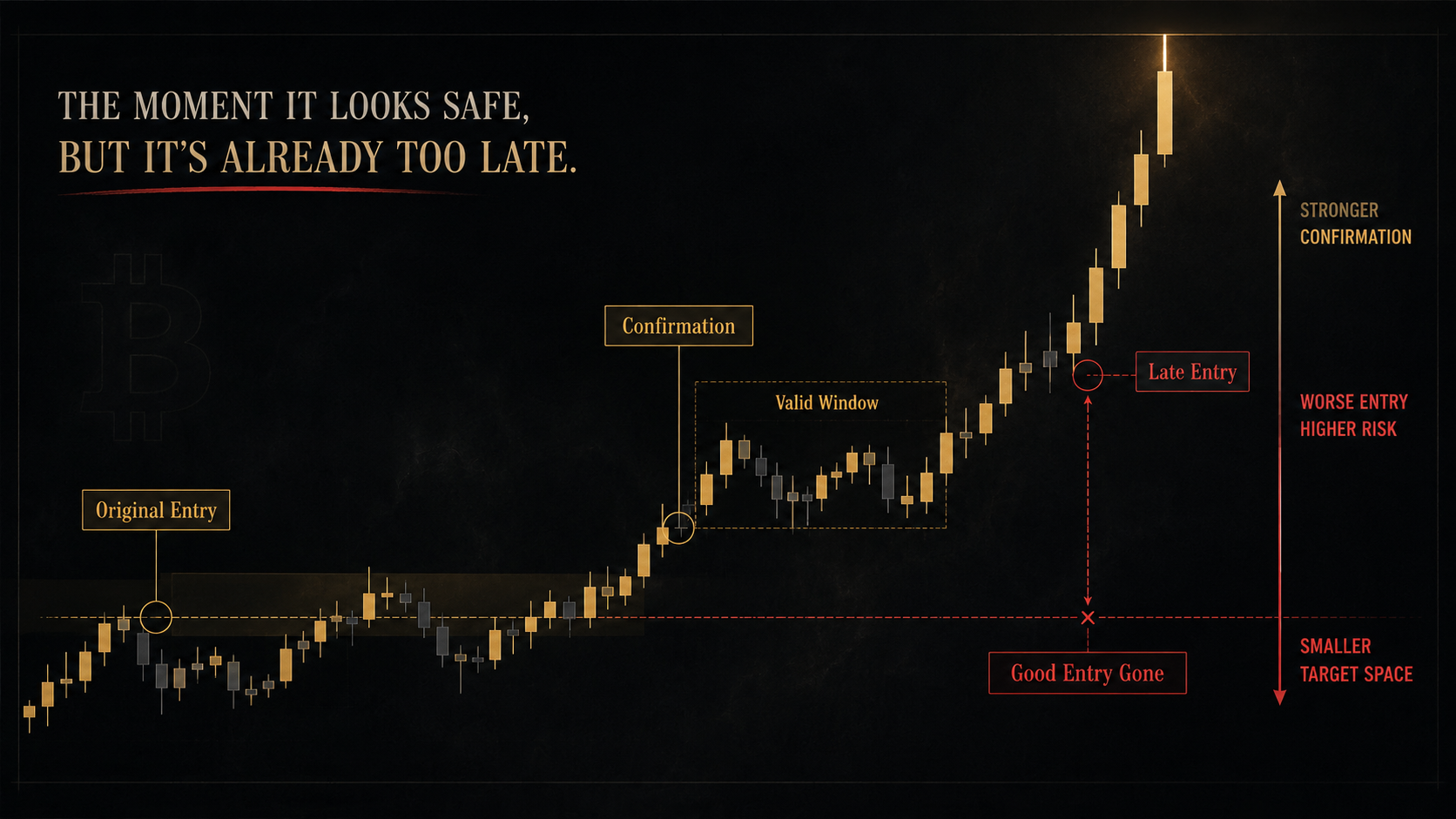
The most dangerous entry often looks like the safest one.
The breakout is visible.
The candle body is large.
Momentum indicators have aligned.
The move finally looks obvious.
But the risk location may already be gone.
A late entry changes the geometry of the trade:
- Entry moves farther away from invalidation;
- Stop distance becomes wider;
- Position size must become smaller;
- The next resistance or support becomes closer;
- Less of the original move remains available;
- A normal pullback becomes more dangerous.
The trader sees more confirmation.
The trade contains less opportunity.
Four Signs the Entry Is Becoming Late
1. Price Has Expanded Away From the Decision Area
The trade was originally based on a boundary reclaim or breakout retest.
Price has now moved several candles away from that location without offering another controlled entry.
The trader is no longer buying the structure.
The trader is buying the distance already travelled.
2. Invalidation Is Now Farther Away Than the Realistic Target
Suppose the structural invalidation is below the reclaimed range boundary.
After price expands, the entry is much farther above that boundary.
At the same time, the next resistance is close.
The trade may still move in the predicted direction, but the remaining geometry no longer supports the entry.
3. The Current Candle Must Continue Immediately
The entry only works if the active candle keeps expanding.
Any pause, wick or ordinary pullback would expose the stop.
That means the setup does not have structural room.
It has urgency.
4. The Trader Is Entering to Stop the Pain of Missing Out
The internal argument changes from:
This is a valid setup.
To:
I cannot watch this move without being in it.
That is not confirmation.
That is emotional relief purchased at a worse price.
For a deeper diagnosis of this pattern, read Why Do I Always Enter Late in Crypto Trading? The Trap of Retail Indicators.
Decision
- Enter: Price remains close enough to the decision area for the original invalidation and target to remain usable.
- Wait: The initial move has expanded, but a controlled pullback or retest could restore the setup.
- Skip: The trade requires chasing price and moving invalidation closer to manufacture acceptable risk.
Check 4 — Is There an Actual Entry Trigger?
A location is not an entry trigger.
A boundary touch is not an entry trigger.
A wick through a level is not automatically an entry trigger.
The trigger is the specific market reaction that converts an observation into an executable setup.
Depending on the strategy, a trigger may be:
- A sweep below support followed by a reclaim;
- A breakout close that holds outside the range;
- A retest that fails to re-enter the previous range;
- A rejection candle at a defined boundary;
- A local market structure shift after the boundary test;
- A failed breakout followed by acceptance back inside the range.
The trigger must match the original setup.
A long breakout trade and a long failed-breakdown trade are not the same setup.
One requires price to hold outside the upper boundary.
The other requires price to reclaim the lower boundary after trading beneath it.
The word “bullish” is not specific enough.
The Open-Candle Problem
While the current candle is still open, its final structure does not exist.
A candle that appears to be breaking resistance can close back inside the range.
A strong rejection wick can disappear if price trades through the level again.
A reclaim can fail before the candle completes.
This does not mean every strategy must wait for every candle to close.
It means the trader must define in advance what evidence the strategy requires.
Do not use a candle-close rule before entry and abandon it because the live candle looks exciting.
Decision
- Enter: The predefined reaction or confirmation has completed.
- Wait: Price is testing the level, but the required reaction is unfinished.
- Skip: Price violated the setup condition or never produced the required trigger.
Check 5 — Where Is the Invalidation Level?
Before opening the position, identify what would prove the trade idea wrong.
Not where the loss becomes uncomfortable.
Not where the position reaches liquidation.
Not where the desired position size produces an attractive number.
The invalidation condition must come from the same structure that created the entry.
Examples:
- A breakout trade may fail when price closes back inside the old range and cannot reclaim the boundary.
- A failed-breakdown long may fail when price loses the reclaimed range low again.
- A rejection short may fail when price accepts above the swept high.
- A retest trade may fail when the former boundary no longer holds in its new role.
You must also decide whether invalidation requires:
- A price touch;
- A wick through the level;
- A candle close;
- Acceptance beyond the boundary;
- A close followed by a failed reclaim.
Do not decide after the position starts losing.
For the complete distinction between structural failure and stop execution, read What Is an Invalidation Level in Crypto Trading? The Line That Proves Your Setup Wrong.
Decision
- Enter: The invalidation condition is clear and defined before entry.
- Wait: The structure exists, but the final failure boundary still needs clarification.
- Skip: The only available stop location is random, emotional or based on liquidation distance.
Check 6 — Is the Remaining Reward Worth the Risk?
The target should not be selected because the trader wants a specific reward-to-risk ratio.
It should come from the next realistic structural obstacle.
For a long trade, that could be:
- The opposite range boundary;
- A previous swing high;
- A resistance zone;
- An untested liquidity area;
- A higher-timeframe reaction level.
For a short trade, the logic is reversed.
Once the target is identified, compare the remaining distance with:
- Entry-to-invalidation distance;
- Spread;
- Trading fees;
- Expected slippage;
- The possibility of an imperfect fill;
- The amount of the move that has already occurred.
A trade can look profitable on the chart while having little realistic room after execution costs.
This matters more in scalping because the intended price movement is often small.
A Simple Geometry Test
Ask:
If price reaches the next logical obstacle, is enough of the move still available to justify the distance to invalidation?
If the answer depends on price breaking another major level, the trade is relying on a second setup that has not happened yet.
Do not use an imaginary extension target to rescue weak entry geometry.
Decision
- Enter: The realistic structural target leaves enough room relative to risk and execution costs.
- Wait: A better entry could improve the distance without changing the thesis.
- Skip: The next obstacle is too close or most of the move has already happened.
Check 7 — Is the Position Size Calculated From Risk?
Position size comes last.
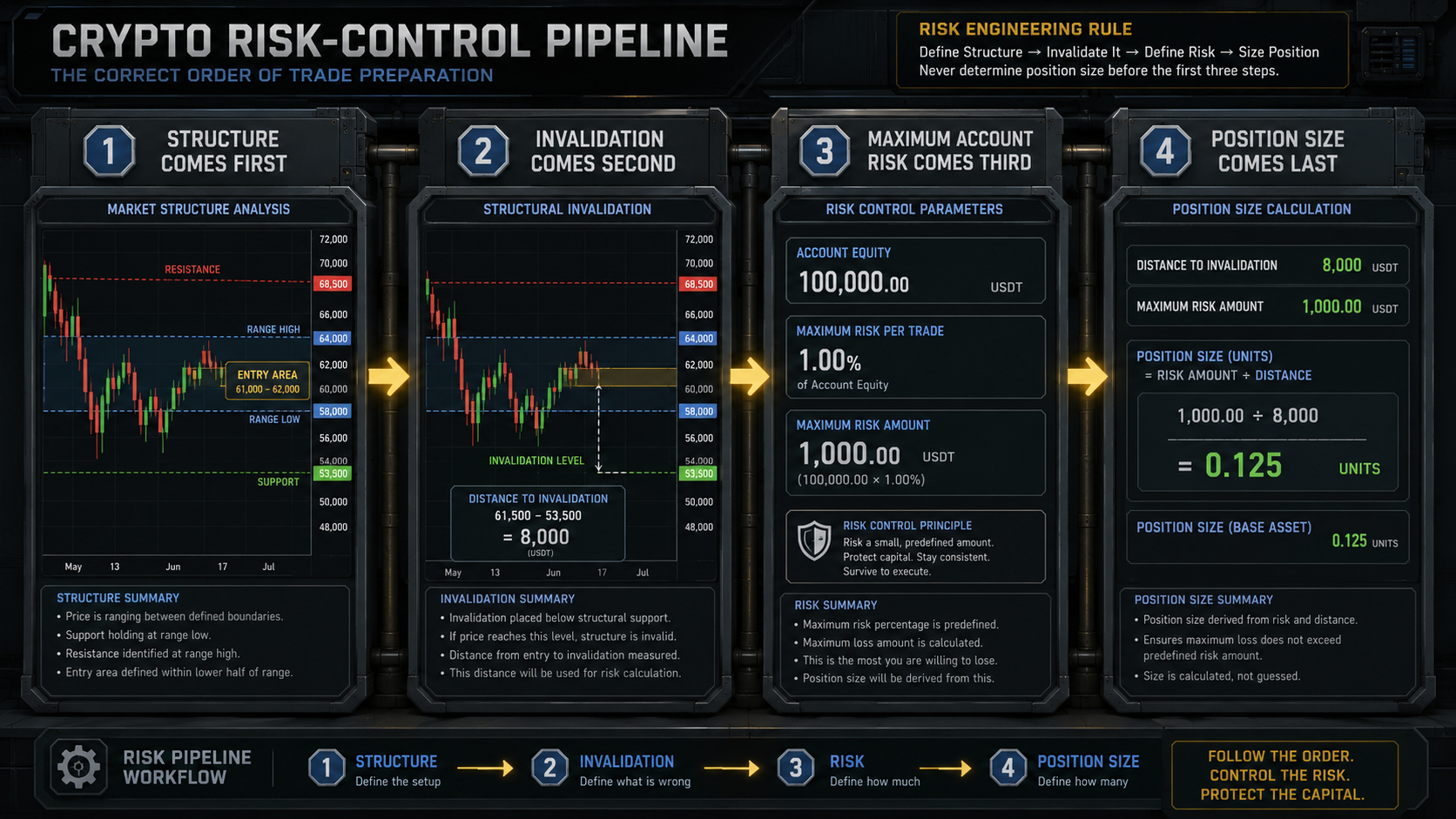
The sequence is:
Structure → Entry → Invalidation → Maximum Risk → Position Size
Not:
Desired profit → Leverage → Large position → Convenient stop
A basic position-size process begins with two inputs:
- Maximum amount the account is allowed to lose;
- Distance between entry and the planned stop execution.
The wider the invalidation distance, the smaller the position must become.
The tighter the distance, the position may become larger—but only when the tighter invalidation is structurally valid.
A tight random stop does not create precision.
It creates a larger position around a fragile level.
The position size must still account for the instrument, fees, slippage and exchange contract rules.
The purpose of the calculation is not to predict the loss perfectly.
It is to prevent confidence from determining exposure.
For the full calculation process, read Crypto Position Size Calculator: How to Define Risk Before Entry.
Decision
- Enter: Position size fits the predefined maximum account risk.
- Wait: Required size or order details have not been calculated.
- Skip: The trade only feels worthwhile with oversized exposure or excessive leverage.
Three Red Flags Before a Crypto Scalp
A setup does not need to look completely broken to be rejected.
Sometimes the weakness appears through small distortions.
Red Flag 1 — The Safest-Looking Candle Is the Entry Candle
The current candle is the largest and cleanest candle in the recent sequence.
It has already moved away from the structural boundary.
The trader feels safe precisely because the uncertain part of the move has already occurred.
The comfort is real.
The original entry location is gone.
Red Flag 2 — The Stop Must Be Forced Inside Normal Noise
The true structural invalidation is too far away for the desired position size.
Instead of reducing size, the trader moves the stop beneath the latest small wick.
The stop now fits the account fantasy.
It no longer fits the trade thesis.
Red Flag 3 — The Target Requires Another Breakout
The scalp is entered directly beneath resistance.
The proposed target sits beyond that resistance.
For the target to work, the market must first complete the current setup and then produce a second successful breakout.
The trader is pricing in evidence that does not exist.
Three No-Click Rules
These rules are designed to stop execution, not improve motivation.
No-Click Rule 1 — No Boundary, No Trade
If you cannot identify the structural area being tested, there is no clean setup.
Do not click because the market is moving.
Do not create a boundary after the position opens.
No-Click Rule 2 — No Completed Reaction, No Trade
If the strategy requires a reclaim, the reclaim must occur.
If it requires a close outside the range, the close must occur.
If it requires a retest, the retest must occur.
A prediction that the trigger is “about to happen” is not a trigger.
No-Click Rule 3 — No Defined Loss, No Trade
If the invalidation, stop execution and maximum loss have not been calculated, the position is not ready.
Do not enter first and calculate later.
A live position creates pressure to justify the position.
The risk decision must happen before that pressure exists.
How to Avoid Late Entries in Crypto Trading
Avoiding late entries does not mean entering earlier without evidence.
That simply replaces chasing with guessing.
The goal is to separate necessary confirmation from expensive confirmation.
Define the Decision Area Before Momentum Appears
Mark the boundary, reclaim area or retest zone while price is still approaching it.
Once momentum expands, you should already know:
- Where the setup begins;
- What reaction is required;
- Where the setup fails;
- How far price can move before the entry becomes unacceptable.
Without a predefined area, the trader evaluates the chart emotionally during the fastest part of the move.
Measure Distance, Not Excitement
A candle can become more convincing while the trade becomes less attractive.
Keep measuring:
- Distance from entry to invalidation;
- Distance from entry to the next obstacle;
- Distance already travelled from the original decision area.
The move may still continue.
That does not mean the current price is still a valid entry.
Use Pullbacks to Restore Geometry
After expansion, do not automatically chase.
A pullback or retest may:
- Bring price closer to invalidation;
- Create a new structural boundary;
- Show whether the breakout can hold;
- Improve the relationship between risk and target.
A pullback does not always arrive.
Missing a trade is cheaper than forcing a bad location.
Separate “Wait” From “I Missed It”
Wait means the setup can still become executable.
Missed means the original setup has passed.
Once the entry requires a completely different invalidation or target, it is no longer the same trade.
Do not keep the old thesis and attach it to a new price.
When Not to Enter a Crypto Trade
A clear no-trade condition is as important as an entry condition.
Do not enter when:
- Price is in the middle of a range;
- The higher-timeframe context conflicts with the proposed scalp;
- The boundary is unclear;
- The candle is still testing the level and the required outcome is unfinished;
- Price has already expanded too far from invalidation;
- The next structural obstacle is too close;
- Invalidation cannot be defined;
- Position size requires excessive exposure;
- The trade needs immediate continuation;
- The entry is motivated by missing the previous move;
- The decision follows a loss and is intended to recover money;
- Fees and likely slippage consume too much of the realistic target.
The market will always provide another candle.
The account may not provide unlimited attempts.
Three Example Setups: Enter, Wait or Skip
Example 1 — Enter
BTC compresses beneath a clear range high.
Price closes above the boundary, returns to test it and fails to re-enter the old range.
The former resistance begins holding as support.
The entry remains close to the boundary.
Invalidation is defined beneath the failed retest structure.
The next resistance leaves enough room for the trade.
Position size fits the maximum account loss.
Decision: Enter.
The trade is not entered because the candle is green.
It is entered because structure, location, reaction, invalidation and risk agree.
Example 2 — Wait
BTC approaches the same range high.
The active candle pierces above it, but the candle is still open.
Price has not shown whether it will hold outside or close back inside.
Invalidation would depend on the final boundary reaction.
Decision: Wait.
The location is relevant.
The evidence is unfinished.
Waiting one candle may remove the trade, but it may also prevent a false-breakout entry.
Example 3 — Skip
BTC broke above the range three candles ago.
Price is now far above the original boundary and approaching the next resistance area.
The structural invalidation remains beneath the old range high.
Entering now creates a wide stop and a small remaining target.
The trader considers moving the stop beneath the latest small candle to make the numbers work.
Decision: Skip.
The original breakout may remain valid.
The available entry is not.
The Phantom Box Pre-Execution Process
The Phantom Box process does not begin by asking which direction to trade.
It begins by reducing uncertainty in a fixed order.
1. Map the Structure
Identify the compression zone, range boundaries and larger market context.
2. Observe the Boundary Test
Do not treat the first pierce as confirmation.
Watch how price reacts around the level.
3. Classify the Outcome
Determine whether price:
- Reclaims the range;
- Holds outside the range;
- Retests the boundary;
- Returns to random rotation.
4. Define Invalidation
State what behavior would prove the selected outcome wrong.
5. Lock Maximum Risk
Decide how much the account is allowed to lose before calculating exposure.
6. Calculate Position Size
Let the invalidation distance and maximum risk determine size.
7. Execute or Reject
The final output is:
Enter. Wait. Skip.
The protocol is not designed to create more trades.
It is designed to remove trades that were never complete.
Frequently Asked Questions
What is a crypto scalping entry checklist?
It is a pre-trade filtering process used to evaluate structure, location, timing, confirmation, invalidation, risk and position size before opening a short-term crypto trade.
Should every checklist item pass before entering?
Every critical item should be resolved.
A trade without structure, invalidation or defined risk is incomplete.
Some secondary conditions depend on the specific strategy, but uncertainty should not be disguised as confirmation.
What is the difference between Wait and Skip?
Wait means the setup could still become valid when additional evidence appears.
Skip means the current setup or available entry is already unacceptable and should be rejected.
Should I enter immediately after a breakout candle closes?
Not automatically.
Check whether price has held beyond the boundary, whether the entry is already stretched, where invalidation sits and whether sufficient target distance remains.
How do I know whether an entry is too late?
The entry may be too late when price has moved far from the decision area, invalidation distance has expanded, the next obstacle is close or the trade requires immediate continuation.
Does waiting for more confirmation prevent late entries?
Not always.
Useful confirmation verifies the structure.
Excessive confirmation can move the entry farther away from invalidation and reduce the remaining opportunity.
Can this checklist be used on one-minute and five-minute charts?
Yes, but the execution chart should be interpreted within a larger structural context.
A lower-timeframe trigger can be technically clean while occurring at a poor higher-timeframe location.
Does this checklist guarantee profitable trades?
No.
It is a selection and risk-control process.
It cannot remove market uncertainty, slippage, execution errors or losing trades.
Final Rule: The Click Comes Last
The candle does not decide the trade.
The checklist does.
Structure comes first.
Location comes second.
Reaction confirms the setup.
Invalidation defines failure.
Risk limits the damage.
Position size follows the risk.
Only then does execution become available.
You do not need to catch every move.
You need to stop paying for moves that were already late, structurally incomplete or too fragile to survive normal price behavior.
A good crypto scalping entry checklist does not tell you to trade more confidently.
It tells you when confidence is not enough.
Educational content only. This article does not provide financial advice, trading signals or guaranteed results. Crypto trading involves significant risk of loss.