The setup looked clean.
Bitcoin reclaimed the level. Momentum expanded. You entered long.
Then price dropped through support, hit your stop, and bounced without you.
Now you are staring at the chart asking the wrong question:
Was my stop too tight?
The real question is:
What price action would have proved that the original trade idea was wrong?
That is the purpose of an invalidation level.
An invalidation level is not where the loss becomes uncomfortable. It is not a random percentage below your entry. It is not the liquidation price supplied by the exchange.
It is the price or structural condition that proves the reason for entering the trade no longer exists.
Without that condition, you do not have a complete trade setup.
You only have an entry and a hope.
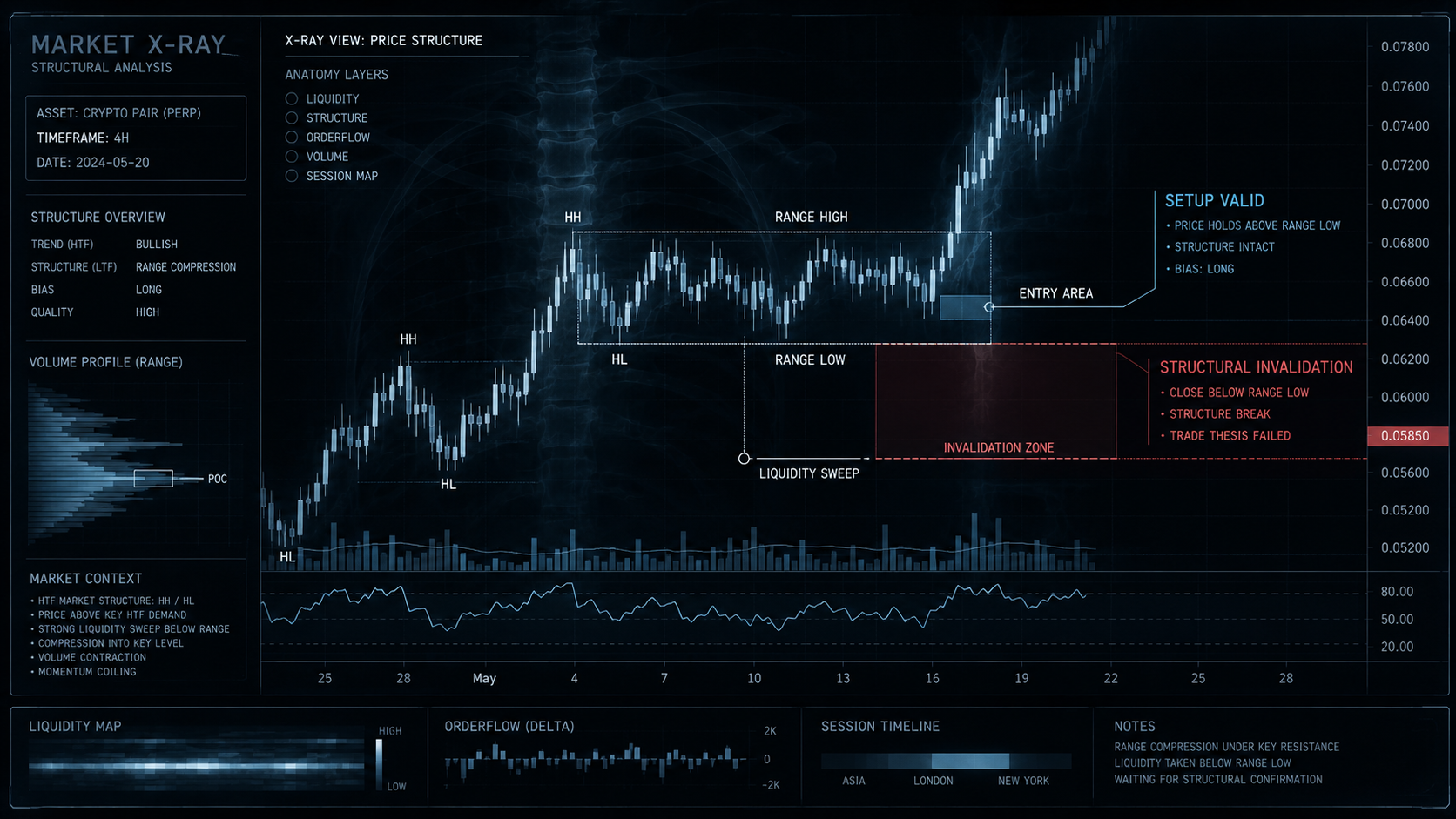
What Does an Invalidation Level Mean in Crypto Trading?
An invalidation level answers one question:
What must happen on the chart for this trade idea to be considered wrong?
Suppose BTC breaks above a range, closes outside it, and then retests the former resistance as support.
The long idea is not simply:
Bitcoin will go up.
The actual idea is:
Bitcoin has left the old range, and the previous resistance is now holding as support.
That idea remains valid only while the new support continues to hold according to the rules defined before entry.
If price falls back into the range and shows acceptance below the reclaimed boundary, the breakout thesis may be invalidated.
The important part is not the exact terminology.
The important part is that the setup contains a condition capable of proving itself wrong.
A serious trade idea must contain both sides:
- What must happen for the trade to become valid?
- What must happen for the trade to become invalid?
Most traders define the first side.
They wait for a breakout, reclaim, sweep, indicator signal, or market structure shift.
Then they leave the second side vague.
That is how a chart setup becomes an emotional position.
Invalidation Level vs Stop Loss
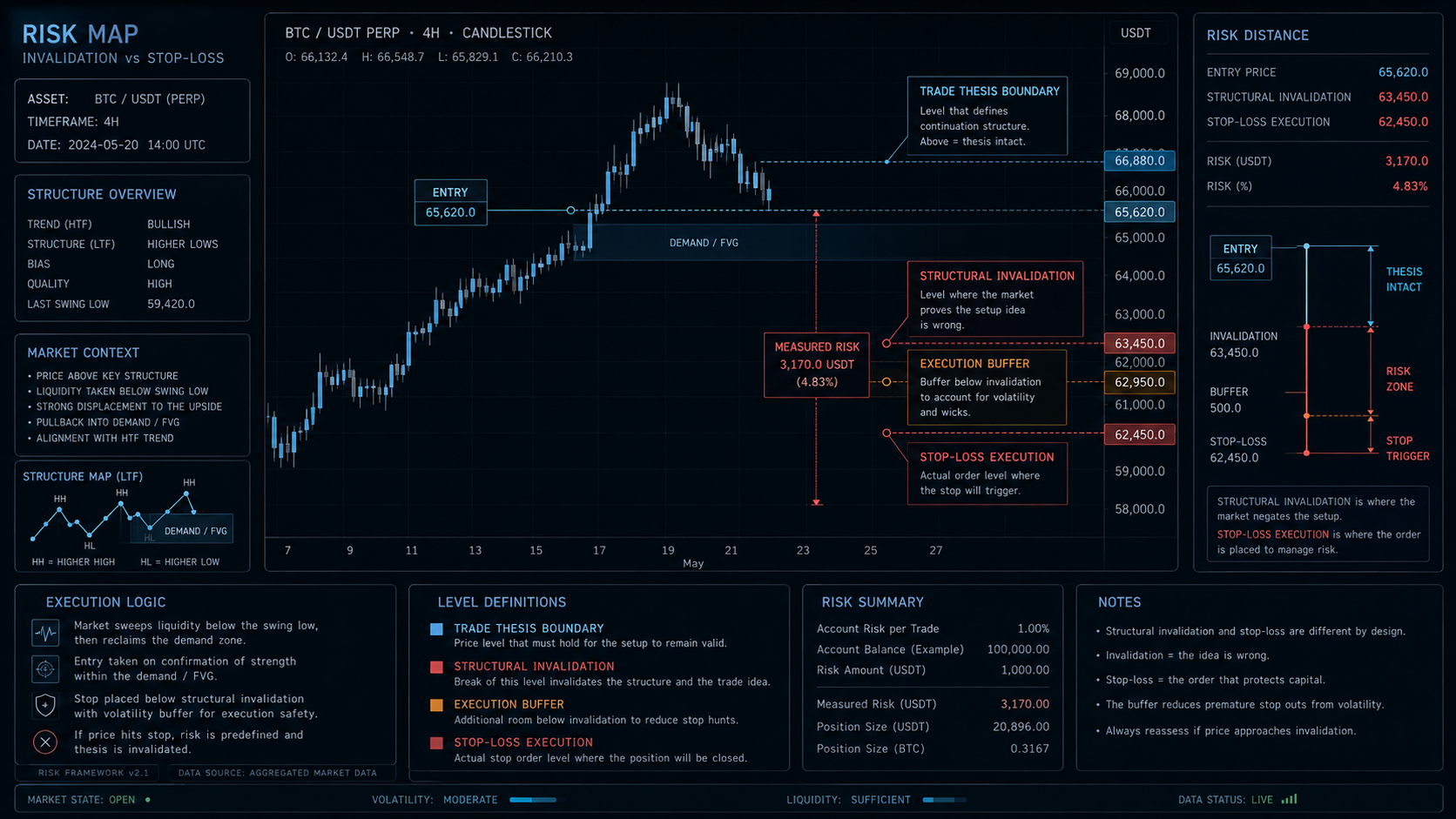
An invalidation level and a stop loss are connected, but they are not automatically the same thing.
The invalidation level belongs to the trade thesis.
The stop loss belongs to trade execution.
An invalidation level defines where the market has disproved the setup. A stop loss is an order or exit instruction intended to control the loss when the setup fails.
In some trades, the stop may sit directly beyond the structural invalidation point.
In other trades, the invalidation rule may require a candle close, a failed reclaim, or another condition that cannot be represented by one exact price alone.
This creates an important distinction:
Invalidation explains why the trade should end. The stop loss determines how the exit is executed.
A trader who sets a stop without defining invalidation is often placing the order according to discomfort:
- Five dollars below entry.
- One percent below entry.
- Just under the latest candle.
- Wherever the position size still looks attractive.
The chart did not create that level.
The desired position size did.
That order is backwards.
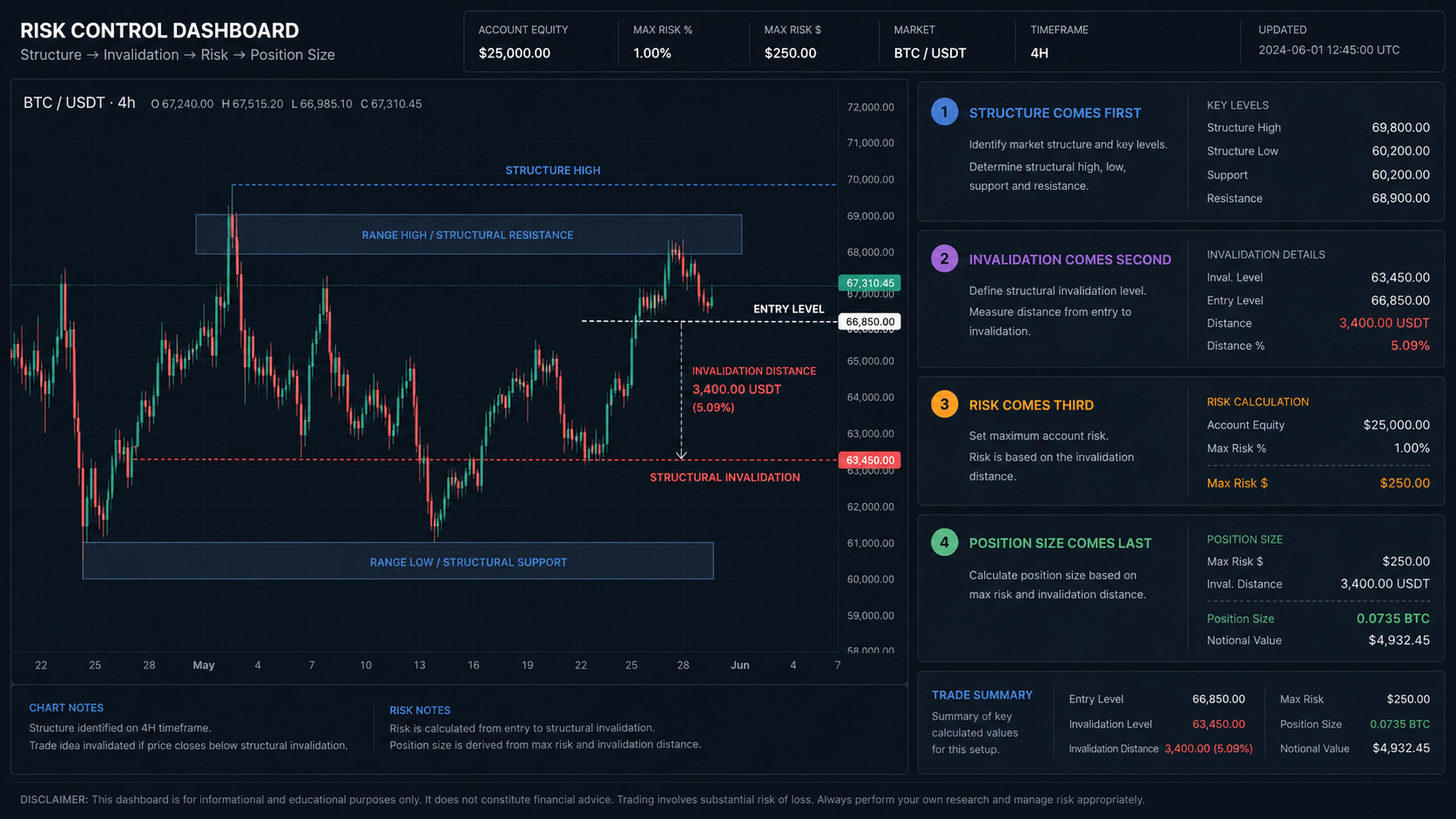
The correct sequence is:
- Identify the structure.
- Define what would invalidate it.
- Measure the distance from entry to invalidation.
- Define the maximum account risk.
- Calculate the position size.
- Decide whether the trade is still acceptable.
The position should fit the invalidation distance.
The invalidation distance should never be squeezed to fit the position.
For the complete sizing sequence, read Crypto Position Size Calculator: How to Define Risk Before Entry.
How to Find an Invalidation Level
An invalidation level should come from the same structure that created the trade idea.
If the entry depends on a reclaim, the invalidation should test whether the reclaim still holds.
If the entry depends on a breakout, the invalidation should test whether price has returned to the old structure.
If the entry depends on a liquidity sweep and reversal, the invalidation should test whether the swept extreme has been decisively reclaimed.
The trader should not search for a convenient stop after entering.
The invalidation must already exist before the order is opened.
Market Structure Invalidation
Market structure invalidation occurs when the price behavior supporting the trade changes.
For example, imagine a possible long setup:
- Price forms a short-term range.
- BTC sweeps below the range low.
- Price reclaims the range.
- A local market structure shift appears.
- The trader considers a long entry.
The trade thesis is based on the failed breakdown and reclaim.
Possible invalidation is therefore connected to the loss of that reclaim.
If price returns below the reclaimed boundary and begins holding there, the reason for the long may no longer exist.
The trade was not invalidated because the position showed a temporary loss.
It was invalidated because the market returned to the state that the entry thesis said should have failed.
For a short trade, the logic works in reverse.
Suppose price sweeps above a visible high, rejects the breakout, falls back into the range, and breaks the local bullish structure.
The short thesis depends on the breakout remaining failed.
If price later reclaims the swept high and holds above it, the failed-breakout thesis may no longer be valid.
The invalidation comes from the setup.
Not from the trader’s feelings about the setup.
Support and Resistance Invalidation
Support and resistance are often treated as exact lines.
Real price behavior is usually less clean.
A visible level may function as a reaction zone rather than one perfect number. Price can wick through it, trade around it, and still maintain the larger structure.
That means the trader needs to define exactly what “losing the level” means.
Possible rules include:
- The first touch through the level invalidates the setup.
- A candle must close beyond the level.
- Price must close beyond the level and fail to reclaim it.
- Multiple candles must show acceptance beyond the boundary.
- The local market structure must change after the level is lost.
There is no universal rule that fits every market, timeframe, or strategy.
The mistake is not choosing the “wrong” rule.
The mistake is choosing the rule after seeing what price does.
If a wick counts as invalidation, that must be decided before entry.
If only a candle close counts, that must be decided before entry.
If a failed reclaim is required, that must be decided before entry.
Changing the definition during the trade turns analysis into negotiation.
Wick Invalidation vs Candle-Close Invalidation
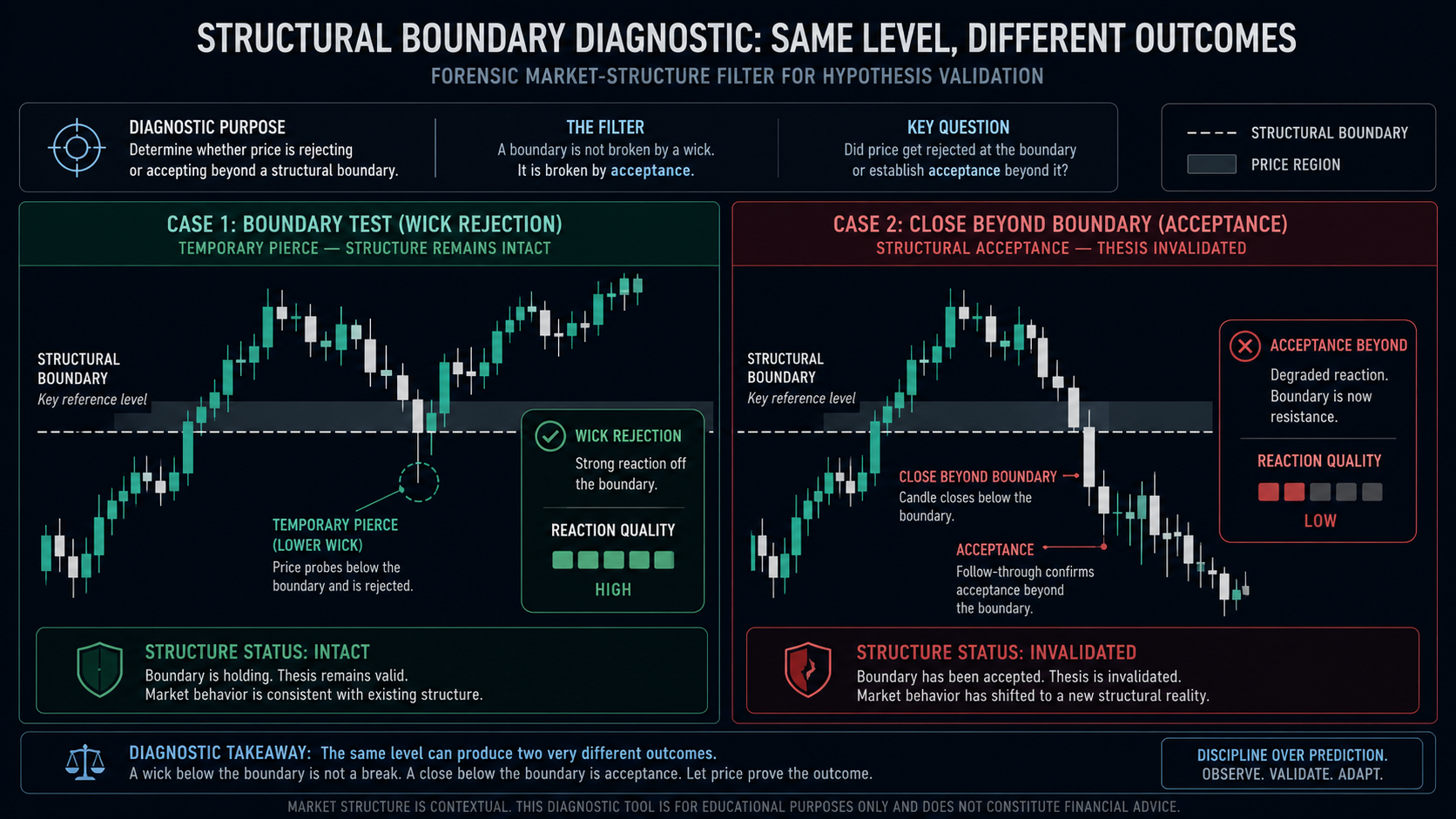
A wick through a level and a candle close beyond a level do not communicate the same thing.
A wick shows that price traded beyond the boundary.
A close shows where price remained when that candle finished.
Neither is automatically more important.
The correct rule depends on what the trade thesis requires.
When a Wick May Be Enough
A wick-based invalidation may be appropriate when the setup depends on an extreme remaining untouched.
For example, a very tight microstructure trade may depend on a specific swing low not being breached.
If price trades through that low, the original structure has already changed.
Waiting for a candle close could create a completely different risk distance.
In this case, the rule is strict:
The level must not trade through.
When a Candle Close May Matter More
A close-based invalidation may be more appropriate when the setup depends on acceptance rather than the first price touch.
For example, a breakout retest may allow a temporary wick back into the old range.
The trade thesis does not require perfect rejection at one exact tick.
It requires price to avoid becoming accepted inside the old range again.
The rule may therefore be:
A wick into the range is a test. A close and failed reclaim inside the range invalidate the breakout thesis.
This is not permission to ignore every wick.
It is a predefined structural rule.
The trader still needs to make sure the potential loss, leverage, and position size can survive the distance required by that rule.
Example 1: A Valid Breakout Retest
BTC trades inside a clear range.
Price closes above the upper boundary and later returns to test it.
The former resistance holds as support. Selling pressure weakens, and price begins moving away from the boundary.
The trade thesis is:
Price has left the range, and the old resistance is now functioning as support.
The invalidation condition could be:
Price closes back inside the old range and fails to reclaim the boundary.
This creates a complete structure:
- Entry reason: breakout hold and successful retest.
- Invalidation: acceptance back inside the previous range.
- Risk distance: entry to structural failure.
- Position size: calculated from the risk distance.
- No-trade condition: entry is too far from the boundary.
The direction can still be correct while the entry is bad.
If price has already expanded far above the retest, the invalidation remains near the boundary while the entry keeps moving farther away.
The risk distance becomes wider.
At that point, the setup may need a smaller position or no entry at all.
Example 2: A Failed Breakdown Reclaim
BTC pierces below a range low.
Breakout sellers enter late.
Price quickly reclaims the range and breaks the short-term bearish structure.
The long thesis is:
The breakdown failed, sellers were trapped, and price returned to the previous structure.
A possible invalidation condition is:
Price loses the reclaimed range low and begins holding below it again.
The trade is not valid merely because a long wick appeared.
The reclaim matters.
The local structure shift matters.
The position of the entry matters.
If price never reclaims the range, there is no failed-breakdown setup.
There is only a breakdown.
No reclaim means no execution.
Example 3: A Trade With No Usable Invalidation
Price is moving rapidly in the middle of a wide range.
There is no clean support.
There is no clean resistance.
The last few candles contain long wicks in both directions.
A trader still wants to enter because momentum looks strong.
Where is the trade wrong?
Below the latest candle?
Below the center of the range?
Below a random moving average?
Ten dollars below entry?
None of those answers comes from a clean thesis.
This is not a setup waiting for a better stop.
It is a setup with no usable invalidation.
The correct decision is not to invent a level.
The correct decision is to skip the trade.
Three Red Flags That the Invalidation Is Weak
Red Flag 1: The Level Appeared After Entry
Before entry, the trader had a direction.
After price moved against the position, the trader began searching for support.
That support is not invalidation.
It is a reason to delay taking the loss.
A valid invalidation condition must exist before the position creates emotional pressure.
Red Flag 2: The Level Keeps Moving Farther Away
Price approaches the original invalidation.
The trader widens the stop.
Price approaches it again.
The trader finds a larger timeframe and widens it again.
The analysis is no longer adapting to the market.
It is protecting the position from being proven wrong.
A trade thesis may be updated when new structure develops, but the loss boundary should not be widened simply because the trader dislikes the outcome.
Red Flag 3: The Liquidation Price Is Being Used as Invalidation
The liquidation price is not the point where the trade idea becomes wrong.
It is the point where the leveraged position approaches forced closure under the exchange’s margin rules.
If liquidation arrives before structural invalidation, the leverage, position size, or margin configuration is controlling the trade.
The structure is not.
To understand the difference between a planned exit and a forced exit, read Crypto Liquidation vs Stop Loss: Why Your Safety Net Fails During Flash Crashes.
Three No-Click Rules
No-Click Rule 1: No Clear Structure, No Invalidation
If the market structure cannot be described clearly, the invalidation cannot be defined clearly.
Do not enter merely because the candle is moving.
Movement is not structure.
No-Click Rule 2: Entry Too Far From Invalidation
A setup can be valid while the available entry is no longer acceptable.
If price has already traveled far from the structural boundary, the risk distance may have expanded beyond the plan.
Do not drag the invalidation closer to justify a late entry.
Do not enlarge the position because the remaining move looks exciting.
The opportunity may still exist.
Your entry may not.
No-Click Rule 3: The Trade Requires Perfect Execution
If the trade only works with zero slippage, an exact wick, an immediate reaction, and no volatility expansion, the risk model is too fragile.
Real execution is imperfect.
A trade should not collapse because the market moved slightly beyond an imaginary perfect line.
If the structure requires a wider invalidation than the account risk allows, the trade is skipped.
For a practical top-down example of structure, decision area and invalidation distance, read 5-Minute Crypto Scalping Strategy: The Top-Down Filter You Need Before Executing.
Why Traders Place Invalidation Too Close
A close invalidation creates an attractive position-size calculation.
The stop distance looks small.
The potential reward-to-risk ratio looks large.
The position can be bigger.
That is exactly why traders force the level.
They do not begin with the structure.
They begin with the amount they want to make.
Then they move the invalidation closer until the trade produces the desired numbers.
The chart becomes decoration for a position-size decision that has already been made.
A tight invalidation is not automatically precise.
Sometimes it is simply disconnected from the structure.
The goal is not to make invalidation as close as possible.
The goal is to place the failure condition where the trade thesis actually fails—and then decide whether the resulting trade still fits the account.
Why Traders Place Invalidation Too Far Away
The opposite mistake is giving every trade unlimited room.
The trader says:
Bitcoin is volatile. It needs space.
But “space” is not a structural rule.
A wide stop can still be arbitrary.
If the trade thesis depends on price holding above a reclaimed boundary, allowing price to travel far below the entire structure does not protect the setup.
It removes the point at which the setup can fail.
The invalidation becomes so distant that it no longer measures the original idea.
It measures how much pain the account can absorb.
A wider invalidation can be valid when the structure requires it.
But position size must become smaller.
Distance defines size.
Size does not define distance.
Common Invalidation Mistakes
Using the Same Percentage on Every Trade
A fixed one-percent or two-percent distance ignores market structure.
Different setups have different boundaries, volatility and timeframes.
The same percentage can be too tight for one trade and meaninglessly wide for another.
Confusing Temporary Discomfort With Structural Failure
A trade can move against the entry without becoming invalid.
A normal retest, wick or pullback may still fit the original setup.
The trader must judge the predefined structure, not the unrealized PnL.
Confusing Structural Failure With Personal Conviction
A trader may remain confident after the market has invalidated the setup.
Confidence does not restore a lost boundary.
The market does not need to agree with the trader’s larger narrative.
It only needs to violate the condition supporting the current position.
Changing Timeframes to Save the Trade
A one-minute trade approaches invalidation.
The trader switches to the five-minute chart.
Then the fifteen-minute chart.
Then the one-hour chart.
Each timeframe provides a farther level and another reason to wait.
This is not multi-timeframe analysis.
It is timeframe escape.
The timeframe that created the entry should define the initial invalidation logic.
Treating Every Stop-Out as Proof of Manipulation
It can feel as though the market knew the exact stop.
But the market does not need to target one account.
Obvious highs, lows and range boundaries attract clusters of orders from many traders.
The real question is not whether liquidity existed near the level.
The real question is whether the stop was placed according to a valid structure and whether the entry left enough room for the setup to behave normally.
For a deeper breakdown of crowded stop zones, read Why Do I Get Stopped Out Before the Price Moves? Liquidity Hunts Explained.
Can an Invalidation Level Be Moved?
An invalidation level should not be widened simply to avoid closing a losing trade.
However, the risk condition can sometimes be updated when the market creates new structure in the trade’s favor.
For example, price may:
- Break out of a range.
- Retest successfully.
- Continue higher.
- Form a new support structure above the entry.
- Hold that structure.
At that point, trade management may use the new structure to reduce exposure or protect the position.
That is different from moving the invalidation farther away.
One follows new evidence.
The other avoids old evidence.
A useful rule is:
Risk may be reduced when new structure forms. Risk should not be expanded because the original structure failed.
The exact management method depends on the strategy, timeframe, exchange and order type.
It must still be planned before emotional pressure appears.
The Invalidation Checklist Before Entry
Before opening a trade, ask:
- What exact market behavior created the setup?
- What level or condition proves that behavior has failed?
- Does a wick invalidate the setup, or is a candle close required?
- Is the invalidation a specific price, a zone, or a structural condition?
- Is the entry already too far from invalidation?
- Can the position size fit the invalidation distance?
- Is the stop being placed according to structure or desired profit?
- Would liquidation occur before the trade reaches structural invalidation?
- Am I willing to exit when the condition occurs?
- If I cannot answer these questions clearly, why am I entering?
If invalidation is unclear, the setup is incomplete.
If the distance is too wide, the position must shrink.
If the position cannot shrink enough, the trade is skipped.
If the entry is already too late, the trade is skipped.
No clear invalidation means no execution.
How Phantom Box Uses Invalidation
The Phantom Box Protocol does not treat every price movement as a trade.
It begins by identifying a structure that can be drawn, tested and judged.
The box creates boundaries.
The boundary test creates evidence.
The candle outcome shows whether price rejected the level, held outside it, or returned to the old range.
Invalidation is what prevents that process from becoming a prediction.
The trader is not saying:
This breakout must continue.
The trader is saying:
This breakout remains valid only while the structural conditions continue to hold.
That changes the relationship with the market.
The trader no longer needs to defend a forecast.
The trader only needs to observe whether the setup remains valid.
Phantom Box requires the failure condition to be defined before execution, not after the loss becomes uncomfortable.
Structure comes first.
Invalidation comes second.
Risk comes third.
Execution comes last.
Frequently Asked Questions
Is an invalidation level the same as a stop loss?
No. An invalidation level defines where the trade thesis becomes wrong. A stop loss is the execution method used to limit the loss. They may be located near each other, but they serve different functions.
Can an invalidation level be a zone instead of one price?
Yes. Some structures behave around an area rather than an exact price. The trader must still define what behavior inside or beyond that zone counts as failure.
Should a wick invalidate the trade?
Only when the strategy defines a wick through the level as structural failure. Other setups may require a candle close or failed reclaim. The rule must be selected before entry.
Can I move the invalidation level after entering?
It should not be moved farther away simply to avoid a loss. Risk may sometimes be reduced when new favorable structure appears, but widening the failure point after the original setup breaks usually changes the trade thesis.
What happens if there is no clear invalidation level?
There is no complete trade setup. A trader who cannot define where the idea is wrong cannot measure the risk distance or calculate position size consistently.
Is the liquidation price an invalidation level?
No. Liquidation is connected to leverage, margin and the exchange’s forced-exit mechanism. Structural invalidation should normally be defined independently of the liquidation price.
Final Rule: A Trade Must Be Able to Prove Itself Wrong
An entry is not a trade plan.
A direction is not a trade plan.
A stop placed according to fear is not a trade plan.
A complete setup needs a condition that can prove the original idea wrong.
That condition must exist before entry.
It must come from the structure.
It must define the risk distance.
It must remain clear when the position becomes emotional.
The best invalidation level is not the tightest level.
It is not the widest level.
It is the level where the reason for holding the trade no longer exists.
Educational content only. This article does not provide financial advice, trading signals or guaranteed results. Crypto trading involves significant risk of loss.