It’s Not Bad Luck, It’s Bad Structure
Every crypto trader knows this deeply frustrating feeling: You stare at the chart, waiting for the perfect moment. Suddenly, a massive green candle breaks through resistance. It looks like the start of a massive rally. The momentum is undeniable. You finally click “Buy.”
But within three minutes, the price stops dead in its tracks, reverses violently, and triggers your stop-loss. Then, as if mocking you, it slowly bleeds out.
You might think the exchange is watching your specific account, or that you are simply cursed. Stop consoling yourself with these conspiracy theories. The brutal truth is that the market is absolutely targeting you—but not you personally. It is targeting the Liquidity Pool where your money was sitting.
The Fakeout: How Smart Money Manufactures Your FOMO
To understand why this happens, you must look at the market through the eyes of Smart Money.
Institutions don’t trade with $500 or $1,000. They are moving millions. When an institution wants to sell a massive position, they have a critical problem: they need an equal amount of buyers to take the other side of their trade. If they just dump their bags, the price will crash before their order is completely filled.
So, what do they do? They engineer a Fakeout.
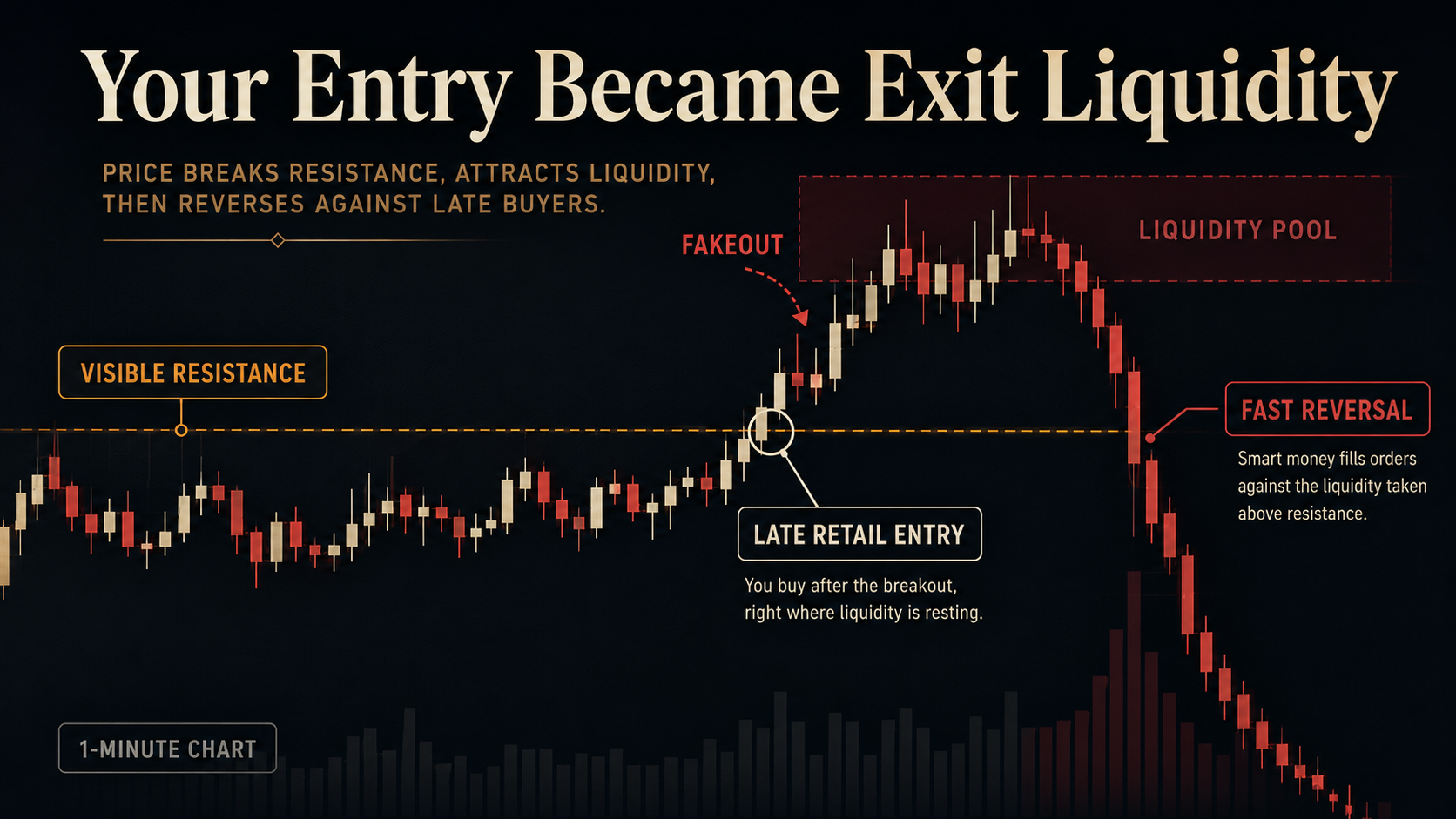
They intentionally push the price just above a highly visible resistance line. Retail traders see this breakout and are immediately hit by FOMO. The retail crowd rushes in to buy, injecting fresh liquidity into the market.
At that exact moment, the institution unloads their massive sell orders into the buying frenzy. Your eager entry is their perfect exit. Once their orders are filled, the buying pressure vanishes, and the price collapses, crushing retail margins in the process.
If this fakeout usually catches you after the candle already looks safe, read Why Do I Always Enter Late in Crypto Trading. That article explains how lagging indicators, visual confirmation, and FOMO push retail traders into the move after the clean entry is already gone.
The Anatomy of a Trap: A 1-Minute Chart Autopsy
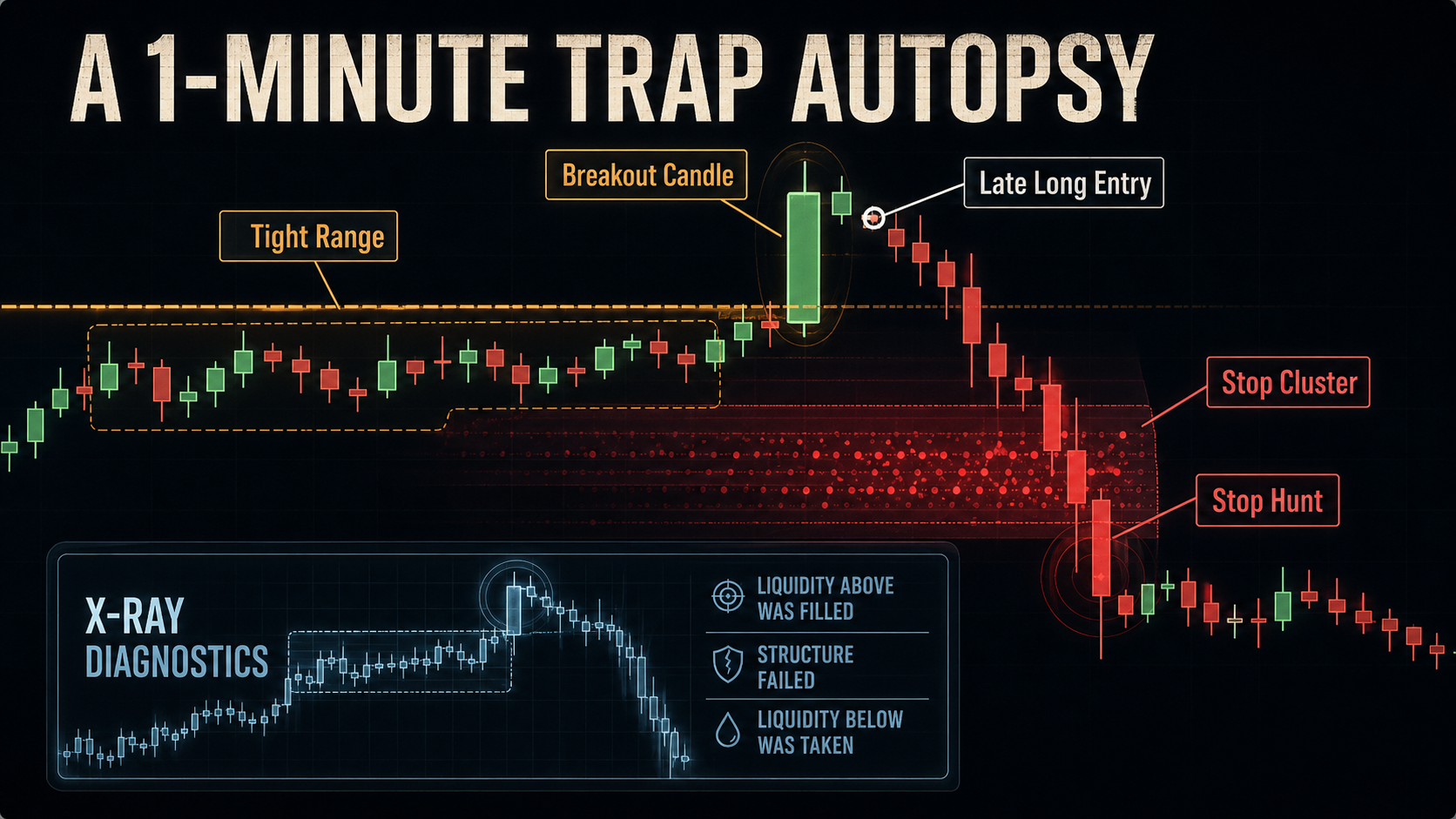
Let’s break down exactly what happens to your screen during these manipulated events. You are watching a 1-minute chart. The price has been consolidating in a tight range for hours. Suddenly, volume spikes. A massive bullish candle closes decisively above the resistance line.
Your standard retail indicators—like the RSI and MACD—are all flashing strong buy signals. You enter a long position with 20x leverage, placing your stop-loss just below the breakout candle.
What you don’t see is the institutional Order Book. The “breakout” was fueled by institutional buying, deliberately engineered to trigger retail breakout alerts. Once the price crosses the resistance, millions of dollars in retail buy orders flood in. The institution immediately flips their position, selling directly into your buying pressure. The next 1-minute candle is a catastrophic red spike downwards. The price doesn’t just fall; it accelerates specifically to hunt the dense cluster of stop-losses—including yours.
If the reversal usually hits your stop before price moves in the original direction, read Why Do I Get Stopped Out Before the Price Moves. That article breaks down how obvious stop-loss zones become liquidity pools before the real move begins.
The Revenge Trading Cycle: How They Drain Your Account
What happens immediately after your stop-loss is hit? The psychological damage kicks in. You watch the price drop, grab your liquidity, and then—infuriatingly—it often reverses again and goes in your original direction.
This creates a dangerous emotional state. You feel cheated by the market, leading directly to revenge trading. You re-enter the market out of anger, usually with a worse entry price, wider stop-loss, or even higher leverage.
Smart Money anticipates this exact emotional response. They know that a trapped trader is an irrational trader. By creating these violent, sudden reversals, they don’t just take your money once; they break your psychological discipline, ensuring you will make a series of fatal errors in the next 15 minutes. You are fighting a highly calculated algorithm with pure, blind emotion.
The Blind Spot: Why Standard Retail Tactics Always Fail
The reason you keep falling for this trap is that retail trading education trains you to look at the surface of the chart. You are taught to trade patterns, but you are not taught to read the underlying mechanics.
To survive, you need X-Ray Diagnostics. While an amateur sees a bullish breakout, a professional uses X-Ray Diagnostics to analyze the volume and structural depth, instantly recognizing it as an institutional trap.
If you don’t know how to identify the subtle signs of a Momentum Reclaim—where the price quickly snaps back below the fakeout level—you will forever be the victim of these liquidity hunts. The market will always seem to reverse the exact second you enter because your entry signals are literally designed by the market makers to trap you.
Stop guessing if the next sudden green candle is a genuine market shift or an institutional trap. Relying on basic retail patterns will only continue to drain your margin. You need a structured system that reads the institutional footprint before you click.
For a faster pre-click filter before entering a sudden move, read 1-Minute Crypto Scalping Strategy. That page shows how structure, reaction, invalidation, and no-click rules should come before fast execution.