BTC broke the level with a strong candle.
The move looked clean enough to chase.
The breakout was visible. The candle had range. The chart finally looked clear.
That was the trap.
Late buyers entered after the clean risk area was already gone. BTC stopped holding above the boundary, slipped back under the level, and turned the breakout into a failed move.
The trade did not fail because BTC scalping is impossible.
It failed because the entry came after visual certainty appeared.
In BTC scalping, the candle that looks the most convincing is often the candle that brings late traders into the worst part of the move. The breakout itself is only the first event. The real information comes after BTC tests whether it can hold the level.
A BTC scalping strategy should not be built around chasing the candle that breaks the line. It should be built around reading what BTC does around the boundary after the break.
A strong candle is not enough.
A level break is not enough.
The trade needs structure, boundary behavior, invalidation, and controlled risk before entry.
This article is for educational purposes only. It does not provide financial advice, trading signals, or guaranteed trading results.
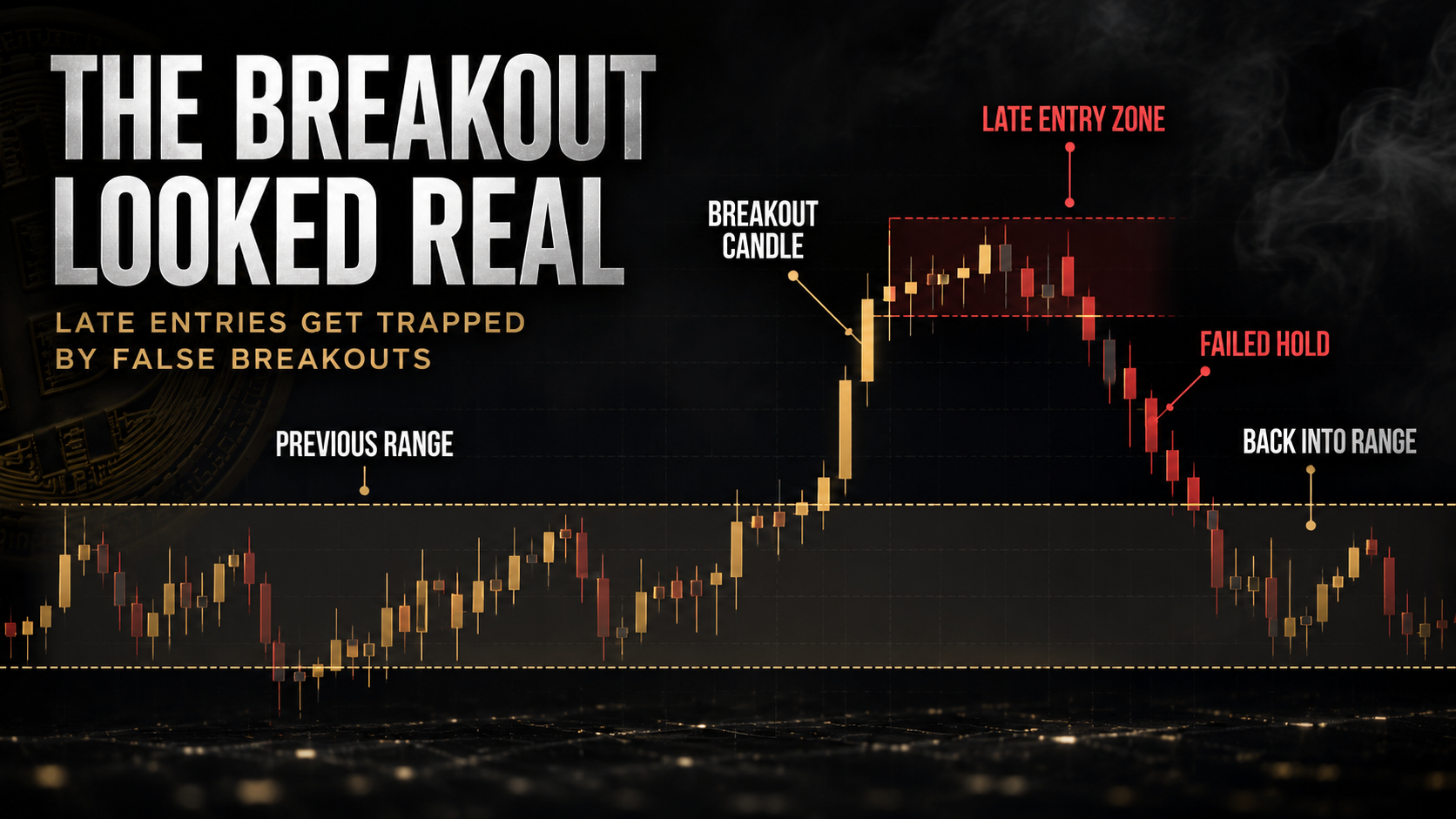
The Candle Looks Safe After the Best Entry Is Gone
The breakout candle gives traders comfort.
It removes uncertainty. It makes the move visible. It makes the chart look easier to read.
That comfort is expensive.
By the time BTC has already pushed through the level with a large candle, the entry is no longer close to the structure that created the idea. The trader is no longer positioned near the boundary. The trader is now entering after expansion.
The visual confirmation comes late.
The risk becomes wider.
The invalidation becomes less clean.
A late entry after a BTC breakout often feels safer because the trader can finally see the move. In reality, the trade may already have a worse risk profile.
BTC does not need to reverse aggressively to punish that entry. It only needs to stop pushing, pause near the level, or slip back into the previous range.
For a scalper, that can be enough.
The late entry was not late because the trader was slow. It was late because the trader waited for the wrong type of confirmation.
If this keeps happening because you wait until the candle looks safe, read Why Do I Always Enter Late in Crypto Trading. That article explains how lagging indicators, visual confirmation, and FOMO push traders into the move after the clean entry is already gone.
The Trap Starts When BTC Fails to Hold the Level
A breakout is only a price event.
BTC crossed the boundary.
That is all the breakout confirms.
It does not confirm that BTC accepted the level. It does not confirm that continuation has enough structure. It does not confirm that late entries still have clean risk.
The real test starts after the break.
BTC either holds above the boundary, builds acceptance, and gives the market a reason to continue, or it fails back under the level and exposes the breakout as a trap.
A false breakout usually starts with something that looks right.
Price breaks the level. The candle expands. Late traders enter. Then the market stops rewarding the breakout. Price struggles above the level, loses the boundary, and returns into the previous range.
At that moment, the breakout is no longer a clean continuation idea.
It becomes a failed acceptance event.
This is where many BTC scalpers get trapped. They treat the crossing as confirmation, but the market is already showing that the level was not accepted.
If BTC breaks a visible level and then reverses after late traders enter, read Why Does Crypto Always Reverse When You Buy?. That article breaks down how fakeouts, liquidity pools, and late retail entries turn obvious breakouts into exit liquidity.
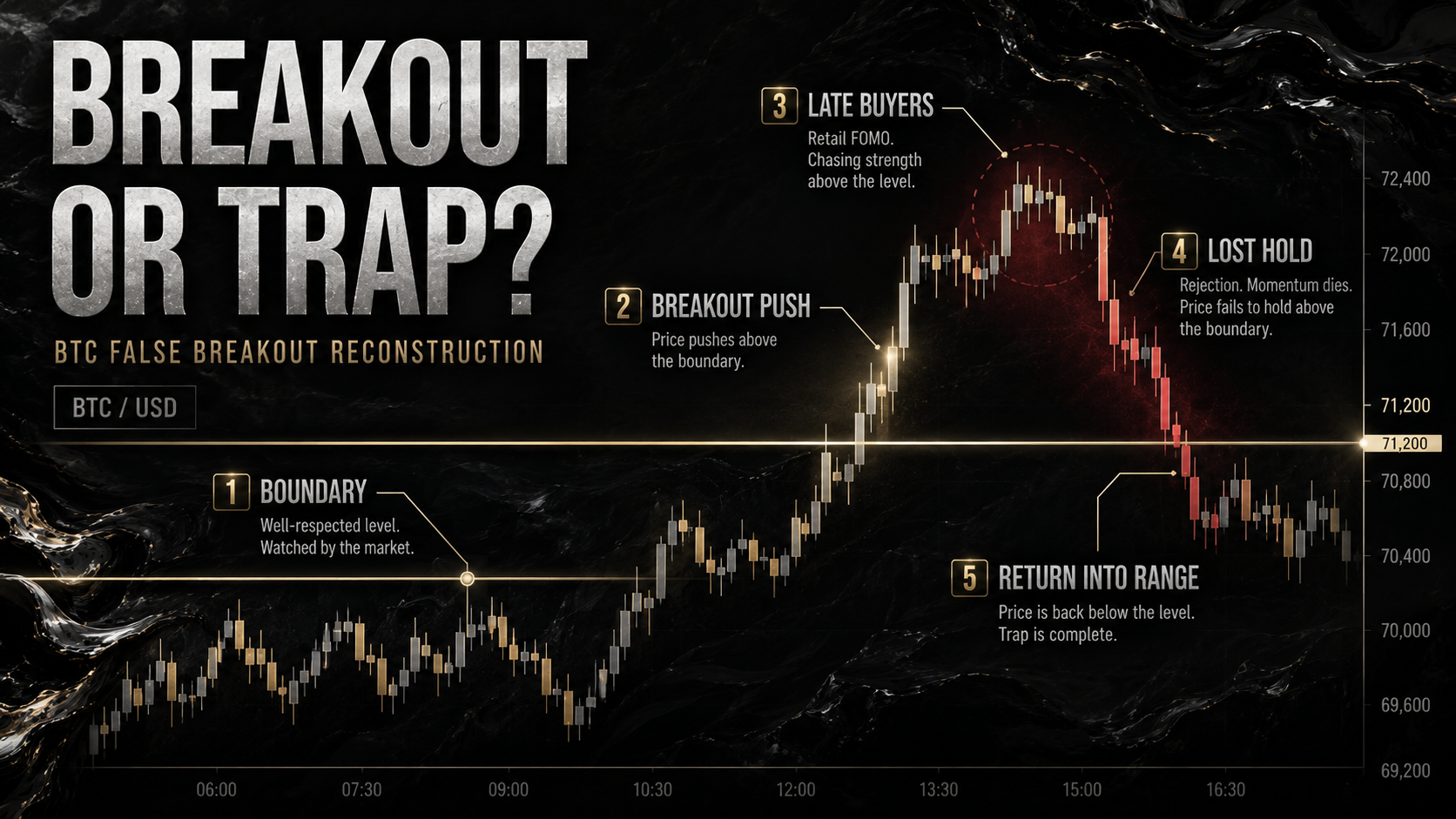
Late Entry Turns Normal Noise Into Immediate Pressure
BTC scalping is sensitive to entry location.
A few candles can change the entire trade.
An entry near the structure gives the trader a clearer invalidation area. An entry after expansion often forces the trader into a worse choice.
A tight stop may be too close for normal BTC movement.
A wider stop may create too much loss for a short scalp.
No stop at all turns a scalp into emotional exposure.
If the trade direction was right but the stop was swept before BTC moved, read Why Do I Get Stopped Out Before the Price Moves. That article explains how obvious stop-loss zones become liquidity pools before the real move begins.
The late entry creates the problem before the trade even has time to develop.
This is why chasing BTC breakouts feels so dangerous after the fact. The trader enters when the move looks strongest, but the position is already far from the cleanest decision point.
The candle did not create edge.
The candle created pressure.
Once BTC stalls after the breakout, the late trader is already uncomfortable. The chart no longer needs to collapse. It only needs to fail to continue.
That is often enough to expose the bad entry.
The Boundary Is the Real Scene of the Trade
The boundary is where the useful information appears.
Not the middle of the impulse.
Not the top of the breakout candle.
Not the point where social media starts calling the move obvious.
The boundary.
At a range high, BTC can break and hold above the level. That creates one type of situation.
At the same range high, BTC can break and fail back inside. That creates a completely different situation.
At a range low, BTC can break down and continue, or it can reclaim the range and trap late sellers.
The line itself is not the trade.
The behavior around the line is the trade.
A professional BTC scalping strategy treats support, resistance, range highs, and range lows as decision areas. They are not automatic entries. They are places where the market reveals acceptance, rejection, or failure.
The trader who only sees the candle is late.
The trader who reads the boundary has more control.
The Fast Candle Is Usually the Warning, Not the Entry
A fast BTC candle makes the setup look urgent.
It also hides the fact that the trade may already be late.
The candle can mark momentum, but momentum alone does not define risk. It does not prove that BTC will hold above the level. It does not show where the idea is invalid. It does not protect the trader from a failed breakout.
The fast candle is information.
It is not permission.
A useful scalp begins before the candle looks obvious. BTC approaches a structure. Price tests a boundary. The market shows whether that area is being accepted or rejected. Only then does the trader have something to evaluate.
If the fast candle breaks the level and BTC holds, the situation may still be worth studying.
If the fast candle breaks the level and immediately fails, the same candle becomes evidence of a trap.
The candle is not enough by itself.
The reaction around the boundary decides what the candle means.
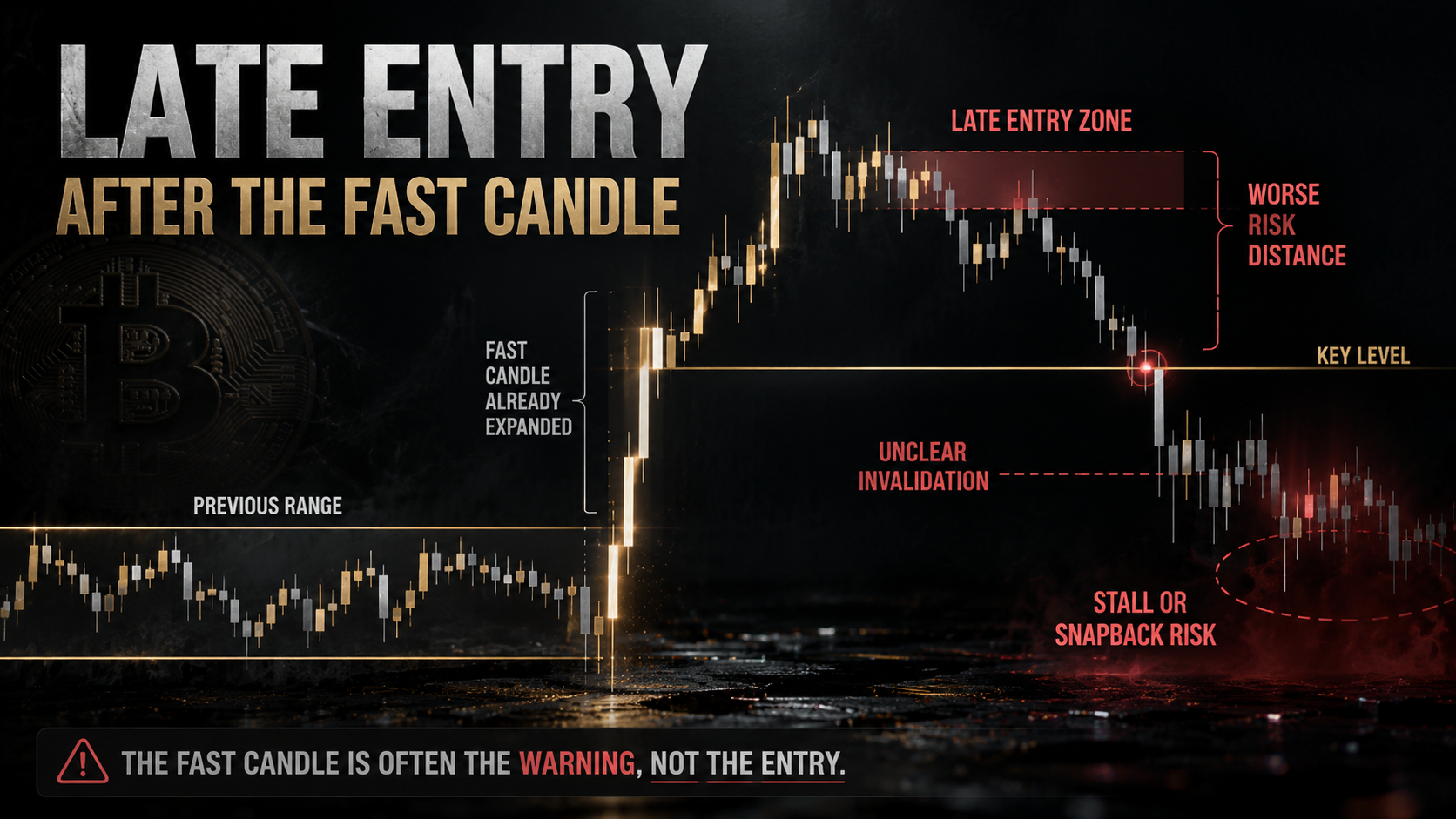
False Breakouts Flip the Pressure Against Late Traders
A false breakout does not only invalidate a weak continuation idea.
It changes who is under pressure.
Before the failure, late buyers believe they are entering strength. After BTC falls back under the level, those same buyers are trapped above the boundary.
Their entry is now sitting in the wrong place.
The market has moved back into the previous range.
The breakout no longer supports them.
This is why the return under the level matters. It is not just a small pullback. It is evidence that BTC could not hold the area that late traders used as confirmation.
A failed breakout can pull price back quickly because the breakout side loses confidence. Late entries exit, stops trigger, and the move that looked like strength becomes a return into the range.
BTC scalping is not about predicting every fakeout.
It is about recognizing when the breakout no longer has acceptance.
The trap becomes visible when BTC fails to hold the boundary.
The Clean Risk Area Usually Appears Before the Candle Looks Obvious
The best risk location is rarely where the chart looks the most exciting.
It usually appears earlier.
Before the large breakout candle.
Before the crowd sees confirmation.
Before the move becomes visually comfortable.
This is the uncomfortable truth of BTC scalping. Clean setups often require the trader to read structure before the move is obvious. Late traders wait for certainty and receive worse risk in exchange.
The market charges for comfort.
That cost appears as wider invalidation, worse entry location, and less room for continuation.
A trader who enters only after the candle looks obvious may feel safer, but the trade is often weaker.
A trader who understands the structure can see where the risk was cleaner before the candle expanded.
That does not mean entering early without confirmation.
It means understanding the sequence:
Structure first.
Boundary test second.
Hold or fail third.
Entry decision after behavior appears.
Chasing after expansion is not discipline. It is fear of missing out dressed up as confirmation.
A Better BTC Scalping Sequence
A better BTC scalping strategy follows the market behavior around the level.
Previous structure sets the context.
The boundary test creates the decision area.
Hold or fail tells the trader what the breakout actually did.
The entry decision comes only after the market shows enough behavior.
Invalidation defines where the idea is wrong.
Risk control decides whether the trade is still worth taking.
This sequence keeps the trader from reacting to the most dramatic candle on the chart.
It also prevents the most common late-entry mistake: entering because the breakout looks obvious, not because the risk is still clean.
When BTC breaks and holds above a level, the trader has one story to evaluate.
When BTC breaks and fails back into the range, the trader has a different story.
When BTC only touches a level and does nothing clear, there may be no trade at all.
A scalp does not need constant action.
It needs a clean reason.
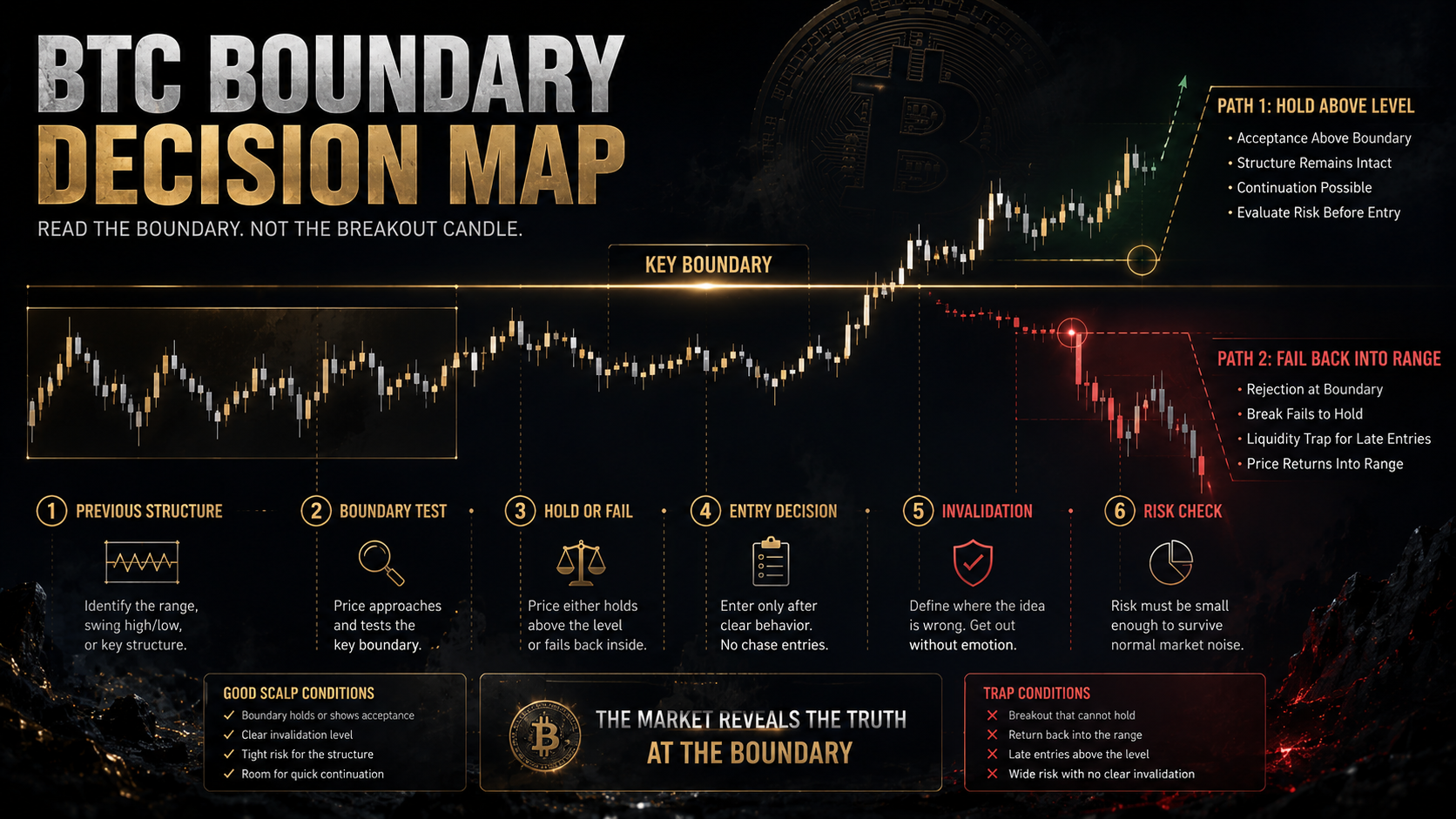
Where the Scalping Mistake Becomes Obvious
The mistake becomes obvious only after the trade starts failing.
Before entry, the candle looked convincing.
During entry, the trader felt late but still confident.
After entry, BTC stopped holding the level.
Then the structure changed.
This is why the error feels frustrating. The trade did not look stupid at the moment of entry. It looked logical. It had movement. It had a level break. It had excitement.
But it did not have acceptance.
That missing piece is what turns many BTC scalps into traps.
The trader who only reacts to the breakout candle sees strength.
The trader who reads the boundary sees whether that strength survives.
That is the difference between a chase and a scalp.
The Final Rule for BTC Scalping
Do not treat the candle that breaks the level as the full trade.
Treat it as the beginning of the test.
BTC still has to show whether the level is accepted or rejected. A breakout that holds above the boundary creates one condition. A breakout that fails back into the range creates another.
The late-entry trap forms when traders enter after the candle looks obvious but before BTC proves it can hold the level.
The breakout looked real because the candle crossed the boundary.
The trap became real when BTC failed to stay there.
A strong BTC scalping strategy is not built around chasing the breakout candle. It is built around reading boundary behavior, defining invalidation, and refusing entries that only look safe because the clean risk area has already passed.