The Most Infuriating Experience in Trading
It is a scenario every crypto trader knows intimately. You spend hours analyzing the chart. You identify a perfect setup. The trend is clear, the support level is holding, and you execute your entry flawlessly. Being a disciplined retail trader, you calculate your risk and place your Stop Loss exactly where the textbook tells you to: just below the support line.
You step away from the screen, confident in your analysis. When you check your account an hour later, you are greeted by a devastating reality.
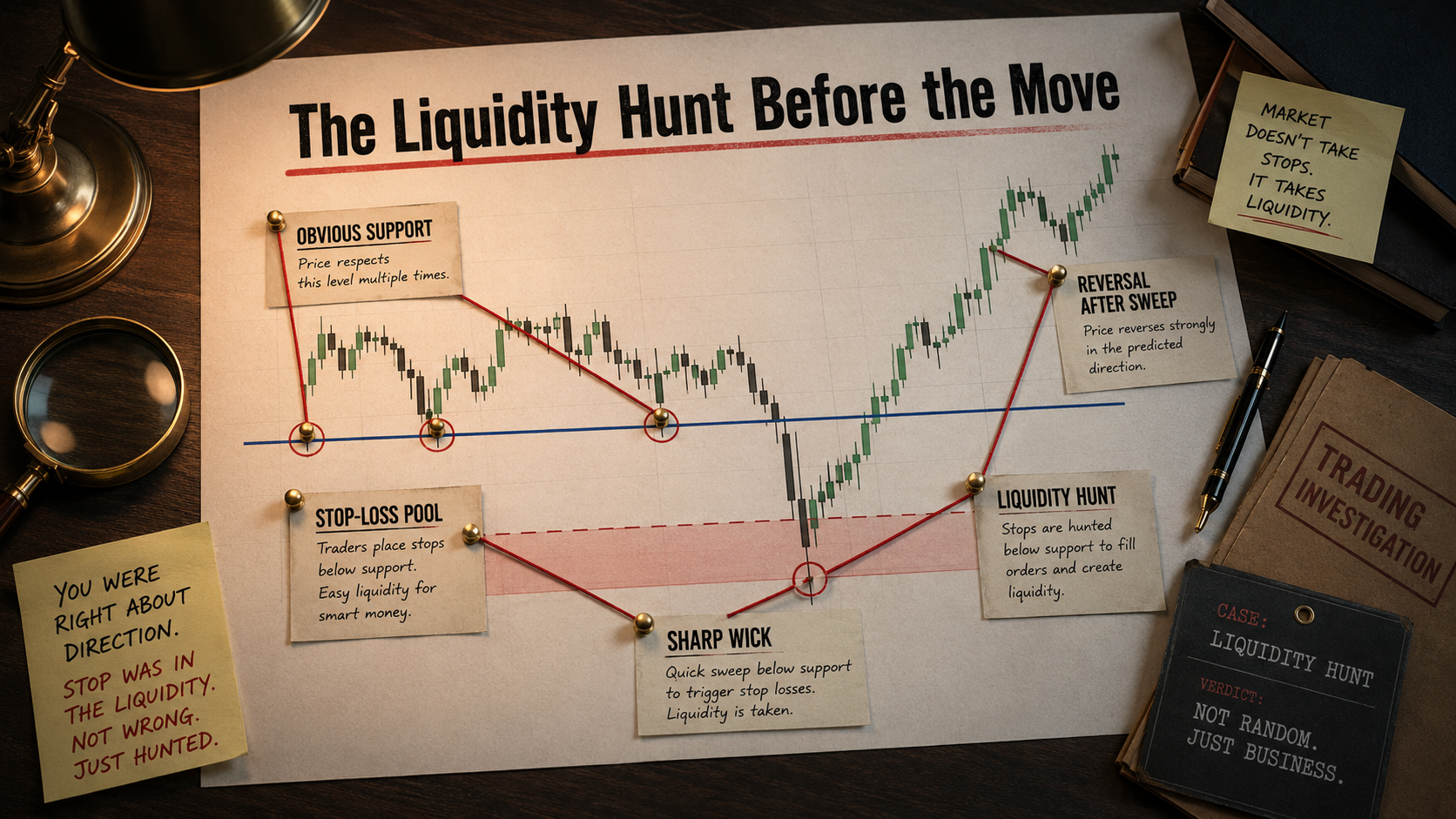
Your Stop Loss was triggered. You took the loss. But that is not the worst part. You look at the chart and see that immediately after your Stop Loss was hit by a single, sharp wick, the price violently reversed and skyrocketed exactly in the direction you predicted.
You were absolutely right about the market direction. Your analysis was flawless. Yet, you lost money, and you are not on the train for the massive profit run. You are left staring at the screen, shouting the ultimate trader’s question: “Why do I always get stopped out right before the price moves?”
You feel like the exchange is watching your specific account. You feel like the market is personally manipulating the price just to take your hundred dollars. It is not personal, but it is highly targeted. You are the victim of a systemic Liquidity Hunt.
The Flaw in “Textbook” Support and Resistance
The root of this problem lies in retail trading education. You have been taught to identify obvious visual boundaries—support lines, resistance lines, and trendlines. You are taught that if the price breaks below support, the trade is invalidated, so you should place your Stop Loss right below that line.
The problem is that millions of other retail traders are reading the exact same textbooks and looking at the exact same charts. You are all placing your Stop Loss orders in the exact same narrow price zone.
What is a Stop Loss for a Long position? It is an automated Market Sell order.
When millions of retail traders place their Sell orders in the same zone just below a support line, they create a massive, concentrated pool of liquidity. In the eyes of Smart Money, this is not a boundary of invalidation; this is a target.
How Smart Money Manufactures the Wick
To understand why you get stopped out, you must think like an institutional algorithm. Institutions do not trade with small retail accounts. They need to fill orders worth millions of dollars.
If Smart Money wants to build a massive Long position, they have a critical problem: they cannot just buy at the current market price. If they do, their massive demand will instantly push the price up before their order is fully filled, destroying their own average entry price.
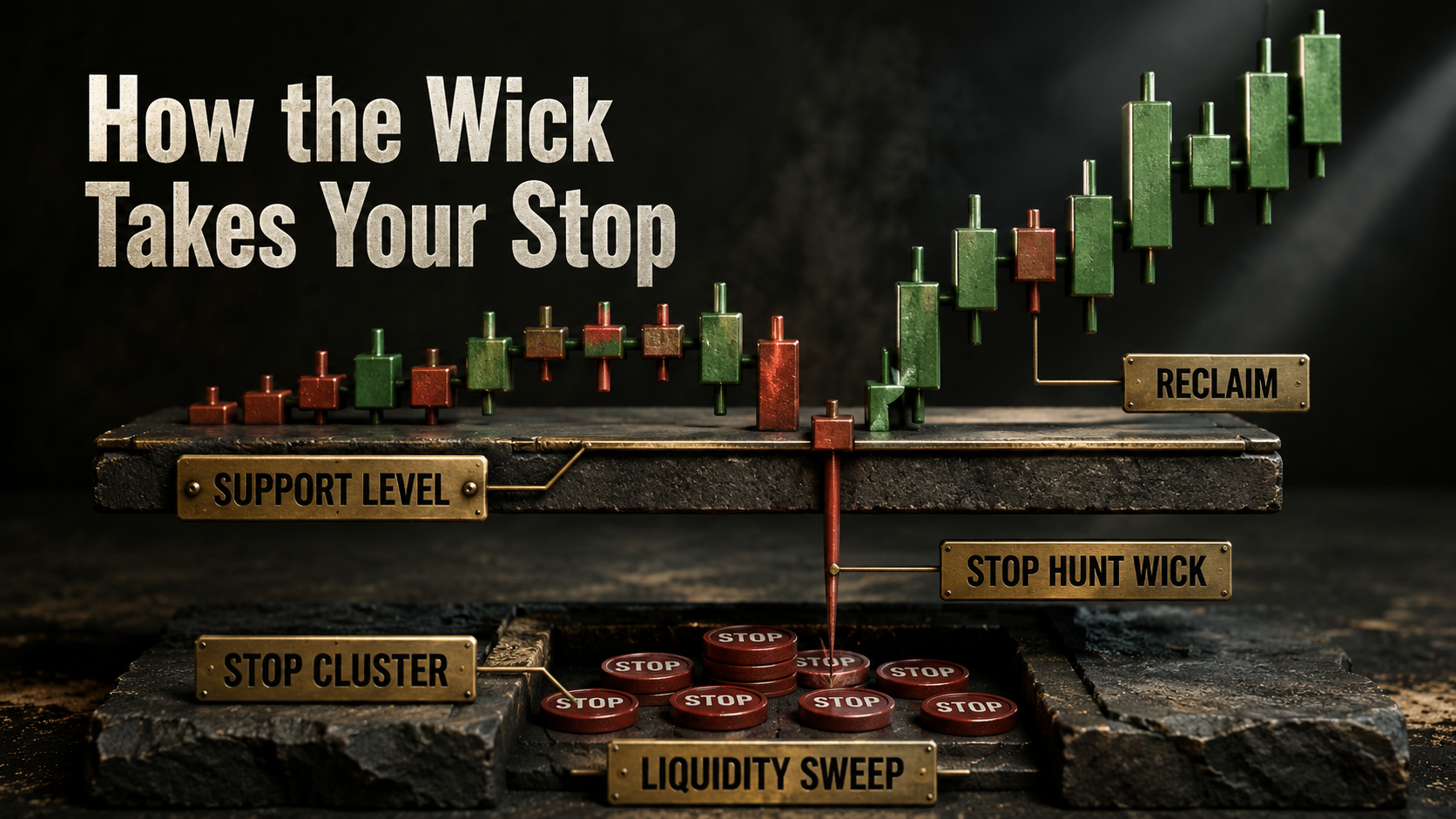
To buy millions of dollars of an asset without moving the price up, they need an equal number of sellers. Where can they find a massive, guaranteed cluster of Sell orders? Right below the retail support line—your Stop Loss pool.
The mechanism is brutally efficient. The institution intentionally exerts short-term selling pressure to push the price down through the support line. This is known as a Liquidity Sweep or a Stop Hunt.
The moment the price crosses that line, a chain reaction occurs. Retail Stop Losses are triggered. Thousands of automated Sell orders flood the market. At that precise fraction of a second, the institution stops selling and flips to buying, absorbing all of those retail Sell orders to fill their massive Long position.
Once their institutional bags are full, they stop suppressing the price. The massive buying pressure causes the price to instantly snap back up, leaving behind nothing but a long wick on the candlestick. Your perfectly calculated Stop Loss was the exact liquidity they needed to fuel their parabolic run.
To understand why a planned stop can still fail during fast leverage conditions, read Crypto Liquidation vs Stop Loss. That article explains why a stop loss is a planned exit, while liquidation is a forced surrender.
The Inducement Trap: Tricking You Into Providing Liquidity
Sometimes, the market will actually create artificial support levels specifically to build these liquidity pools. This is known as Inducement.
Market makers will intentionally allow the price to bounce off a specific level two or three times. This creates a highly visible, compelling support level. Retail traders see this “strong” support, gain confidence, and heavily layer their Stop Losses just below it.
The market makers are literally inducing you to enter the market and place your stops where they want them. Once the pool is large enough, they engineer the violent downward spike, sweep the liquidity, and then initiate the real directional move. You were tricked into acting as the exit liquidity for their entry.
The Psychological Devastation and the Wrong Lesson
Being stopped out right before a massive winning move is psychologically more damaging than being completely wrong about the market direction. When you are completely wrong, you accept the loss and move on. When you are right but still lose, you feel cheated.
This leads to the most dangerous retail mistake: abandoning risk management.
Traders who repeatedly suffer from Stop Hunts often conclude that Stop Losses are the problem. They decide to trade “naked” without a Stop Loss, believing they can manually exit if things go wrong.
Smart Money algorithms anticipate this exact behavioral shift. The next time the price drops, it will not be a quick sweep; it will be a true structural breakdown. Because the trader removed their Stop Loss, they will hold the position all the way down to a catastrophic Liquidation. You cannot solve a structural problem by removing your only safety net.
Changing the Paradigm: How to Survive the Hunt
If you want to stop being the victim of the Stop Hunt, you have to stop placing your orders where retail liquidity clusters. You cannot use obvious retail patterns to survive in an institutional environment.
The solution is not to stop using Stop Losses. The solution is to change your entry criteria. Stop trying to buy the obvious support line. Instead, wait for the Liquidity Sweep to happen.
Professional traders look for the exact moment the retail Stop Losses are triggered. They wait for the price to drop below support, grab the liquidity, and quickly reclaim the level. They enter the market alongside the Smart Money, using the very Stop Hunt that used to destroy them as their ultimate confirmation signal.
If the stop hunt begins with a fake breakout first, read Why Does Crypto Always Reverse When You Buy?. That article breaks down how late retail entries become liquidity during failed breakouts.
You must learn to read the institutional footprint and identify where the true liquidity lies. Stop trading the lines on the chart, and start trading the mechanics of the order book. Until you stop placing your stops in the engineered liquidity pools, you will always be the fuel for the moves you correctly predicted but failed to profit from.