The Frustration of the Late Click
It is the most universal and infuriating experience in cryptocurrency trading. You sit in front of your screen, watching a chart consolidate. You have identified a potential setup, but you want to be safe. You decide to wait for “confirmation.” You watch as a green candle begins to form. You tell yourself not to chase it, waiting for your indicators to align.
The price keeps pushing higher. Your Moving Averages finally cross. Your RSI breaks above the midline. Every retail condition for a “safe” entry is met. The momentum looks unstoppable. You finally succumb to the fear of missing out and click “Buy.”
Almost immediately, the momentum dies. The chart stalls. The next candle is a brutal red wipeout that instantly puts your position underwater. You didn’t buy the start of the trend; you bought the absolute top. You are left staring at the screen, asking yourself the same agonizing question: Why do I always enter late?
The answer is not that your reaction time is slow, nor is it that you are simply unlucky. You enter late because the entire framework of retail trading education is mathematically designed to make you the last person to the party. You are operating on a delayed timeline deliberately constructed by Smart Money.
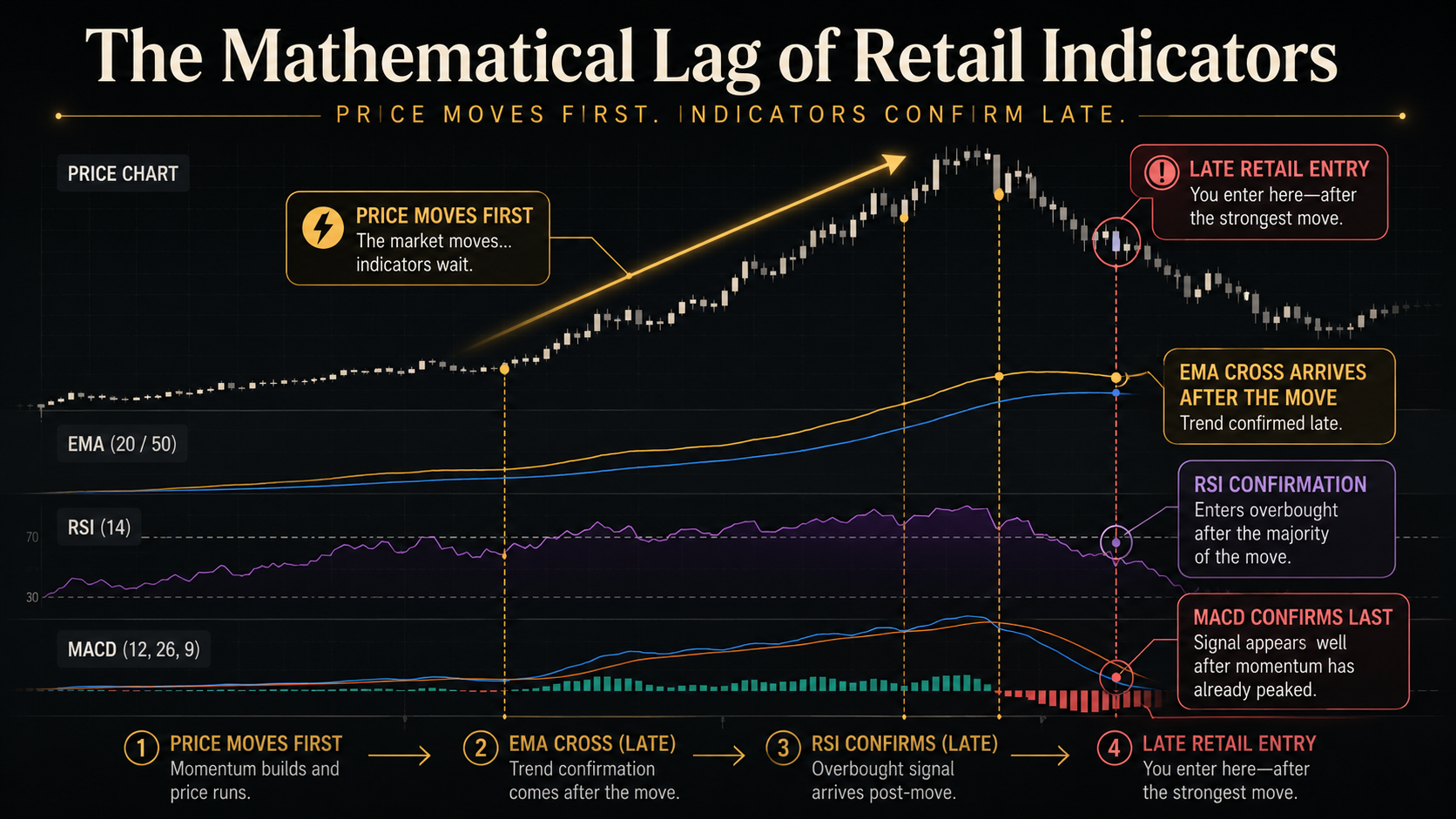
The Mathematical Lag of Retail Indicators
To understand your late entries, you must first understand the tools you are using to make decisions. The vast majority of retail traders rely on derivative indicators: Moving Averages (SMA, EMA), the MACD, the RSI, and Bollinger Bands.
What is the fundamental mathematical reality of these tools? They are inherently lagging.
An indicator does not predict the future; it averages the past. An Exponential Moving Average (EMA) cross only happens after the price has already made a significant directional move. By the time the MACD histogram shows strong bullish momentum, the underlying price action has already surged.
When you wait for these indicators to give you “confirmation,” you are not waiting for a signal to enter; you are waiting for a historical summary of a move that has already occurred. You are essentially trying to drive a car by only looking in the rearview mirror. Smart Money algorithms do not use the MACD to decide when to buy. They use raw liquidity and order flow. They are initiating the move, while your indicators are just waking up to report it.
The Illusion of Confirmation
The concept of “waiting for confirmation” is the most dangerous psychological trap in retail trading. You are taught that waiting for a candle to close above resistance reduces your risk. In reality, in a highly leveraged and manipulated market like crypto, waiting for visual confirmation often maximizes your risk.
When a massive breakout candle closes, it creates an illusion of safety. The chart looks decisively bullish. However, you must ask yourself: Who is selling to you right now?
Institutions accumulate their positions quietly during periods of boring, sideways consolidation. They buy when the chart looks weak, ugly, or entirely directionless. When they are ready to mark the price up, they engineer a sudden burst of volatility.
By the time the visual confirmation is so obvious that even the most hesitant retail trader feels safe enough to enter, the move is mature. The institutions have achieved their objective. They now have a massive, profitable position that they need to unload. To sell millions of dollars of an asset without crashing the price, they need a massive influx of late buyers.
Your late, “confirmed” entry is precisely the liquidity they require to execute their exits. You are not joining a new trend; you are providing the exit liquidity for the Smart Money that bought the bottom.
If this late entry usually happens after a breakout candle, read Why Does Crypto Always Reverse When You Buy? That article breaks down why obvious entries often become exit liquidity.
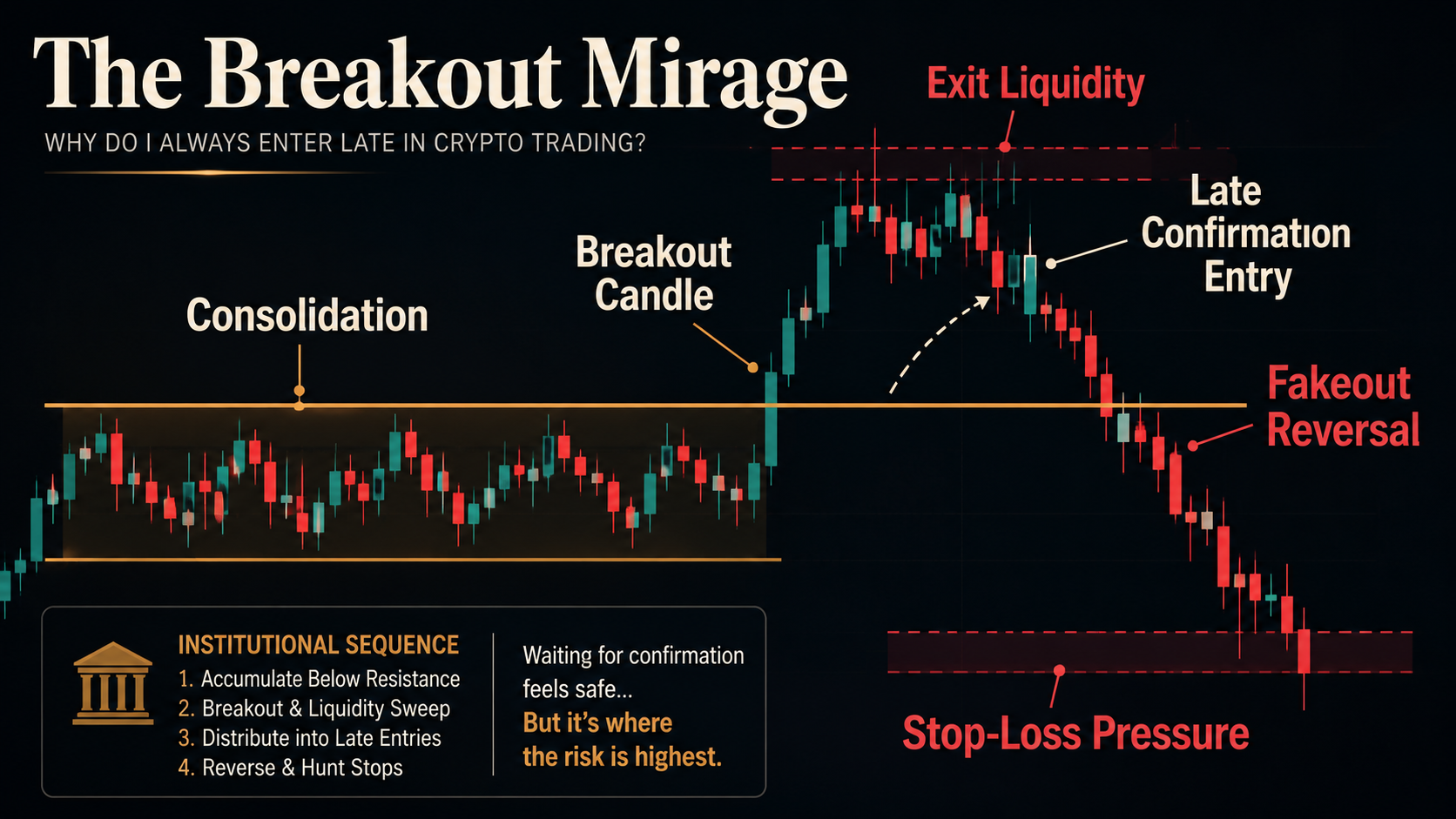
The Case Study: The Breakout Mirage
Let us break down a typical scenario on a 15-minute chart. Bitcoin has been ranging between $60,000 and $61,000. It suddenly spikes and breaks through $61,000.
A professional analyst using institutional structures might have anticipated this by reading the liquidity sweeps at $59,800. They are already in the trade.
You, however, are waiting for confirmation. You wait for the 15-minute candle to close above $61,000. The candle closes strongly at $61,200. Your lagging indicators finally flip bullish. You feel confident and enter a long position at $61,250.
What is actually happening in the Order Book? The initial push from $61,000 to $61,200 was driven by institutional algorithms triggering the stop-losses of early short sellers. This creates a forced buying cascade. Once the short-sellers are liquidated, the buying pressure evaporates.
Because you waited for the candle to close, your entry at $61,250 is placed exactly where the institutional buying stops and their profit-taking begins. The market makers immediately begin fading the move, absorbing your late buy orders with their sell walls. The price drops back to $60,800, creating a Fakeout. Your late entry placed your stop-loss in a highly vulnerable position, resulting in an almost immediate, calculated loss.
The Psychological War: Hesitation and FOMO
Entering late is not just a technical failure; it is a psychological sequence that market makers exploit flawlessly. The cycle always plays out in two distinct emotional phases: Hesitation and FOMO (Fear of Missing Out).
During the initial phase of a true move, the market structure often looks ambiguous. The price action might seem choppy. This is by design. Smart Money creates localized uncertainty to shake out weak hands. During this phase, you hesitate. You tell yourself the market is too unpredictable and that you need more data.
Then comes the aggressive expansion. A massive green candle prints on the chart. Your hesitation instantly transforms into panic. You watch your potential profits evaporating tick by tick. The pain of missing the trade overwhelms your risk management protocols. Your brain demands that you participate in the rally.
You click buy. But you are not buying a logical setup; you are buying emotional relief. You are paying a premium to relieve the anxiety of being left behind. Market algorithms are explicitly programmed to identify and exploit this exact acceleration in retail buying volume. They measure your FOMO and use it as the trigger to initiate a violent reversal.
Shifting the Paradigm: How to Stop Being the Exit Liquidity
If you want to stop entering late, you must completely discard the retail trading paradigm. You must stop trading derivatives of price and start trading the underlying structure.
This requires a fundamental shift in how you read a chart. You must stop asking, “What are my indicators telling me?” and start asking, “Where is the liquidity?”
Instead of waiting for a lagging MACD crossover, you must learn to identify institutional footprints. This involves mastering X-Ray Diagnostics—the ability to look beneath the surface of a candle and understand the order flow that created it.
You must learn to recognize a Momentum Reclaim, understanding when a sudden drop is not a trend reversal, but a deliberate Liquidation Sweep designed to gather the necessary volume for a major upward expansion.
For the broader execution framework behind BTC scalping, read BTC Scalping Strategy. That page explains why late entries, false breakouts, and weak invalidation often matter more than the raw win rate number.
Professionals do not wait for the chart to look safe. They enter when the institutional structure aligns, often when the chart looks the most terrifying to a retail trader. They buy the manipulation, whereas retail traders buy the illusion of confirmation. Until you learn to read the market through the lens of liquidity rather than lagging indicators, you will forever remain trapped in the cycle of the late entry, endlessly funding the profits of those who entered first.