Binary options trading signals can look simple.
A message appears.
A direction is given.
A short expiry time is attached.
The trader feels that the decision has already been made for them.
That is exactly why these signals are dangerous when used without filters.
A fast call can create pressure. It can make the trader feel that there is no time to think, no time to check structure, and no time to question the source. The trade becomes less about decision-making and more about reaction.
That is not disciplined trading.
Before following any binary options trading signal, a trader should slow down and check the red flags.
This article is for educational purposes only. It does not provide financial advice, trading signals, or guaranteed trading results.
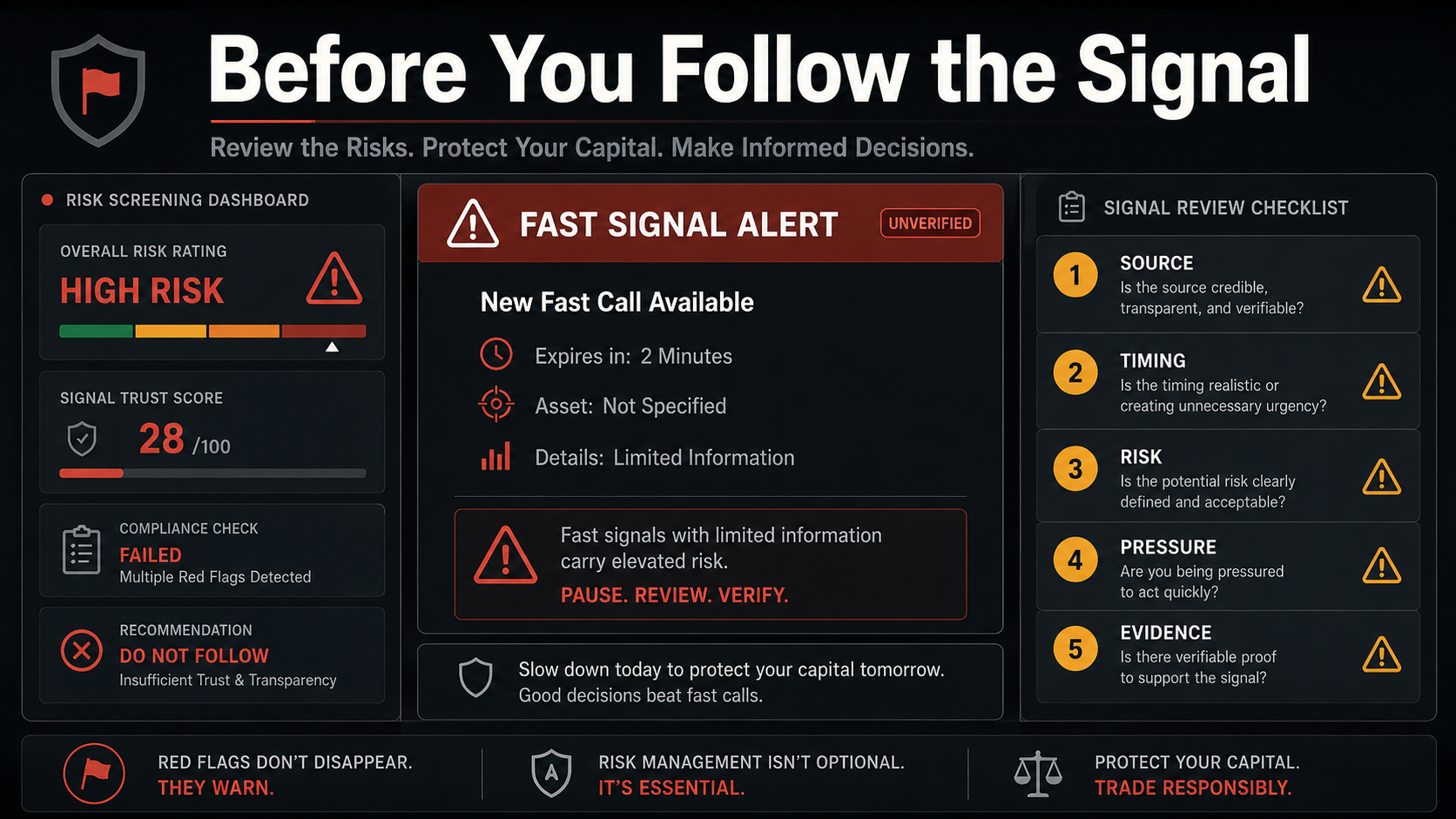
Why Fast Trading Signals Feel So Persuasive
Fast signals work because they reduce thinking time.
The trader does not have to build a trade idea. The signal has already created one.
This can feel comfortable, especially for beginners who are still learning market structure, price action, risk control, and timing.
But comfort can become dependency.
When a trader follows signals without understanding the setup, several problems appear:
- The trader does not know why the trade exists.
- The trader does not know when the idea is wrong.
- The trader cannot evaluate the quality of the entry.
- The trader reacts emotionally after a loss.
- The trader may follow the next signal just to recover.
A signal may look like guidance.
But if it removes your ability to think, it becomes a risk.
The first question should never be:
“Is this signal going to win?”
The better question is:
“Can I understand why this signal exists?”
If the answer is no, the trader is not making a decision.
They are outsourcing the decision.
Red Flag 1: The Signal Uses Too Much Urgency
Urgency is one of the biggest red flags in binary options trading signals.
Common phrases include:
- Enter now
- Last chance
- Immediate entry
- Do not miss this
- Only 30 seconds left
- Follow exactly
- No time to think
Fast trading already creates pressure. A signal provider who adds even more pressure may be pushing the trader into emotional action.
A serious setup should still be understandable after a few seconds of analysis.
If a trade idea only works when the trader has no time to think, the signal may not be built on structure. It may be built on impulse.
Before following a fast call, ask:
“Why does this trade need to be taken immediately?”
If the only answer is urgency, that is not enough.
Red Flag 2: The Signal Does Not Explain Structure
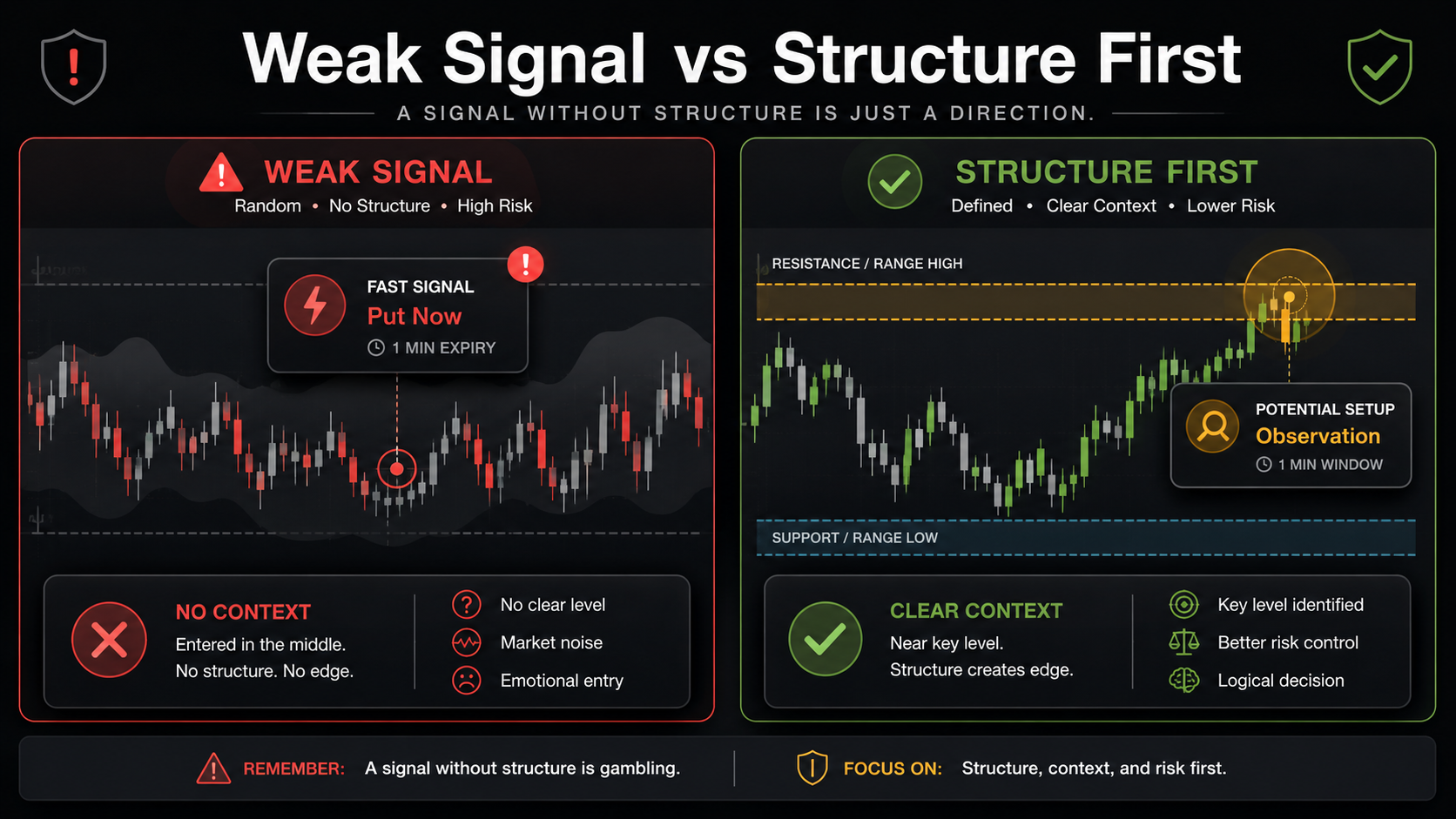
A trading signal without structure is only a direction.
For example:
“Call now.”
“Put now.”
“Buy here.”
“Sell here.”
This tells the trader what to do, but it does not explain why.
A cleaner signal should at least be connected to structure:
- Is price near support or resistance?
- Is price inside a range?
- Is price testing a boundary?
- Is price reacting after a breakout?
- Is price rejecting a level?
- Is momentum supporting the idea?
Without structure, the trader cannot judge quality.
The market may move in the suggested direction, but that does not mean the signal was good. A weak decision can still win sometimes. That is what makes bad habits dangerous.
A good result does not prove a good process.
Before following any binary options signal, ask:
“What market structure is this based on?”
If there is no clear structure, the signal is weak.
If the signal is based on fixed expiry timing but does not explain structure, read Fixed Time Trading Strategy. That article explains why short-duration trades should start with structure, reaction, and timing filters before the timer becomes important.
Red Flag 3: The Signal Promises High Accuracy
Any signal provider that focuses only on high win rate claims should be treated carefully.
Examples include:
- 90% accuracy
- 95% win rate
- Almost guaranteed
- Never lose
- Safe strategy
- Daily profit system
These claims are designed to create confidence before the trader asks questions.
But trading is not only about win rate.
A trader also needs to understand:
- How losses are handled
- How many signals are sent
- Whether results are verified
- Whether losing trades are hidden
- Whether the strategy changes after losses
- Whether position size is controlled
A high win rate claim without transparent context is not useful.
It may only show the result the provider wants the trader to see.
Before trusting a signal provider, ask:
“Do they show the full process, or only the wins?”
If only the wins are shown, that is a red flag.
Red Flag 4: The Risk Is Not Defined
Many signal providers focus on entry direction but ignore risk.
That is dangerous.
Even in fixed time trading, where the loss amount may be known before the trade, risk still matters. The trader can still overtrade, increase position size, chase losses, or follow too many signals in a short period.
A signal should not make the trader forget risk control.
Before following any fast call, define:
- How much can be lost on this trade?
- How many trades are allowed in one session?
- What happens after two losses?
- Is the position size fixed or emotional?
- Is the trader entering because of structure or pressure?
- Is the trader trying to recover a previous loss?
If the signal does not allow the trader to think about risk, it is not helping the trader.
It is only creating action.
The most important rule is simple:
Never let a signal decide your risk.
If a fast call makes you enter before checking structure, timing, and risk, read 1-Minute Trading Strategy. That page shows how short-term entries should be filtered before the click instead of followed blindly.
Red Flag 5: The Signal Encourages Recovery Trading
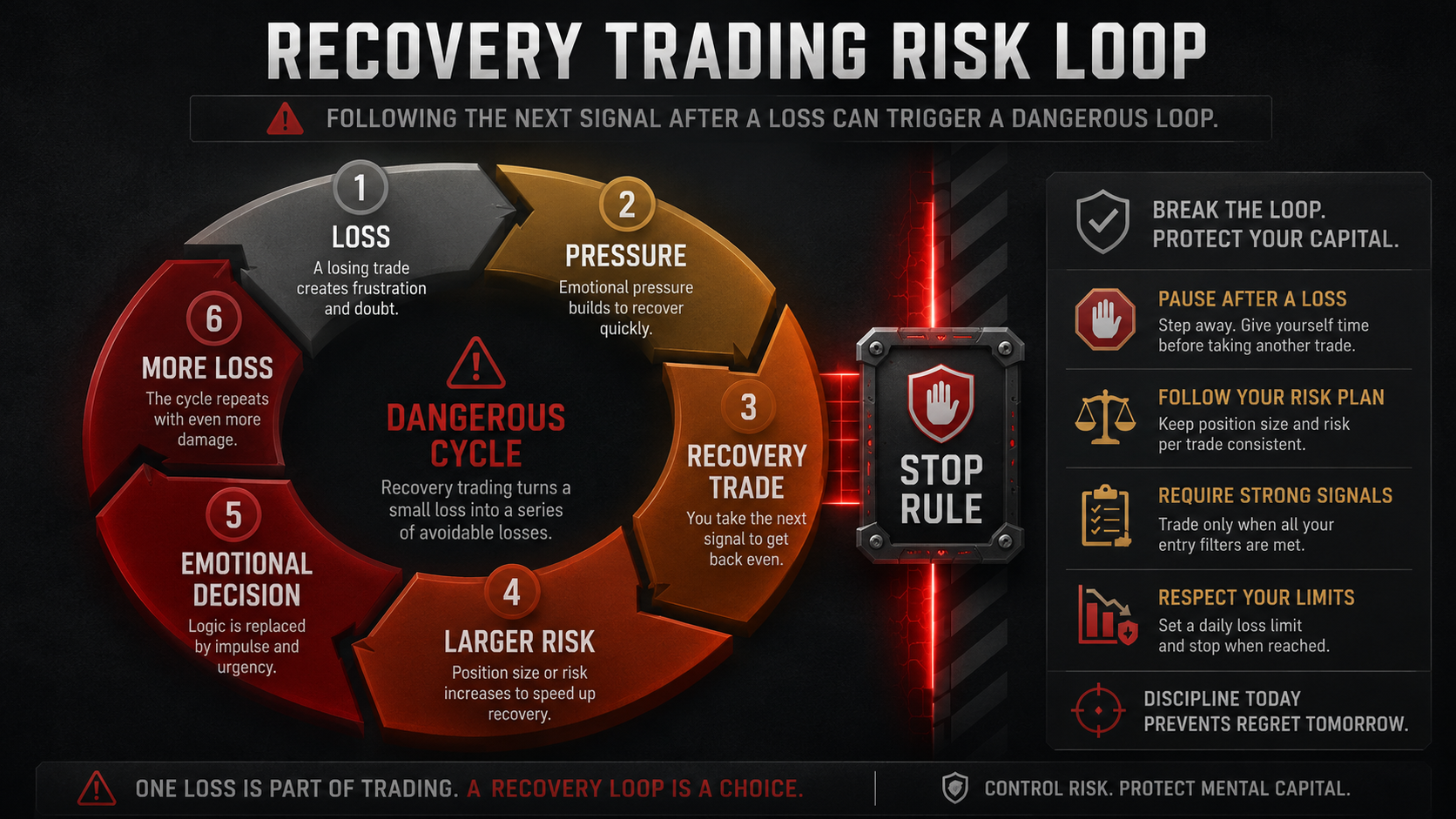
Recovery trading is one of the fastest ways to lose control.
It usually starts after a loss.
The trader feels frustrated and wants to make the money back immediately. Then the next signal appears. Instead of evaluating the setup, the trader follows it because they want relief.
This is not analysis.
This is emotional recovery.
Dangerous signal environments often encourage this behavior with phrases like:
- Next one will recover it
- Increase size
- Trust the process
- We will get it back
- Follow the next trade
- Do not stop now
This creates a cycle.
Loss.
Pressure.
Another signal.
Larger position.
More emotion.
Worse decisions.
A serious trader must have a stop rule before the session begins.
For example:
- Stop after a fixed number of losses.
- Stop after emotional pressure appears.
- Stop when the trader no longer understands the setup.
- Stop when the reason for entering is recovery, not structure.
Before following the next signal, ask:
“Am I trading this setup, or am I trying to recover?”
If the answer is recovery, stop.
If the next signal feels like a way to recover the previous loss, read Revenge Trading Crypto. That article explains how one loss can turn into an emotional recovery cycle when the trader tries to win the money back too quickly.
Red Flag 6: The Signal Provider Avoids Accountability
A serious source should be clear about uncertainty.
A weak source avoids accountability.
Common signs include:
- Deleted losing signals
- Edited results after the trade
- Only showing winning screenshots
- Blaming users for every loss
- Changing the strategy name after bad results
- No clear explanation of failed calls
- No record of full trade history
A good trader can review mistakes.
A bad signal environment hides them.
If the provider only celebrates wins and never studies losses, the trader cannot learn anything useful.
Losses are part of trading.
The issue is not whether losses happen.
The issue is whether the process is transparent enough to evaluate.
Before trusting a signal source, ask:
“Can I review both wins and losses?”
If not, the source is not transparent.
Red Flag 7: The Signal Replaces Your Own Process
A signal can be used as information.
It should not replace thinking.
The trader still needs a personal checklist:
- Is there structure?
- Is price at a meaningful location?
- Is there a clear reaction?
- Is momentum clean or fading?
- Is the timing reasonable?
- Is the risk acceptable?
- Am I calm enough to make this decision?
If the signal skips all of this, the trader becomes dependent.
Dependency is dangerous because the trader cannot trade without instruction. They cannot evaluate quality. They cannot recognize when the environment is bad. They cannot stop when the signals become poor.
A signal should be tested against a process.
It should not become the process.
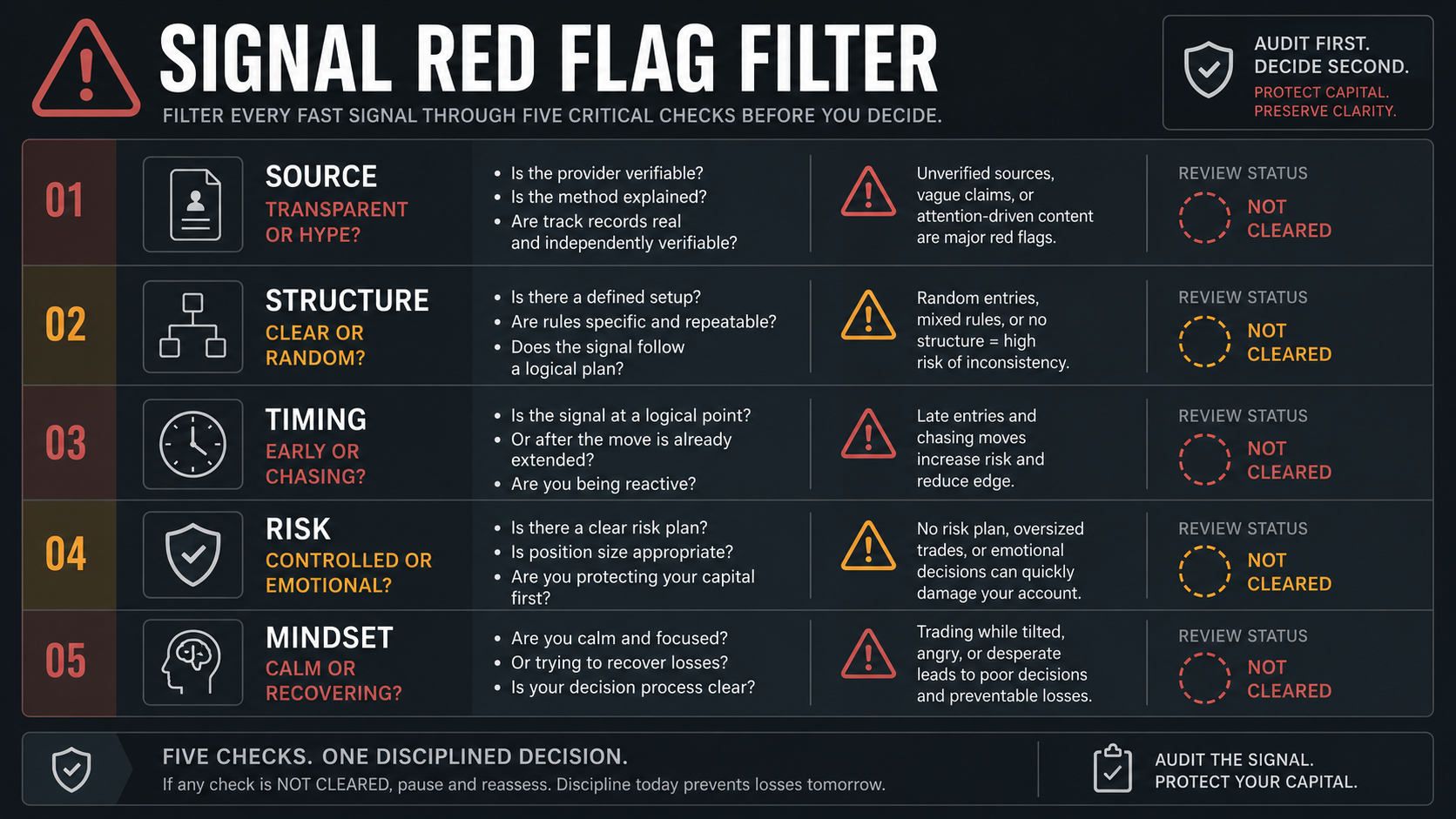
A Safer Way to Evaluate Binary Options Trading Signals
Before following a fast call, use a red flag filter.
This filter does not guarantee a good result.
It simply helps the trader avoid low-quality decisions.
Step 1: Check the source
Ask:
- Who is providing the signal?
- Do they explain the setup?
- Do they show losses?
- Do they use pressure language?
- Do they claim unrealistic accuracy?
If the source depends on hype, be careful.
Step 2: Check the structure
Ask:
- Is price near a meaningful level?
- Is there a range, boundary, or retest?
- Is the signal in the middle of nowhere?
- Is the trade idea clear without the signal message?
If the setup cannot be explained on the chart, the signal is weak.
Step 3: Check the timing
Fast timing does not automatically mean good timing.
Ask:
- Is the entry early or late?
- Has the move already happened?
- Is the signal chasing a candle?
- Does the expiry window match the market behavior?
A correct direction can still fail if timing is poor.
Step 4: Check the risk
Ask:
- Is the trade size controlled?
- Is there a session loss limit?
- Is the trader already emotional?
- Is this trade being taken after a loss?
- Would this trade still make sense without pressure?
If the risk is unclear, do not enter.
Step 5: Check your mental state
The trader is part of the setup.
Ask:
- Am I calm?
- Am I chasing?
- Am I trying to recover?
- Am I afraid of missing out?
- Am I following the signal because I understand it, or because I want certainty?
If the trader is not stable, even a decent setup can become a bad trade.
Good Signals vs Bad Signals
A better signal gives context.
A bad signal gives pressure.
A better signal explains structure.
A bad signal only gives direction.
A better signal allows the trader to reject it.
A bad signal makes the trader feel guilty for missing it.
A better signal accepts uncertainty.
A bad signal sells certainty.
This difference is important.
The trader should never feel forced to take a trade.
The ability to say no is part of risk management.
The Most Important Rule: No Signal Is More Important Than Risk
The market does not care who sent the signal.
It does not care how confident the message sounded.
It does not care how many screenshots were shown.
Once the trade is opened, only risk remains.
That is why the trader must keep control of position size, timing, and emotional state.
A signal may suggest a direction.
It should never control the account.
Before following any binary options trading signal, remember:
If the setup is unclear, skip it.
If the risk is too high, skip it.
If the source uses pressure, skip it.
If you are trading to recover, skip it.
No trade is better than a forced trade.
Final Checklist Before You Follow a Fast Call
Before following a binary options signal, check:
- Is the source transparent?
- Is the setup based on structure?
- Is the timing clear?
- Is the trade not chasing a candle?
- Is the risk controlled?
- Is there no pressure language?
- Are losses shown honestly?
- Is the trader calm?
- Is this not a recovery trade?
- Can the trader explain the setup without copying the signal?
If these answers are unclear, the best decision may be to wait.
The goal is not to follow more signals.
The goal is to avoid low-quality decisions.