The Psychological Dissonance of a Red Portfolio
It is the most confusing and isolating experience in cryptocurrency trading. You open Twitter, and your timeline is flooded with screenshots of massive gains, euphoric celebrations, and declarations that a new financial paradigm has arrived. Bitcoin is breaking all-time highs. The total market capitalization is expanding by billions of dollars a day. Every metric screams that a massive Bull Market is in full swing.
Then, you look at your own exchange application. Your portfolio balance is not moving up. In fact, it is slowly bleeding out. You are taking losses during the greatest wealth-generation event of the decade.
You ask yourself: “If everyone is making money, why am I losing it?” You feel inadequate, assuming you have terrible luck or inherently flawed judgment.
The truth is much darker. Your losses are not an accident, nor are they a matter of luck. You are losing money in a bull market because the very architecture of the market is designed to use your capital as the fuel for institutional profits. You are operating under the false assumption that a bull market is a rising tide that lifts all boats. It is not. It is a highly coordinated sequence of capital extraction.
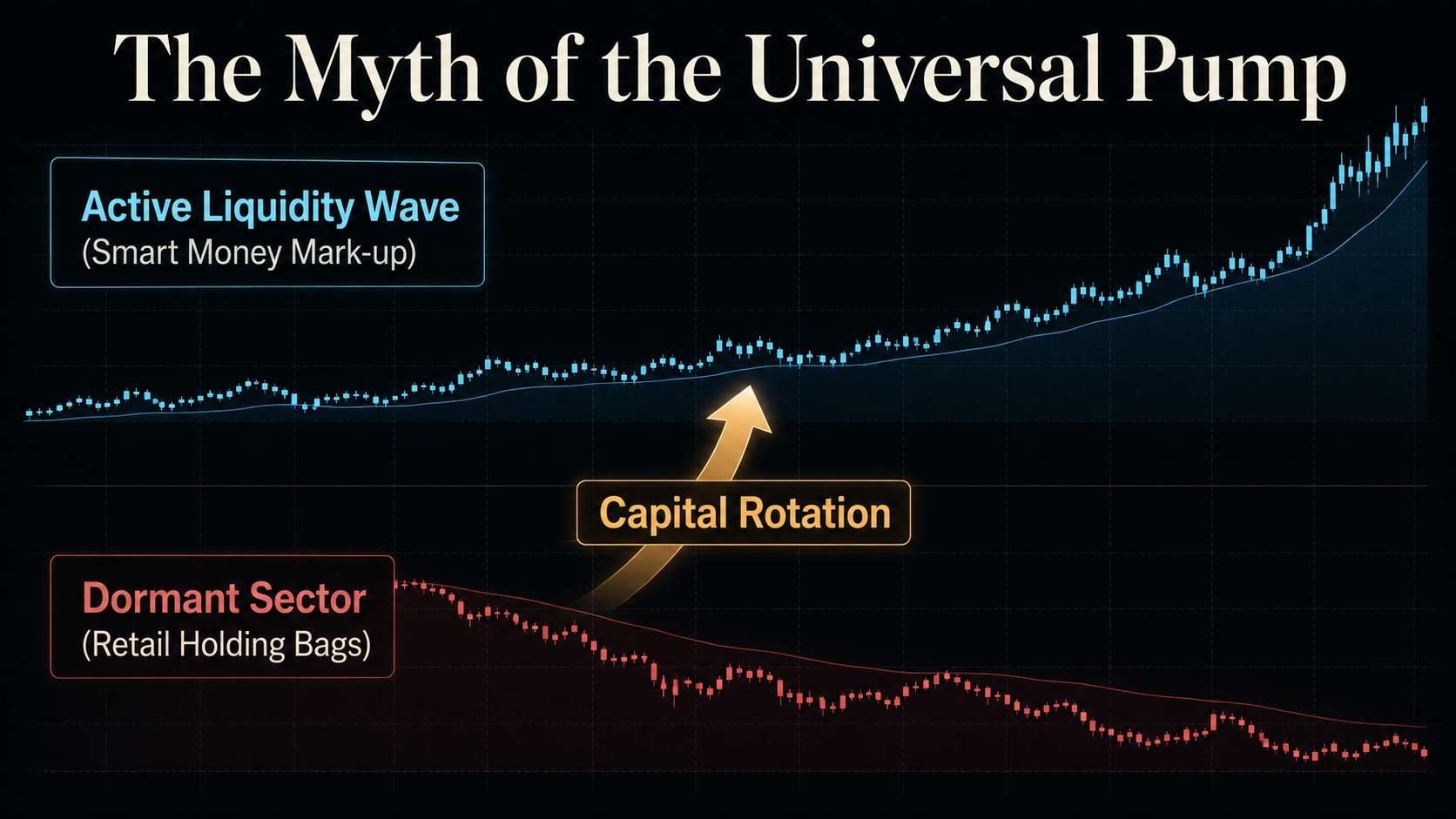
The Myth of the Universal Pump
The greatest lie sold to retail traders is that in a bull market, you can simply buy any asset, hold it, and watch it appreciate. This is a fundamental misunderstanding of how massive liquidity moves.
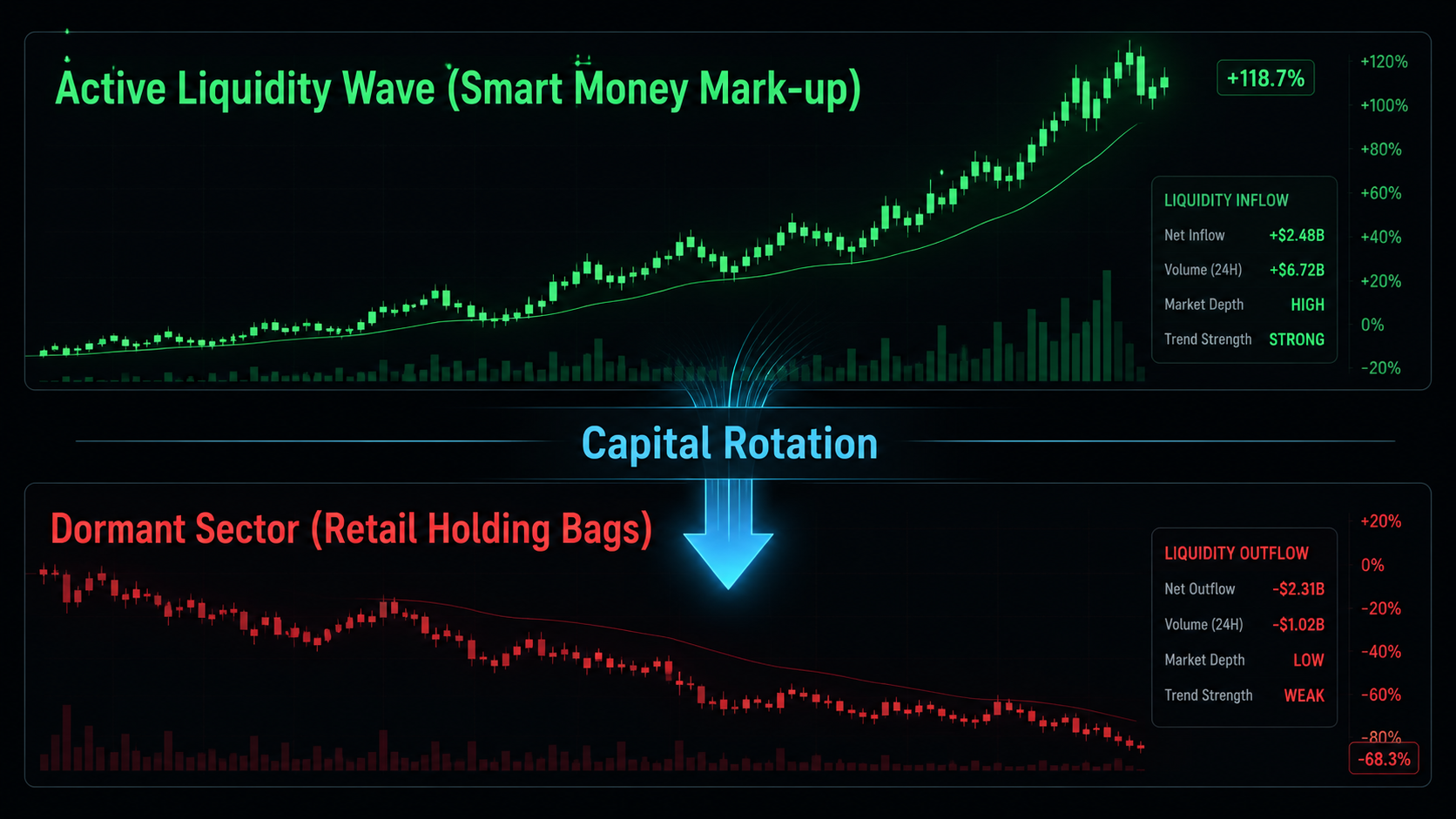
Smart Money—institutional investors, market makers, and algorithmic funds—does not buy the entire market at once. They simply do not have the capital efficiency to pump thousands of alternative coins simultaneously. Instead, they play a ruthless, systematic game known as Sector Rotation.
Capital behaves like a massive wave that moves from one specific sector of the market to another. It starts with Bitcoin, drawing in massive external liquidity. Once Bitcoin consolidates, that profit is rotated into Large-Cap Altcoins. From there, it flows into specific narratives—Artificial Intelligence, Layer 1 Blockchains, Gaming, or Memecoins.
While the wave is lifting the AI sector, the Gaming sector is likely bleeding. If you are holding a bag of tokens in a dormant sector, waiting for “the bull market” to push your price up, you will wait forever. The market is going up, but your specific asset is being ignored.
The “Exit Liquidity” Trap: Why You Buy the Top
The true reason you lose money is a tragic misalignment of timing. Retail traders and Smart Money operate on entirely opposite timelines.
Institutions position themselves in a specific sector before the narrative becomes popular. They accumulate during the boring, sideways consolidation phases when the assets look dead.
Then, they initiate the markup phase. The price starts to climb. Financial media starts reporting on it. Crypto influencers start posting technical analysis charts showing massive upside potential. The chart goes parabolic, printing massive green daily candles.
This is the exact moment you, the retail trader, feel the maximum amount of FOMO (Fear of Missing Out). You see the massive gains, you believe the hype, and you finally click “Buy.”
But you must ask yourself: If the price is up 300% in a week, who is selling you those tokens?
Smart Money is. The entire media hype cycle and the massive green candles were engineered specifically to attract your attention. They need a massive influx of late, emotional buyers to absorb their enormous sell orders without crashing the price. You are not arriving at the beginning of a massive trend; you are arriving at the end. You are acting as the Exit Liquidity for the institutions. You bought their heavy bags so they could realize their profits and rotate into the next quiet sector.
If you usually buy after the candle already looks obvious, read Why Do I Always Enter Late in Crypto Trading. That article explains how lagging indicators and confirmation signals can turn retail entries into exit liquidity.
The Death Spiral of Chasing Rotations
Once you become Exit Liquidity at the top, the psychological torture begins. The asset you just bought immediately stops going up and begins a slow, painful bleed as the remaining institutions distribute their tokens.
Now, you are trapped. Meanwhile, you see another entirely different sector suddenly start pumping.
Driven by the pain of your current loss and the desperate desire to catch the new wave, you commit the ultimate portfolio-destroying sin: You sell your current bags at a massive loss, and you immediately use that depleted capital to buy into the newly pumping sector.
Statistically, because you waited for visual confirmation again, you are buying the absolute top of the second sector. You just sold the bottom to buy the top, twice in one week. Do this three or four times, and your portfolio will be decimated, even while the overall cryptocurrency market cap doubles.
If one bad scalp or late entry keeps erasing your small wins, read Realistic Win Rate for BTC Scalping Strategies. That article breaks down why high accuracy still loses money when one oversized loss, fees, and slippage destroy the account.
Shifting from Reactive to Proactive
You are losing money in a bull market because you are playing a reactive game. You are reacting to price action, reacting to Twitter hype, and reacting to your own emotions. In the cryptocurrency market, reaction equals execution.
If the bull-market loss begins with a fake breakout, read Why Does Crypto Always Reverse When You Buy?. That article explains how obvious green candles, liquidity pools, and retail FOMO can turn your entry into someone else’s exit.
To survive and actually extract wealth from a bull cycle, you must stop chasing the green candles. You must abandon the retail mindset of looking for what is pumping today.
Professionals do not chase the rotation; they anticipate it. They identify the macro capital flows, park their capital in undervalued narrative zones with strong institutional footprints, and they wait for the liquidity wave to come to them. They sell when the retail euphoria is highest, and they buy when the retail boredom is deepest. Until you understand that your FOMO is a mathematical variable in an institutional algorithm, the bull market will continue to take your money and give it to the people who entered months before you even knew the asset existed.