Revenge trading in crypto happens when a trader takes another trade mainly to recover a loss.
The market moves against them.
They close the trade.
Then they feel pressure to win the money back quickly.
That next trade often feels urgent, emotional, and obvious.
This is why it is dangerous.
The trade may look like a new opportunity, but in many cases, it is not a fresh decision. It is a reaction to pain.
Crypto markets move fast. Leverage, volatility, and 24-hour access make revenge trading even easier. A trader can lose, reopen a position, increase size, and lose again within minutes.
That is not strategy.
That is emotional exposure.
This guide explains why the trade after a loss is often the most dangerous trade of the session, and how a trader can slow down before the next click.
This article is for educational purposes only. It does not provide financial advice, trading signals, or guaranteed trading results.
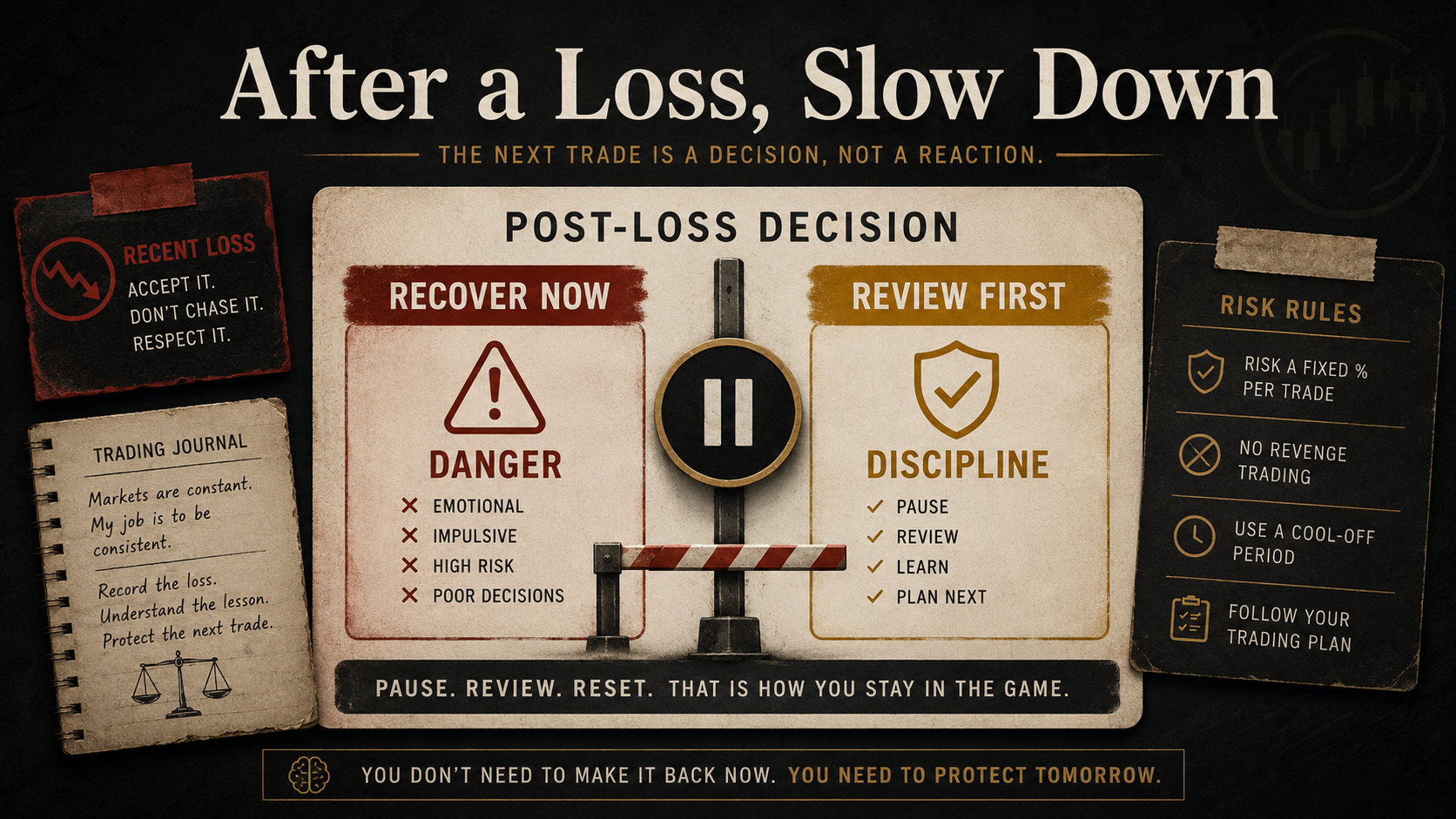
What Is Revenge Trading in Crypto?
Revenge trading is not just taking another trade after a loss.
A trader can lose a trade, review the setup, remain calm, and later take another valid trade.
That is not revenge trading.
Revenge trading starts when the next trade is driven by emotion.
The emotional goal becomes:
“I need to make it back.”
That goal changes the trader’s behavior.
They may enter too quickly.
They may increase position size.
They may ignore structure.
They may use more leverage.
They may follow a weak signal.
They may take a setup they would normally reject.
The danger is that the trader thinks they are making a trading decision, but they are actually trying to repair how they feel.
That is the core of revenge trading.
The market does not know the trader lost money.
The chart does not adjust because the trader wants recovery.
A loss does not create a better setup.
It only creates pressure.
Why the Next Trade After a Loss Feels So Tempting
After a loss, the brain wants relief.
The trader wants to remove the negative feeling as fast as possible. In crypto trading, the fastest way to feel in control again is to enter another position.
This is why revenge trading often feels logical in the moment.
The trader may think:
- “I can recover it quickly.”
- “The next setup looks better.”
- “I was right, just early.”
- “I should increase size to get back faster.”
- “If I stop now, the loss becomes real.”
- “The market owes me another chance.”
These thoughts feel convincing because they appear immediately after emotional pain.
But they are not structure.
They are pressure.
A trade taken to remove emotional discomfort is usually lower quality than a trade taken from a clear plan.
The problem is not only the loss.
The problem is the decision state after the loss.
Crypto Makes Revenge Trading Easier
Crypto markets can make revenge trading worse for several reasons.
First, the market is open all the time.
There is no natural closing bell that forces the trader to stop.
Second, many crypto platforms make it easy to enter quickly.
A trader can open, close, reverse, increase size, and change leverage very fast.
Third, volatility creates the illusion of constant opportunity.
There is always another candle.
There is always another breakout.
There is always another fast move.
Fourth, leverage can turn emotional decisions into serious account damage.
A revenge trade with normal size is already risky.
A revenge trade with increased leverage is much worse.
The trader is not only fighting the market.
They are fighting urgency, frustration, and the desire to erase the previous trade.
That is a dangerous combination.
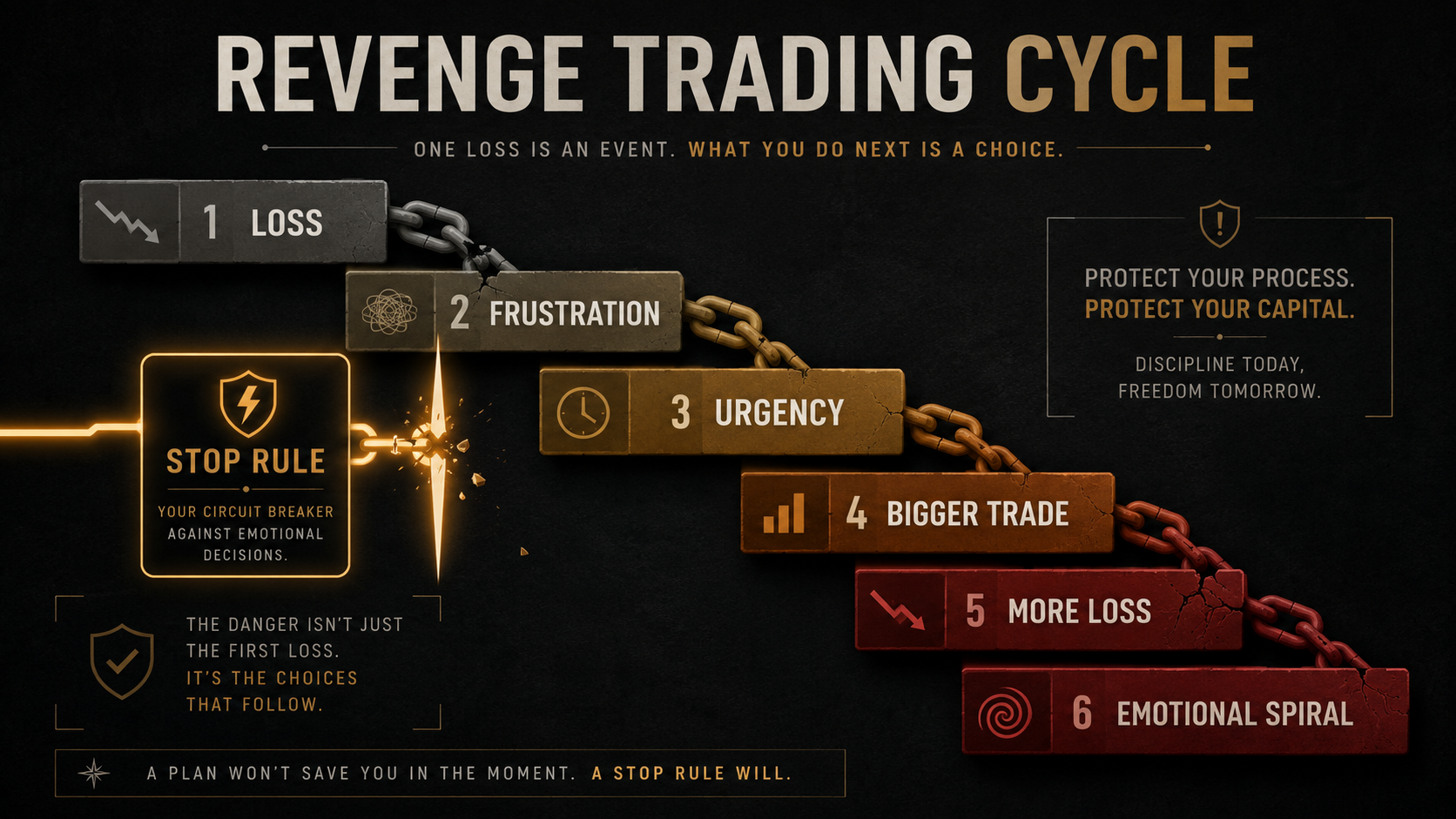
The Revenge Trading Cycle
Revenge trading usually follows a simple cycle.
Loss.
Frustration.
Urgency.
Bigger or faster trade.
Another loss.
More pressure.
Even worse decision.
The cycle can repeat until the trader stops thinking clearly.
This is why one losing trade can become a losing session.
The first loss may be normal.
The second and third losses may come from emotional reaction.
If one losing trade turns into too many rushed entries, read Overtrading Crypto. That article explains how fast traders lose control when they chase candles, recover losses, and enter before structure, reaction, and risk are clear.
A disciplined trader accepts that losses happen.
An emotional trader tries to cancel the loss immediately.
That difference matters.
A loss is part of trading.
A revenge cycle is a breakdown of process.
Warning Signs of Revenge Trading
Revenge trading is easier to stop when the trader can recognize the warning signs early.
Common warning signs include:
- Entering immediately after a loss
- Increasing position size to recover faster
- Switching direction without a clear reason
- Ignoring the original trading plan
- Taking trades in the middle of a range
- Following random signals after losing
- Feeling angry at the market
- Feeling that stopping would mean failure
- Checking the account balance after every candle
- Saying “just one more trade”
One warning sign is serious.
Several warning signs together mean the trader should stop.
A trader does not need to wait for a large loss to recognize the problem.
The moment the trade becomes about recovery, the decision quality has changed.
Before entering again, ask:
“Would I take this trade if I had not just lost?”
If the answer is no, the trade is probably emotional.
Why Revenge Trades Often Have Bad Entries
Revenge trades often have poor entries because the trader is not waiting for the market.
They are waiting for relief.
That means they may enter:
- Too late after a candle already moved
- Too early before confirmation
- In the middle of a range
- Without a clear invalidation level
- With a larger position than usual
- Against the original plan
- Only because the trade feels urgent
A bad entry after a loss is especially dangerous because the trader’s patience is already reduced.
They may not wait for structure.
They may not wait for reaction.
They may not check momentum.
They may not calculate risk.
They only want the account balance to return to where it was.
That is not a trading edge.
That is emotional chasing.
If the next trade after a loss happens too fast, read 1-Minute Crypto Scalping Strategy. That page explains why structure, reaction, invalidation, and position size must be filtered before a fast entry deserves execution.
The Role of Leverage in Revenge Trading
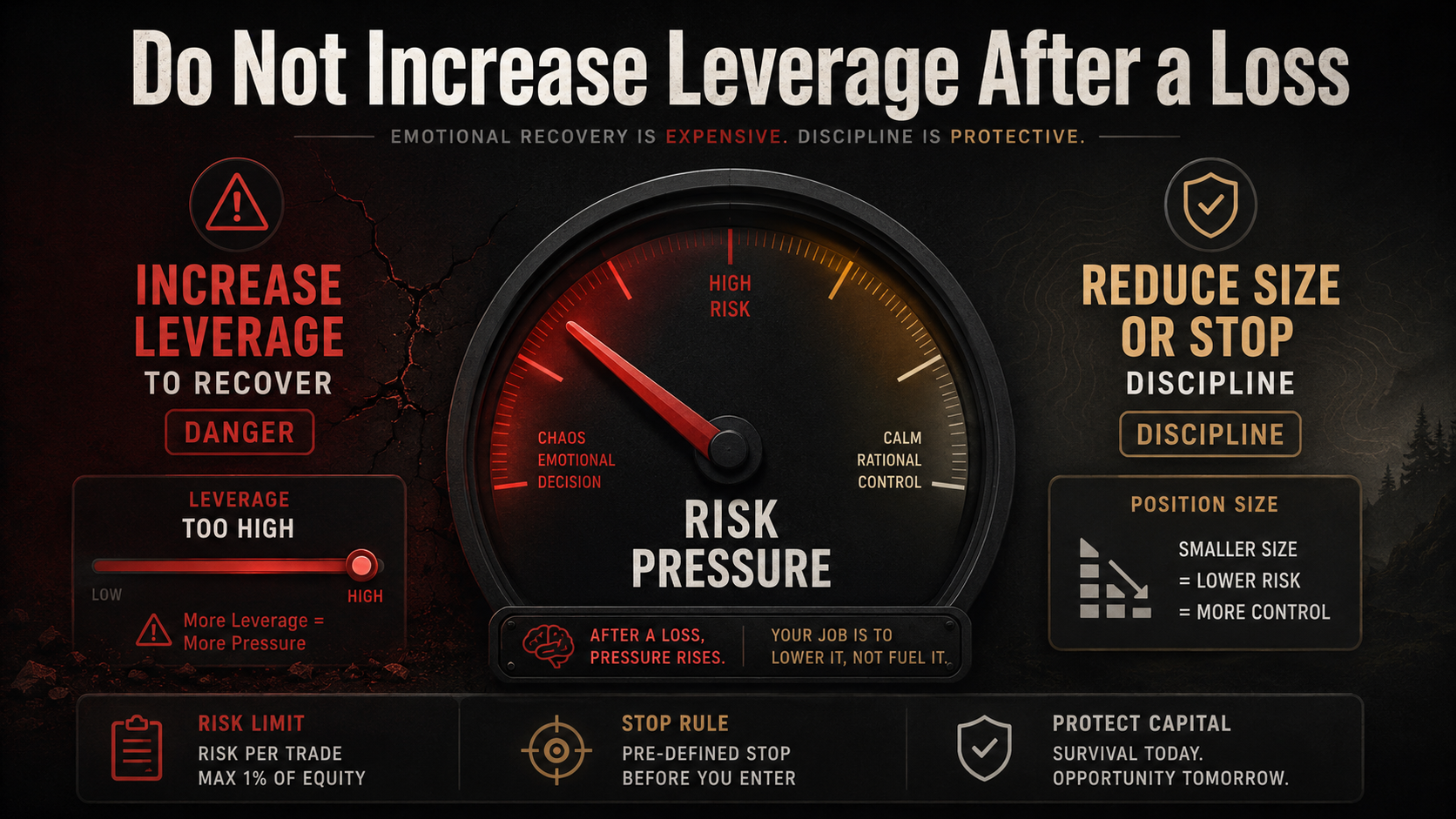
Leverage makes revenge trading more dangerous.
After a loss, some traders increase leverage because they want a faster recovery.
This creates a serious problem.
The trade does not need to be completely wrong to hurt the account.
Normal market noise can become enough to force a bad exit or liquidation if the position is too large.
A revenge trade with leverage can damage the account faster than the original mistake.
Before using leverage after a loss, a trader should ask:
- Is the setup actually stronger, or am I just trying to recover?
- Is my position size still within my plan?
- Is the liquidation distance safe enough?
- Do I have a clear invalidation level?
- Would I accept this loss calmly if it fails?
If the answer is unclear, the trade should be skipped.
Leverage should never be used as an emotional recovery tool.
Stop Rules: The Most Important Protection
The best time to create a stop rule is before the session begins.
Not after emotions appear.
A stop rule tells the trader when to stop trading, regardless of how tempting the next setup looks.
Examples of stop rules include:
- Stop after two losing trades.
- Stop after reaching a fixed daily loss limit.
- Stop after breaking the trading plan.
- Stop after increasing size emotionally.
- Stop after feeling anger, panic, or urgency.
- Stop when the trader cannot explain the next setup clearly.
A stop rule is not a punishment.
It is protection.
It protects the trader from making decisions in a damaged emotional state.
Many traders think discipline means finding better entries.
But sometimes discipline means refusing to take the next trade.
A Simple Post-Loss Checklist
Before taking another trade after a loss, use this checklist.
Do not enter until the answers are clear.
- What exactly went wrong in the last trade?
- Was it a normal loss or a broken rule?
- Am I calm enough to evaluate the next setup?
- Is price at a meaningful structure level?
- Is there a clear reaction?
- Is the entry early enough, or am I chasing?
- Is my position size the same or smaller than normal?
- Do I know where the trade idea is invalid?
- Can I accept another loss without increasing risk?
- Would I take this trade if the previous trade had been a win?
The last question is important.
If the trade only looks attractive because the previous trade lost, it is not a clean setup.
It is recovery pressure.
What to Do Immediately After a Loss
A trader does not need a complicated routine after every loss.
They need a simple interruption.
The goal is to break the emotional chain before the next decision.
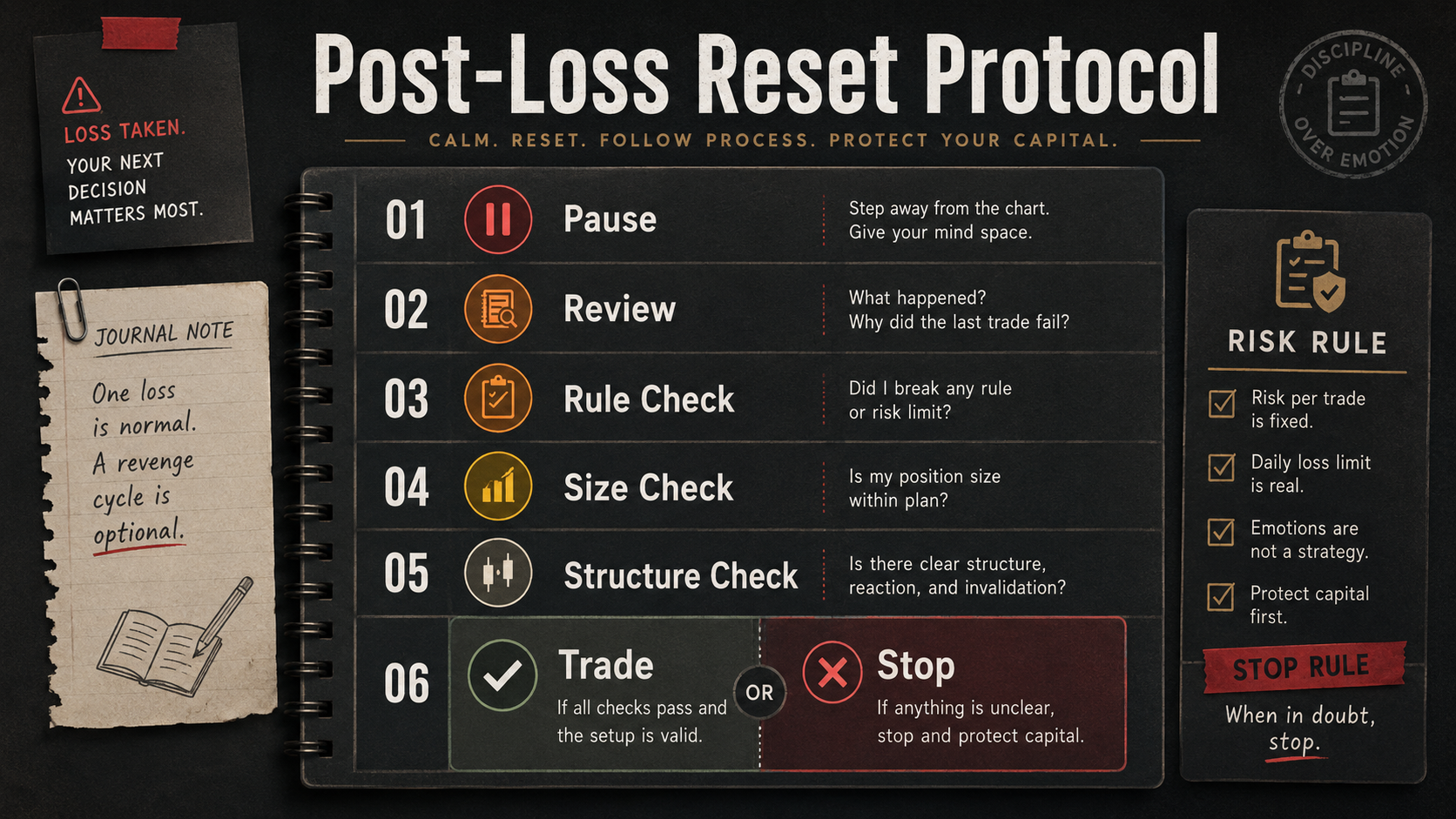
After a loss, do this:
- Step away from the chart for a few minutes.
- Write down why the trade failed.
- Check whether any rule was broken.
- Reduce position size if trading continues.
- Take the next trade only if it meets the original plan.
- Stop completely if the next trade is based on recovery.
This short pause can prevent one loss from becoming a series of losses.
The pause is not weakness.
It is risk control.
Revenge Trading vs Disciplined Re-Entry
It is important to separate revenge trading from disciplined re-entry.
A disciplined re-entry has structure.
It has a clear reason.
It has defined risk.
It does not depend on recovering the previous loss.
The trader can explain the setup calmly.
A revenge trade is different.
It feels urgent.
It often comes with increased size.
It is emotionally connected to the previous result.
The trader may struggle to explain why the setup is valid.
The difference is not whether the trade wins.
The difference is the decision process.
A revenge trade can win and still be a bad decision.
A disciplined trade can lose and still be a good decision.
Good trading is not measured by one outcome.
It is measured by repeatable process.
How to Reduce Revenge Trading Over Time
Revenge trading is not solved by one rule.
It is reduced by building structure around emotional moments.
A trader can reduce revenge trading by:
- Using fixed position size
- Setting a daily loss limit
- Writing a session plan before trading
- Avoiding trading immediately after anger or panic
- Reviewing losses without rushing
- Removing leverage after emotional mistakes
- Taking fewer trades
- Focusing on structure instead of recovery
- Keeping a simple trade journal
The goal is not to remove emotion completely.
That is unrealistic.
The goal is to stop emotion from controlling position size, timing, and risk.
A trader does not need to feel perfect.
They need rules that work when they do not feel perfect.
The Best Trade After a Loss May Be No Trade
After a loss, the trader wants action.
But action is not always control.
Sometimes control means doing nothing.
No trade protects capital.
No trade protects mental clarity.
No trade prevents emotional escalation.
No trade gives the trader time to review.
This is difficult because it feels passive.
But in fast crypto markets, refusing a bad trade is often more valuable than forcing another entry.
The market will still be there.
The account may not be, if every loss turns into a recovery attempt.
That is why the next trade after a loss must be treated carefully.
It is not just another trade.
It is a test of discipline.
Final Rule: Do Not Let One Loss Become a Session Breakdown
One losing trade is normal.
A revenge trading cycle is preventable.
The trader cannot control every market movement.
But the trader can control what happens after a loss.
Before taking the next trade, check:
- Am I calm?
- Is there structure?
- Is the risk defined?
- Is the position size controlled?
- Am I trying to recover?
- Can I walk away if the setup is not clear?
If the answer is unclear, stop.
The goal is not to win the money back immediately.
The goal is to protect the account, protect the process, and return only when the next decision is clean.
In crypto trading, the most dangerous trade is often not the first loss.
It is the trade taken immediately after it.