A 1-minute crypto scalping strategy should not begin with the question, “Where do I enter?”
That question comes too early.
On the 1-minute chart, price can move before the trader has finished thinking. A fast candle looks like confirmation. A small breakout feels urgent. A quick pullback feels like a second chance.
That is where many bad scalps begin.
The trader does not lose because the chart is fast.
The trader loses because the click happens before the setup has earned the right to be traded.
A stronger 1-minute crypto scalping strategy starts with elimination. Before looking for an entry, the trader first removes every condition where the mouse should not be clicked at all.
The goal is not to enter faster.
The goal is to reject weak trades faster.
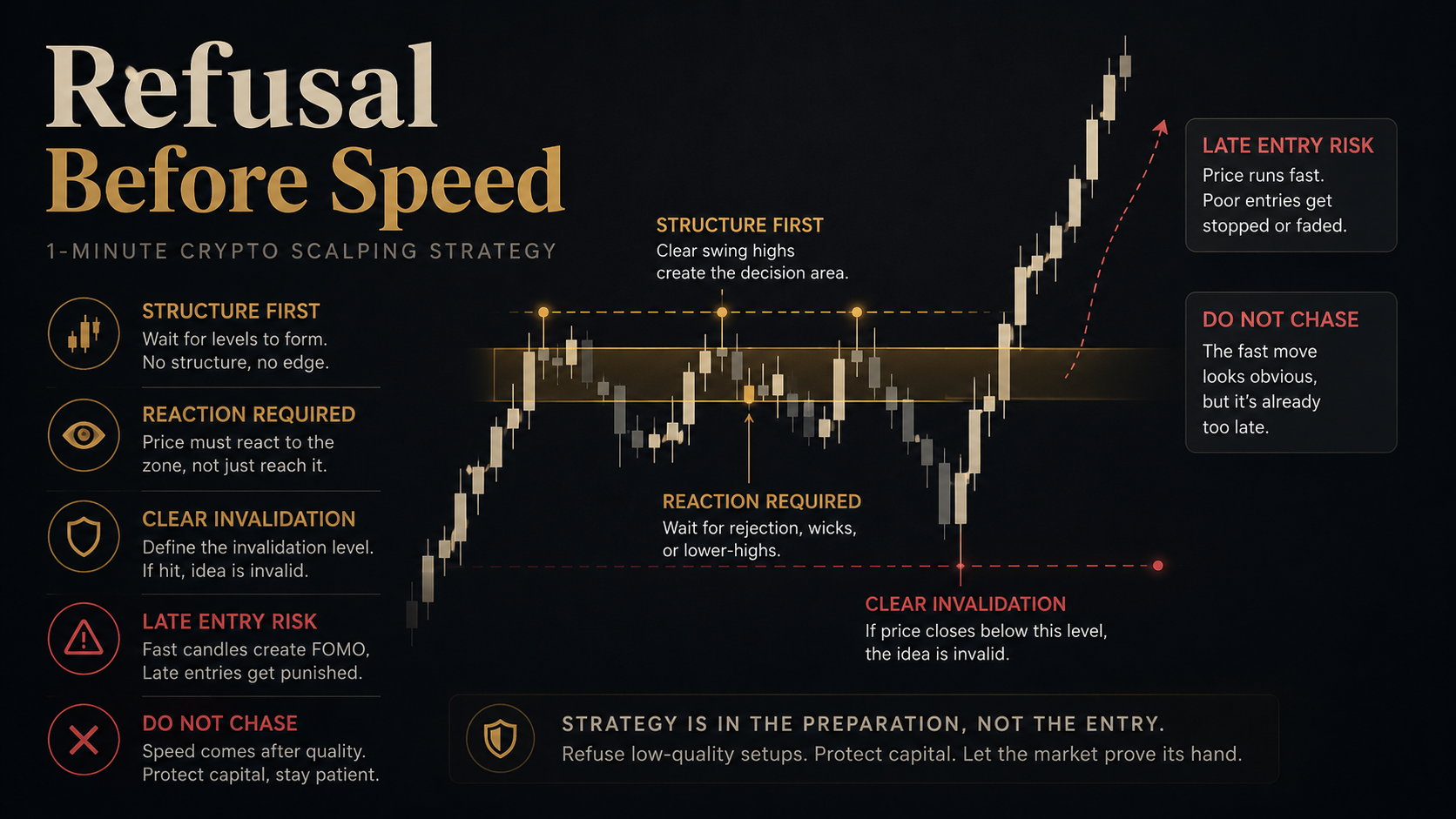
What This 1-Minute Crypto Scalping Strategy Is Really Trying to Do
This is not a prediction system.
It is not a promise that a fast candle will continue.
It is not a reason to click every time price touches a level.
A 1-minute crypto scalping strategy has a narrower job.
It helps the trader decide whether a fast setup is still clean enough to trade, or whether the move has already become too late, too stretched, or too unclear.
That distinction matters.
A good 1-minute scalp usually has a small window of quality. Before that window, the setup may not be confirmed. After that window, the entry may already be late.
The trader’s job is not to chase the candle.
The trader’s job is to recognize whether the trade still has structure before the click.
The No-Click Rule Comes First
Before a 1-minute crypto scalp is allowed, the trade must survive the no-click filter.
The setup is rejected if:
- the larger structure is unclear
- the candle only wicks through the level but cannot hold
- the entry is already far from the invalidation area
- the trade only works if price moves immediately
- the position size cannot fit the defined loss
- the liquidation distance sits inside recent 1-minute noise
This is the core of the strategy.
A weak setup is not improved by speed.
A late setup is not improved by confidence.
A messy setup is not improved by leverage.
If the trade fails the filter, it is not missed.
It is removed.
Red Flag 1: The Larger Structure Is Still Unclear
The first red flag is a fast move inside unclear structure.
A 1-minute candle can break a small local high while the broader market is still trapped inside a messy range. It can push through a short-term level while the 5-minute or 15-minute chart still has no clean direction.
That is not a clean breakout.
It is movement inside noise.
For example, price may be sitting in the middle of a wider range. It may be sweeping both sides without holding above or below either boundary. It may be reacting to every small level but respecting none of them.
In that condition, a 1-minute breakout is dangerous because it can look strong while still having no meaningful location.
The red flag is simple:
If price is not near a clear decision area, the setup does not deserve a click.
A decision area can be a range boundary, a prior reaction zone, a recent liquidity sweep area, or a clean structure point where price has already shown interest.
If the trade is happening in the middle of random movement, the trade is skipped.
No clear structure means no trade.
Red Flag 2: The Candle Breaks the Level but Does Not Hold
The second red flag is a weak candle close.
On the 1-minute chart, price often pokes through a level and then immediately closes back inside the range. That wick can attract impatient traders because it looks like a breakout while it is happening.
But a wick is not the same as acceptance.
A wick only shows that price visited the level.
A body close shows whether price was accepted beyond it.
If price breaks above a boundary but the candle body closes back below the boundary, the breakout has not held.
If price pushes below a support area but the candle body closes back above it, the breakdown has not held.
If the candle needs “one more candle” to make the setup look valid, the current setup is not valid yet.
This is where many fast traders click too early. They enter because price touched the level, not because price proved that the level mattered.
A 1-minute crypto scalping strategy should not treat every touch as a trade.
The candle must show a real reaction.
If the level is touched but not respected, the trade is skipped.
No hold means no trade.
If the candle breaks a visible level and immediately reverses after you enter, read Why Does Crypto Always Reverse When You Buy?. That article explains how fakeouts, liquidity pools, and late retail entries turn obvious breakouts into traps.
Red Flag 3: The Entry Is Already Too Far From Invalidation
The third red flag is distance.
This is one of the most important parts of 1-minute crypto scalping.
A fast candle can make the trade look safer because direction has become obvious. But by the time the candle looks obvious, the clean entry may already be gone.
The trader enters late.
Now the invalidation area is far away.
That changes everything.
The setup may still look attractive on the chart, but the trade is no longer efficient. The trader now needs a wider failure area, a smaller position size, or an unrealistic immediate continuation.
That is not the same trade anymore.
A clean 1-minute scalp should still be close enough to the structure point that proves the idea wrong. If the entry has moved too far away from that point, the trade becomes fragile before it opens.
The warning signs are clear:
- price has already expanded away from the decision area
- the candle is strong, but the failure point is now far behind
- the entry would require accepting a wider distance than planned
- the trade only feels acceptable because the candle is moving quickly
- a normal pullback could damage the position immediately
That is not a clean scalp.
That is a chase.
If the entry is too far from invalidation, the trade is skipped.
Late entry means changed trade.
If this keeps happening because you wait until the candle looks safe, read Why Do I Always Enter Late in Crypto Trading. That article breaks down how lagging indicators, confirmation bias, and FOMO push traders into the move after the clean entry is gone.
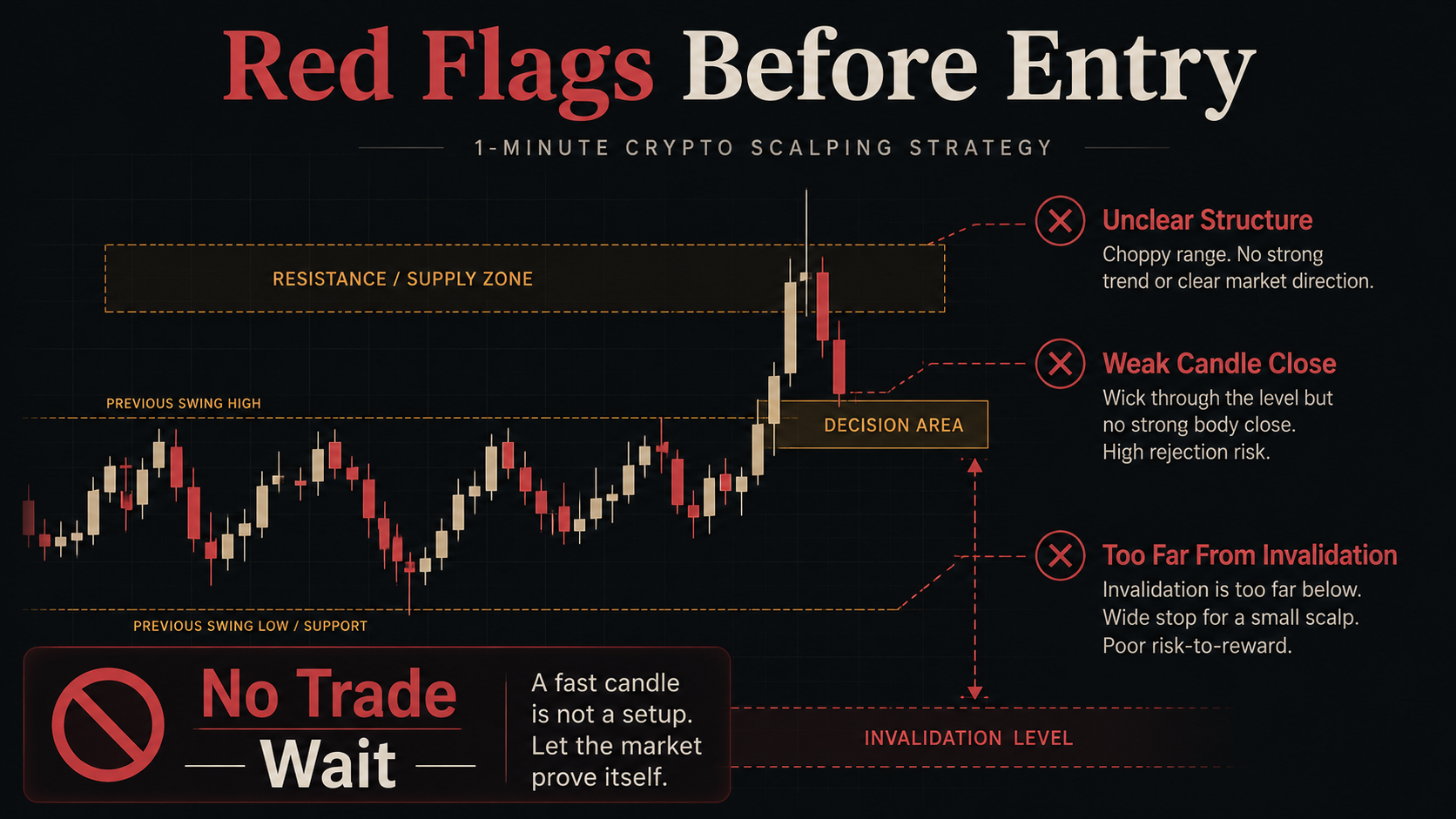
The Actual Strategy: Structure, Reaction, Invalidation, Size
After the bad trades are removed, the strategy becomes cleaner.
A valid 1-minute crypto scalp needs four parts.
Structure. Reaction. Invalidation. Size.
The order matters.
If the trader starts with the entry, everything becomes emotional.
If the trader starts with structure, the trade can be judged before the click.
Step 1: Define the Structure Area
The trade must begin near a meaningful area.
Not every candle is a setup.
A structure area can be:
- a range boundary where price previously reacted
- a short-term support or resistance area
- a failed breakout area
- a recent sweep that returned back into structure
- a local order-flow zone where price changed behavior
The exact label matters less than the function.
The area must help answer one question:
Where is the trade idea wrong?
If the chart cannot answer that, the trade is not ready.
The 1-minute chart should refine execution. It should not create the entire trade idea by itself.
Step 2: Wait for a Reaction, Not Just Arrival
Price reaching the area is not enough.
The market must react.
A reaction can be a failed push, a rejection candle, a body close that holds outside a boundary, or a short pause where price stops accepting lower or higher levels.
The point is not to memorize a pattern.
The point is to see whether price behavior changes at the decision area.
If price reaches the area and slices through it without hesitation, there is no clean reaction.
If price touches the area but the candle body cannot hold, there is no clean reaction.
If price reacts only after the move has already stretched too far, the entry may already be late.
The reaction must appear before the trade becomes inefficient.
Step 3: Define Invalidation Before the Click
Invalidation is the point where the trade idea is no longer valid.
It must be defined before entry.
For a 1-minute crypto scalp, invalidation cannot be vague. It should be tied to the structure that created the trade idea.
If the idea is based on a boundary reaction, invalidation should relate to that boundary failing.
If the idea is based on a failed breakout, invalidation should relate to price accepting beyond that failed area.
If the idea is based on a sweep and return, invalidation should relate to price losing the return structure.
The key is simple:
The invalidation area must prove the trade idea wrong.
If it only proves that the trader feels uncomfortable, it is not structural invalidation.
Step 4: Let the Distance Decide the Position Size
Position size should not be chosen first.
The trade idea creates the invalidation point.
The invalidation point creates the distance.
The distance determines whether the position size is acceptable.
If that order is reversed, the trader is no longer building a strategy. The trader is forcing size onto a setup.
A fast scalp should never require the trader to ignore distance.
If the invalidation is too far, the position size must shrink.
If the position size cannot shrink enough while still making sense, the trade is skipped.
If the trade only feels worth taking when the size is increased, the setup is not clean enough.
That is the difference between a controlled scalp and an emotional click.
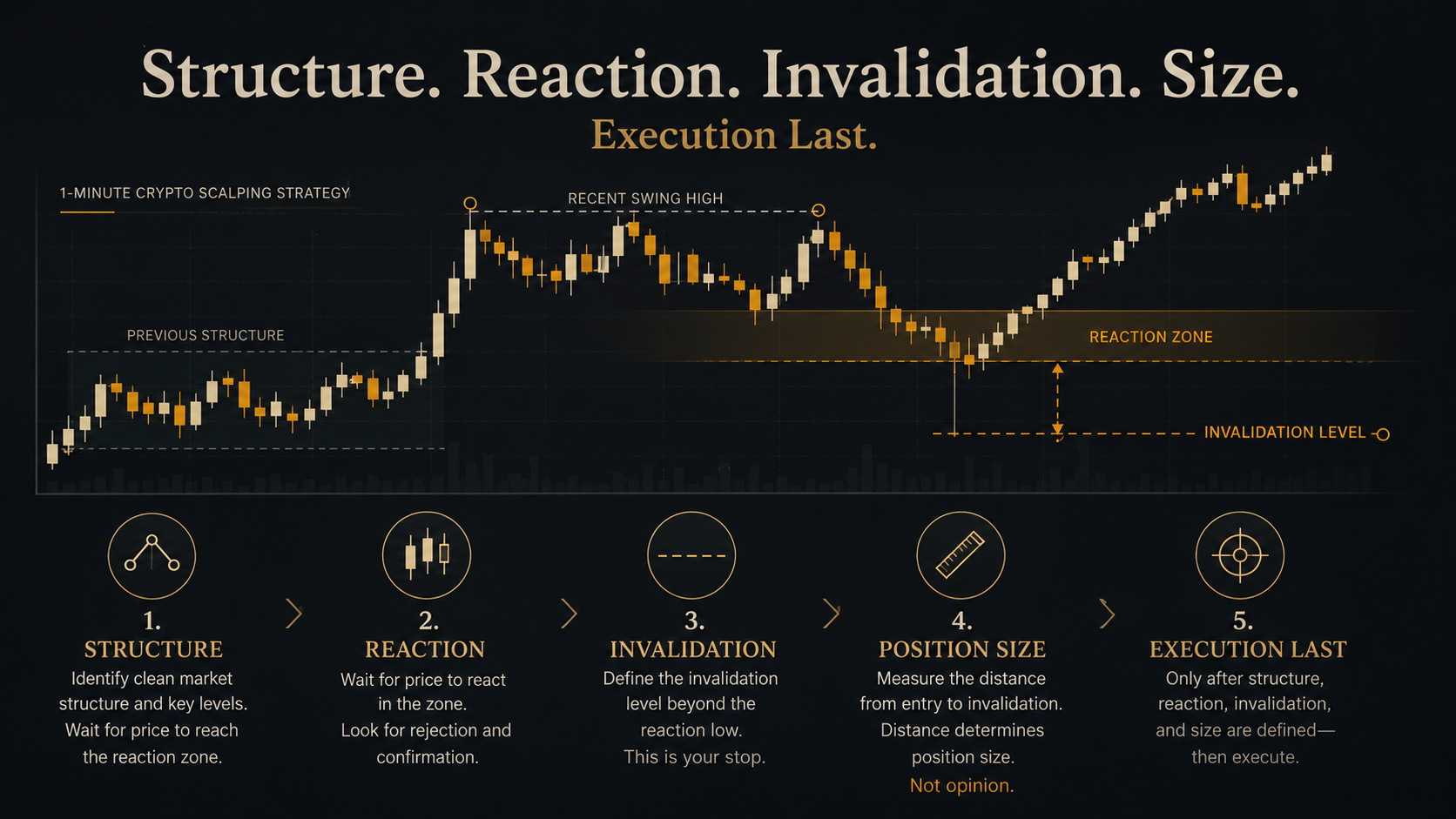
When a Setup Is Allowed to Continue
After the no-click conditions are removed, the setup can continue only if the chart still has structure.
A valid setup should answer these questions before entry:
- Is price near a meaningful decision area?
- Did price react at that area?
- Did the candle body hold or reject the level clearly?
- Is invalidation close enough to keep the trade efficient?
- Can position size be calculated from the distance?
- Would a normal 1-minute pullback damage the trade immediately?
If the answers are clear, the setup can be considered.
If the answers are unclear, the setup is skipped.
This is not hesitation.
This is the strategy.
Where the Maximum Risk Calculator Fits
A 1-minute crypto scalp still needs a fixed maximum loss before entry.
The chart may move quickly, but the amount at risk should already be defined.
The order should be:
Account balance. Risk percentage. Maximum loss. Invalidation distance. Position size. Execution.
Not the other way around.
A trader should not click first and then decide how much the trade can lose.
Use the calculator before choosing position size:
Open the Maximum Risk Calculator
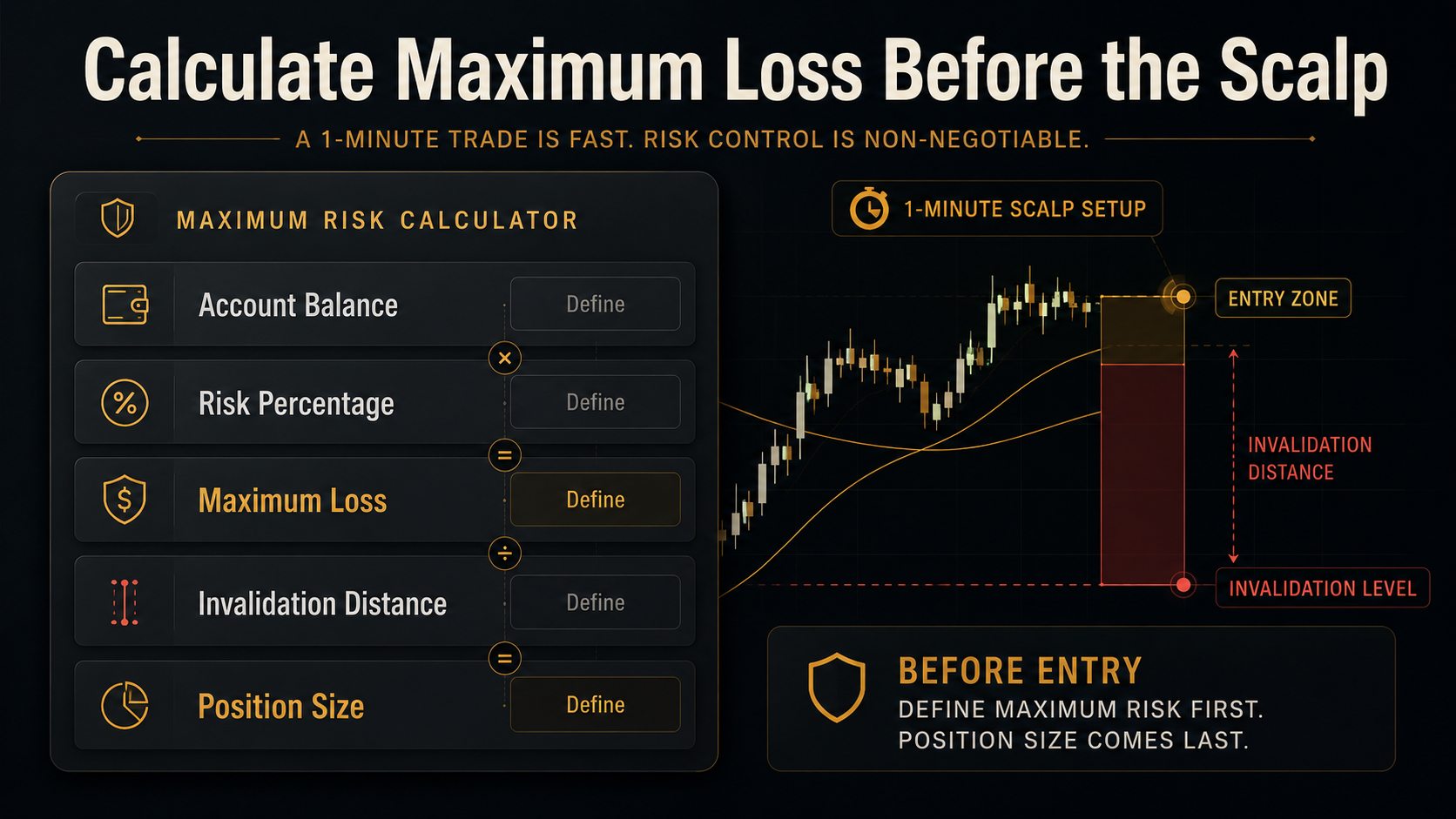
If the invalidation distance does not fit the maximum loss, the trade is skipped.
If the position size only works by accepting a liquidation distance inside recent 1-minute noise, the trade is skipped.
If the trade needs oversized exposure to feel meaningful, the setup is not clean enough.
The calculator does not make the trade good.
It tells the trader whether the trade is still acceptable after the structure is defined.
What Makes This Different From a Normal 1-Minute Trading Strategy
A normal 1-minute trading strategy focuses on timing.
A 1-minute crypto scalping strategy must also respect volatility.
Crypto can expand quickly. A candle can move far enough to make a previously clean setup inefficient. That is why late entries are more dangerous on crypto pairs than on slower markets.
The trader is not only asking:
Is this the right moment?
The trader is also asking:
Is this still the same trade after the candle expanded?
That question prevents many bad entries.
If the 1-minute chart feels too fast and the setup needs a higher-timeframe filter, read 5-Minute Crypto Scalping Strategy. That page explains how 1-hour structure, liquidity grabs, market structure shifts, and no-click rules should guide slower execution.
For a broader timing framework, read:
1-Minute Trading Strategy: Entry Filters Before You Click
For a broader scalping framework, read:
Why Crypto Scalping Entries Fail After the Fast Candle
This page connects those two ideas.
The focus here is narrower:
How to avoid bad 1-minute crypto scalping entries before the click happens.
Final Checklist Before You Click
Before entering a 1-minute crypto scalp, check:
- Is the larger structure clear enough?
- Is price near a real decision area?
- Did the candle body hold or reject the level clearly?
- Is the reaction visible before the entry becomes late?
- Is the invalidation area already defined?
- Is the entry still close enough to invalidation?
- Does the position size fit the maximum loss?
- Would recent 1-minute noise immediately threaten the trade?
- Would this trade still make sense if the previous trade was a loss?
If one answer is unclear, the setup is not ready.
If several answers are unclear, the trade is not a setup.
It is only motion.
Final Rule: Refusal Before Speed
The best 1-minute crypto scalping strategy is not the one that clicks first.
It is the one that refuses the most weak trades before the order is opened.
If structure is unclear, do not click.
If the candle cannot hold the level, do not click.
If the entry is already far from invalidation, do not click.
If the position size only works by ignoring distance, do not click.
Fast charts reward patience differently.
They do not reward the trader who reacts to every candle.
They reward the trader who can see movement, recognize that the setup is not clean, and still keep the mouse still.
Speed is only useful after the setup deserves execution.
Before that, refusal is the strategy.