You opened a trade with $100. You thought you risked $100. You were wrong. You were exposed to the full value of the position, and that is why you were liquidated.
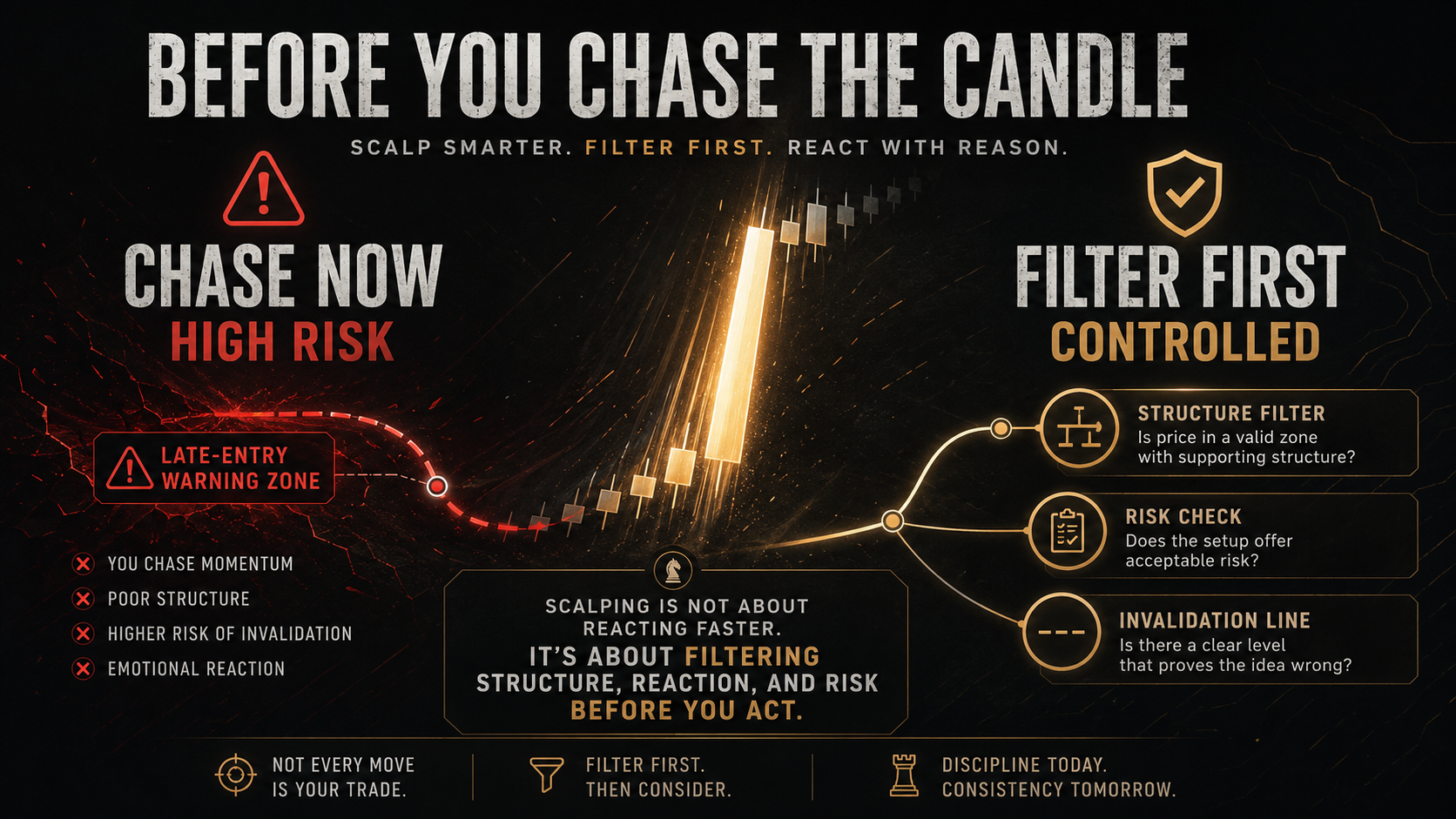
A crypto scalping strategy should not be built around chasing every fast candle.
It should be built around filtering.
Scalping attracts traders because it feels fast, active, and full of opportunity. A candle moves quickly, price reaches a level, and the trader feels pressure to enter before the move is gone.
That pressure is where many bad scalping trades begin.
A fast candle does not automatically mean a good entry. A price touch at a boundary does not automatically mean a trade either. The important question is not only where price is, but how price reacts there.
A practical crypto scalping strategy should answer five questions before entry:
- Where is the structure?
- Is price near a meaningful decision area?
- Has price reacted at that area?
- Where is the invalidation?
- Is the risk still acceptable?
If these questions are unclear, the trade is not ready.
This article explains how to use entry filters before chasing a fast candle. It is for educational purposes only and does not provide financial advice, trading signals, or guaranteed trading results.
Why Most Crypto Scalping Losses Start Before the Entry
Most scalping losses do not begin when the market moves against the trader.
They begin before the entry.
A trader sees a fast move and enters late. The candle already expanded. The distance to invalidation is wider. The risk is harder to define. The chart looks active, but the entry is no longer clean.
This is one of the most common problems in crypto scalping.
The trader is not entering from a planned structure.
They are reacting to speed.
A late entry creates several problems:
- The risk becomes larger.
- The reward becomes smaller.
- The trader has less room for normal pullback.
- The position may be too close to a reaction area.
- The invalidation point becomes unclear.
- The trade becomes emotional instead of structured.
A strong candle can attract attention, but attention is not a trading plan.
The question is not:
“Is price moving fast?”
The better question is:
“Is price reacting from a structure I already planned?”
That difference matters.
What a Crypto Scalping Strategy Should Actually Do
A crypto scalping strategy is not just a fast entry system.
It should be a decision filter.
The goal is not to trade every small move. The goal is to reject weak movement and only consider trades that have structure, location, reaction, invalidation, and risk control.
A clean scalping strategy should help the trader:
- Avoid chasing after a long candle
- Avoid entering in the middle of random movement
- Wait for price to reach a meaningful decision area
- Watch how price reacts at a boundary
- Define invalidation before entry
- Control position size before using leverage
- Skip trades when the setup is unclear
This is important because crypto markets can move quickly. BTC, ETH, and other high-volume crypto markets can create sharp candles that look attractive but become traps for late entries.
The best scalping opportunities usually do not come from panic clicking.
They come from preparation.
A trader marks the structure first.
Then waits for price to reach a decision area.
Then watches the reaction.
Then defines risk.
Only after that does the trader decide whether the setup is worth considering.
Filter 1: Start With Structure, Not Speed
The first filter is structure.
Before looking for a scalp entry, the trader should know what price is doing.
Is price inside a range?
Is price testing a boundary?
Is price breaking out?
Is price retesting a previous level?
Is price returning after a failed breakout?
Without structure, a scalping trade becomes a guess.
Many traders start from the lowest timeframe and try to react to every candle. That creates too much noise. A cleaner approach is to first check a slightly higher timeframe, such as the 5-minute or 15-minute chart, then use the lower timeframe only for timing.
The higher timeframe gives context.
The lower timeframe gives execution.
Without context, fast execution is dangerous.
Before entering a scalp trade, ask:
“What structure is this trade based on?”
If the answer is unclear, wait.
Filter 2: Treat Boundaries as Decision Areas
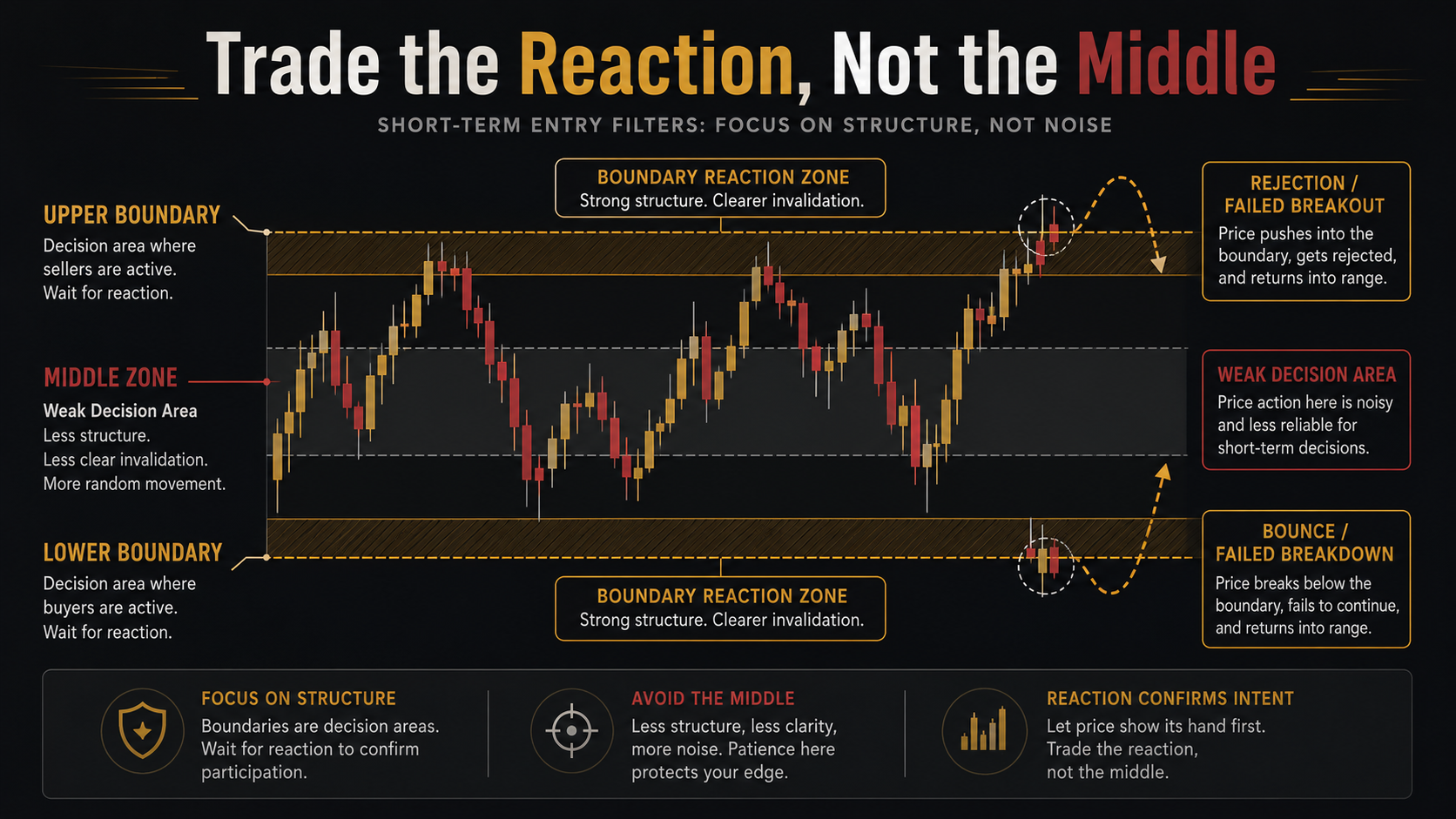
A boundary is not an automatic entry.
It is a decision area.
This is where many traders misunderstand support, resistance, and range structure. They think touching the upper boundary automatically means one thing, and touching the lower boundary automatically means the opposite.
That is too simple.
A boundary only tells the trader:
“Pay attention here.”
The reaction decides whether there is a trade idea.
At the upper boundary, price may reject and return into the range. It may also break through and continue. It may fake out and come back. The trader must watch the reaction.
At the lower boundary, price may bounce and return upward. It may also break down and continue lower. It may fake a breakdown and reclaim the range. Again, the reaction matters.
A boundary is useful because it gives the trader a place to define risk.
The middle of a range is weaker because there is usually less structure, less clear invalidation, and more random movement.
This does not mean the middle can never move.
It means the middle often gives the trader less control.
Before entering, ask:
“Am I reacting to a real boundary response, or am I chasing movement in the middle?”
That is a more professional way to think about scalping.
Filter 3: Wait for Reaction
A level alone is not enough.
Price must react.
A trader should not enter only because price touched support, resistance, or a range boundary. Touching a level only means price has reached a place to observe.
The reaction is what gives the level meaning.
A reaction may appear as:
- A rejection wick near the upper boundary
- A bounce near the lower boundary
- A failed breakout that returns into the range
- A failed breakdown that reclaims the range
- A retest that holds
- A slowdown after a strong push
- A shift in candle quality near the level
For scalping, this filter is important because entries happen quickly. If the trader enters before any reaction, the trade becomes prediction.
The goal is not to predict every candle.
The goal is to wait until price gives enough information to define the idea.
For example, if price reaches the lower boundary and immediately reacts upward, that may become a potential scalp idea if risk is clear. If price reaches the upper boundary and fails to break through, that rejection may also become a potential scalp idea.
The key is not the boundary alone.
The key is boundary plus reaction.
Before entering, ask:
“Has price actually reacted, or am I entering before the market has shown anything?”
If there is no reaction, there is no setup to evaluate.
Filter 4: Do Not Chase the Fast Candle
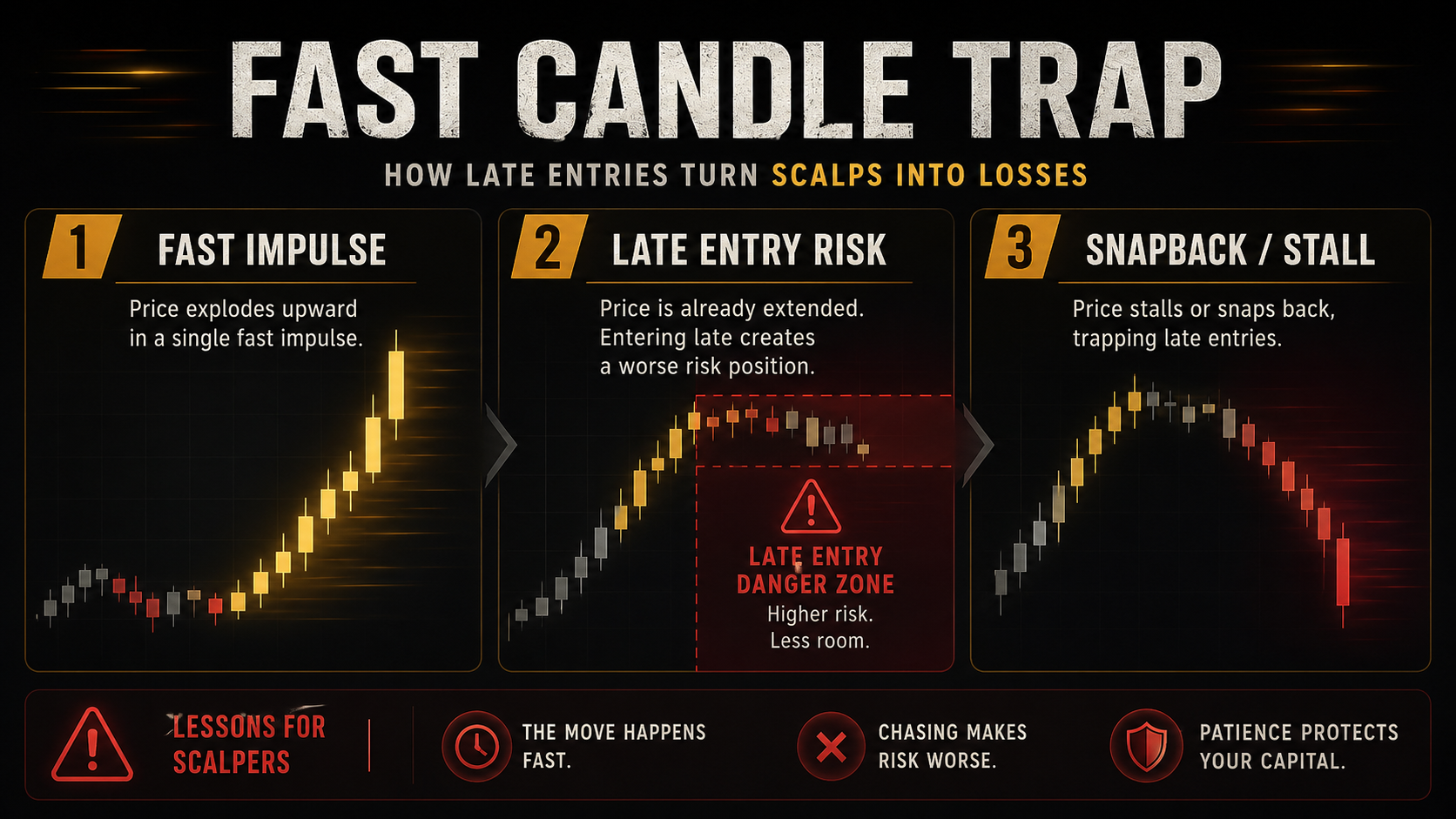
The fast candle is one of the biggest traps in crypto scalping.
It creates urgency.
It makes the trader feel late.
It makes the setup look obvious.
But by the time the candle is fully visible, the entry may already be poor.
A fast candle can mean several things:
- Real momentum
- Short-term stop run
- Late breakout
- Liquidity grab
- Emotional buying or selling
- A move that is already near exhaustion
The trader should not assume that every strong candle should be followed.
Instead, ask:
“Did this candle begin from a clean decision area, or am I reacting after the move?”
If the candle began from a planned boundary reaction, it may be useful.
If the candle appears in the middle of a move after price has already traveled far, chasing it may be dangerous.
A good scalping strategy does not tell the trader to chase speed.
It tells the trader to judge whether speed is happening in the right place.
If the fast candle looks safe only after the clean entry is gone, read Why Do I Always Enter Late in Crypto Trading. That article explains how lagging indicators, visual confirmation, and FOMO push traders into the move after the best risk location has already disappeared.
Filter 5: Define Invalidation Before Entry
A scalping trade without invalidation is not a strategy.
Invalidation means the point where the trade idea is wrong.
If the trader cannot define invalidation, they cannot define risk.
This is especially important in crypto because volatility can move quickly against a position. A small mistake can become larger when leverage is used or when position size is too high.
Before entering, define:
- What price behavior makes this trade wrong?
- Where should the idea be invalidated?
- Is the invalidation distance too wide?
- Can the position size survive normal noise?
- Is the risk acceptable if the trade fails?
A boundary reaction helps because it can give the trader a cleaner invalidation area.
For example, if price reacts from a lower boundary, the trader can evaluate whether that reaction remains valid. If price loses the boundary again, the idea may be invalid. If price rejects from an upper boundary and then breaks through with acceptance, the rejection idea may no longer be valid.
The exact trade decision depends on the trader’s rules.
But the principle stays the same:
Risk must be defined before entry.
Many traders enter first and think about risk later.
That is backwards.
If the invalidation is unclear, the trade should be skipped.
A Simple Crypto Scalping Strategy Framework
This framework is not a signal system.
It is a filter system.
The purpose is to help the trader avoid low-quality entries.
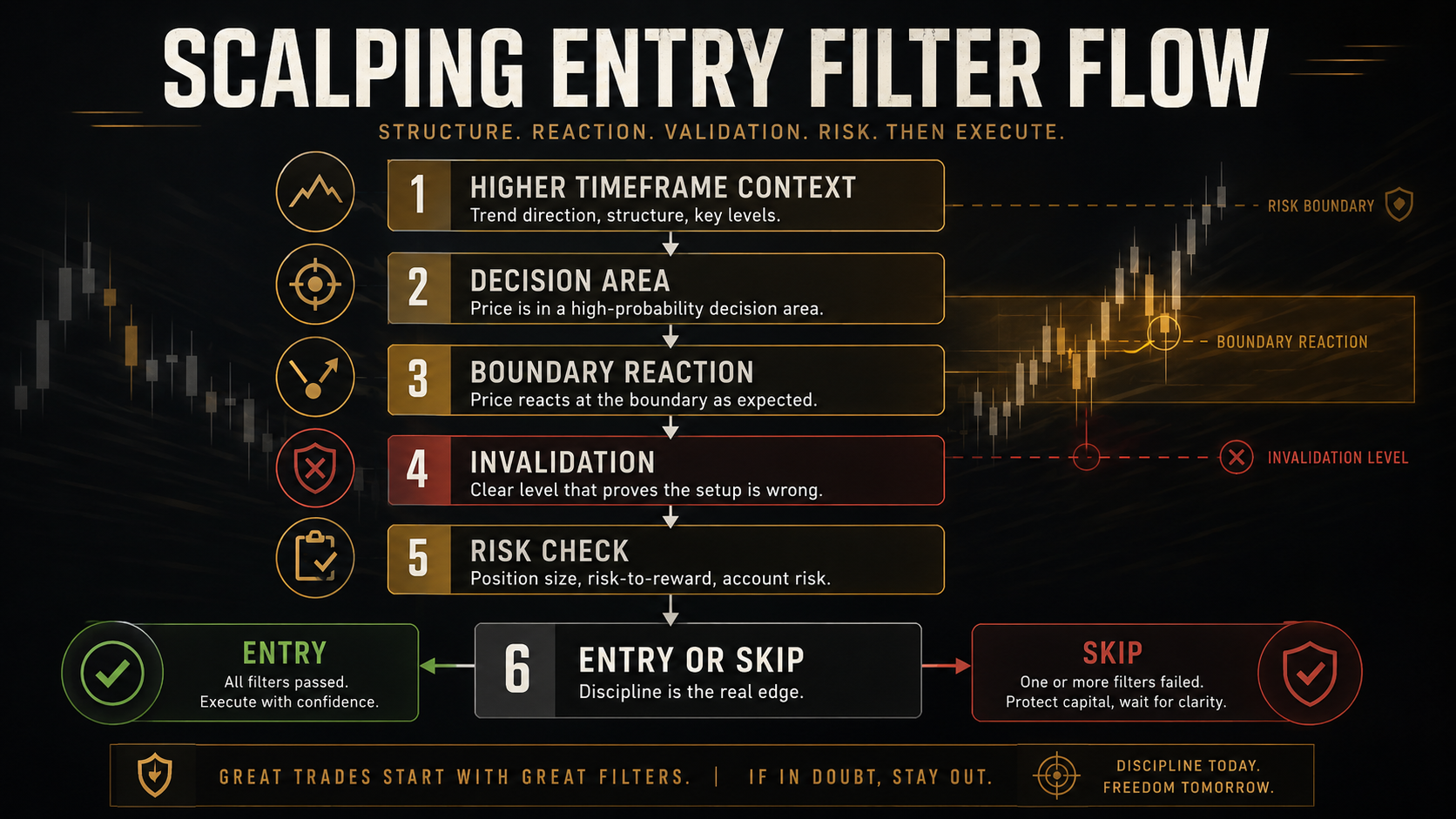
Step 1: Check Higher Timeframe Context
Start with a slightly higher timeframe.
Look for:
- Clear range
- Key boundary
- Retest zone
- Breakout area
- Failed breakout area
- Directional pressure
Do not begin by staring only at a 1-minute chart.
The lower the timeframe, the more noise appears.
Higher timeframe context helps reduce that noise.
Step 2: Mark the Decision Areas
Mark the areas where price has a reason to react.
These can include:
- Range high
- Range low
- Retest area
- Failed breakout zone
- Failed breakdown zone
- Previous support or resistance
Do not clutter the chart with too many lines.
A good decision area should be easy to explain.
For example:
“Price is returning to the range high.”
“Price is testing the lower boundary.”
“Price is retesting a failed breakout.”
If the area cannot be explained simply, it may not be clean enough.
Step 3: Wait for Price to Reach the Area
Most bad scalps happen because the trader enters before price reaches a useful location.
Waiting is part of the strategy.
If price is in the middle, wait for more information.
If price is already extended, wait.
If price is moving fast but far from structure, wait.
A scalping strategy should create fewer trades, not more trades.
The goal is not to predict every movement.
The goal is to wait until price reaches a place where a decision can actually be made.
Step 4: Watch the Boundary Reaction
When price reaches the decision area, observe the reaction.
Do not click immediately.
Look for whether price is accepting the area or rejecting it.
At an upper boundary, watch for:
- Rejection
- Failed breakout
- Return into range
- Clean breakout and acceptance
At a lower boundary, watch for:
- Bounce
- Failed breakdown
- Range reclaim
- Clean breakdown and acceptance
This is important.
The same boundary can create different trade ideas depending on the reaction.
The level does not decide.
The reaction decides.
Step 5: Define Invalidation and Risk
Before entry, define the invalidation point and risk amount.
This includes:
- Position size
- Maximum loss
- Stop area
- Leverage risk
- Liquidation distance if using futures
- Whether the entry is early or late
If the trade only works with oversized leverage, it is not a clean setup.
If the risk is too large, the trade should be skipped.
Step 6: Enter Only If the Filters Are Clear
The final decision is simple.
If structure, decision area, reaction, invalidation, and risk are clear, the trader may consider the setup.
If one or more filters are unclear, skip it.
No trade is also a decision.
In scalping, avoiding weak trades can be more important than finding perfect trades.
What a Bad Crypto Scalping Setup Looks Like
A bad setup usually feels urgent.
The trader sees movement and wants to enter before the opportunity disappears.
Common bad scalping setups include:
- Entering after a long candle has already formed
- Chasing a breakout with no reaction or retest
- Trading in the middle of random movement
- Entering without a clear invalidation point
- Increasing leverage because the entry is late
- Using large size after a previous loss
- Ignoring fees, spread, and slippage
- Taking trades only because the chart looks active
A bad setup often looks exciting.
A clean setup often looks boring.
That is why many traders ignore the clean setup and chase the bad one.
Scalping rewards discipline, not excitement.
Crypto Scalping Risk: Fees, Spread, Slippage, and Leverage
Crypto scalping is sensitive to small costs.
Because the target move is often small, fees and spread matter more than many beginners realize.
A setup may look clean on the chart, but after fees and slippage, the actual result may be weaker.
The trader should also consider leverage.
Leverage does not improve a bad entry.
It only makes the result larger.
Before scalping with leverage, ask:
- Is the entry close enough to invalidation?
- Is the position size reasonable?
- Is liquidation distance safe enough?
- Are fees and spread acceptable?
- Am I chasing because the candle already moved?
- Would this trade still make sense without leverage?
If the answer is unclear, the setup is not strong enough.
If frequent small wins still leave the account red after fees, slippage, and one oversized loss, read Realistic Win Rate for BTC Scalping Strategies. That article explains why high accuracy can still lose money when trade frequency and bad loss structure work against the account.
Crypto Scalping vs Random Fast Trading
Scalping and random fast trading can look similar from the outside because both involve fast decisions.
The difference is process.
A scalper uses structure, boundary reaction, risk limits, and invalidation.
A random fast trader reacts to movement.
A scalper can explain why a trade exists.
A random trader only says the chart is moving.
A scalper can skip a trade.
A random trader feels forced to click.
This distinction matters because fast markets create emotional pressure. A trader who does not have a process will usually replace process with impulse.
That is how overtrading begins.
Final Checklist Before You Enter a Crypto Scalp
Before entering a crypto scalping trade, check:
- Is there clear structure?
- Is price near a meaningful decision area?
- Has price reacted at the boundary?
- Am I entering early enough, or chasing late?
- Is the invalidation point clear?
- Is the position size controlled?
- Is the liquidation distance safe enough?
- Are fees and spread acceptable?
- Am I calm enough to make the decision?
- Would I still take this trade if the last trade was a loss?
If the answers are unclear, skip the trade.
The goal of a crypto scalping strategy is not to click faster.
The goal is to filter better.
The Best Crypto Scalping Strategy Is Not the Fastest Entry
The best crypto scalping strategy is not the one that enters the fastest.
Fast entries often feel attractive because the candle is already moving. But by the time the move looks obvious, the entry may already be late, the invalidation may be too wide, and the risk may no longer be clean.
A stronger crypto scalping strategy starts with structure first. Price location, reaction, invalidation, and position size should be clear before speed matters.
For short-term crypto scalping, the better question is not how fast the entry is. The better question is whether the trade still has structure after the fast candle appears.
Final Rule: Trade the Reaction, Not the Candle
Crypto scalping can be useful when it is built around structure, decision areas, boundary reaction, invalidation, and risk.
But when scalping becomes candle chasing, the trader loses control.
A fast candle is not enough.
A boundary touch is not enough.
A signal is not enough.
The trade needs structure and reaction.
Before chasing the next fast candle, slow down and ask:
Where is the decision area?
What reaction has appeared?
Where is the invalidation?
What is the risk?
If those answers are not clear, the best trade may be no trade.