You won 8 trades today. You felt like a genius. Your dashboard was flashing green. You were finally “cracking the code.”
Then, one late BTC scalp erased all of them.
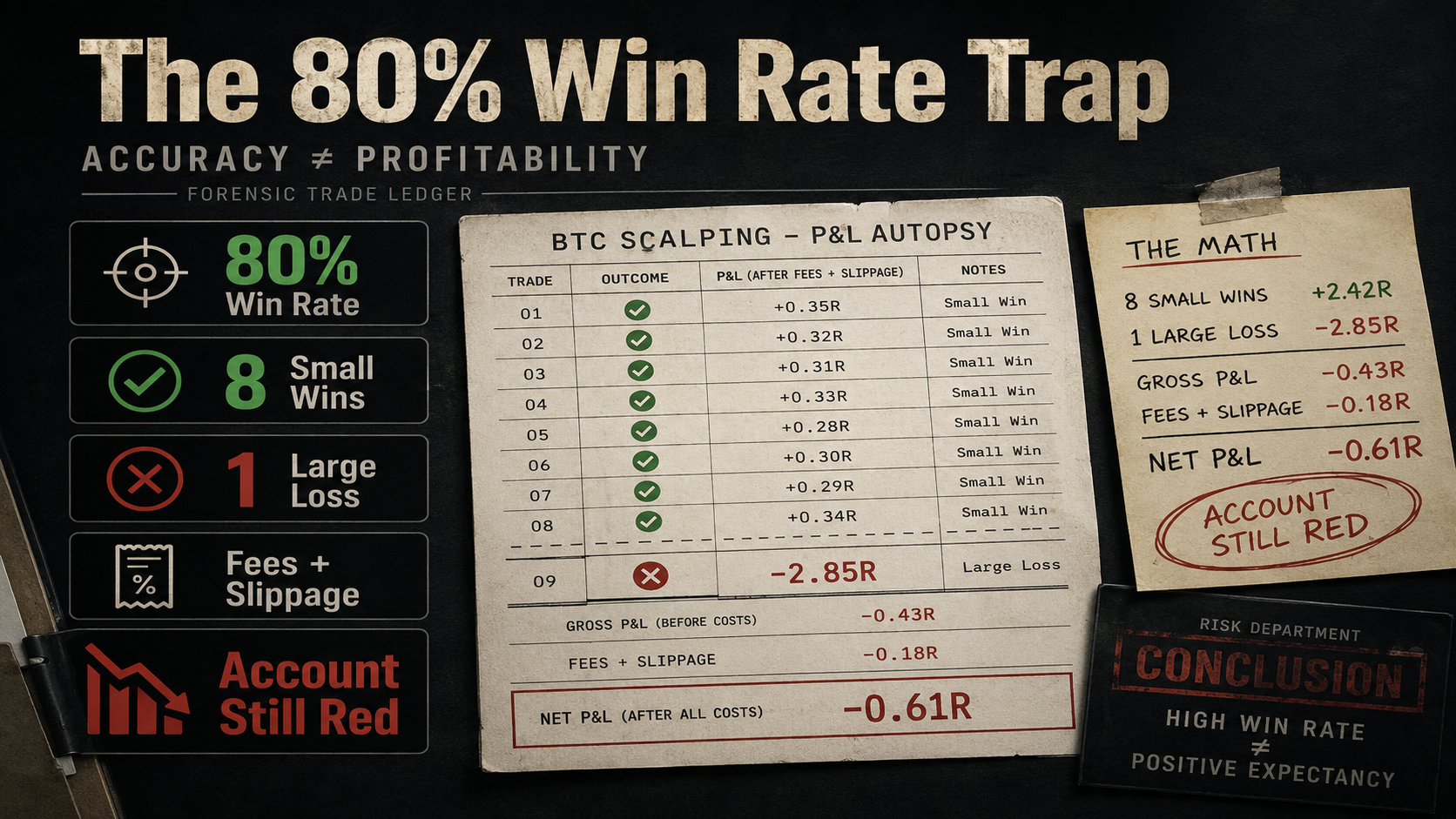
You look at your screen, stunned. Your win rate looked excellent—80% accuracy. Your account balance? It still went down. This is the silent killer of retail traders: the obsession with being “right” rather than being profitable. If you think a high win rate is your path to wealth, you are already walking into a liquidation trap.
The 80% Win Rate Trap: How One Loss Erases Eight Wins
Let’s look at the actual crime scene of your portfolio. Many scalpers operate with a strategy that yields many small, consistent wins but suffers from catastrophic, infrequent losses.
Imagine this scenario: You execute 10 BTC scalps. 8 of them are successful, each netting you $10 in profit. Total profit: $80. 1 of them goes wrong. You hesitate, you move your stop loss, and you finally exit with a $120 loss. Suddenly, your gross P&L is -$40.
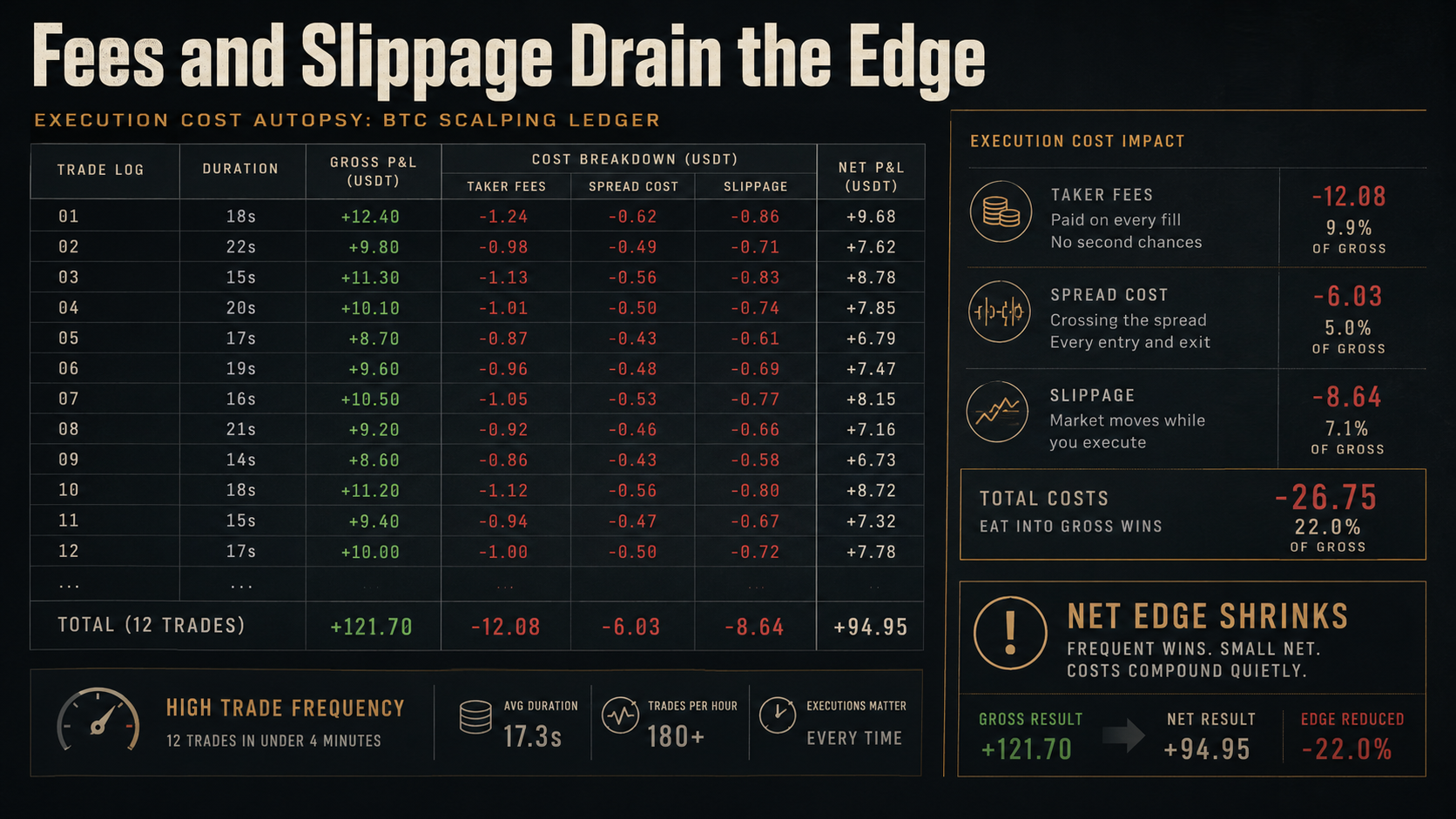
Now, add the hidden parasites. You paid $15 in exchange taker fees for those 10 trades, and you suffered $5 in slippage because your entry was too slow. Your final result is -$60.
You won 8 out of 10 trades, yet you lost 6% of your $1,000 account in a single day. This is the reality of “High Accuracy” trading. It creates the illusion of progress while the underlying structure of your risk management is rotting from the inside.
If one late BTC scalp keeps erasing a full day of small wins, the problem may not be your win rate. It may be your entry timing. Read Why Do I Always Enter Late in Crypto Trading to understand why the most comfortable entry is often the most expensive one.
The Mathematical Reality: Accuracy vs. Expectancy
The pros do not care about accuracy. They care about Expectancy.
Expectancy is the average amount you can expect to win or lose per trade. Professional scalpers focus on increasing the RRR (Risk-to-Reward Ratio) rather than the win rate. A trader with a 40% win rate and a 3:1 Risk-to-Reward ratio will absolutely destroy a trader with an 80% win rate who has a 1:5 Risk-to-Reward ratio.
Stop asking, “How can I win more trades?” and start asking, “How can I make my losers smaller and my winners larger?” If your strategy requires you to be right 80% of the time to survive, your strategy is not a business; it is a gambling habit with a slow burn.
For the broader execution framework behind BTC scalping, read BTC Scalping Strategy. That page explains why late entries, false breakouts, and weak invalidation often matter more than the raw win rate number.
A Realistic Look at Win Rates
You asked for a realistic benchmark. Here is the blunt truth:
For many risk-first BTC scalping strategies, a 45%–55% win rate can still be workable if the risk-to-reward structure is clean.
If your win rate is significantly higher, you are likely over-leveraged, holding losers too long, or failing to account for the impact of market friction. If your win rate is lower, your execution or your setup selection is structurally flawed. Do not chase the 70% or 80% win rate promised by charlatans. Chasing that number forces you to take sub-optimal trades and avoid the necessary risks that lead to your biggest winners.
The Hidden Killers: Fees and Slippage
When you scalp BTC, you are fighting a war on two fronts: the market and the exchange.
Every time you enter a position, you are paying the spread (slippage). Every time you exit, you are paying taker fees. If you are taking 20 trades a day, you are essentially working for the exchange, not for yourself.
A realistic scalping strategy accounts for these costs in the “edge” calculation. If a setup only offers a potential gain that is barely covered by the cost of the trade, it is not a setup—it is a donation to the exchange. Professionals filter their setups so aggressively that they may only take 3 or 4 high-quality trades a day, keeping their net profit higher than the trader who “won” 20 times but ended the day red after fees.
If fees, slippage, and one oversized loss are damaging the account, define the maximum acceptable loss before the next scalp. Use the Maximum Risk Calculator before choosing position size.
Shifting the Paradigm: Focus on the Cost of Being Wrong
The moment you stop caring about your win rate, you become a better trader.
When you obsess over win rate, you become emotionally attached to every single trade. You fear the loss because it ruins your “percentage.” This fear leads to hesitation—the most lethal emotion in scalping.
Professional scalpers do not view trades as wins or losses. They view trades as execution exercises. They have a defined setup based on liquidity and order flow, and they execute it. Whether the outcome is profit or loss is irrelevant to their execution.
Stop trying to find a strategy that never loses. Start building a strategy that manages its losses so efficiently that they never threaten your account longevity. The professional scalper’s edge is not found in being right; it is found in managing the cost of being wrong.