Learn a practical 1-minute trading strategy based on structure, location, reaction, momentum, and risk filters before entering a fast trade.
A 1-minute trading strategy should not be built around speed.
It should be built around filters.
Most traders who open a 1-minute chart are not looking for structure. They are looking for a fast decision. One candle moves up, they click. One candle drops, they click. A signal appears, they follow it. The market moves against them, and they immediately look for the next trade.
That is not a strategy.
That is reaction.
A 1-minute chart can be useful, but only when the trader already knows what to look for before the candle moves. The lower the timeframe, the less time there is to think. That means the decision process must be prepared in advance.
The goal of this guide is simple:
Before you click, check the filters.
This article is for educational purposes only. It does not provide financial advice, signals, or guaranteed trading results.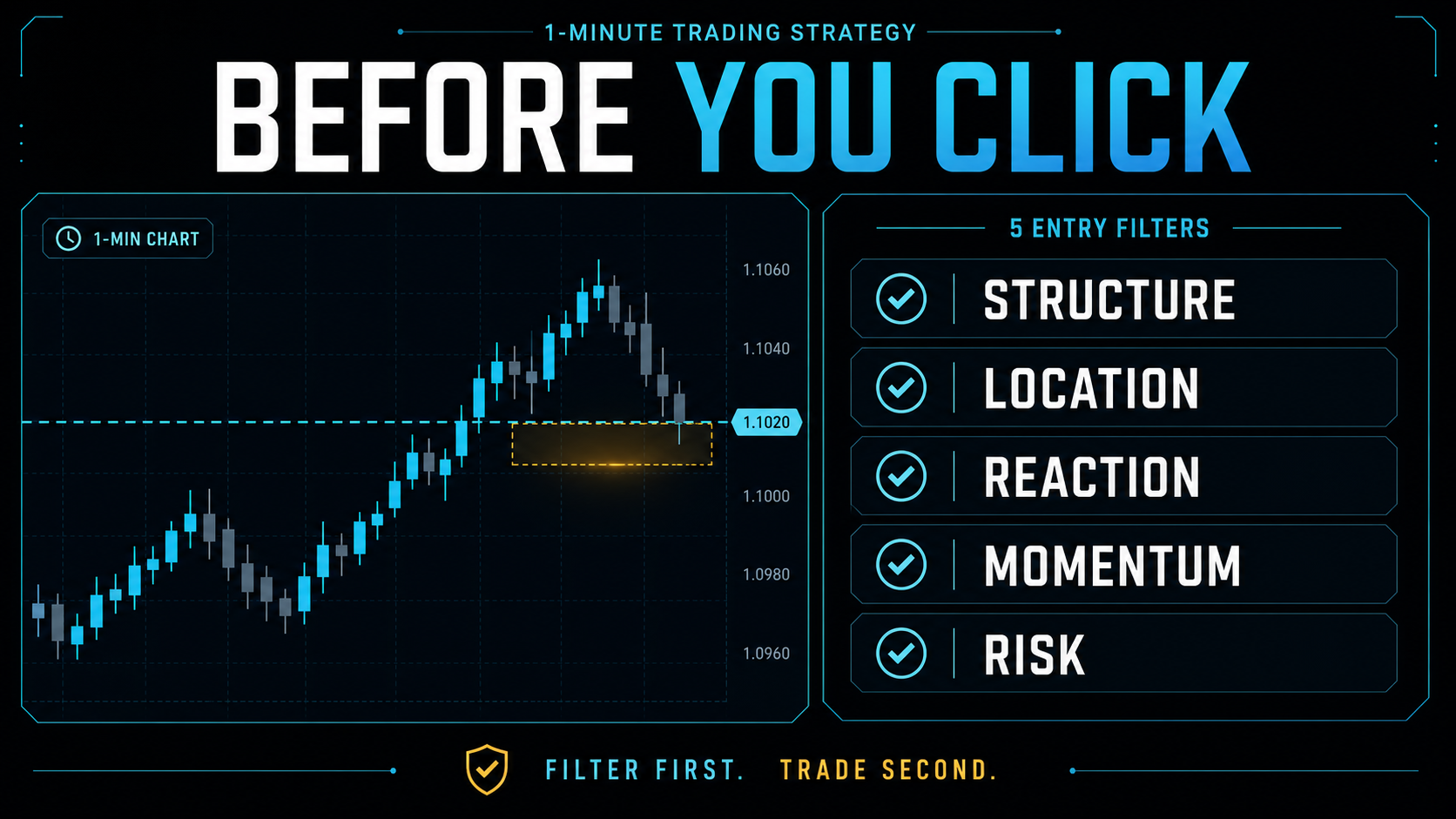
Why Most 1-Minute Trades Fail Before the Entry
The biggest problem with 1-minute trading is not the timeframe itself.
The problem is that the timeframe exposes every weakness in the trader.
On a higher timeframe, a trader may have more time to think. On a 1-minute chart, hesitation, fear, greed, revenge trading, and overconfidence show up immediately.
Most bad 1-minute trades come from five problems:
- The trader enters in the middle of a range.
- The trader chases a candle after the move already happened.
- The trader follows a signal without checking structure.
- The trader ignores spread, fees, slippage, or liquidation risk.
- The trader opens another trade immediately after a loss.
A fast trade does not become better because it happens quickly.
A fast trade only makes sense when the setup is already filtered.
If there is no structure, there is no trade.
If there is no invalidation, there is no trade.
If the risk is not defined, there is no trade.
That is the first rule of a serious 1-minute trading strategy.
The Core Idea: Do Not Predict the Next Candle
Many beginners think 1-minute trading means predicting the next candle.
That is the wrong mindset.
A cleaner approach is not to ask:
“Will the next candle go up or down?”
A better question is:
“Is price reacting at a meaningful level?”
This changes the entire decision process.
Instead of chasing movement, the trader waits for location.
Instead of guessing direction, the trader watches reaction.
Instead of trusting one fast candle, the trader checks whether the trade has structure, timing, and risk control.
A 1-minute strategy should not be a prediction machine.
It should be a filtering system.
The Five Entry Filters Before You Click
Before entering any 1-minute trade, check these five filters.
If one filter is missing, the trade is weaker.
If several filters are missing, there is no trade.
Filter 1: Structure
The first filter is market structure.
Structure means price is doing something clear enough to read.
For example:
- Price is moving inside a range.
- Price is testing a boundary.
- Price is rejecting a level.
- Price has broken out and is retesting.
- Price is returning back inside a failed breakout zone.
Without structure, the 1-minute chart becomes noise.
Many traders enter just because a candle is moving. But movement alone is not structure. A strong candle in the middle of nowhere does not create a clean setup.
Before you click, ask:
“Where is price inside the structure?”
If the answer is unclear, wait.
Filter 2: Location
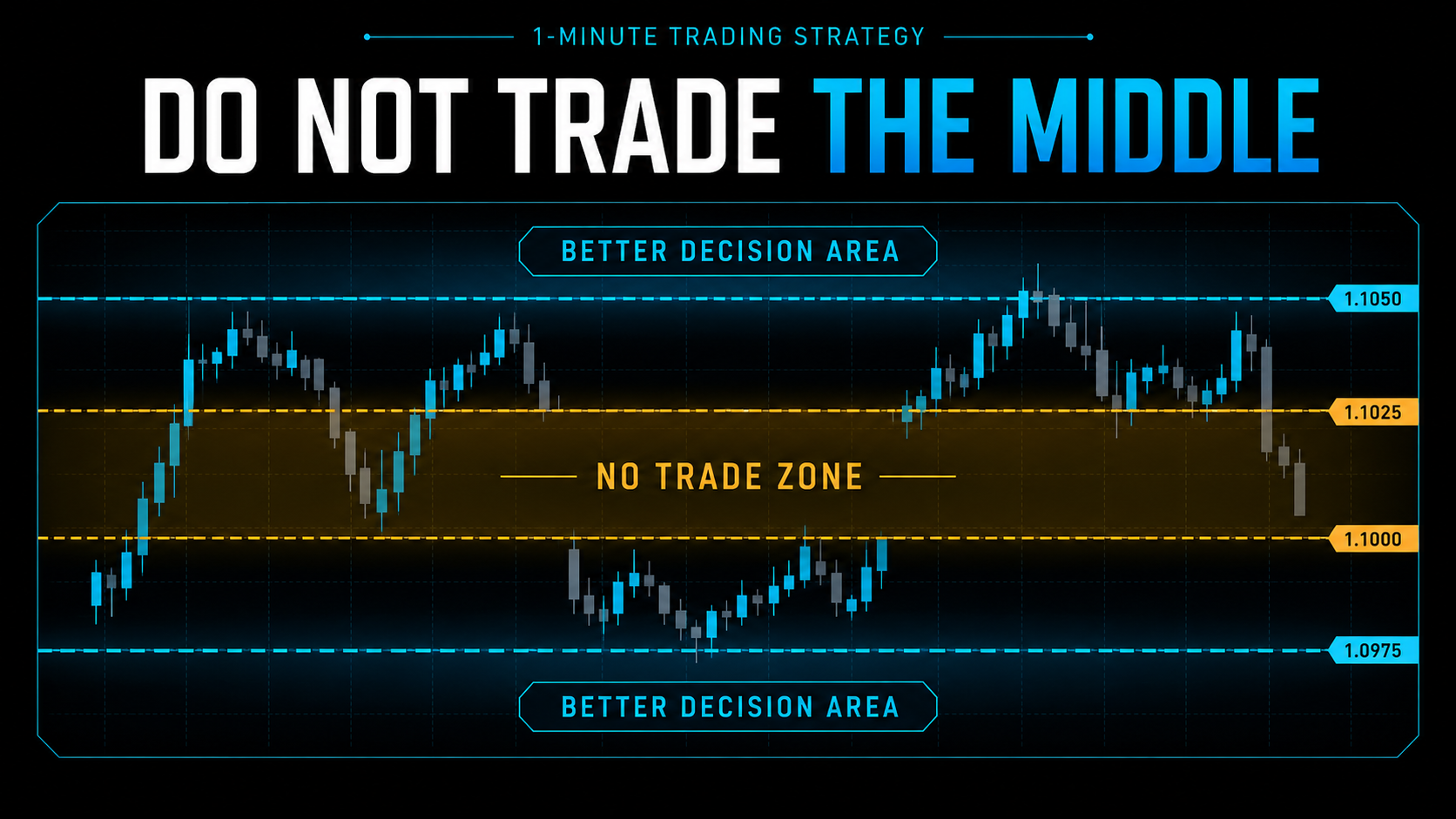
A good 1-minute entry depends heavily on location.
The same candle can mean different things depending on where it appears.
A rejection candle near a clear boundary may matter.
The same candle in the middle of a range may mean nothing.
This is why many traders lose money even when they “read the candle correctly.” The candle was not the problem. The location was the problem.
Better locations include:
- Range highs
- Range lows
- Retest zones
- Failed breakout areas
- Clear support or resistance boundaries
- Areas where risk can be defined tightly
Weak locations include:
- The middle of a range
- After a long candle has already moved
- Random areas with no clear level
- Entries taken only because a timer is about to expire
Before you click, ask:
“Am I entering at a meaningful location, or am I just reacting to movement?”
Filter 3: Reaction
After structure and location, the next filter is reaction.
A level alone is not enough.
Price must react.
Reaction can appear as:
- A rejection from a boundary
- A failed breakout
- A retest that holds
- A fast return back into the range
- A slowdown after pushing into a key area
The important point is this:
Do not enter only because price touched a level.
A level is a place to pay attention.
A reaction is what gives the level meaning.
For example, if price reaches a range high, that does not automatically mean it should drop. It may break out. It may continue. It may fake out and return.
The trader must observe how price behaves at the level.
Before you click, ask:
“Has price actually reacted, or am I entering before the market confirms anything?”
Filter 4: Momentum Quality
Momentum is another important filter, especially on a 1-minute chart.
Fast candles can look powerful, but not all movement is clean.
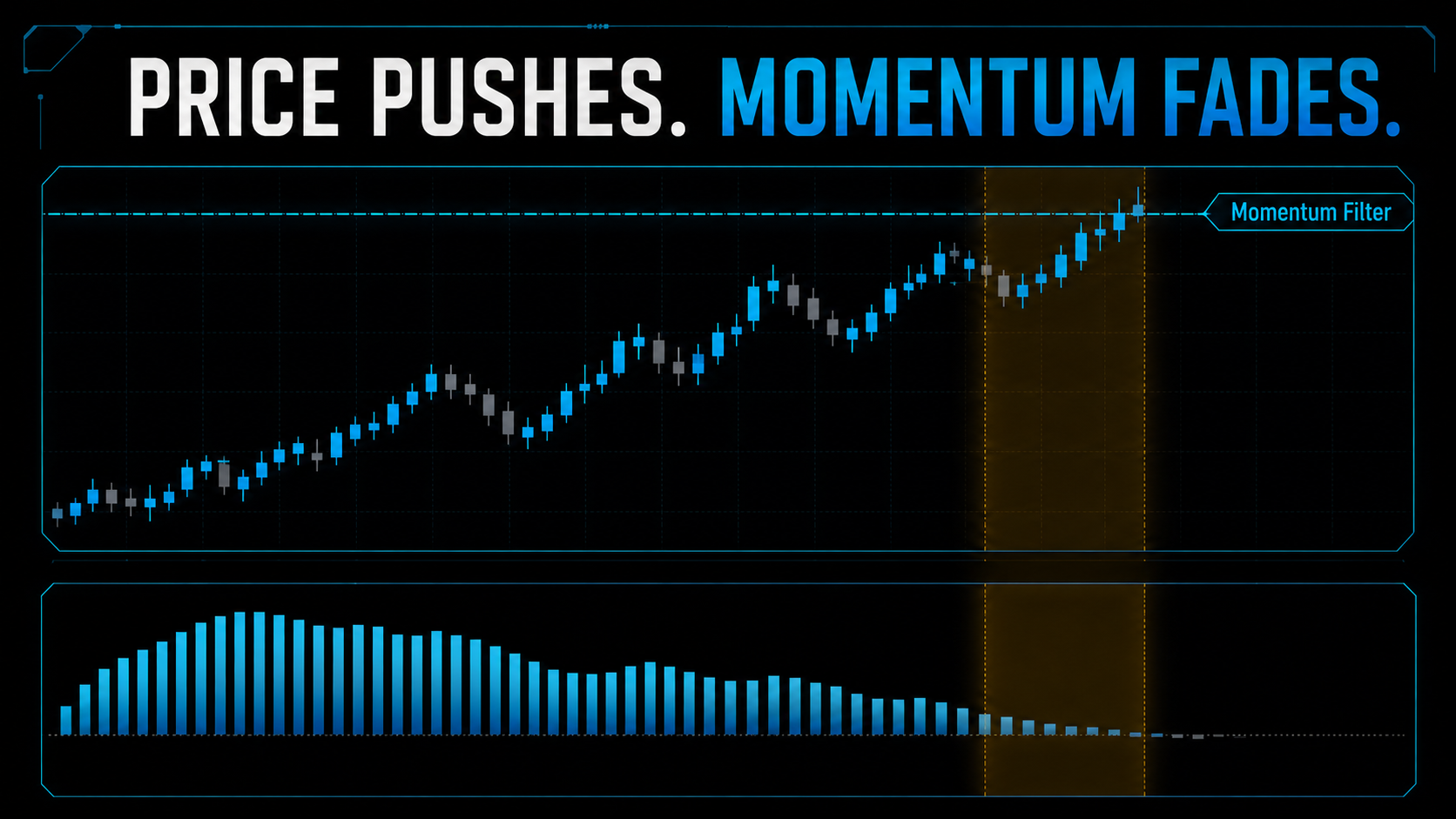
Sometimes price pushes higher while momentum becomes weaker. Sometimes price breaks a level but fails to continue. Sometimes one large candle attracts late entries, then price snaps back.
This is where many short-term traders get trapped.
A cleaner entry should not rely on one aggressive candle. It should check whether the move still has quality.
Before entering, ask:
- Is the move still expanding, or is it slowing?
- Did price break the level cleanly, or did it immediately return?
- Are candles becoming weaker near the boundary?
- Is the trader entering early, or chasing late?
For crypto scalping, this is especially important because a small delay can change the entire risk profile. On leveraged trades, a bad entry can quickly turn into forced liquidation if position size is too large.
If the fast entry is specifically a crypto scalp, read 1-Minute Crypto Scalping Strategy. That article explains why structure, reaction, invalidation, and no-click red flags must come before speed on the 1-minute chart.
For fixed time trading, the risk is different but still serious. A trader may be correct about the larger direction but wrong about the next short time window. Timing error becomes the main risk.
That is why momentum must be filtered before entry.
Filter 5: Risk
The final filter is risk.
This is the filter most beginners ignore.
They ask:
“Is this a good entry?”
But the better question is:
“What happens if this entry is wrong?”
A trade without risk control is not a strategy. It is exposure.
Before entering a 1-minute trade, define:
- The invalidation point
- The maximum loss
- The position size
- The stop area, if applicable
- The liquidation distance, if using leverage
- The reason to avoid the trade if risk is too large
For crypto futures, the liquidation distance is critical. A setup can look good on the chart, but if the position size is too large, the trade may not survive normal market noise.
For fixed time trading, the position risk is usually known before entry, but the timing risk is higher. That means the trader must be even more selective. A weak entry should not be taken just because the payout looks attractive or the timer is close.
If the trade depends on a fixed expiry window, read Fixed Time Trading Strategy. That article explains why structure, reaction quality, timing filters, and predefined risk must come before any fast short-duration entry.
Before you click, ask:
“Can I accept the loss if this trade fails?”
If the answer is no, the position is too large or the setup is not clean enough.
A Simple 1-Minute Trading Strategy Flow
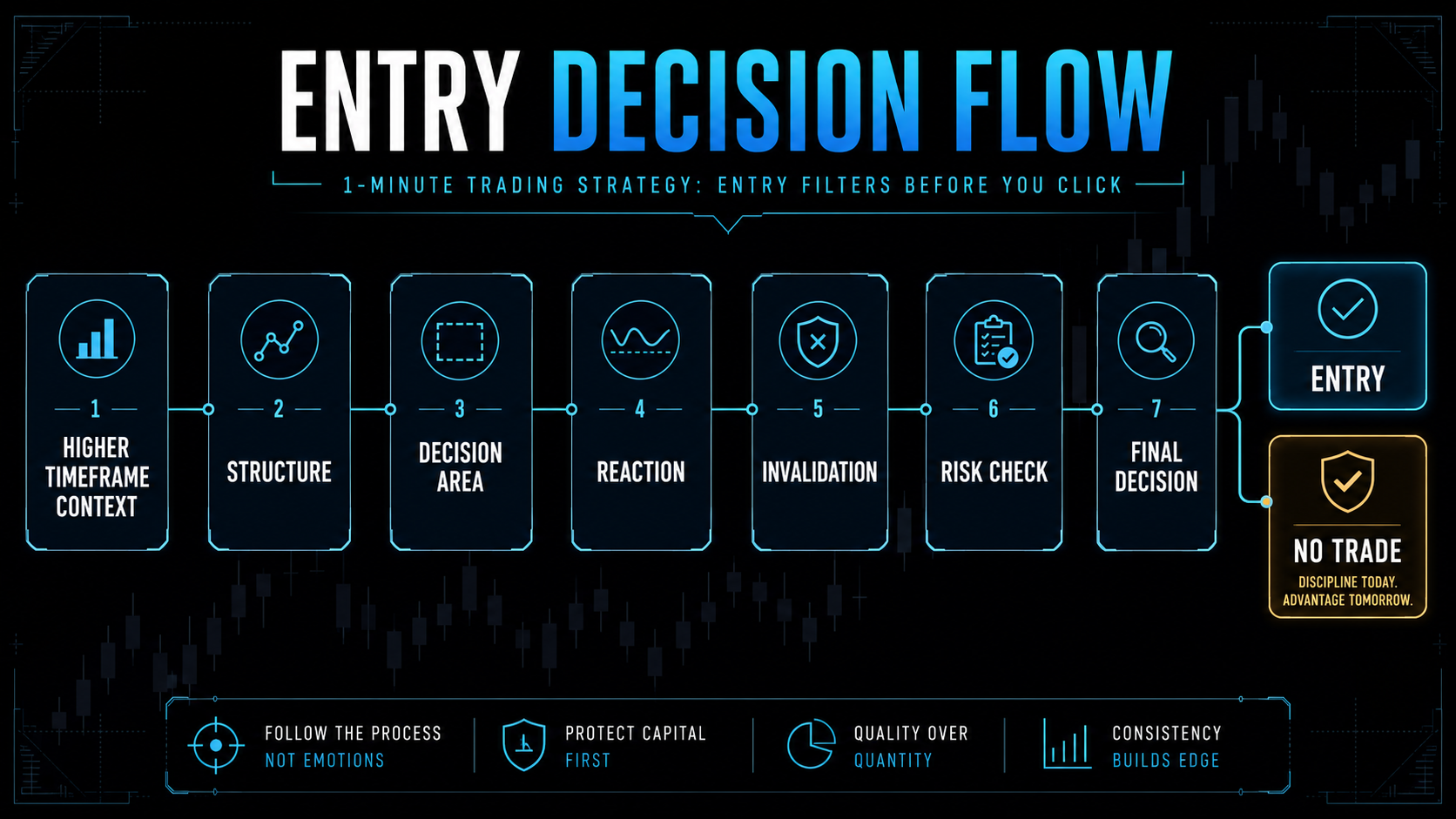
Here is a simple decision flow.
This is not a signal system.
It is a filter system.
Step 1: Start from the higher timeframe
Do not begin with the 1-minute chart.
First, check a slightly higher timeframe, such as the 5-minute or 15-minute chart.
Look for:
- A clear range
- A key support or resistance area
- A breakout zone
- A failed breakout zone
- A clean trend structure
The higher timeframe gives context.
The 1-minute chart gives timing.
Without context, the 1-minute chart becomes random noise.
Step 2: Mark the structure
Mark the range, boundary, or key level.
Do not draw too many lines.
A cluttered chart usually creates unclear decisions.
The trader should be able to answer:
“Where is the trade idea coming from?”
If there is no clear answer, there is no setup.
Step 3: Wait for price to reach the decision area
The best part of the strategy is often waiting.
Most bad trades happen before price reaches a useful location.
Do not force a trade in the middle of the chart.
Wait for price to move into a zone where the decision actually matters.
A clean 1-minute trade usually starts before the entry, not at the entry.
The preparation happens first.
The click happens last.
Step 4: Watch the reaction
When price reaches the level, watch the reaction.
Do not click immediately.
Look for signs that price is accepting or rejecting the area.
If price breaks and holds, the market may be showing continuation.
If price breaks and quickly returns, the market may be showing failure.
If price reaches the level and momentum fades, the move may be losing quality.
The goal is not to catch every move.
The goal is to avoid low-quality entries.
Step 5: Define invalidation before entry
Before clicking, define the point where the trade idea becomes wrong.
This is the difference between a trade and a guess.
If the trader cannot define invalidation, the trade is not ready.
A simple question helps:
“What price behavior would prove this idea wrong?”
If there is no clear answer, wait.
Step 6: Enter only if the risk still makes sense
Even if the setup looks clean, the trade can still be bad if the risk is too large.
Do not increase position size because the setup “feels obvious.”
Do not use leverage to recover losses.
Do not click faster because the market is moving quickly.
The final decision should be based on structure, location, reaction, momentum, and risk.
Not emotion.
What a Bad 1-Minute Entry Looks Like
A bad entry usually feels urgent.
The trader feels like the market is leaving without them.
They see a fast candle and think:
“I need to enter now.”
But urgency is not a trading reason.
Common bad entries include:
- Entering after three candles already moved in one direction
- Clicking because of fear of missing out
- Entering in the middle of a range
- Following a random signal without checking structure
- Increasing size after a loss
- Trading when spread or volatility is too high
- Entering because the timer is about to close
- Ignoring where the trade becomes invalid
Bad entries often look exciting.
Good entries often look boring.
That is why many traders avoid good setups and chase bad ones.
A Practical Entry Checklist
Before opening a 1-minute trade, use this checklist:
- Is there a clear structure?
- Is price near a meaningful location?
- Has price reacted at the level?
- Is momentum clean, or is it fading?
- Is the entry early enough, or am I chasing?
- Do I know where the trade idea is wrong?
- Is the maximum loss acceptable?
- Is my position size controlled?
- Am I entering because of a setup, not emotion?
- Would I still take this trade if I had just lost the previous one?
If the answer to most of these questions is unclear, do not enter.
The best filter in 1-minute trading is often patience.
Crypto Scalping vs Fixed Time Trading
The same entry filters can be used in different fast-trading environments, but the risks are not the same.
In crypto scalping, the trader must consider:
- Fees
- Spread
- Slippage
- Stop placement
- Position size
- Liquidation distance
- Volatility spikes
A small mistake can become large if leverage is too high.
In fixed time trading, the trader must consider:
- Timing risk
- Expiry window
- Overtrading
- Emotional clicking
- Signal dependence
- Entries taken too late
The market may move in the expected direction later, but the fixed time window may expire before that happens.
That is why a fast strategy should never be based only on direction.
Timing, structure, and risk must all align.
The Real Purpose of a 1-Minute Trading Strategy
The purpose of a 1-minute trading strategy is not to trade more.
It is to reject more.
A beginner looks for reasons to enter.
A disciplined trader looks for reasons to avoid the trade.
This difference matters.
On a 1-minute chart, there will always be movement. There will always be candles. There will always be something that looks like an opportunity.
But most movement is not worth trading.
The job of the trader is not to click every possible setup.
The job is to wait until the trade has enough structure to justify the risk.
Final Rule: Filter Before You Click
A 1-minute chart can create pressure.
It makes the trader feel like every second matters.
But the real edge does not come from clicking faster.
It comes from filtering better.
Before entering a fast trade, check:
Structure.
Location.
Reaction.
Momentum.
Risk.
If those filters are not clear, the best trade may be no trade.
A serious 1-minute trading strategy is not built around prediction.
It is built around control.