Most beginners do not lose in crypto futures because they fail to predict the market.
They lose because they use leverage before defining risk.
A fast BTC candle creates pressure. Leverage makes that pressure larger. And without a clear invalidation point, a beginner is no longer trading a setup. He is reacting to speed.
Crypto futures trading can look simple from the outside. Price goes up, long. Price goes down, short. Add leverage, and the result looks faster.
But the real problem is not whether a trader can press long or short.
The real problem is whether the trader understands what can go wrong before entering.
This guide is not about predicting the next candle. It is about building a simple risk filter before taking a crypto futures trade: structure, invalidation, maximum risk, and market reaction.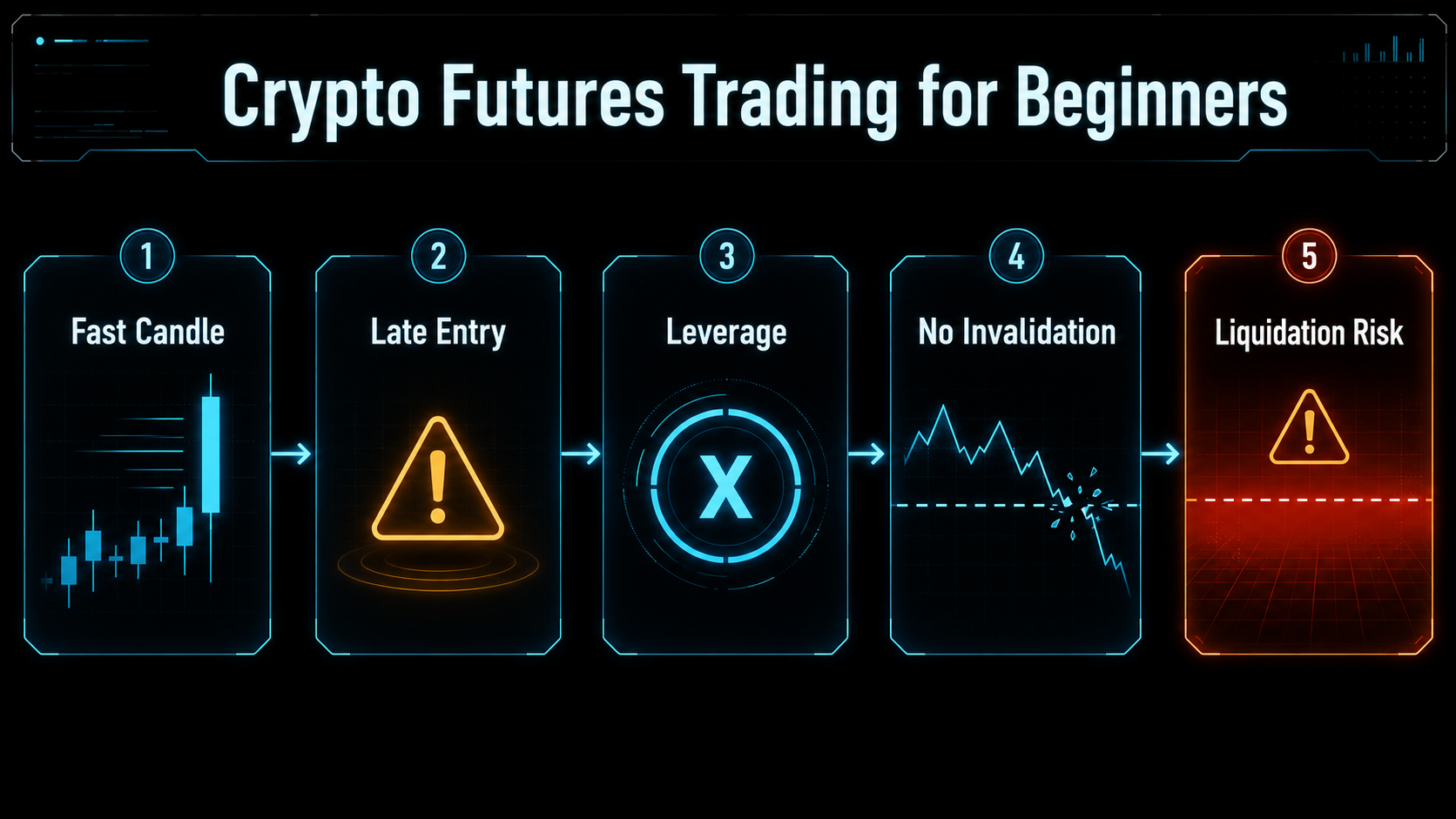
What Is Crypto Futures Trading?
Crypto futures trading allows traders to speculate on the future price movement of a crypto asset without simply buying and holding the asset.
In spot trading, a trader buys an asset directly. If the price drops, the value of the position falls, but the position is not automatically closed just because price moves against the trader.
Futures trading is different.
With crypto futures, traders can open long or short positions, often with leverage. This means a trader can control a larger position than the amount of margin placed in the account.
That is why futures feel attractive to beginners.
A smaller amount of capital can create a larger position. A small move can feel meaningful. The trade moves faster. The emotions move faster too.
But that same speed is also the danger.
A larger position does not make a trade better. It only makes the result larger.
If the trade is poorly timed, leverage does not fix it. It only makes the mistake more expensive.
Crypto Futures vs Spot Trading
The difference between spot trading and futures trading is not only technical. It changes the entire risk profile.
In spot trading, a trader usually buys the asset and holds it. The position can lose value, but it does not normally get force-closed because of leverage.
In crypto futures trading, the position can be liquidated.
That means the exchange can close the trade automatically when the trader’s margin is no longer enough to support the leveraged position.
For beginners, this is the first major lesson:
A futures trade is not just about direction. It is about distance to liquidation, position size, margin, volatility, and risk control.
A trader can be right about the larger direction and still lose money if the entry is too late, the leverage is too high, or the position size is too large.
This is why futures trading requires a different mindset.
Spot trading asks: “Do I want exposure to this asset?”
Futures trading asks: “Can this position survive normal market movement before the idea is proven wrong?”
That second question is where many beginners fail.
What Leverage Really Does
Leverage does not improve a trade setup.
It only increases the size of the outcome.
If a trade has no structure, leverage will not create structure. If the entry is late, leverage will not make the entry clean. If the trader has no invalidation level, leverage will not define one.
Leverage simply magnifies the position.
That means it magnifies both sides:
- profit if the trade moves in favor of the position
- loss if the trade moves against it
- emotional pressure while the trade is open
- liquidation risk if the move is large enough
Many beginners think leverage is mainly a tool for making more from a smaller move.
A better way to think about leverage is this:
Leverage reduces the amount of room a trader has to be wrong.
The higher the leverage, the less distance price needs to move before the position becomes dangerous.
If leverage still feels like a simple multiplier, read What Is Leverage Trading Crypto?. That article explains why small margin can hide larger exposure before a beginner understands the real position size.
This is why beginners should not ask first, “How much leverage should I use?”
They should ask:
“What is the maximum loss I can accept if this trade fails?”
“What price level proves the trade idea wrong?”
“Is my entry close enough to structure, or am I chasing after the move?”
Without those answers, leverage becomes pressure.
What Liquidation Means for Beginners
Liquidation happens when an exchange force-closes a leveraged position because the trader no longer has enough margin to keep the trade open.
For beginners, liquidation often feels sudden. But in most cases, the risk was already there before the trade was opened.
The liquidation is only the final result.
The real problem usually starts earlier:
- entering after price already moved
- using leverage before defining risk
- holding without a clear invalidation level
- increasing position size after a loss
- confusing fast movement with opportunity
Many traders only understand liquidation after their first forced close.
Before that moment, leverage feels like a shortcut.
After that moment, the trader realizes that a futures position can end before the market has finished moving.
This is why a beginner should never treat liquidation as just a number on an exchange interface.
Liquidation risk is a sign that the trade has a survival problem.
To understand why liquidation is not the same as a planned exit, read Crypto Liquidation vs Stop Loss. That article explains why a stop loss is part of the trader’s plan, while liquidation is the platform taking control away from the trader.
If normal volatility can force-close the position before the setup is confirmed, the position is too fragile.
Why Beginners Lose Fast in Crypto Futures
Crypto futures trading is attractive because the feedback is immediate.
A trade can move into profit quickly. It can also move into loss quickly. This fast feedback creates a dangerous habit: reacting to every candle.
Beginners often lose fast because they mistake speed for quality.
A candle breaks upward, so they enter long.
A candle dumps, so they enter short.
A position goes red, so they double down.
A trade gets stopped or liquidated, so they immediately try to win it back.
This is how overtrading begins.
The market creates movement. The trader creates pressure. The pressure creates another entry.
But a fast market does not mean every move is tradable.
A beginner needs fewer undefined decisions, not more indicators.
The most common beginner mistakes in crypto futures are:
- entering late after a candle already expanded
- using leverage before knowing the failure point
- trading without maximum loss defined
- treating every breakout as confirmation
- holding a trade after the original structure has failed
- revenge trading after a loss
- increasing size because the first entry was wrong
None of these problems are solved by another signal.
They are solved by structure.
For a deeper futures risk filter, read Why Crypto Futures Trades Fail Even When the Setup Looks Clean. That article breaks down why invalidation, position size, and liquidation distance matter more than a clean-looking candle.
The Three Things to Define Before Any Futures Trade
Before entering any crypto futures trade, define three things.
1. Maximum Loss
This is the amount you are willing to lose if the trade fails.
It should be defined before entry, not after the position moves against you.
If the maximum loss is not written down, the trader will often negotiate with the position while emotional.
That is when a small mistake becomes a large mistake.
2. Invalidation Level
The invalidation level is the price area where the trade idea is no longer valid.
It answers a simple question:
“What price behavior proves this setup wrong?”
Without invalidation, there is no clear exit logic.
A beginner may keep holding because the market “might come back.” But hope is not a risk plan.
3. Reason the Structure Is Still Valid
Every futures trade should have a structural reason.
Not just a feeling. Not just a fast candle. Not just a call from someone else.
A valid reason may involve a range, a boundary, a retest, a reaction, or a clear failure point.
If price no longer respects the structure, the trade idea weakens.
If the structure is still valid, the trader has a reason to continue observing.
This does not guarantee a winning trade. It simply keeps the decision process grounded.
Risk Before Entry: A Simple Beginner Filter
Before taking a crypto futures trade, a beginner can use a simple filter.
Ask four questions:
- Is there a clear structure?
- Is there an invalidation level?
- Is the maximum loss defined?
- Has price reacted in a way that supports the setup?
If the answer is no, the trade is not ready.
This filter is especially important for fast entries.
When price moves quickly, the trader feels pressure to act. But pressure is not confirmation.
A fast candle is only movement.
The question is whether the market accepts the move, rejects it, or traps late traders.
This is why reaction matters.
A breakout without reaction is only a test.
A liquidation move without structure is only an event.
A futures entry without risk control is only exposure.
How the Phantom Box Protocol Fits Into Futures Trading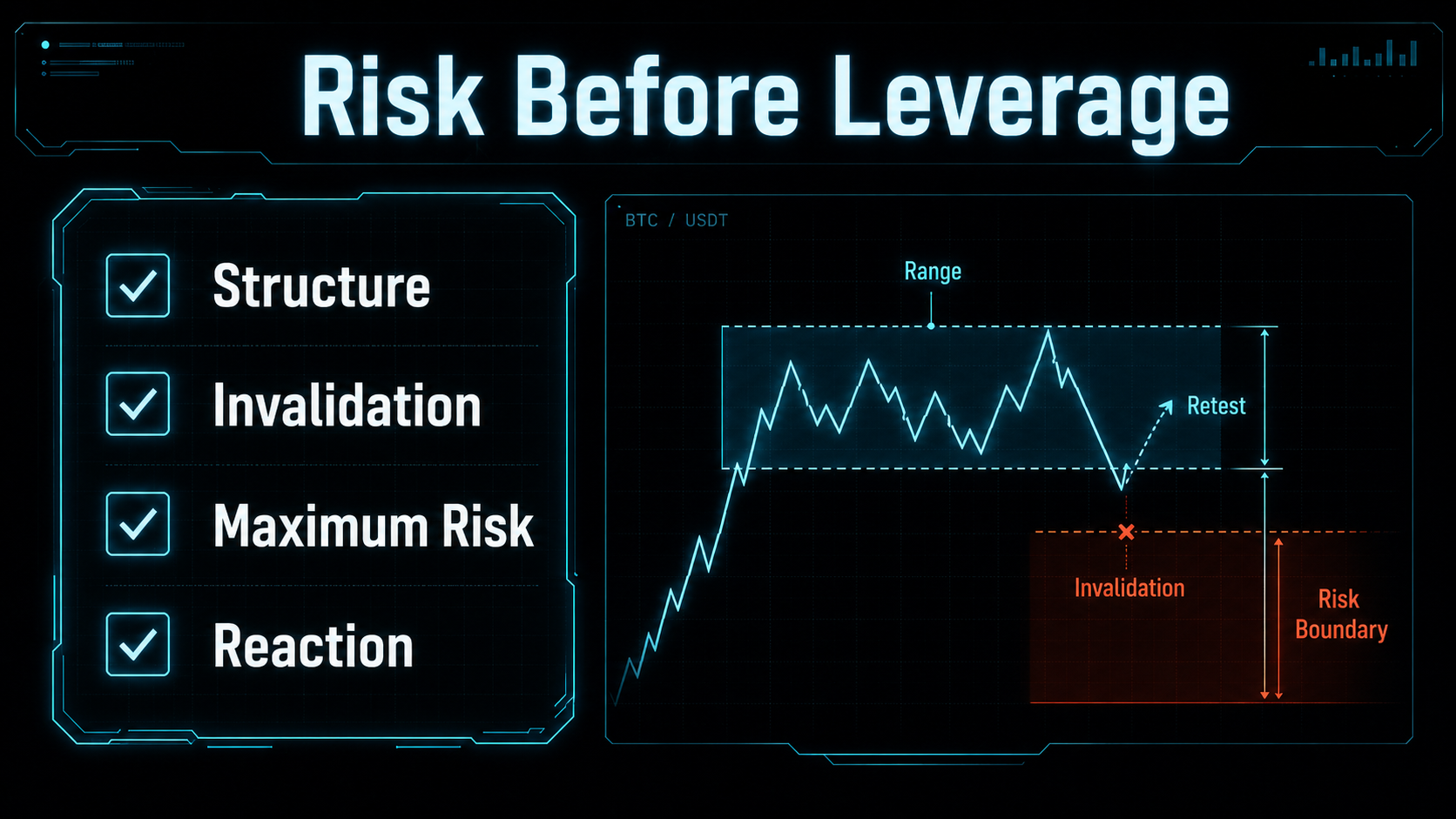
The Phantom Box Protocol is not a signal system.
It is a structure-first filter.
Before a fast futures entry, it asks whether price has a range, a boundary, a reaction, and a clear failure point.
That matters because beginners often enter futures trades too early or too late.
Too early, and the structure has not confirmed.
Too late, and the trader is chasing after the move.
The Phantom Box Protocol focuses on reading the current structure before execution. It does not try to predict every candle. It tries to reduce undefined decisions before the trade begins.
For crypto futures beginners, that is the important shift.
The first goal is not to find more trades.
The first goal is to stop entering trades that have no structure, no invalidation, and no defined risk.
No defined risk, no execution.
Final Checklist Before Your Next Futures Trade
Before your next crypto futures trade, slow the decision down.
Use this checklist:
- What is the structure?
- Where is the boundary?
- What reaction confirms or weakens the setup?
- Where is the invalidation level?
- What is the maximum loss?
- Is the entry late?
- Is leverage being used before risk is defined?
- Would this trade still make sense without emotional pressure?
If these questions cannot be answered, the trade is not ready.
Crypto futures trading is not dangerous only because of leverage.
It is dangerous when leverage is combined with speed, emotion, and undefined risk.
A beginner does not need more buttons to press.
A beginner needs a cleaner filter before pressing one.