The setup looked clean.
BTC broke out of the range. The candle had momentum. The chart looked like it was finally choosing a direction.
The trader opened a futures position with leverage.
The problem was not the direction.
The problem was the risk.
Position size was too large. Invalidation was not clearly defined. The liquidation price was too close to normal market noise. A small pullback became account pressure before the trade had enough room to develop.
That is where many crypto futures trades fail.
A crypto futures trading strategy is not only about finding a direction. It is about knowing whether the trade can survive being wrong, early, or slightly late.
Spot trading can punish a bad entry.
Futures trading can punish it faster.
Leverage does not create a better setup. It only makes the result larger. If the trade has no invalidation, no position size control, and no liquidation distance, the strategy is already broken before the entry.
A serious futures trade needs risk filters before the order is opened.
This article is for educational purposes only. It does not provide financial advice, trading signals, or guaranteed trading results.
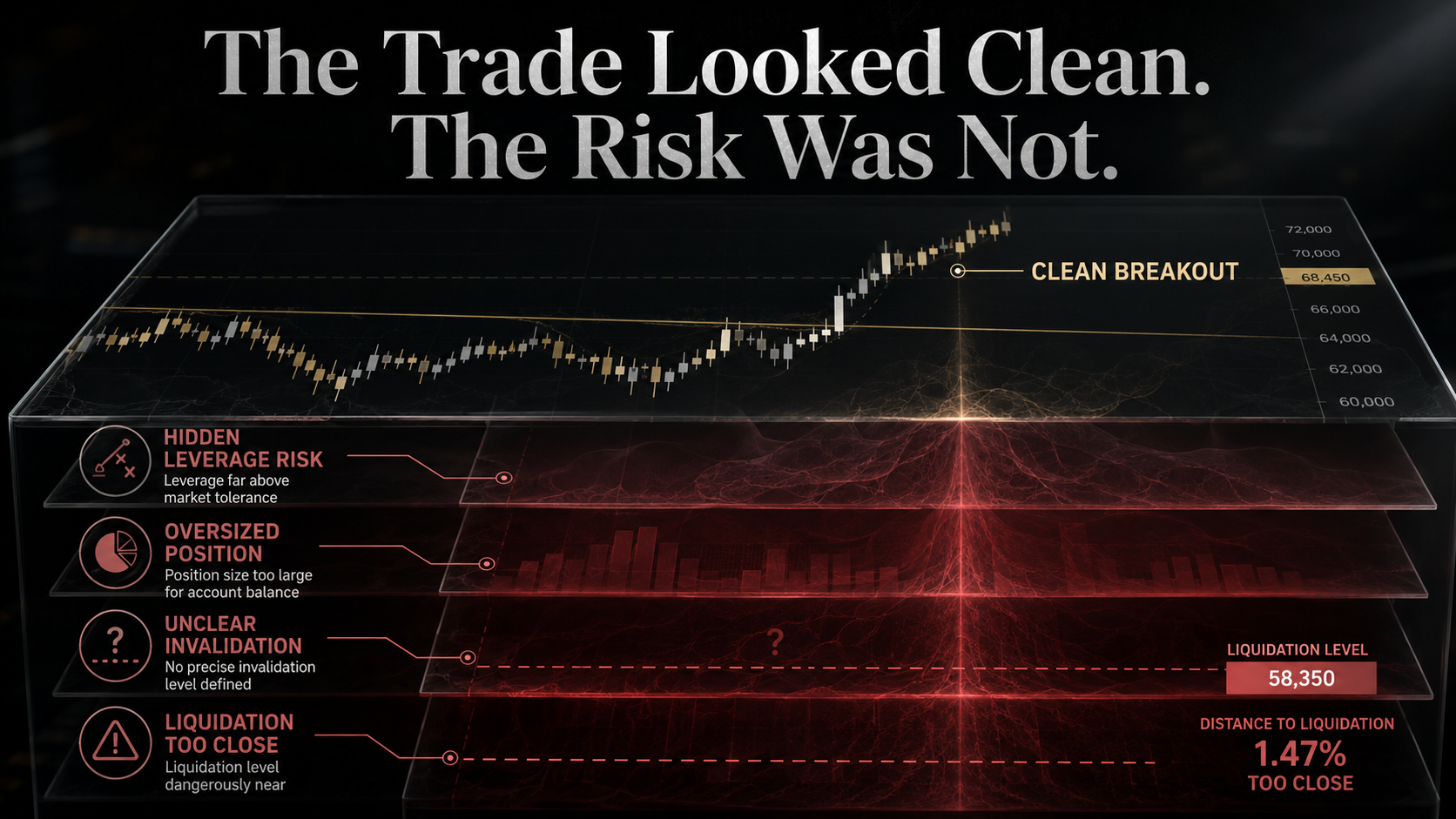
A Clean Setup Can Still Be a Bad Futures Trade
A chart setup can look reasonable and still be a poor futures trade.
That is the part many traders miss.
The market structure may be clear. The breakout may be real. The direction may even continue later. But if the entry uses too much size, places liquidation too close, or has no clear invalidation, the trade can fail before the idea has time to work.
In futures trading, the quality of the setup and the quality of the risk are separate things.
A clean chart does not automatically mean clean risk.
The trade may look like continuation, but the trader may be entering too far from the level that matters. The stop area may be unclear. The position size may be based on confidence instead of account risk. Leverage may be chosen before the trader knows where the idea is wrong.
That turns a futures trade into exposure.
The market does not need to fully reverse to damage that trade.
It only needs to pull back enough to pressure margin, trigger emotional decisions, or move too close to liquidation.
A futures strategy becomes serious only when the risk is defined before the entry.
Leverage Makes Timing Errors More Expensive
Leverage is not the main problem.
Using leverage before the trade is defined is the problem.
A trader often increases leverage because the setup looks obvious. The candle breaks out, momentum appears, and the trade feels urgent. The larger position makes the opportunity feel more meaningful.
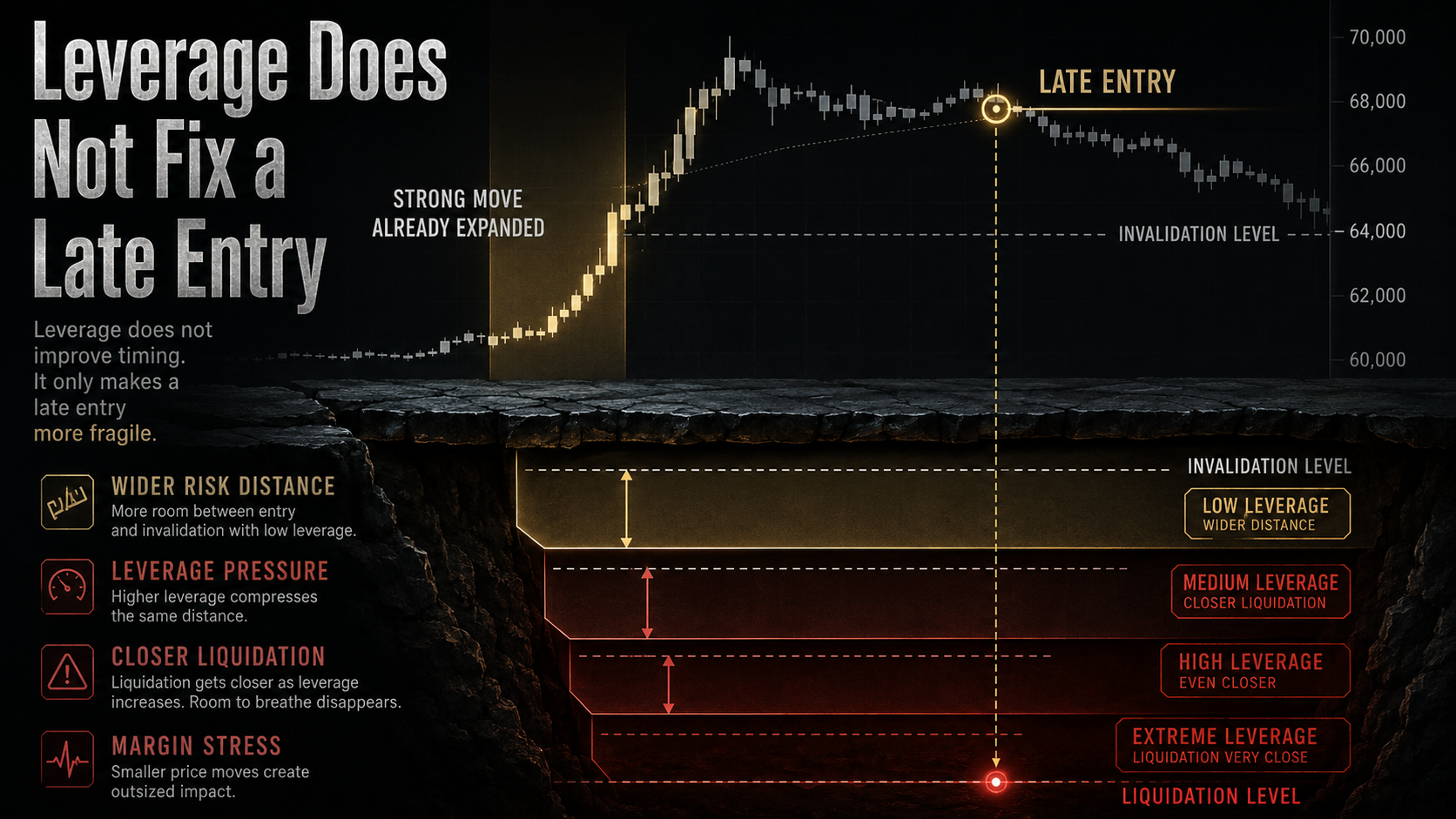
But leverage does not improve timing.
It does not make a late entry better.
It does not make an unclear invalidation clearer.
It does not protect the account from normal volatility.
It only reduces the amount of movement needed to create pressure.
A small BTC or altcoin pullback that would be normal on spot can become uncomfortable in futures. The trader may close early, add margin emotionally, widen the stop, or increase size to recover.
The trade was not destroyed by the market.
It was destroyed by leverage applied before risk was understood.
If leverage still feels like a simple multiplier instead of a liquidation mechanism, read How Does Leverage Work in Crypto Futures Trading?. That article explains how initial margin, maintenance margin, collateral, and the liquidation engine work inside crypto futures.
A good futures strategy does not start by asking how much leverage can be used.
It starts by defining the trade idea and then sizing the position around the risk.
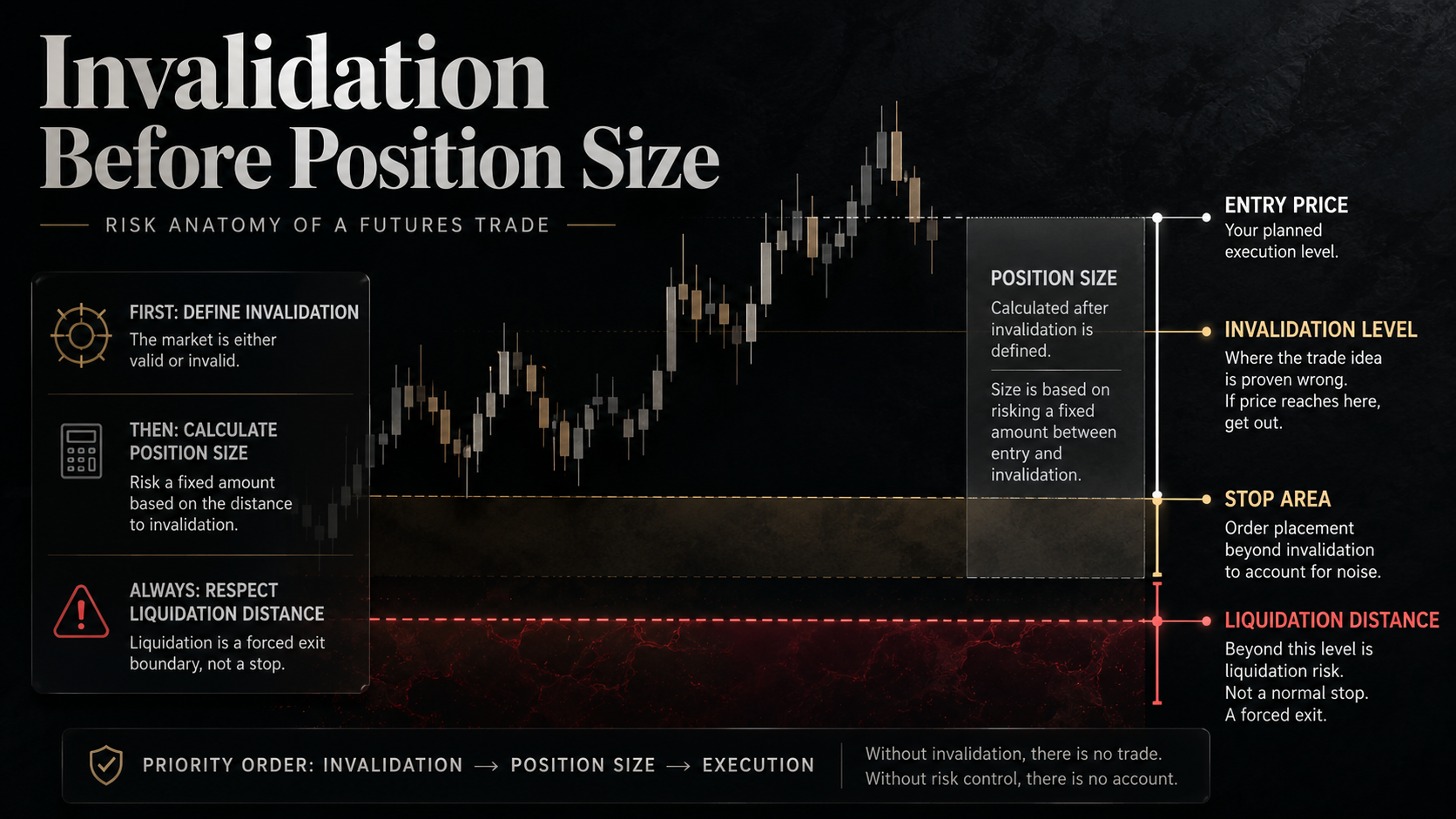
Invalidation Must Come Before Position Size
Invalidation is the price behavior that proves the trade idea wrong.
Without invalidation, position size becomes guesswork.
Many futures traders enter first and define risk later. That is backwards. Once the position is open, emotion changes the decision. A small pullback feels personal. A normal retest feels dangerous. A candle against the trade feels like the market is attacking the account.
That pressure comes from missing invalidation.
The trade needs a clear line between normal movement and a broken idea.
If BTC breaks out and the trade idea depends on holding above the breakout level, losing that level may invalidate the idea. If price reclaims a range after a failed breakdown, losing the reclaim may invalidate the idea. If price reacts from a boundary, failure to maintain that reaction may invalidate the idea.
The exact invalidation depends on the structure.
But the principle does not change.
The trader should know where the idea is wrong before choosing position size.
Position size should be calculated from the distance to invalidation, not from how confident the setup feels.
If position size keeps changing based on confidence instead of invalidation distance, read Crypto Position Size Calculator. That article explains why structure creates invalidation, invalidation creates risk distance, and risk distance defines position size.
When size comes before invalidation, the account is no longer being managed by risk.
It is being managed by emotion.
Liquidation Distance Is Not the Same as a Stop
Liquidation price and invalidation are not the same thing.
This distinction matters in crypto futures.
Invalidation is where the trade idea is wrong.
Liquidation is where the exchange forces the position out because margin is no longer enough.
A trader who uses liquidation as the real stop is giving up control.
To separate a planned exit from a forced platform exit, read Crypto Liquidation vs Stop Loss. That article explains why a stop loss is part of the trader’s plan, while liquidation is the platform taking control away.
The account is no longer exiting because the structure failed. It is exiting because margin failed.
That is not a strategy.
It is forced risk.
A futures trade should have enough distance between the entry, invalidation, and liquidation level. If normal market noise can push the position close to liquidation, the trade is oversized or overleveraged.
The position may look fine at entry, but the structure is fragile.
This is especially dangerous when traders enter late after a breakout candle. The invalidation may be far away, so they increase leverage to make the trade feel worthwhile. That pushes liquidation closer, exactly when the trade needs more room.
The cleaner approach is the opposite.
Define invalidation first.
Size the position around the acceptable loss.
Then make sure liquidation is not sitting inside normal market noise.
The Futures Trap Begins When the Trade Feels Obvious
The most dangerous futures trades often feel obvious.
The candle breaks out.
The level gives way.
The market moves fast.
The trader feels that hesitation will cost money.
That feeling creates the trap.
When the trade feels obvious, the trader may skip the risk work. They enter before checking position size. They increase leverage because the setup looks strong. They assume the invalidation will become clear later.
But futures punishes unclear risk quickly.
A trade that feels obvious can still have a poor entry location. It can still be far from invalidation. It can still sit too close to liquidation. It can still have no clean exit plan if the breakout fails.
The market does not reward confidence by itself.
It rewards a setup that can survive uncertainty.
In futures trading, the entry is only one part of the decision. The risk structure around the entry is what determines whether the trade can be managed.
A trader who enters because the candle looks obvious is reacting to movement.
A trader who enters after defining invalidation, size, and liquidation distance is managing exposure.
The Order Should Be Built Backwards
A better crypto futures trading strategy builds the trade backwards.
Start from the point where the idea is wrong.
That is invalidation.
Then define how much the account can lose if the idea is wrong.
That is maximum risk.
Then calculate position size based on that distance.
Then check whether leverage places liquidation too close.
Only after that does the trader decide whether the entry is still worth taking.
Most traders do the opposite.
They see a candle.
They choose direction.
They choose leverage.
They enter.
Then they figure out risk after the position starts moving.
That order creates emotional trading.
The correct order removes emotion before the trade starts.
The trade is no longer based on how strong the candle looks. It is based on whether the idea, invalidation, size, and liquidation distance fit together.
If they do not fit, the setup is not ready.
A Futures Strategy Needs a Risk Filter, Not More Signals
Many traders look for a better signal when the real problem is risk structure.
The entry signal may not be the weak part.
The weak part may be position size.
The weak part may be liquidation distance.
The weak part may be trading without invalidation.
The weak part may be entering after the candle already expanded.
A new indicator will not fix those problems.
A better signal still becomes a bad futures trade if the account risk is undefined.
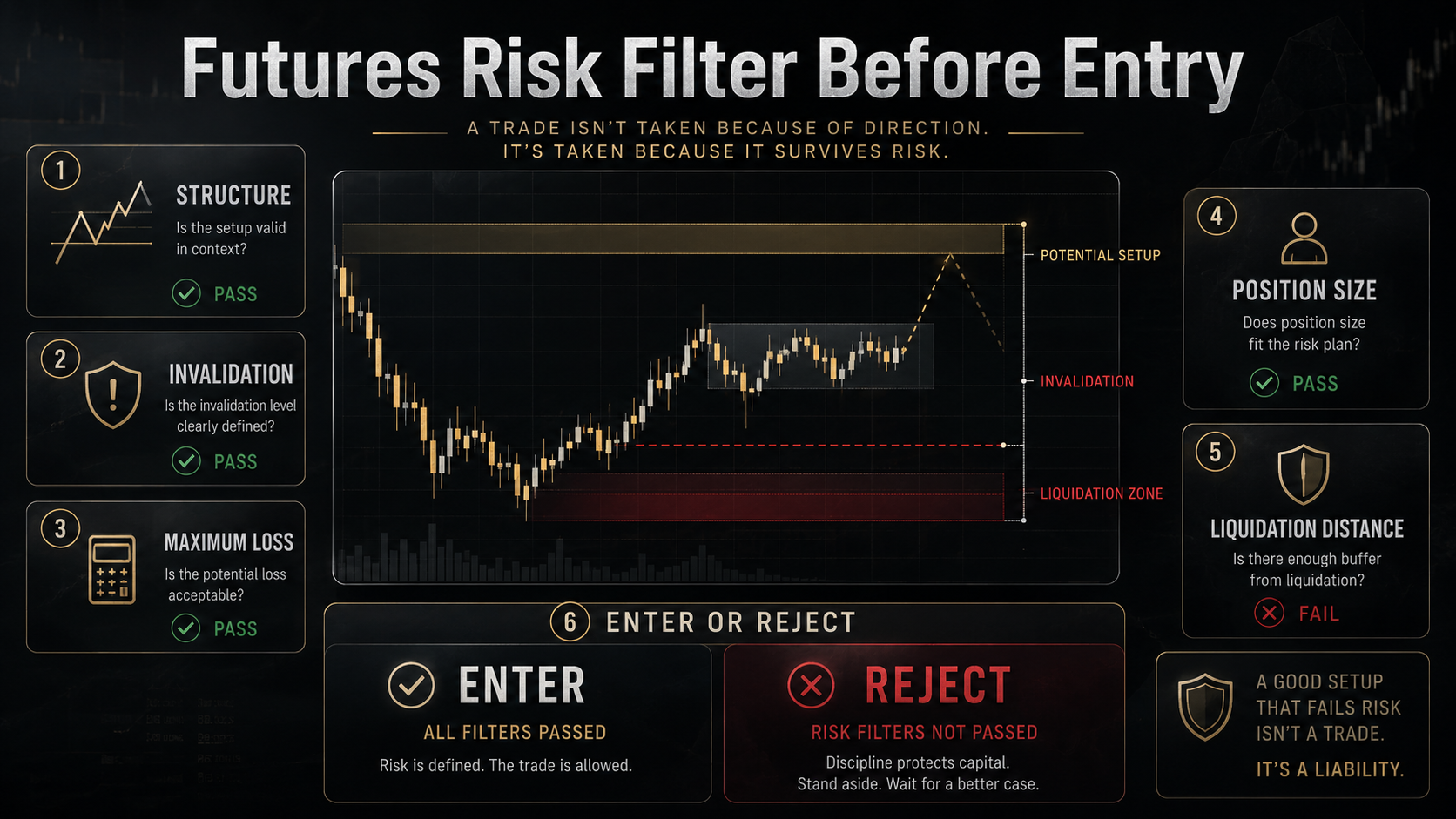
The futures trader needs a risk filter before entry.
The risk filter should block trades that look attractive but cannot be managed properly.
A strong-looking breakout should be rejected if invalidation is too far away.
A clean reaction should be rejected if the position size becomes too large.
A momentum setup should be rejected if liquidation sits inside normal noise.
The strategy is not only about finding trades.
It is about refusing trades that would damage the account if slightly wrong.
What a Bad Futures Entry Looks Like
A bad futures entry often looks strong at first.
It usually has movement.
It usually has a candle that feels convincing.
It usually gives the trader enough confidence to use leverage.
The weakness is hidden inside the risk.
The entry is too far from the level.
The invalidation is unclear.
The position size is too large for the distance to the stop.
The liquidation price is too close.
The trader does not have a plan for what happens if BTC or the market retests.
This is why futures losses can feel sudden.
The chart did not need to collapse.
The risk was already too tight.
A trade can survive being early if the size is controlled.
A trade can survive normal volatility if liquidation is far enough away.
A trade can survive a retest if invalidation is clear.
But a trade with leverage, late entry, unclear invalidation, and oversized position has no room.
It is fragile from the start.
The Trade Must Survive the First Pullback
Most futures trades are tested quickly.
After entry, price may pull back. It may retest the level. It may pause. It may shake out late entries before continuation.
A futures strategy must account for that.
If the first normal pullback creates panic, the trade was probably sized wrong.
If a small retest threatens liquidation, leverage was too high.
If the trader does not know whether the pullback invalidates the idea, the structure was not defined.
The first pullback reveals whether the trade was planned or only clicked.
A strong futures setup is not one that never moves against the trader.
A strong futures setup is one where the trader already knows what movement is acceptable, what movement is invalidation, and how much loss is allowed.
That clarity must exist before the position opens.
The Final Rule for Crypto Futures Trading
A futures trade is not ready because the candle looks strong.
It is ready only when the risk is defined.
The setup may look clean, but the trade is still weak if invalidation is unclear, position size is oversized, or liquidation distance is too close.
Leverage should be the last adjustment, not the first decision.
A serious crypto futures strategy follows this order:
Structure first.
Invalidation second.
Maximum loss third.
Position size fourth.
Liquidation distance fifth.
Entry last.
When that order is reversed, the trader is no longer trading a strategy. The trader is only adding leverage to a guess.
In crypto futures, the trade that looks clean can still be dangerous.
The risk has to be clean too.