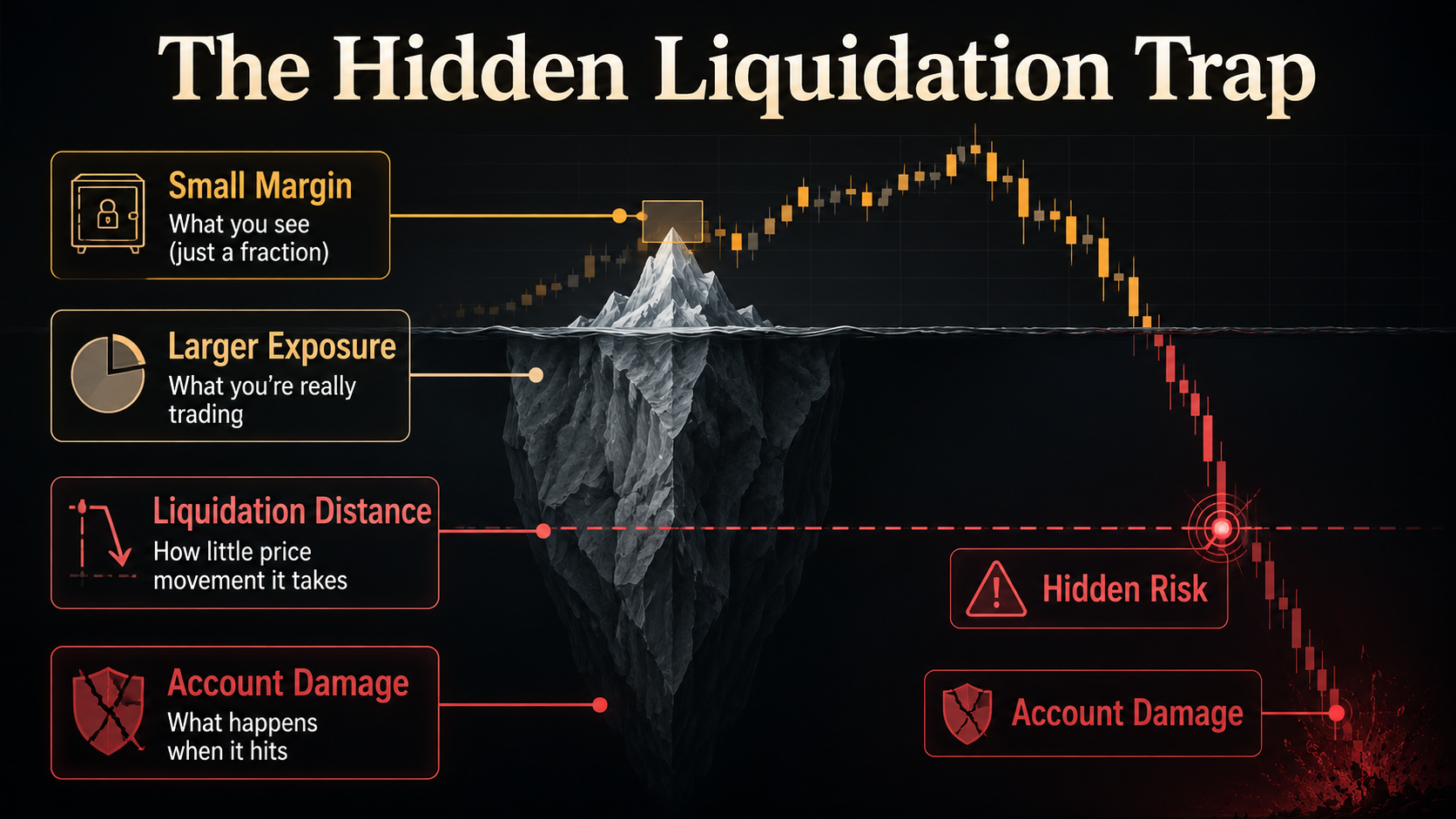
The number on the margin box can look small.
That is the trap.
A trader may see a small amount committed to a crypto leverage trade and assume that is the full danger. The position looks controlled because the visible margin looks limited.
But the market does not move against the margin box.
It moves against the full position size.
That is why the real question is not only:
“How much margin did I use?”
The real question is:
“How much of my account can this position damage if price moves fast, liquidity disappears, or liquidation arrives before I can react?”
This is where many beginners misunderstand leverage trading crypto.
They think they are risking the amount they clicked into the trade.
In reality, the loss depends on margin mode, position size, liquidation distance, slippage, and whether the trade was placed in a fragile area before the move even started.
The Brutal Truth: Margin Is Not the Same as Maximum Loss
A leveraged crypto trade can make a small account feel larger than it is.
That feeling is dangerous.
If a trader opens a position with leverage, the margin shown on screen is only the collateral supporting the position. It is not automatically the full risk of the trade.
A small margin can control a much larger position.
That means a small price move against the position can create a loss that feels much larger than the trader expected.
This is why beginners often say:
“I only used a small amount.”
But that sentence does not answer the real risk question.
The market does not care how small the margin looked.
The market cares about the position size, the distance to liquidation, and whether there is enough account equity to keep the position alive.
If the basic leverage concept still feels unclear, read What Is Leverage Trading Crypto?. That article explains why small margin can hide larger exposure before a beginner even understands the real position size.
Cross Margin Can Expose More Than One Trade
The first serious risk is margin mode.
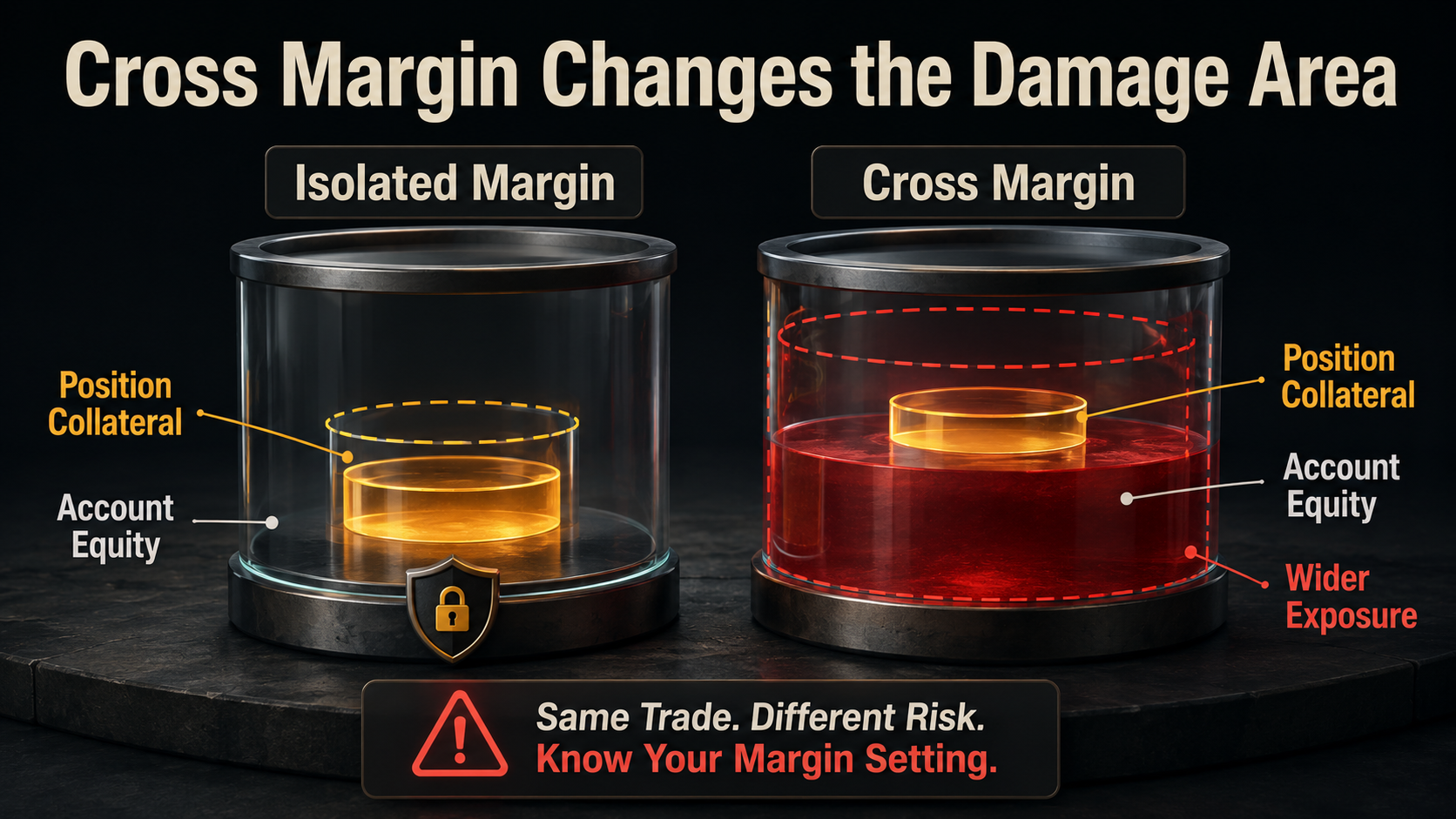
In isolated margin, the position is usually separated from the rest of the account. The funds allocated to that specific position are the main collateral at risk for that trade.
In cross margin, the position can draw from available account equity to support the trade.
That difference matters.
A beginner may think:
“I only put a small amount into this trade.”
But if the account is using cross margin, the system may use more available balance to keep the position open as the trade moves against the trader.
That can make the loss feel sudden.
The trader is not only watching one small margin number anymore.
The trader is exposing a wider pool of account equity.
This does not mean every cross-margin trade will lose the entire account. Platform rules, account settings, collateral, and liquidation systems all matter.
But the risk is clear:
If the trader does not understand cross margin, the account may be exposed more deeply than the trader intended.
Isolated Margin Can Still Be Destroyed Quickly
Isolated margin can reduce the damage area.
It does not make the trade safe.
A trader can still lose the isolated margin if the position is oversized, the liquidation distance is too close, or the entry is taken after price has already stretched.
This is where many beginners become careless.
They switch to isolated margin and think the risk problem is solved.
It is not solved.
It is only contained.
The trade can still be poorly built. The entry can still be late. The position size can still be too large. The liquidation price can still sit inside normal market noise.
Isolated margin limits the area of damage.
It does not repair a bad trade idea.
The Scene of the Crime: The Stop-Loss Does Not Always Save the Price
Many traders believe a stop-loss creates a hard wall.
It does not.
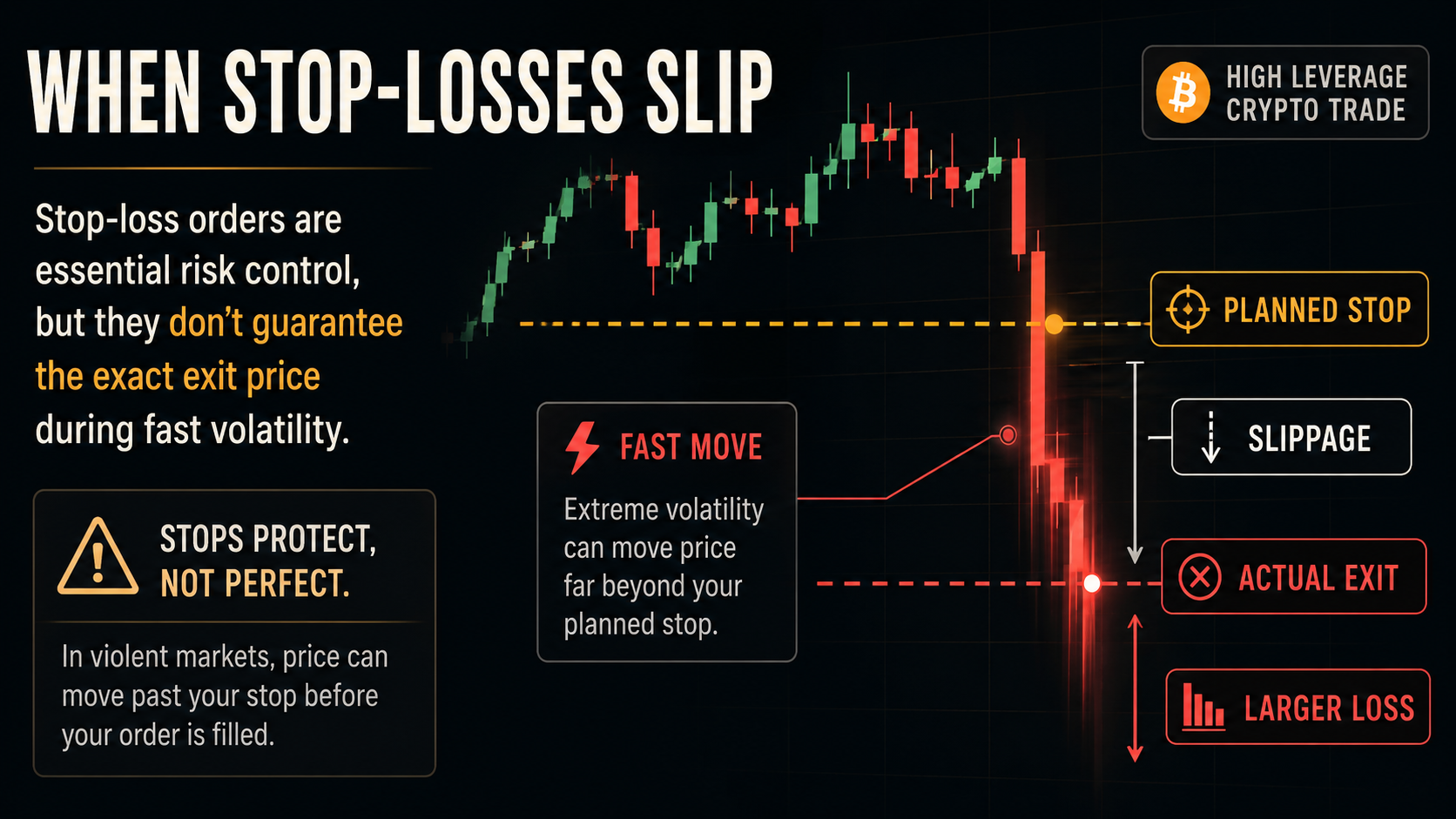
A stop order can trigger when price reaches the stop level, but the actual execution price may be worse during fast movement. In a thin, violent, or rapidly moving market, the order may fill away from the level the trader expected.
This difference is slippage.
The trader may plan to lose a small amount.
But if price moves quickly through the level, the actual exit can be worse than the planned exit.
This is especially important in leverage trading.
Leverage does not only increase the position.
It also increases the consequence of poor execution.
A trader may think:
“I will exit if I lose 50 dollars.”
But in a fast crypto move, the market may not offer a clean exit at that exact point.
The stop can trigger.
The fill can be worse.
The loss can be larger than expected.
This is not a reason to ignore stops.
It is a reason to understand that a stop is not magic.
A stop is part of risk control.
It is not a guarantee that the trade will close at the exact price the trader imagined.
To separate a planned exit from a forced platform exit, read Crypto Liquidation vs Stop Loss. That article explains why a stop loss can fail during violent movement while liquidation removes control from the trader.
Flash Moves Can Turn a Planned Loss Into a Different Loss
Crypto can move quickly.
When price drops or spikes through a level, the chart may not give the trader a calm exit. The order book can thin. The spread can widen. Liquidation engines can add pressure. Other traders may be forced out at the same time.
In that environment, the planned loss and the actual loss may be different.
This is why a trader should not build a leverage trade around the assumption that everything will execute perfectly.
A clean plan asks:
Where is the invalidation?
How far is liquidation from the entry?
How much can be lost if the exit is worse than expected?
Does the trade still make sense if the stop slips?
If the trade only works under perfect execution, the trade is fragile.
A fragile trade should not be opened.
The Diagnosis: Beginners Look at Leverage, Not Exposure
Many beginners ask:
“Is 10x leverage safe?”
That question is too shallow.
The leverage number alone does not explain the full risk.
A 10x trade entered at a poor location can be more dangerous than a lower-leverage trade entered with a clear invalidation point, defined size, and enough liquidation distance.
The deeper question is:
Where is the position located inside market structure?
If the trade is opened directly after a fast candle, near a liquidity sweep, or far away from the structure point that proves the idea wrong, the trade may already be weak.
The trader may think the problem is leverage.
But the deeper problem is location.
The position was built where a normal market reaction could damage it.
That is why leverage loss is not only a math problem.
It is a structure problem.
For the full futures leverage mechanism behind margin pressure and liquidation distance, read How Does Leverage Work in Crypto Futures Trading?. That article breaks down initial margin, maintenance margin, and the liquidation engine behind forced exits.
Why Liquidity Sweeps Make Leverage Feel Unfair
Many traders enter after a visible breakout.
The level breaks. The candle moves. The chart looks obvious.
Then price snaps back.
The trader feels targeted.
In many cases, the problem is not that the trader was personally targeted.
The problem is that the trader entered where many other late traders were also likely to enter, with similar stops, similar liquidation zones, and similar emotional timing.
This creates crowded risk.
A liquidity sweep can move through a level, trigger stops, attract breakout traders, and then return back into the range.
If a leveraged trade is opened during that sweep, the liquidation distance may already be too close.
The trader thinks:
“The breakout failed.”
But the trade may have been fragile before the failure was visible.
The position was opened in the wrong part of the structure.
The X-Ray Question: What Can Actually Damage This Trade?
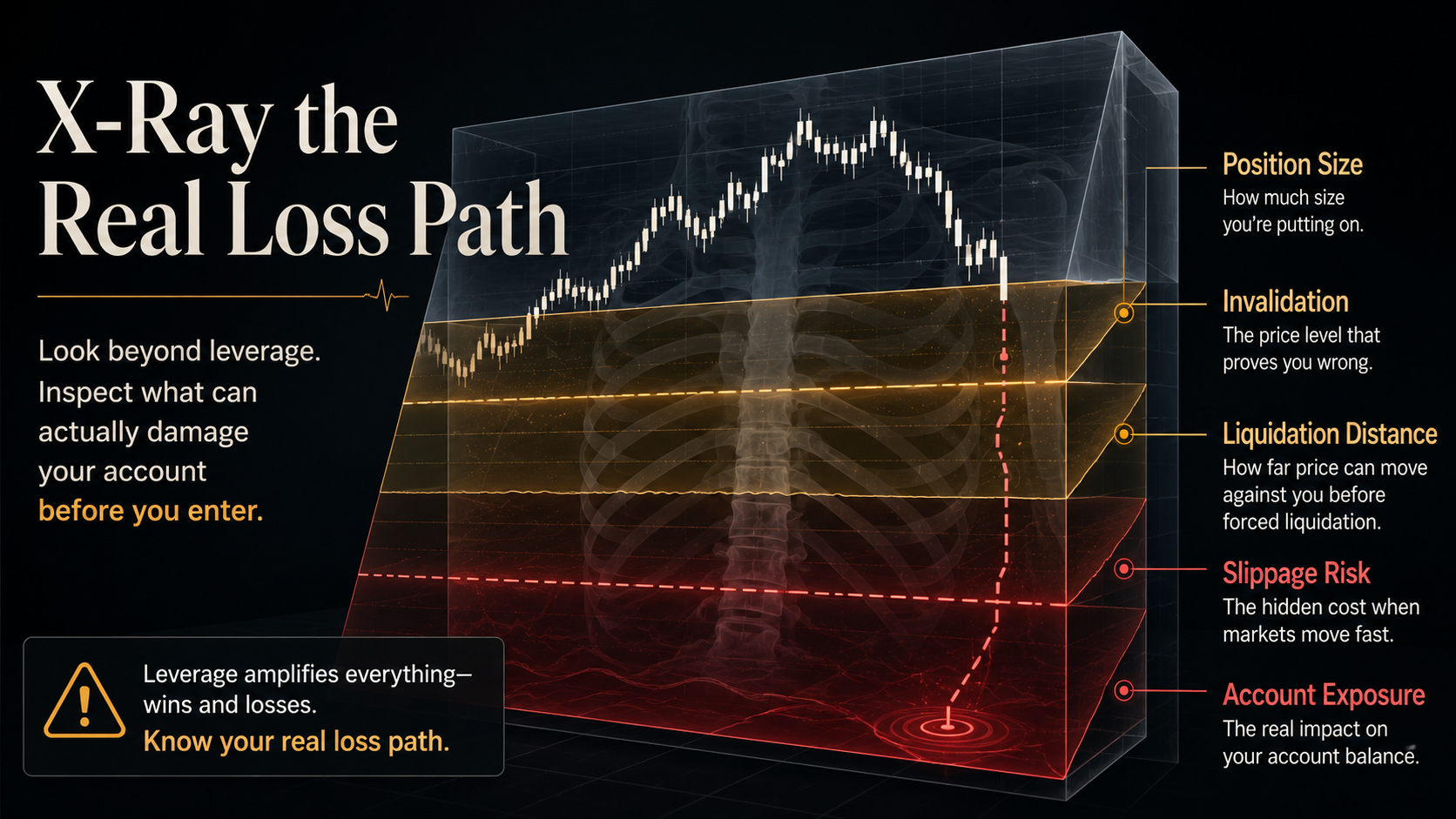
Before opening a leveraged crypto trade, the trader needs an X-ray view of risk.
Not prediction.
Not emotion.
Not confidence.
The trader should ask:
What position size am I controlling? Where is the invalidation point? Where is the liquidation price? How much distance exists between entry and liquidation? Is liquidation sitting inside normal noise? Can a fast wick damage the position before the trade idea is truly wrong? If the stop slips, can the account still survive the outcome?
These questions reveal the real loss path.
They also expose fake safety.
A small margin box can look safe.
A wide position can still be dangerous.
A close liquidation price can make the entire trade fragile.
A stop-loss can help, but it cannot remove all execution risk.
This is the X-ray.
The trade is not judged by how small the margin feels.
It is judged by what can actually damage the account.
So How Much Can You Lose?
The honest answer is:
It depends on the structure of the trade.
In isolated margin, the direct damage is usually limited to the collateral assigned to that position, plus fees and platform-specific liquidation effects.
In cross margin, more account equity may be exposed because available balance can support the position.
In fast markets, slippage can make the realized loss worse than the planned stop.
In extreme conditions, the final result depends on exchange rules, liquidation engine behavior, insurance fund mechanisms, and contract terms.
This is why the answer cannot be reduced to one simple number.
The better answer is:
You can lose more than you think if you only look at margin.
You can lose faster than you expect if liquidation is close.
You can lose differently than planned if slippage appears.
You can expose more of the account if cross margin is used without understanding it.
That is the hidden liquidation trap.
The Maximum Loss Must Be Defined Before the Trade
The correct process is not:
Choose leverage. Enter the trade. Hope the stop works. Check the damage later.
The correct process is:
Define account balance. Define maximum acceptable loss. Define invalidation. Measure risk distance. Calculate position size. Check liquidation distance. Choose leverage last.
Use the calculator before choosing position size or leverage:
Open the Maximum Risk Calculator
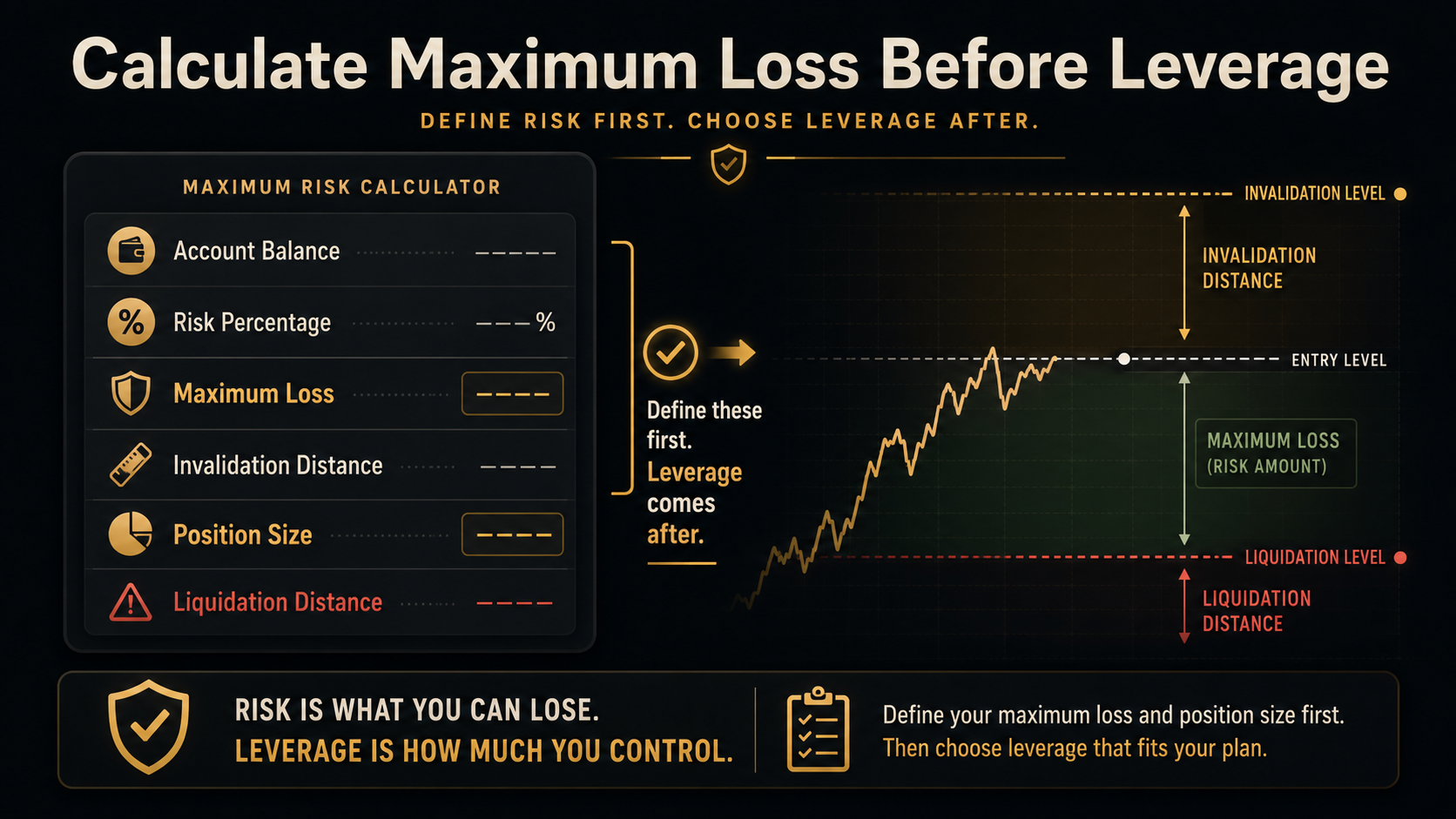
If the position cannot fit the maximum loss, the trade is skipped.
If liquidation sits too close to normal market noise, the trade is skipped.
If the only way to make the trade feel meaningful is to increase leverage, the setup is not clean enough.
The calculator does not remove risk.
It prevents the trader from pretending the risk is smaller than it is.
Final Rule: The Margin Box Is Not the Danger
The danger is not the number displayed as margin.
The danger is the exposure behind it.
A trader can lose the isolated margin.
A trader can expose more account equity through cross margin.
A trader can lose more than planned when execution slips.
A trader can be liquidated before the original trade idea has enough time to prove itself.
That is why the real question is not:
“How much margin did I use?”
The real question is:
“What can this trade do to my account if price moves fast and the exit is not clean?”
That question changes the entire trade.
It forces the trader to look beyond leverage.
It forces the trader to see position size, invalidation, liquidation distance, slippage, and account exposure.
A leveraged trade should never begin with confidence.
It should begin with damage control.
If the damage cannot be defined before entry, the trade does not deserve to be opened.