The Trap of Leverage: Why Definitions Do Not Protect You
Most retail traders transition from spot trading to leveraged trading looking for faster wealth accumulation. They are presented with two distinct battlefields: Margin Trading and Futures Trading.
Retail education often simplifies the choice to mere interface preferences or leverage limits. You are told that both allow you to multiply your purchasing power, and therefore, both carry the same risks. This is a fatal oversimplification.
Margin Trading and Futures Trading are fundamentally different ecosystems. They operate on entirely different mathematical engines, and more importantly, they are manipulated by Smart Money algorithms in entirely different ways. If you do not understand the underlying architecture of the battlefield you are stepping into, your account will be systematically drained by invisible fees and engineered liquidations.
Margin Trading: The Borrowing Illusion
Margin trading is the traditional approach to leverage. In the crypto market, when you trade on margin, you are literally borrowing actual cryptographic assets from the exchange or from a decentralized liquidity pool.
If you want to long Bitcoin with 5x leverage, you provide $1,000 in USDT as collateral, and the exchange lends you $4,000 in USDT to buy actual Bitcoin on the spot market. If you want to short, you borrow actual Bitcoin to sell it, hoping to buy it back cheaper later.
Because you are borrowing real assets, you are subjected to the oldest financial trap in history: the Interest Rate.
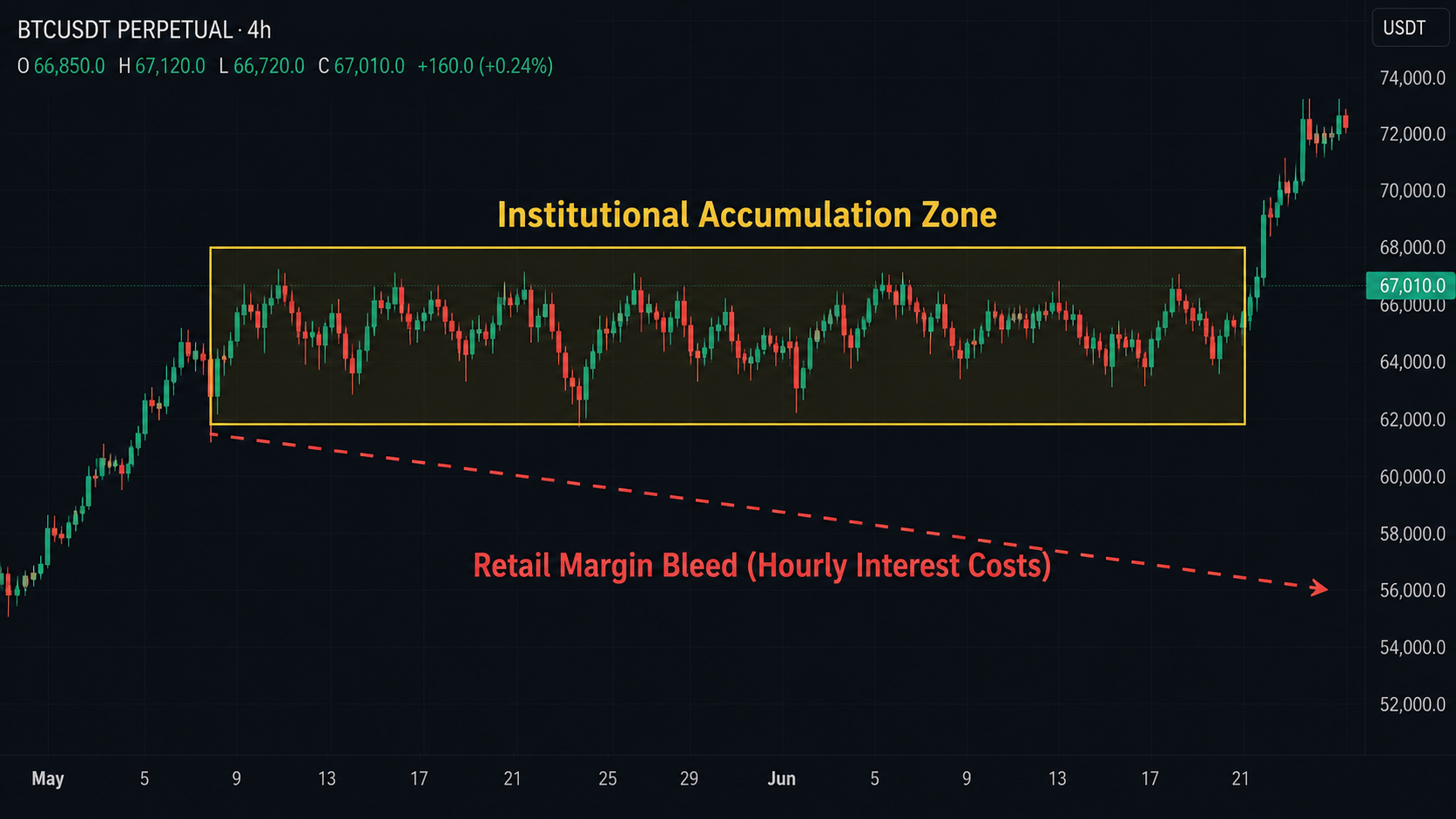
The danger of Margin Trading lies in the silent bleed of hourly interest. The exchange charges you a continuous fee for borrowing their assets. Retail traders often enter a margin position expecting a quick breakout. When the market goes into a prolonged, sideways consolidation—a tactic frequently engineered by institutional players—the retail trader holds the position, waiting for the move. Day after day, the interest rate compounds, eating directly into the maintenance margin.
You can be absolutely correct about the long-term direction of the market, but the holding costs will bleed your account dry before the breakout ever occurs.
Futures Trading: The Perpetual Liquidity Game
Crypto Futures Trading, specifically Perpetual Swaps, is an entirely different beast. When you trade futures, you are not borrowing or trading actual cryptocurrencies. You are trading a derivative contract—a mathematical agreement that tracks the price of the underlying asset.
Because no actual assets are changing hands, crypto exchanges can offer astronomical leverage, sometimes up to 100x or 200x. This creates an environment of hyper-volatility, making it the preferred hunting ground for Smart Money.
The mechanism that keeps the futures price tethered to the actual spot price is the Funding Rate. This is where the true institutional manipulation occurs.
Unlike the fixed interest in margin trading, the Funding Rate is dynamic. It is a fee exchanged directly between traders. If the majority of retail traders are overwhelmingly Long (bullish), the futures price will drift higher than the spot price. To correct this, the exchange forces the Longs to pay a funding fee to the Shorts every 8 hours.
When retail FOMO is at its peak, funding rates skyrocket. Institutions will deliberately hold massive Short positions during these periods, not just to bet against the market, but to passively farm the massive funding fees paid by trapped retail buyers. You are literally paying the market makers to keep your position open.
For the full futures leverage mechanism, read How Does Leverage Work in Crypto Futures Trading?. That article explains how collateral, initial margin, maintenance margin, and the liquidation engine work inside crypto futures.
The Liquidation Engine: How They Execute the Kill
While both systems feature forced liquidations, the mechanics of how you lose your money differ drastically, and Smart Money exploits both.
In Margin Trading, because you are trading on the spot order book, liquidity is often thinner. When an institution wants to execute a Stop Hunt, they only need to push the spot price down momentarily. If you are highly leveraged, a sudden 5% drop on the spot order book will trigger your margin call. Your collateral is seized, and the exchange automatically market-sells your position, often resulting in severe slippage that wipes out your entire balance.
Futures Trading, however, utilizes a “Mark Price” system to calculate liquidations, theoretically to protect against single-exchange manipulation. But the extreme leverage available in futures creates dense, highly predictable clusters of retail liquidation levels.
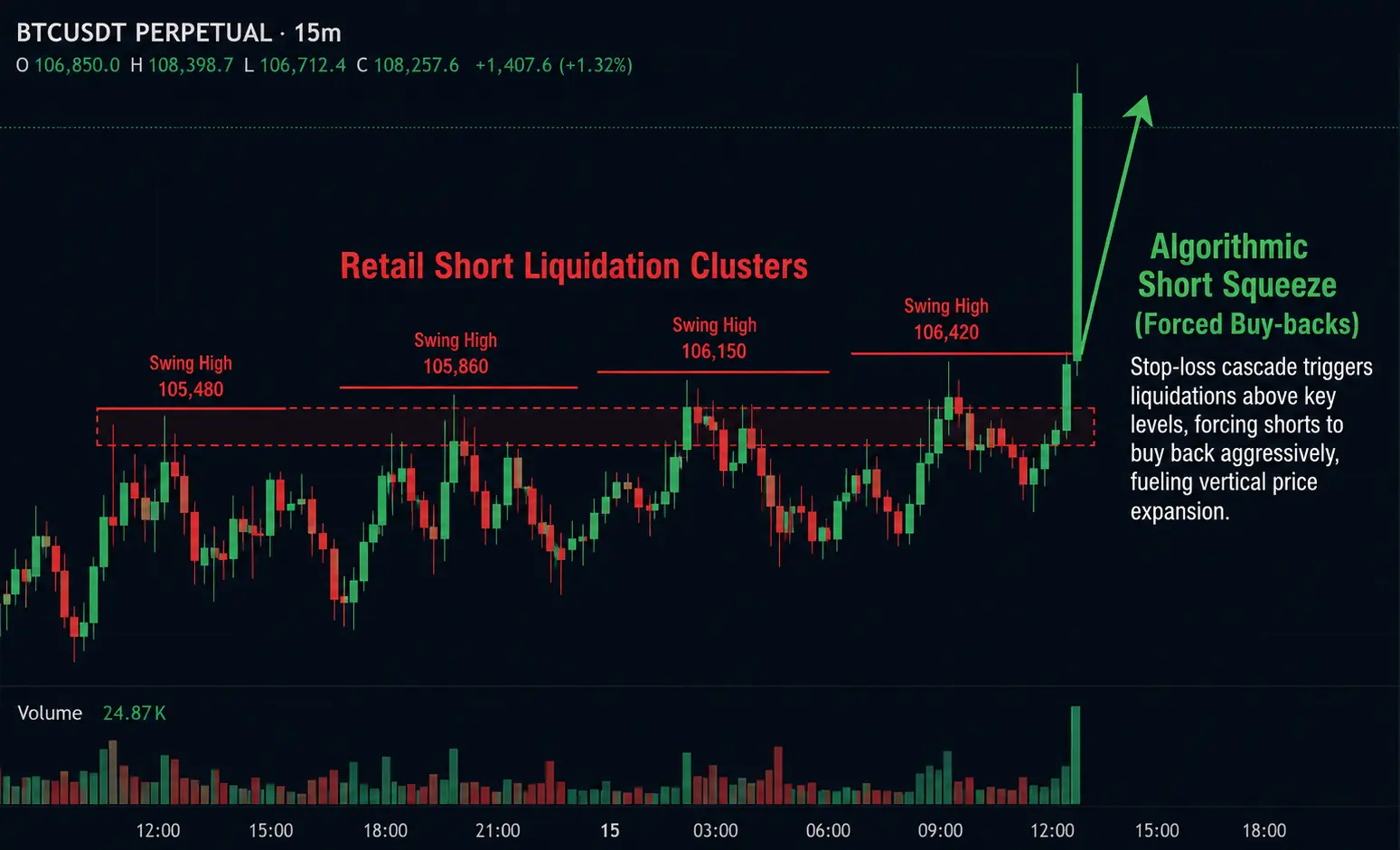
Algorithms map these liquidation clusters with pinpoint accuracy. Instead of a slow bleed, futures liquidations are violently cascading. Smart Money will engineer a rapid price spike to trigger the first cluster of retail short liquidations. As those positions are forced to buy back at market price, it fuels the spike even higher, triggering the next cluster, and the next. This is the classic “Short Squeeze,” and it is entirely manufactured by order flow dynamics, not fundamental market shifts.
If the forced-exit mechanism is still unclear, read Crypto Liquidation vs Stop Loss. That article breaks down why a stop loss is a planned exit, while liquidation is the platform taking control away from the trader.
Choosing Your Battlefield: Structural Survival
If you treat Margin and Futures trading merely as tools to get rich quick, you will fail in both. You must choose your vehicle based on your structural understanding of the market.
Margin trading is fundamentally a spot transaction with borrowed funds. It is suitable only for short-duration, high-conviction directional plays where you are certain the momentum will expand immediately, preventing the interest rates from eroding your edge.
Futures trading is a high-speed derivative environment dominated by algorithmic liquidity hunting. It demands a flawless execution of X-Ray Diagnostics. You cannot survive in the futures market by trading simple chart patterns. You must read the Funding Rates, analyze the Open Interest, and identify exactly where the institutional liquidity pools are resting.
Stop viewing leverage as a tool for amplification, and start viewing it as a structural vulnerability. Whether you are paying hourly interest to the exchange or funding rates to institutional algorithms, the house is always collecting a premium on your impatience. To survive, you must stop trading the surface price and start trading the underlying mechanics.