The margin looked small.
The trade was not.
That is where many beginners misunderstand crypto leverage trading.
The platform made the position easy to open. The required margin looked manageable. The candle was moving. The setup looked active enough to click.
But the account was not exposed to the margin amount only.
It was exposed to the full position.
That difference is where leverage becomes dangerous.
Leverage trading in crypto means using borrowed exposure or margin-based contracts to control a larger position than the capital placed upfront. A trader may put down a smaller amount of margin while controlling a larger trade.
That sounds efficient.
It can also make a small market move feel much larger inside the account.
Leverage does not only increase potential profit. It increases the effect of every mistake. A late entry becomes more expensive. An oversized position becomes more fragile. A normal pullback can become margin pressure. A poorly placed liquidation level can end the trade before the market fully proves the idea wrong.
The beginner mistake is thinking leverage is the opportunity.
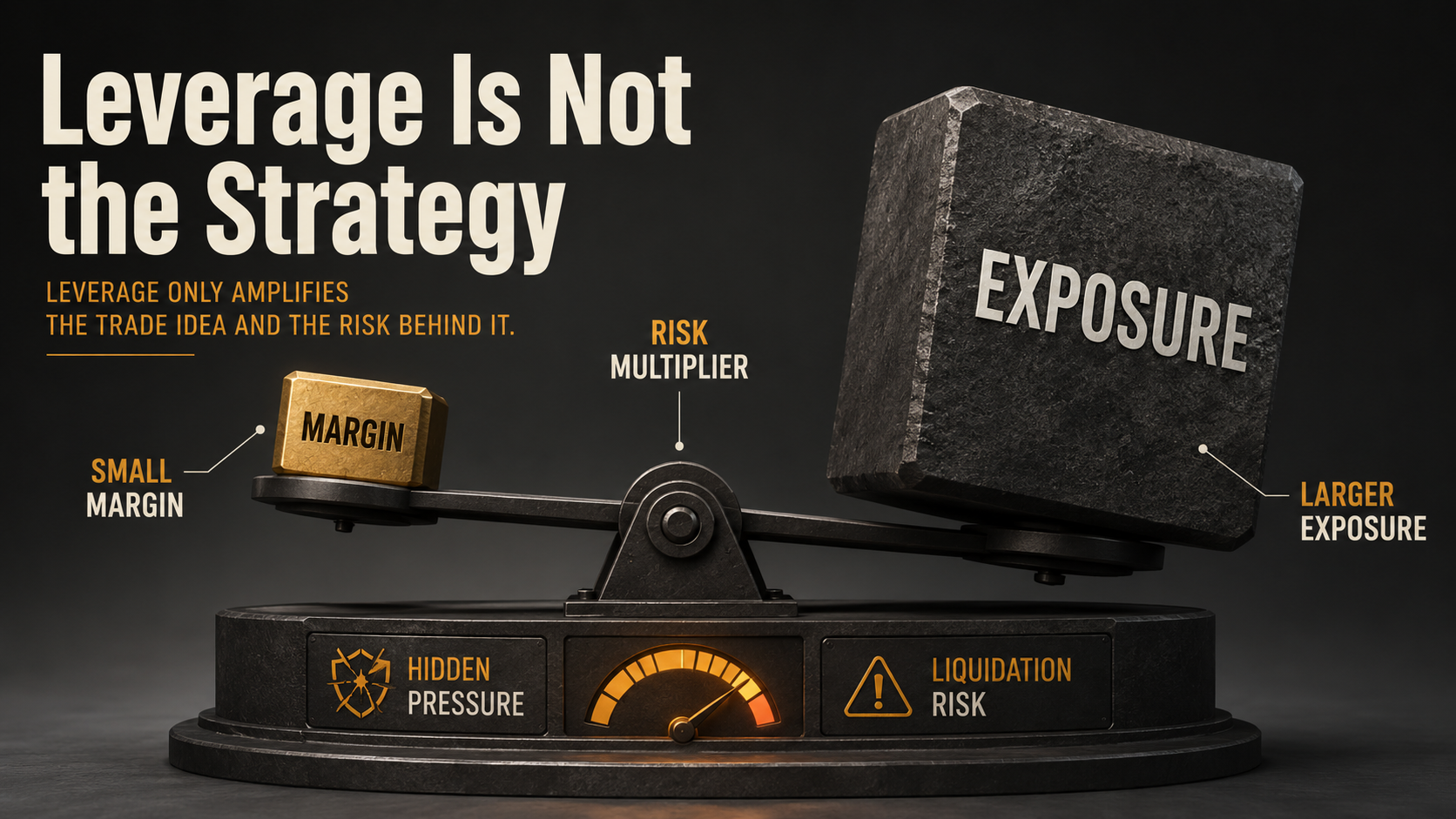
Leverage is not the strategy.
It is a multiplier.
If the trade is structured, sized correctly, and protected by clear invalidation, leverage may be managed with more control. If the trade is late, oversized, and close to liquidation, leverage only makes the mistake larger.
A serious crypto trade should not begin with the leverage number.
It should begin with risk.
This article explains what leverage trading in crypto means, why beginners misunderstand it, and what must be checked before opening a leveraged position.
This article is for educational purposes only. It does not provide financial advice, trading signals, or guaranteed trading results.
The Position Is Larger Than the Margin Feels
The simplest definition of leverage is easy to understand.
Leverage allows a trader to control a larger position with a smaller amount of margin.
The problem is that beginners often stop there.
They see the smaller margin and feel the trade is smaller. The account screen makes the position look affordable. The trade feels easier to open because less capital is required upfront.
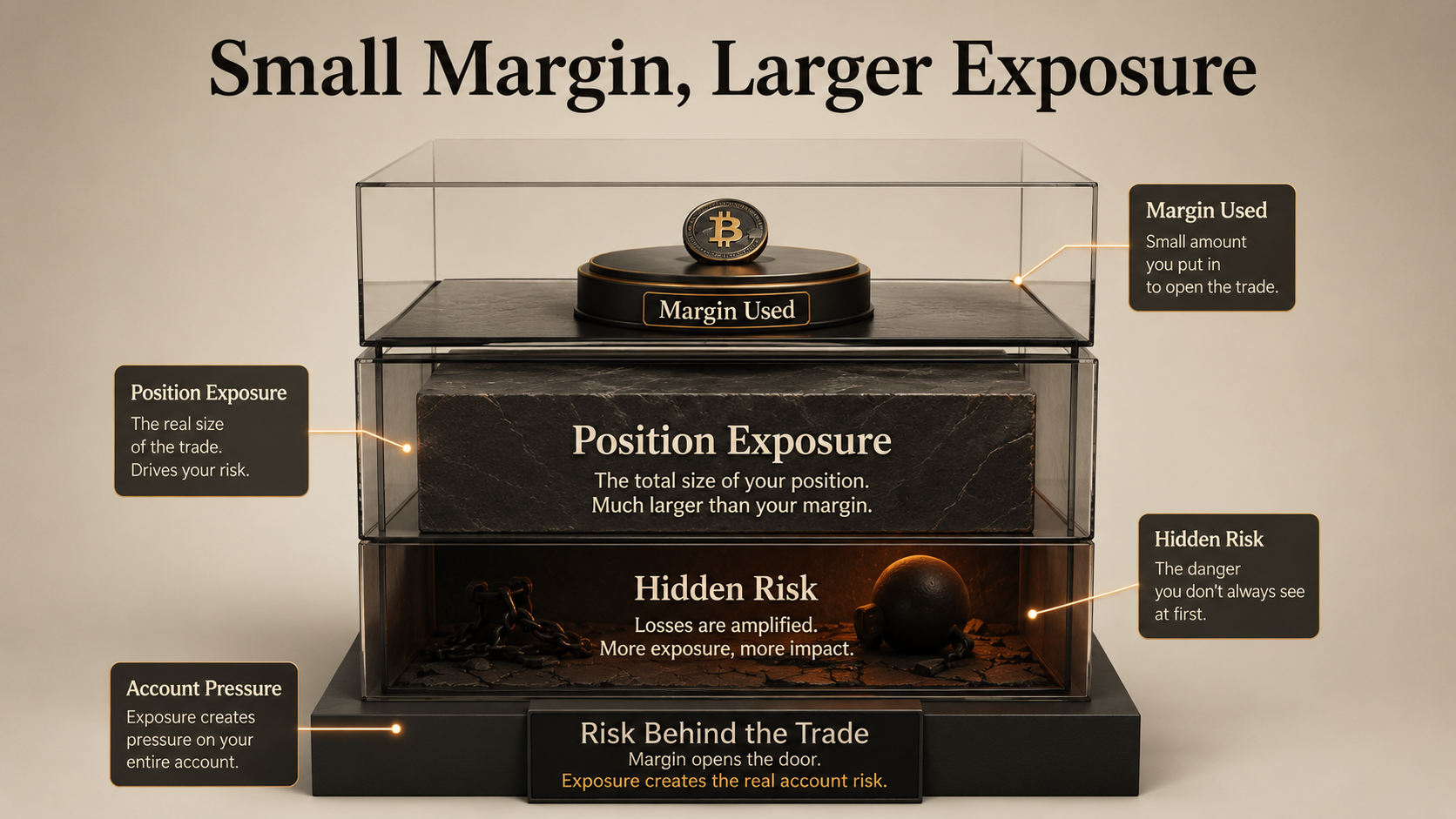
But the market does not move against the margin only.
It moves against the full position exposure.
That is the part that matters.
A leveraged position can feel small at entry and become stressful within a few candles. The trader may believe the risk is limited because the margin posted looks limited. In reality, the position may be much larger than the account should carry.
This is why beginners often get surprised.
The platform showed a manageable margin.
The market exposed the real position.
The risk was not hidden by the exchange. It was misunderstood by the trader.
Margin opens the door.
Exposure creates the pressure.
Margin Is Not the Same as Risk
Margin is the amount required to open or maintain the position.
Risk is what the trade can cost if the market moves against the idea.
Those two things are not the same.
A beginner may look at the margin and think that is the amount at risk. This creates false comfort. The position may require a small amount to open, but the account can still be exposed to a much larger move.
Risk depends on several things working together:
- entry location
- position size
- invalidation distance
- leverage
- fees and funding
- liquidation distance
When those pieces are not defined, leverage becomes dangerous.
A small margin does not mean the trade is controlled.
A small margin can hide large exposure.
If the margin box still feels smaller than the real danger, read How Much Can You Lose Trading Crypto With Leverage?. That article explains why visible margin is not the full risk, and how cross margin, slippage, position size, and liquidation distance expose hidden account damage.
This is especially important in crypto because price can move quickly. A candle that would be normal on a spot chart can become uncomfortable on a leveraged position. The trader may start watching margin instead of reading structure.
That shift is the warning sign.
The trade is no longer being managed by the setup.
It is being managed by pressure.
Leverage Does Not Make a Bad Entry Better
A bad entry stays bad.
Leverage only makes it more sensitive.
This is one of the most important lessons in crypto leverage trading.
Many beginners use leverage when the chart already feels urgent. Price moves fast. A candle expands. The trader enters after the move looks obvious because waiting feels painful.
The problem already exists before leverage is added.
The entry is late.
The clean structure is far away.
The invalidation point is wider.
The room for normal movement is smaller.
Adding leverage does not repair that situation. It compresses the space between the entry and account pressure. The market does not need to fully reverse. It only needs to pause, retest, or pull back normally.
A late entry without leverage may be uncomfortable.
A late entry with leverage can become emotional very quickly.
This is why leverage should not be used to make a weak trade feel important. If the setup only feels worth taking after leverage is added, the trade may already be too weak.
Leverage should scale a controlled idea.
It should not be used to rescue an unclear one.
Liquidation Is Where Control Can End
Liquidation is one of the biggest risks beginners discover too late.
In spot trading, price can move against a position without the exchange automatically forcing the position closed in the same way. The value may fall, but the position itself is not usually liquidated like a futures position.
In leveraged crypto futures, liquidation can happen when margin is no longer enough to support the position.
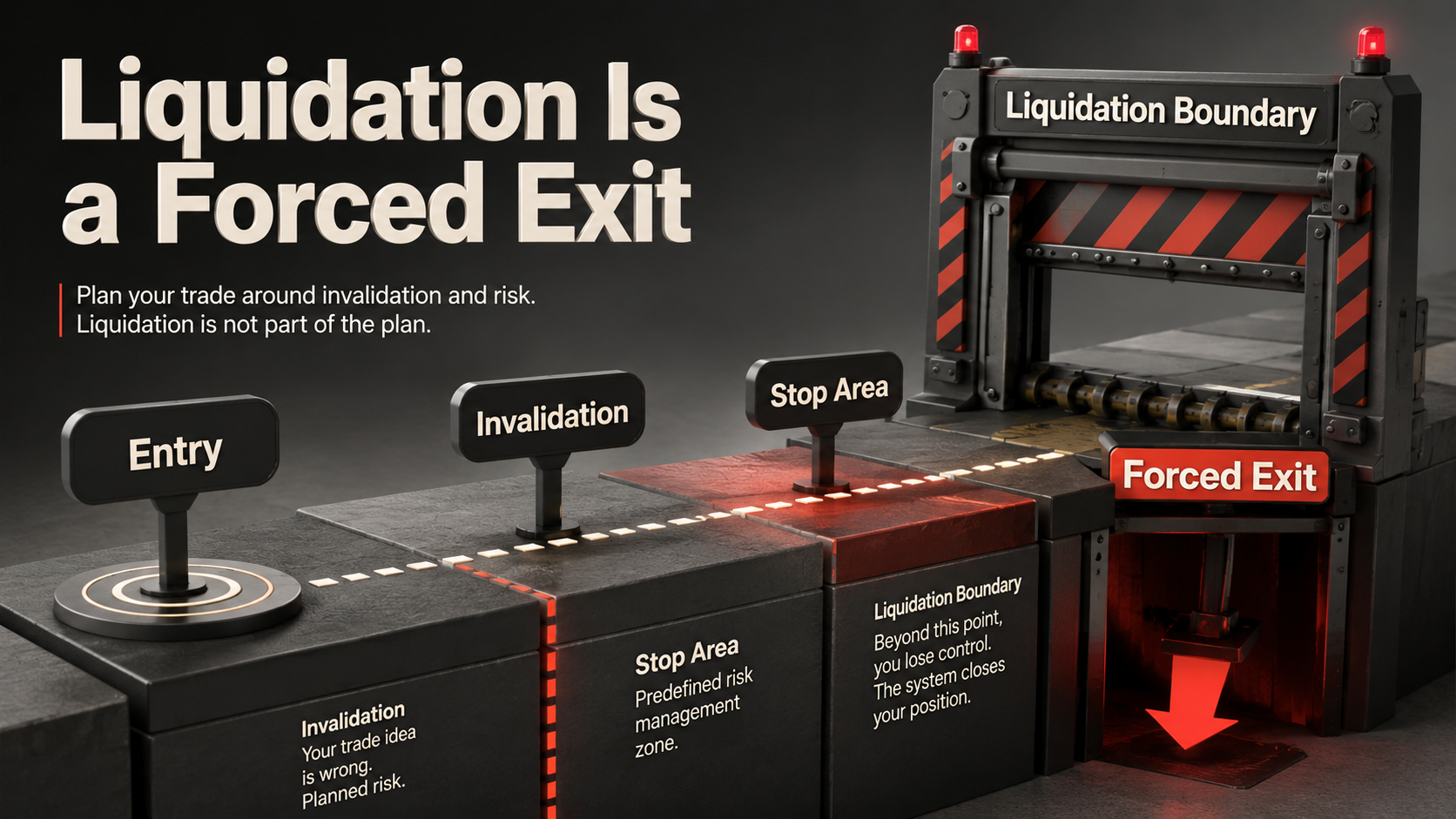
That is a forced exit.
The exchange closes the position because the account can no longer maintain it.
Liquidation is not the same as a stop loss.
A stop loss is part of the trader’s plan.
Liquidation is the result of margin failure.
To understand the difference between a planned exit and a forced platform exit, read Crypto Liquidation vs Stop Loss. That article breaks down why a stop loss can fail during violent movement while liquidation removes control from the trader.
This difference matters. A trader should exit because the trade idea is invalidated, not because the exchange forces the exit. When liquidation becomes the real stop, the trader has lost control of the decision.
A leveraged trade should have enough distance between entry, invalidation, and liquidation.
If liquidation is too close to normal market noise, the position is fragile from the start.
The trade may not be wrong yet.
But the position may already be in danger.
Beginners Usually Choose Leverage Too Early
The leverage number is easy to choose.
That is why it becomes the first decision for many beginners.
They open the platform, look at the leverage slider, and start thinking about how much leverage to use before the trade is fully defined.
That order is backwards.
The trade should not start with leverage.
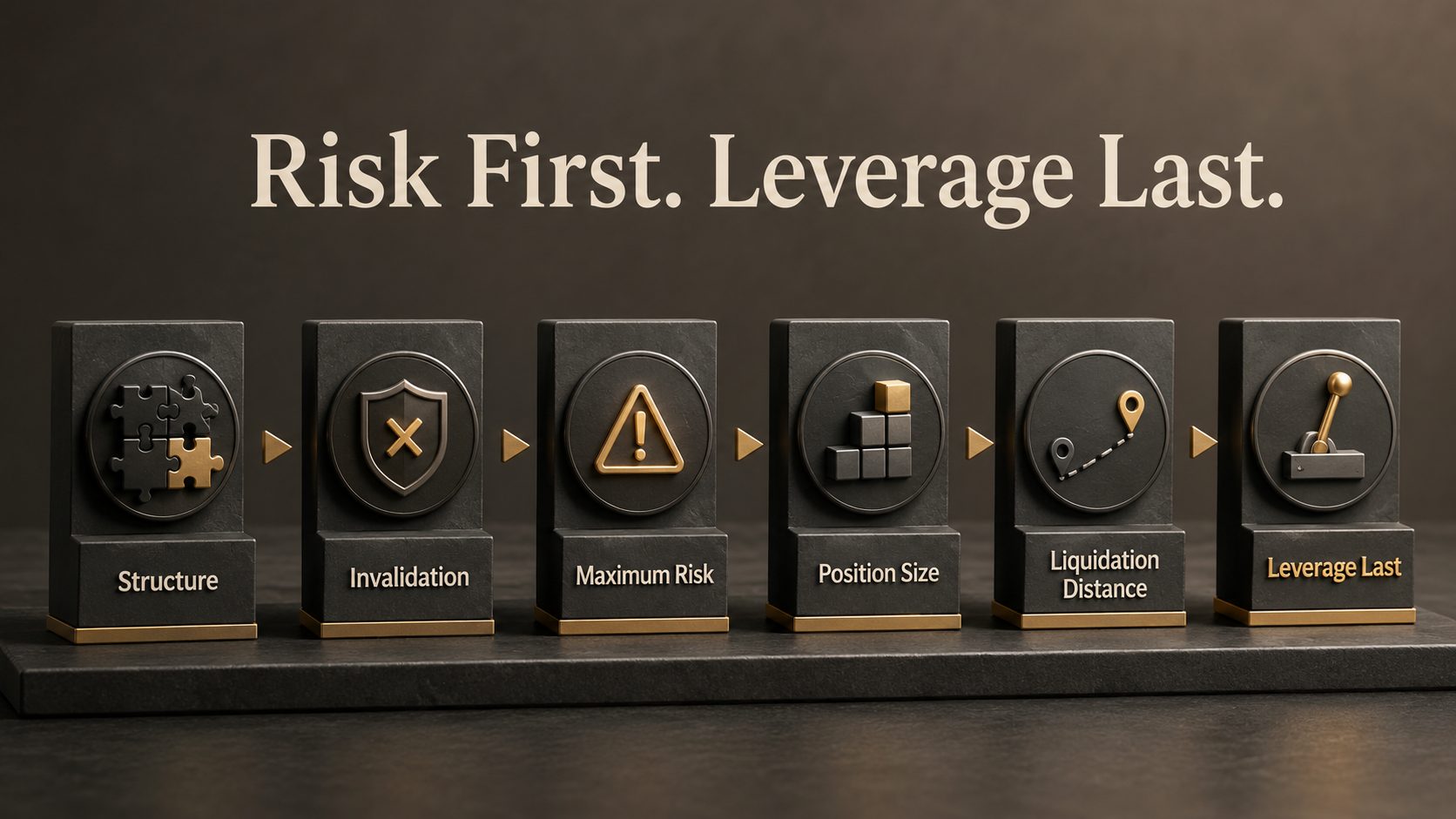
It should start with structure.
The structure creates the trade idea. Invalidation defines where that idea is wrong. Maximum risk defines how much the account can lose. Position size connects the account risk to the trade. Liquidation distance shows whether the position has enough room.
Leverage should come after those steps.
When leverage comes first, the trader builds the trade from exposure.
When risk comes first, the trader builds the trade from control.
For the full futures leverage mechanism behind margin pressure and forced exits, read How Does Leverage Work in Crypto Futures Trading?. That article explains how initial margin, maintenance margin, and the liquidation engine decide when control is taken away.
This is the difference between using leverage as a tool and using leverage as a shortcut.
Beginners lose money when leverage becomes the reason to enter.
Professional risk control treats leverage as the last adjustment.
Position Size Matters More Than the Leverage Number
The leverage number alone does not tell the full story.
A trader using lower leverage can still carry too much risk if the position size is too large. A trader using higher leverage can still control risk better if the actual position size is small, invalidation is clear, and liquidation distance is acceptable.
The platform leverage setting is not the whole trade.
Position size is what determines how much the account feels each move.
This is why beginners should not focus only on whether leverage is high or low. The better question is whether the position fits the account and the trade idea.
A position that is too large will feel dangerous even with moderate leverage.
A properly sized position gives the trader more room to follow the plan.
Leverage attracts attention because it sounds powerful.
Position size deserves more attention because it controls damage.
A trader who understands this starts thinking differently.
The goal is no longer to find the biggest position the platform allows.
The goal is to find the position the account can survive if the trade fails.
Maximum Risk Comes Before Leverage
Before a trader uses leverage, maximum account risk should already be defined.
This is the amount the trader accepts losing if the idea fails.
Without that boundary, leverage becomes emotional. The trader increases size because the setup looks strong, because they want to recover a loss, or because the platform allows it.
That is not risk management.
That is exposure chasing.
A maximum risk calculator can help turn account balance and risk percentage into a fixed amount before the trade is planned.
Use the calculator here before choosing position size or leverage:
Open the Maximum Risk Calculator
A Leveraged Trade Needs Invalidation
Invalidation is the place where the trade idea is wrong.
Without invalidation, leverage becomes dangerous because the trader does not know where the idea fails. The position is open, but the exit logic is unclear.
This creates emotional management.
A small move against the entry feels dangerous. A normal pullback feels personal. A wick feels like an attack. The trader starts reacting to unrealized loss instead of market structure.
A clear invalidation level separates normal movement from a broken idea.
It gives the trader a reason to exit before liquidation becomes the real stop.
If a breakout trade depends on price holding above a boundary, falling back into the range may invalidate the idea. If a support reaction creates the trade, losing that reaction area may invalidate it. If a reclaim is the reason for entry, losing the reclaim may invalidate it.
The exact level depends on the structure.
The principle stays the same.
Leverage should not be added to a trade that has no invalidation.
Without invalidation, the trader is not using leverage to execute a plan.
The trader is using leverage to enlarge uncertainty.
A Simple Way to Understand Crypto Leverage Risk
Leverage becomes easier to understand when the order is correct.
The market structure creates the trade idea.
Invalidation defines where that idea is wrong.
Maximum risk defines what the account can lose.
Position size connects the trade to the account.
Liquidation distance shows whether the position has enough room.
Leverage adjusts exposure after those pieces are known.
The mistake happens when the order is reversed.
A beginner sees movement, chooses leverage, opens the position, and only then starts thinking about risk. At that point, the trade is already emotional.
The better process is slower, but safer.
It forces the trader to decide whether the trade deserves leverage before the position exists.
If the trade cannot survive the risk check, leverage should not be used to force it.
The Final Rule for Crypto Leverage Trading
Leverage is not the reason to enter a trade.
It is only a way to scale exposure after the trade has a reason.
Beginners often misunderstand leverage because it makes the position feel accessible. The margin looks small, the platform is easy to use, and the move looks exciting.
That does not mean the risk is small.
A leveraged crypto trade is not ready because the trader can open it.
It is ready only when the risk is defined.
Structure must exist before leverage.
Invalidation must exist before leverage.
Maximum risk must exist before leverage.
Position size must fit before leverage.
Liquidation distance must be checked before leverage.
If those pieces are missing, the trader is not using leverage as a tool.
The trader is using leverage to make an unclear trade bigger.
That is where many beginner losses begin.