A fixed time trading strategy should not start with the timer.
It should start with structure.
Many traders approach fixed time trading by asking one question:
“Will price go up or down before the expiry?”
That question is too simple.
In fast trading, direction alone is not enough. A trader can be right about the general direction and still lose because the entry is late, the timing window is too short, or price reacts before the expiry finishes.
This is why many fast entries fail.
The problem is not always the market direction.
The problem is often structure, timing, and reaction.
A practical fixed time trading strategy should answer these questions before entry:
- Where is price inside the structure?
- Is price near a meaningful decision area?
- Has price reacted?
- Does the expiry window match the setup?
- Is the trader entering early, or chasing late?
- Is the risk acceptable if the trade fails?
If these questions are unclear, the trade is not ready.
This article explains why fast entries fail without structure and how traders can use filters before entering short-duration trades.
This article is for educational purposes only. It does not provide financial advice, trading signals, or guaranteed trading results.
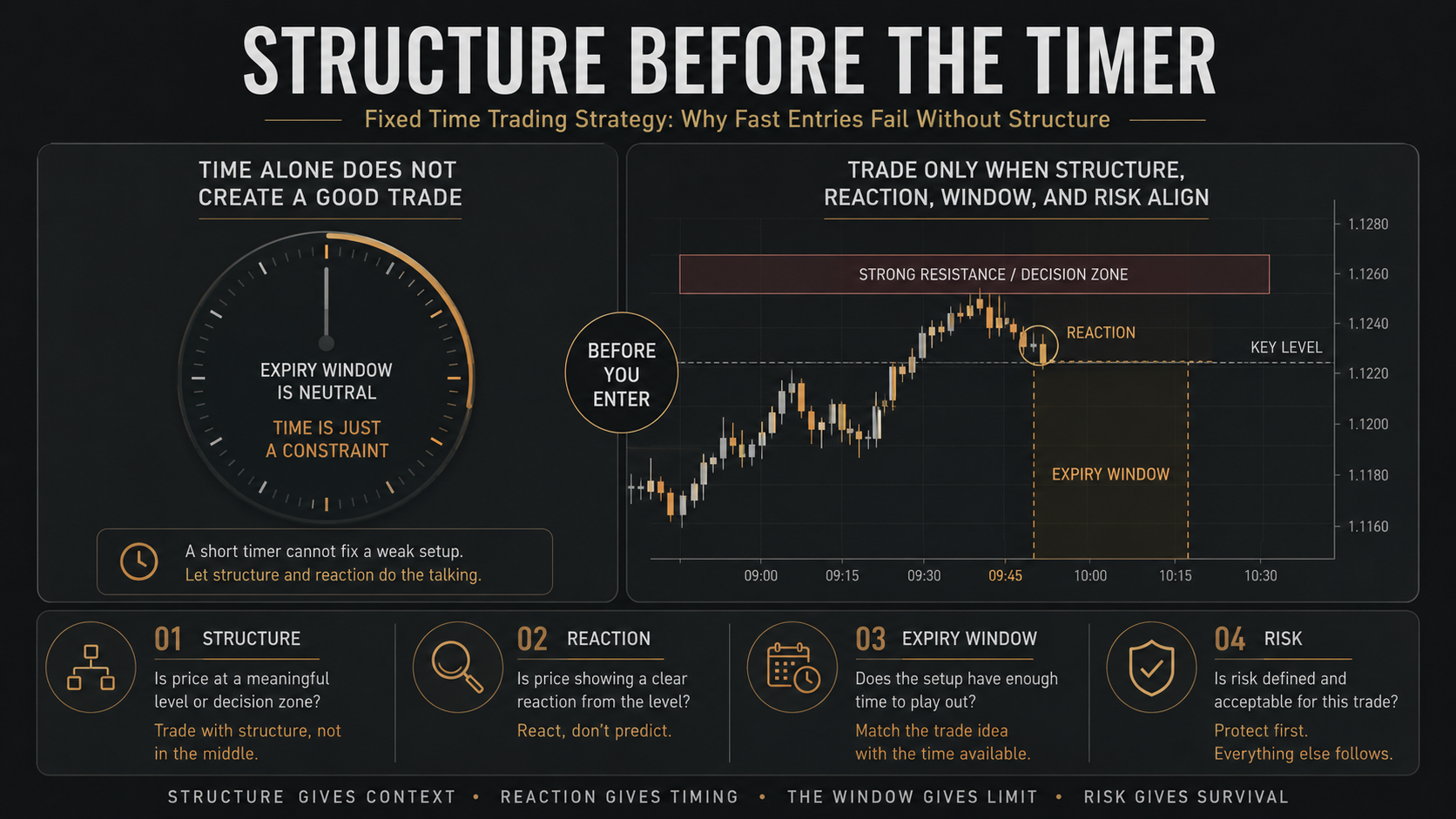
What Is Fixed Time Trading?
Fixed time trading is a type of short-duration trading where the result depends on where price is after a set period of time.
The time window may be short.
It may be one minute.
It may be several minutes.
It may be another fixed expiry period depending on the platform.
Because the time window is fixed, traders often focus too much on speed. They try to enter quickly because they believe a few seconds can decide the result.
Speed matters, but speed is not the full strategy.
A fast entry without structure is only a guess with a timer attached.
The trader still needs context.
The trader still needs location.
The trader still needs reaction.
The trader still needs risk control.
A fixed expiry does not remove the need for analysis.
It makes analysis more important because there is less time for the trade idea to develop.
Why Fast Entries Fail
Fast entries usually fail for one of five reasons.
The trader enters too late.
The trader enters in the middle of random movement.
The trader follows a candle instead of structure.
The trader ignores the expiry window.
The trader enters emotionally after a loss or missed move.
In fixed time trading, these mistakes can be more damaging because the trader does not have unlimited time for price to recover.
A setup may eventually move in the expected direction, but if it does not move within the selected time window, the trade can still fail.
This is why fixed time trading requires a different type of discipline.
The trader must not only ask:
“Is this direction reasonable?”
The trader must also ask:
“Is this timing reasonable?”
A trade idea without timing alignment is weak.
Filter 1: Start With Market Structure
The first filter is market structure.
Before entering a fixed time trade, the trader should know what price is doing.
Is price inside a range?
Is price near a boundary?
Is price testing a previous support or resistance area?
Is price breaking out?
Is price retesting?
Is price returning after a failed breakout?
Without structure, the trader is only reacting to movement.
A short candle movement can look attractive on a low timeframe, but if it is happening in the middle of a messy range, the entry may have no real edge.
Structure gives the trade context.
It tells the trader where price is, what area matters, and where reaction may appear.
Before entering, ask:
“What structure is this trade based on?”
If the answer is unclear, wait.
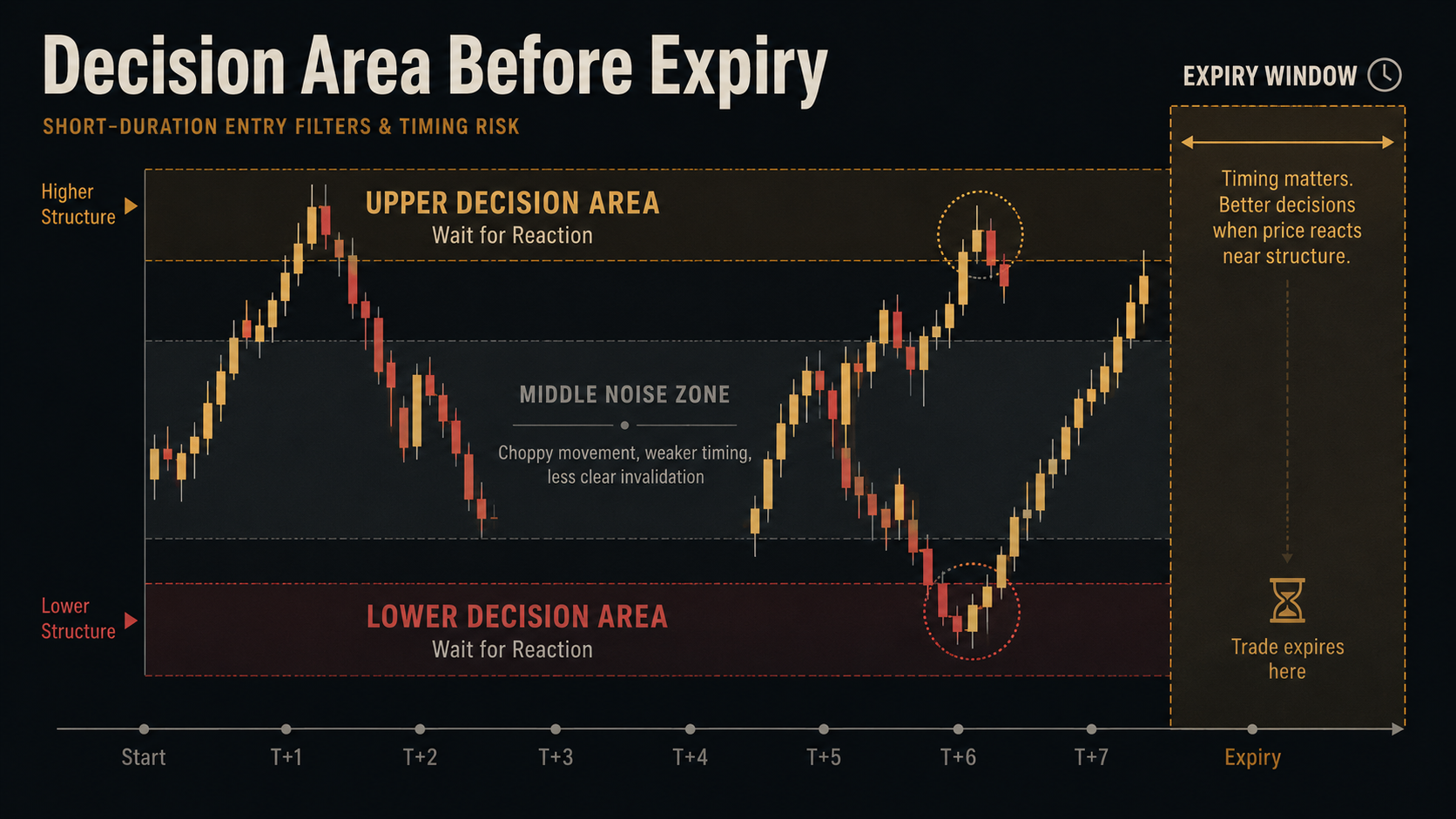
Filter 2: Use Decision Areas, Not Random Movement
A decision area is a place where price has a reason to react.
Examples include:
- Range high
- Range low
- Retest zone
- Failed breakout area
- Failed breakdown area
- Previous support or resistance
- Clear liquidity sweep area
A fixed time trade taken in the middle of random movement is usually weaker because the trader has less structure and less control.
This does not mean the middle can never move.
It means the middle usually gives the trader less information.
At a boundary, the trader can watch for a reaction.
At a retest, the trader can watch whether price holds or fails.
At a failed breakout, the trader can observe whether price returns into the range.
These areas help the trader build a reason for the trade.
The middle often only gives movement.
Movement alone is not enough.
Filter 3: Wait for Reaction
A level alone is not enough.
A timer alone is not enough.
A candle alone is not enough.
Price must react.
Reaction is what gives meaning to a decision area.
At an upper boundary, price may reject and return into the range. It may also break through and continue. The trader cannot decide based only on the touch.
At a lower boundary, price may bounce. It may also break down. Again, the reaction matters.
A reaction can appear as:
- Rejection from a boundary
- Bounce from a lower area
- Failed breakout
- Failed breakdown
- Retest holding
- Retest failing
- Candle speed slowing near a level
- Price returning back into the range
For fixed time trading, reaction matters because the expiry window is limited.
If the trader enters before reaction appears, the trade is based on prediction.
If the trader enters too late after the reaction already happened, the trade may have poor timing.
The goal is to wait for enough reaction to confirm the idea, but not chase after the move is already extended.
Before entering, ask:
“Has price reacted, or am I entering because the timer feels urgent?”
If the trade depends only on urgency, it is weak.
Filter 4: Match the Setup With the Expiry Window
This is one of the most important parts of fixed time trading.
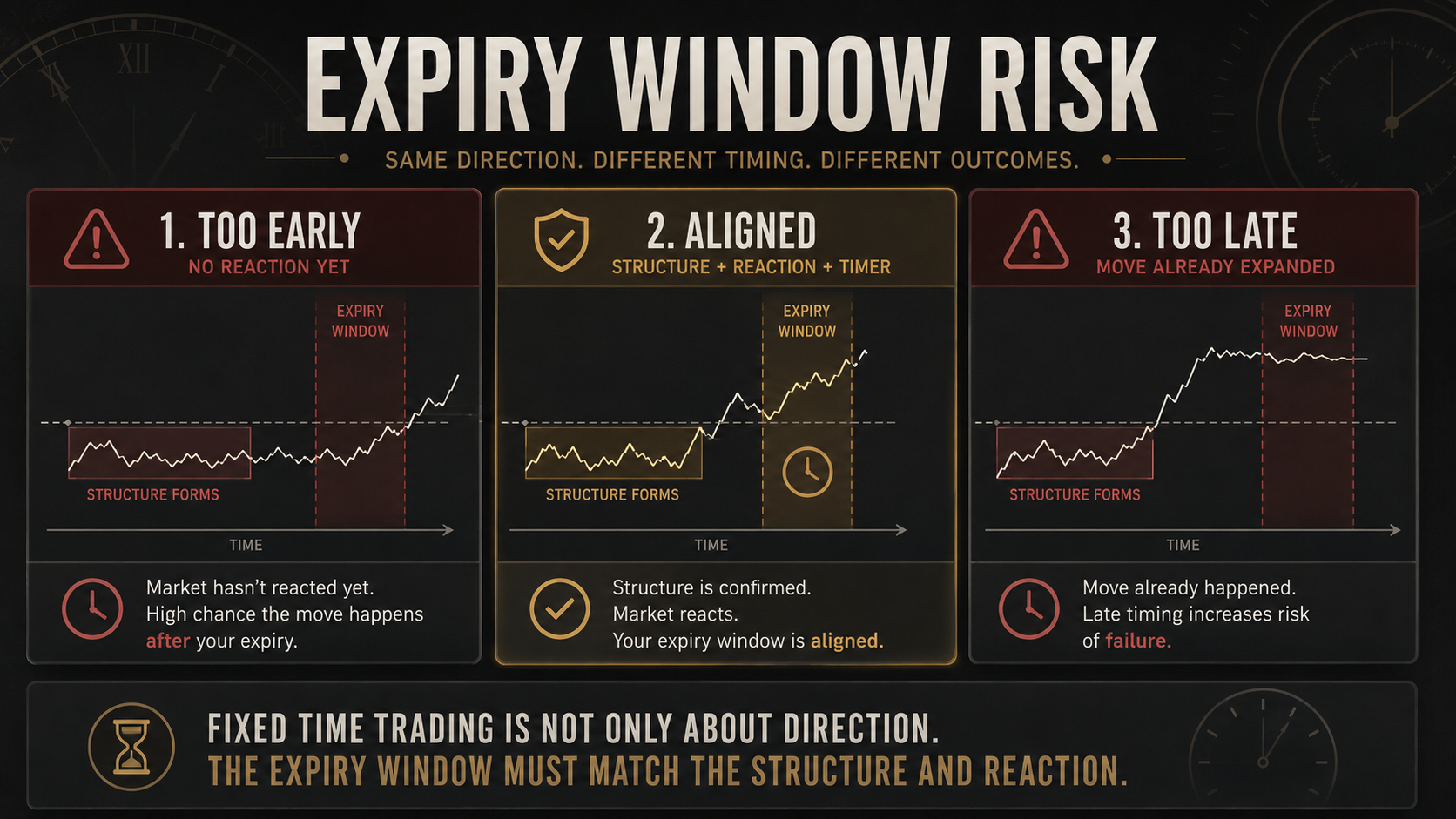
A trade can have structure and still fail if the expiry window does not match the setup.
For example, price may be near a lower boundary and may begin reacting upward. But if the selected time window is too short, price may not have enough time to move cleanly.
Another setup may have already moved too far. The direction may still be right, but the entry is late and the remaining time window is poor.
A fixed time trading strategy must consider timing.
Ask:
- Is the move just starting, or already extended?
- Is the reaction fresh, or already late?
- Does the expiry window give the idea enough time?
- Is price near a boundary or trapped in the middle?
- Is volatility too unstable for the selected time window?
The timer should not force the entry.
The structure should decide whether the timer makes sense.
If the expiry window does not fit the setup, skip the trade.
If the trade depends on one short expiry candle, read Why 60 Second Trades Fail Even When the Direction Looks Right. That article explains why direction can be correct while the one expiry candle still exposes poor timing and weak pre-entry structure.
Filter 5: Avoid Late Candle Chasing
Late candle chasing is one of the most common fixed time trading mistakes.
A trader sees a candle move strongly and enters because the direction looks obvious.
But by the time the candle looks obvious, the best timing may already be gone.
This creates a problem.
The trader enters when price is already extended.
The expiry window begins after the move has already happened.
Then price stalls, pulls back, or moves sideways.
The trader may have followed the correct direction, but the timing was poor.
A fast candle can mean many things:
- Real momentum
- A short-term liquidity move
- A reaction from a boundary
- A stop run
- A move near exhaustion
- Emotional buying or selling
The trader should not follow every fast candle.
Instead, ask:
“Did this move begin from a structure I planned, or am I chasing after it?”
If the move began from a clear reaction area, it may be worth evaluating.
If the move is already extended and the trader is entering late, the risk is higher.
If the fast entry happens because the trader feels pressure to click before the structure is clear, read 1-Minute Trading Strategy. That page explains why structure, location, reaction, momentum, and risk should be checked before entering a fast trade.
Filter 6: Control Session Risk
Fixed time trading can create fast repetition.
Because each trade has a short duration, the trader may feel tempted to take many trades in a single session.
This can lead to overtrading.
One loss becomes two.
Two losses become pressure.
Pressure becomes a recovery trade.
Then the trader starts taking entries that no longer match the plan.
This is why session risk matters.
Before starting, define:
- Maximum trades per session
- Maximum loss per session
- Stop rule after repeated losses
- Fixed position size
- Conditions for stopping
- Conditions for skipping
A fixed time trading strategy is not complete without a stop rule.
The trader must know when to stop before emotions appear.
If the trader waits until frustration appears, the rule may be too late.
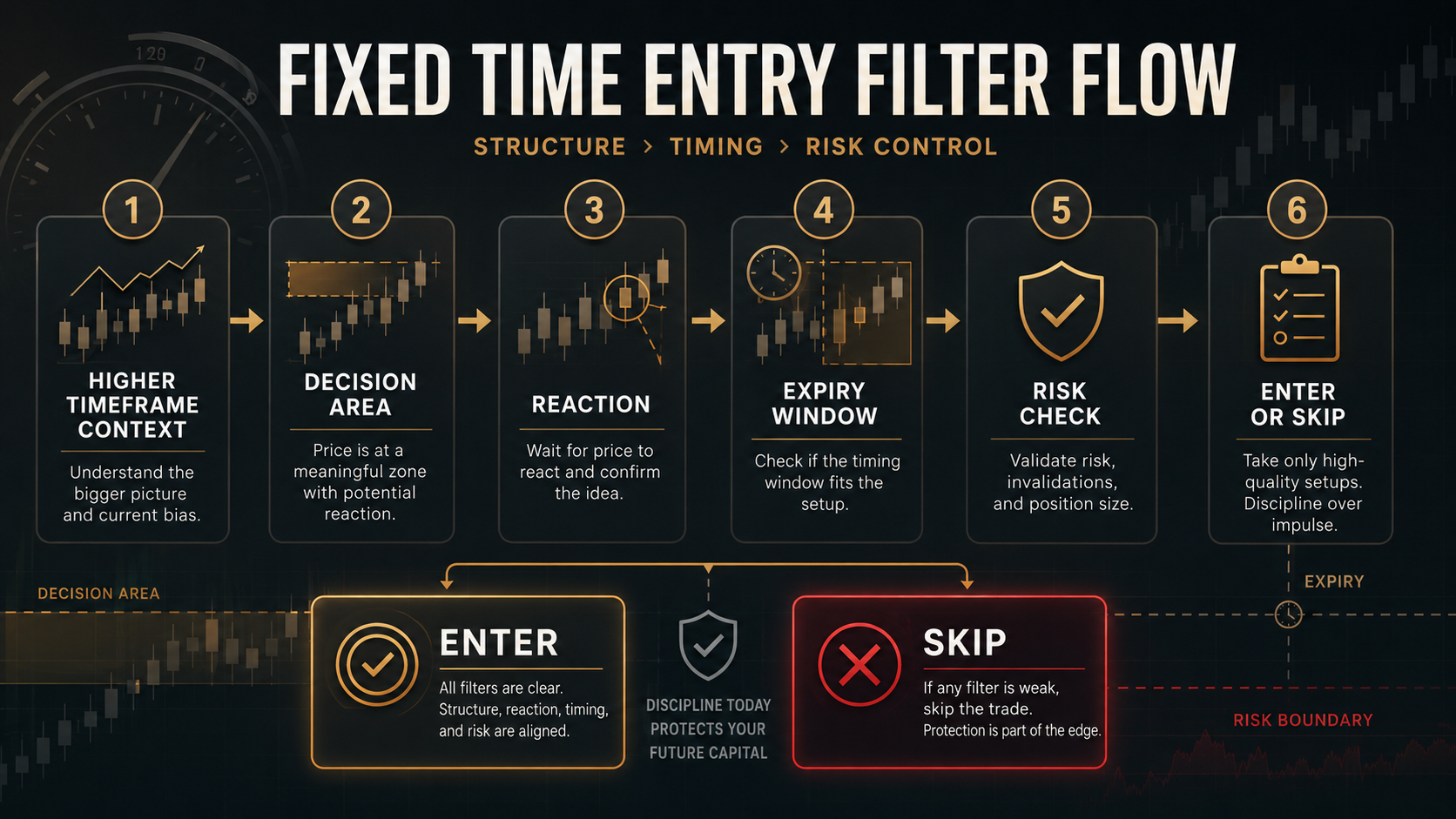
A Simple Fixed Time Trading Strategy Framework
This framework is not a signal system.
It is a filter system.
The purpose is to avoid weak fast entries.
Step 1: Check Higher Timeframe Context
Start with context.
Look at a slightly higher timeframe to identify the current structure.
The trader should know whether price is ranging, trending, retesting, breaking out, or returning after a failed breakout.
Low timeframes can be useful for timing, but they should not be the only source of the trade idea.
Step 2: Mark the Decision Area
Mark the area where price has a reason to react.
This may be a range boundary, a retest zone, or a failed breakout area.
The decision area should be simple enough to explain.
If the trader needs too many lines to justify the setup, the structure may not be clean.
Step 3: Wait for Reaction
When price reaches the decision area, observe.
Do not enter only because price touched the level.
Watch whether price accepts the level, rejects it, breaks through, or returns into the range.
The reaction is what creates the trade idea.
Step 4: Check the Expiry Window
Before entering, check whether the selected time window matches the setup.
If the reaction is fresh and the timing is reasonable, the setup may be worth evaluating.
If the move is already extended, the entry may be late.
If the expiry is too short for the structure, skip it.
Step 5: Define Risk and Stop Conditions
Before entering, define how much can be lost and when the session stops.
Even if the trade has a fixed outcome, the trader still controls position size and trade frequency.
Risk control is not optional.
Step 6: Enter Only If the Filters Are Clear
The trade should pass through all filters:
- Structure
- Decision area
- Reaction
- Expiry alignment
- Risk control
- Mental state
If any major filter is unclear, skip it.
No trade is better than a forced trade.
What a Bad Fixed Time Entry Looks Like
A bad fixed time entry usually feels urgent.
The trader feels that the timer is running out.
They see movement and believe they must act immediately.
Common bad entries include:
- Entering because the candle is already moving fast
- Entering in the middle of random price action
- Entering before any reaction appears
- Entering after the move is already extended
- Choosing an expiry window that does not fit the setup
- Taking the next trade to recover a previous loss
- Following a signal without checking structure
- Increasing size after a losing trade
These mistakes do not always lose immediately.
That is what makes them dangerous.
A bad process can sometimes produce a winning trade.
But over time, a weak process creates unstable decisions.
A serious trader should judge the process, not only the result.
Fixed Time Trading vs Random Fast Clicking
Fixed time trading and random clicking can look similar from the outside.
Both are fast.
Both use short time windows.
Both can create emotional pressure.
The difference is process.
A fixed time strategy uses structure, reaction, timing, and risk control.
Random clicking uses impulse.
A fixed time strategy can explain why the trade exists.
Random clicking only says the chart is moving.
A fixed time strategy can skip.
Random clicking feels forced.
This difference matters because fast markets reward preparation, not panic.
The trader who waits for structure may take fewer trades.
But fewer trades can mean better control.
Final Checklist Before a Fixed Time Trade
Before entering a fixed time trade, check:
- Is there clear market structure?
- Is price near a meaningful decision area?
- Has price reacted?
- Is the expiry window aligned with the setup?
- Am I entering early enough, or chasing late?
- Is the risk controlled?
- Is my position size fixed?
- Have I defined my session stop rule?
- Am I calm, or trying to recover?
- Would I still take this trade if the previous trade was a loss?
If the answers are unclear, skip the trade.
The goal is not to enter faster.
The goal is to filter better.
Is There a Best Strategy for Fixed Time Trading?
There is no best strategy for fixed time trading if the entry is taken without structure.
A strong fixed time trading strategy does not start with the expiry clock. It starts with price location, previous structure, reaction, and risk. The time window only matters after the trade idea already has context.
For fast fixed-time entries, the better question is not which strategy is best. The better question is whether the market has given enough structure before the expiry candle begins.
Final Rule: Structure Before the Timer
A fixed time trading strategy should not be built around urgency.
It should be built around structure.
The timer does not create a good trade.
A fast candle does not create a good trade.
A signal does not create a good trade.
The trade needs a structure, a decision area, a reaction, a suitable expiry window, and controlled risk.
Before entering the next fast trade, slow down and ask:
Where is price?
What structure matters?
What reaction has appeared?
Does the expiry window fit?
What is the risk?
If those answers are not clear, the best decision may be to skip.
In fixed time trading, the most important skill is not clicking fast.
It is refusing fast entries that do not have structure.