The previous candles already did the work.
Price pushed into a boundary.
A small reaction appeared.
Then the fast call arrived late.
The trader entered as if there was still time for the setup to develop.
But there was only one 60-second expiry candle left.
That is where many 60-second trades fail.
A 60 second trading strategy is not about entering and then waiting for the market to build structure after the click. In a short-expiry setup, the structure should already exist before entry. The reaction should already be visible before entry. The 60-second candle is not the analysis window.
It is the risk window.
The mistake happens when traders treat the next 60 seconds like a normal chart sequence. They expect price to confirm, react, continue, and resolve after they enter.
But in many short-expiry trades, there is only one candle that matters after the decision.
The trader enters.
One 60-second candle opens.
The candle closes.
The result is decided.
That means the real work must happen before the entry.
Before entering a 60-second trade, a trader should already know:
- What the previous structure is
- Where the decision area is
- Whether price has reacted before entry
- Where the entry decision happens
- What the next 60-second candle needs to do
- What makes the setup invalid
If those answers are unclear, the trade is not ready.
This article is for educational purposes only. It does not provide financial advice, trading signals, or guaranteed trading results.
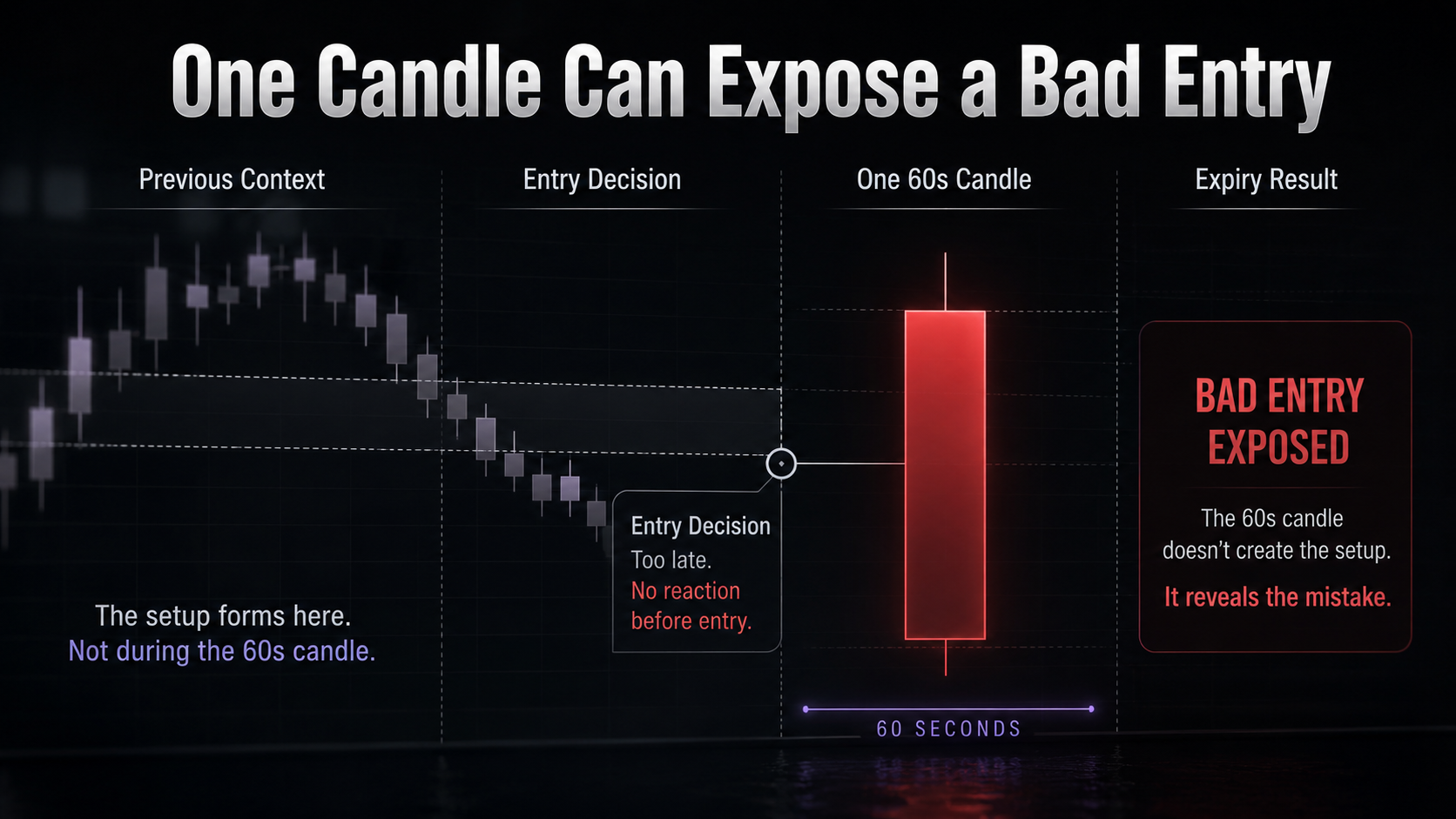
The Biggest 60-Second Mistake
The biggest mistake in 60-second trading is not being wrong about direction.
It is entering before the setup is ready.
A trader sees price touch a level and assumes the next candle will react.
A trader sees a fast candle and assumes the next candle will continue.
A trader sees a signal and assumes the timing is still good.
But the one-candle expiry does not give much room for correction.
If the reaction has not appeared before entry, the trader may be using the 60-second candle to discover whether the setup exists.
That is backwards.
The setup should be visible before the entry.
The 60-second candle should only test whether the prepared idea follows through.
A good short-expiry decision does not start with the timer.
It starts with previous context.
If the trade depends on a fixed expiry window, read Fixed Time Trading Strategy. That article explains why structure, decision areas, reaction, and timing alignment must come before any short-duration entry.
Previous Context Comes First
A 60-second trade still needs context.
The trader should know what price was doing before the entry.
Was price inside a range?
Was price pushing into a boundary?
Was price rejecting a level?
Was price reclaiming a failed breakdown?
Was price returning into the range after a failed breakout?
This previous context matters because the next 60-second candle does not have enough time to build the whole story from nothing.
The trader should not enter just because the current candle looks active.
The trader should enter only after previous price action has created a reason to consider the next candle.
A weak 60-second trade usually starts like this:
Price moves fast.
A call appears.
The trader enters.
Then the trader hopes the next candle will create confirmation.
A cleaner 60-second trade starts differently:
Structure is already visible.
Price reaches a decision area.
A reaction appears before entry.
The next 60-second candle becomes the execution window.
That is the difference.
The Timer Is Not the Setup
A 60-second timer creates pressure.
It makes the trader feel that the opportunity is disappearing.
That pressure is dangerous because it can replace analysis.
The trader may stop asking:
“Where is the structure?”
“Has price reacted?”
“Is the entry late?”
“What does the next candle need to do?”
Instead, the trader thinks:
“I need to enter now.”
That is how the timer becomes the decision-maker.
But the timer does not create a setup.
It only defines how little time the trade has to work.
If the previous structure is weak, the timer makes the trade worse.
If the reaction has not appeared, the timer makes the trade more fragile.
If the entry is late, the timer exposes the bad position quickly.
In 60-second trading, time is not an edge.
Time is a constraint.
If the trader feels pressure to click before the setup is clear, read 1-Minute Trading Strategy. That page explains how structure, location, reaction, momentum, and risk should be checked before entering a fast trade.
A Boundary Touch Is Not Enough
Many short-expiry traders misuse boundaries.
They see price touch an upper boundary and expect immediate rejection.
They see price touch a lower boundary and expect immediate bounce.
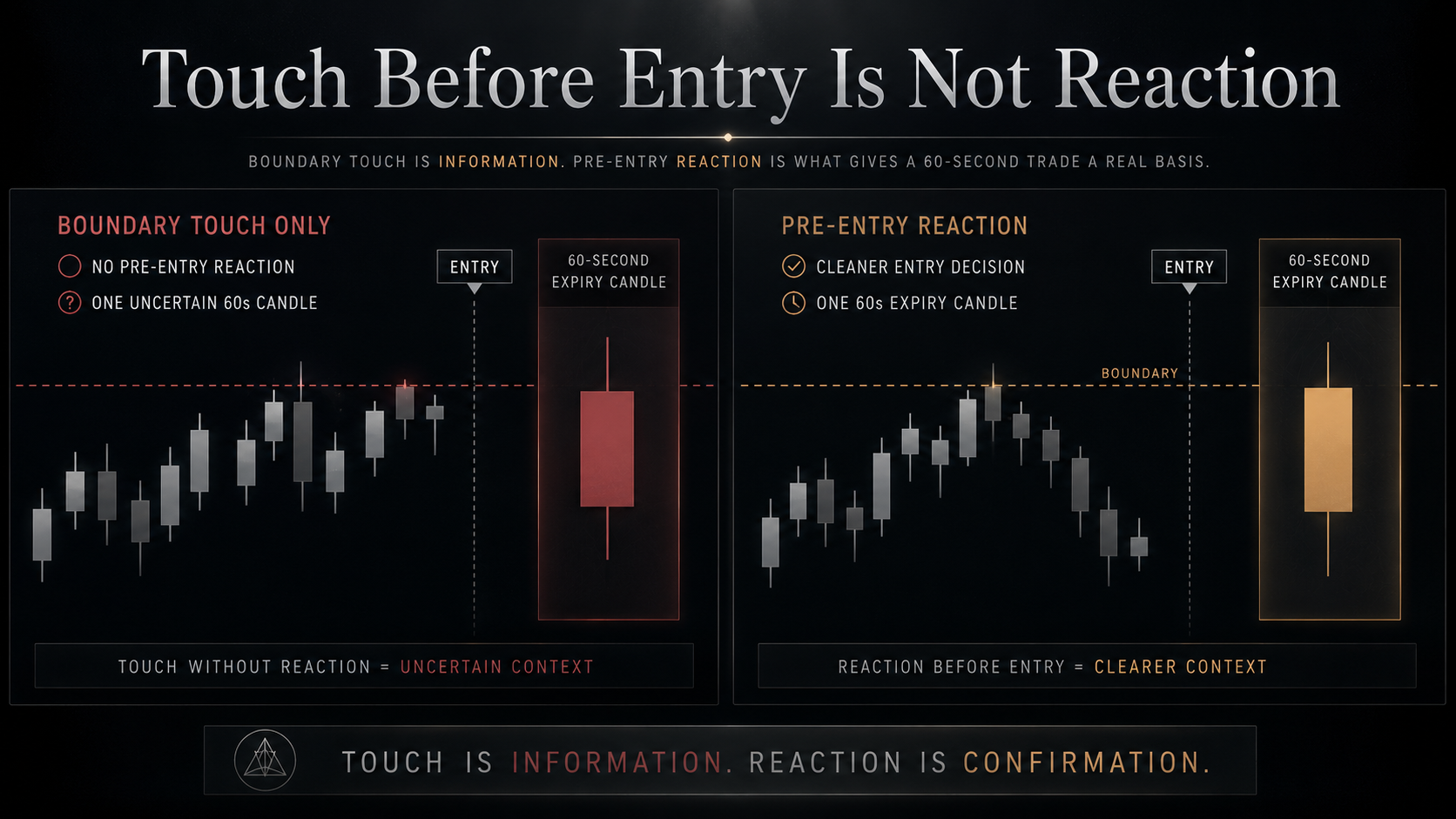
But a boundary touch is only information.
It is not a complete trade idea.
A boundary becomes useful only when price reacts there.
That reaction should usually be visible before the 60-second entry.
At an upper boundary, the trader may watch for rejection, failed breakout, or a return back into the range.
At a lower boundary, the trader may watch for bounce, failed breakdown, or a range reclaim.
The important point is simple:
The trader should not use the next 60-second candle to find out whether the boundary matters.
The boundary should already matter before the entry.
The entry should happen only after the chart has shown enough reaction to define the idea.
A touch is not reaction.
A reaction is what gives the next candle a reason.
The Fast Call Often Comes Too Late
A fast call feels useful because it removes hesitation.
But in 60-second trading, many fast calls arrive after the useful part of the move already happened.
The previous candle pushed.
The reaction occurred.
The call appeared.
The trader entered on the next candle.
Now the trader is not entering the beginning of the idea.
They are entering the leftover part of the idea.
That is dangerous because the next 60-second candle may stall, pull back, or simply fail to extend enough before expiry.
This does not mean every fast call is wrong.
It means the trader must ask where the call appears in the sequence.
If the call appears before the reaction, it may be too early.
If the call appears after the reaction and after the move has expanded, it may be too late.
If the call appears when previous context, reaction, and the next candle window align, then it may be worth evaluating.
The call is not the trade.
The sequence is the trade.
If the 60-second entry comes from a fast signal without explaining structure, read Binary Options Signals Exposed. That article breaks down why fast calls, pressure, weak structure, and recovery trading can turn short-duration entries into traps.
The 60-Second Sequence That Matters
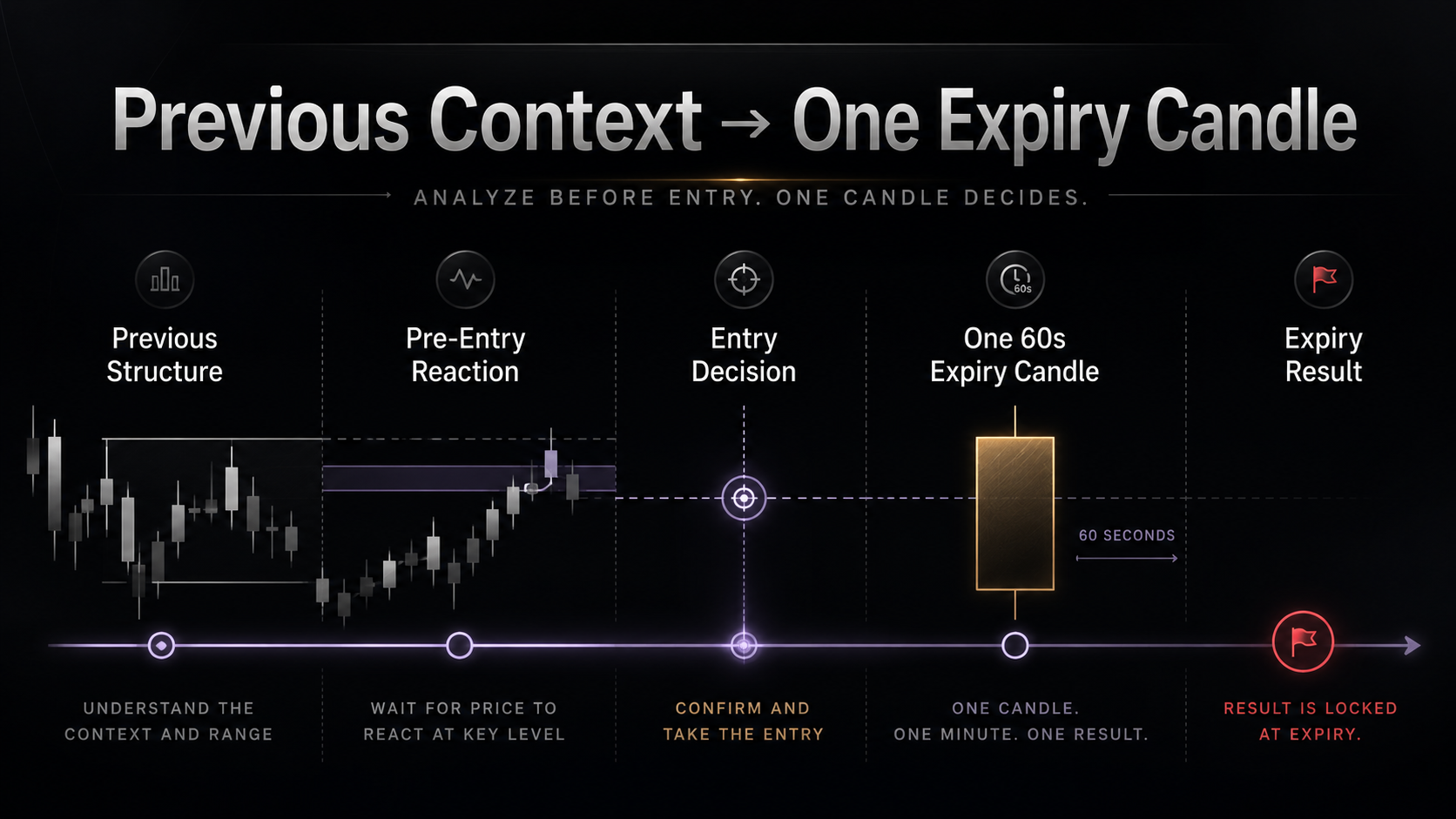
A professional way to read a short-expiry setup is to separate the trade into five parts:
Previous structure.
Pre-entry reaction.
Entry decision.
One 60-second expiry candle.
Expiry result.
This sequence prevents the trader from confusing analysis with execution.
Previous structure gives the setup context.
Pre-entry reaction gives the setup meaning.
The entry decision chooses whether the next candle is worth the risk.
The 60-second candle carries the result.
The expiry result confirms whether the timing was good or poor.
If the trader skips the first two parts, the trade becomes blind.
If the trader enters before reaction, the next candle has to do too much work.
If the trader enters after the move is extended, the next candle may have too little room left.
The setup is not just about direction.
It is about where the trader enters in the sequence.
Three Ways One Expiry Candle Fails
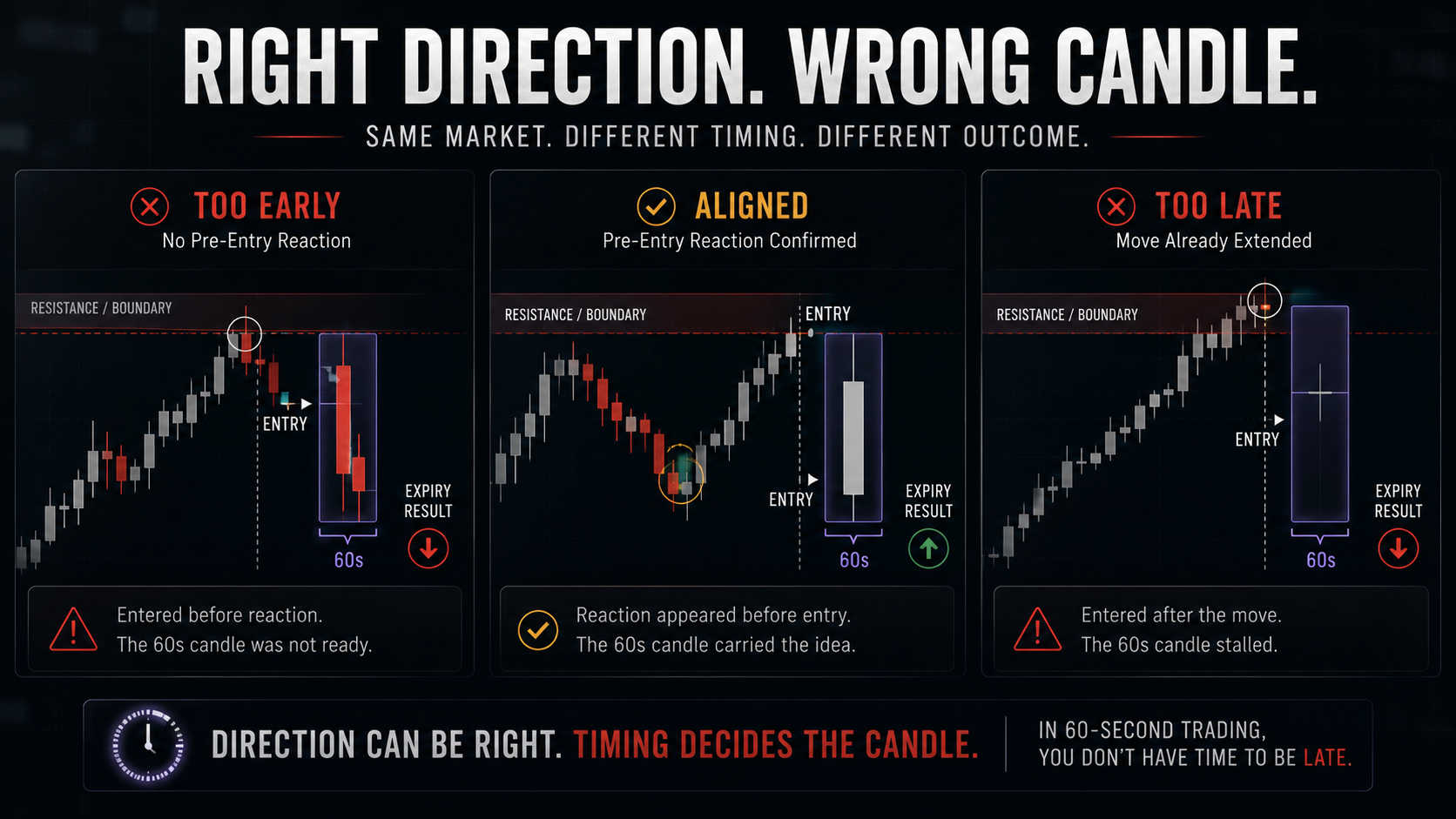
A 60-second trade can fail in three common ways.
1. Too Early
The trader enters before reaction appears.
The level has been touched, but the market has not shown whether it accepts or rejects the area.
Now the next 60-second candle has to create the reaction and deliver the result at the same time.
That is too much to ask from one candle.
2. Too Late
The trader enters after the reaction already produced the move.
The chart looks obvious because the best part has already happened.
Now the next 60-second candle may stall, pull back, or close in the wrong place.
The direction may have been right.
The entry was late.
3. No Structure
The trader enters in random movement.
There is no clear boundary.
No pre-entry reaction.
No obvious invalidation.
The next 60-second candle becomes a coin flip.
The trader may still win sometimes, but the process is weak.
A good result does not make a bad entry professional.
Right Direction Can Still Be the Wrong Candle
This is the part many traders miss.
The market can move in the expected direction.
But if it happens before the entry or after the expiry, the trade still fails.
That is why one-candle timing matters.
A trader may say:
“I was right.”
But the expiry does not care.
A 60-second trade only cares about what happens inside that specific candle after entry.
The trade is not judged by what price does five candles later.
It is judged by the selected expiry candle.
This is why a correct market idea can still become a bad 60-second trade.
Right direction.
Wrong candle.
Wrong result.
The trader must stop thinking only in direction and start thinking in sequence.
A Practical 60-Second Entry Filter
This is not a signal system.
It is a rejection system.
The goal is not to create more trades.
The goal is to avoid forcing one candle to solve an unclear setup.
Before entering, check the sequence.
1. Previous Structure
There should be a clear context before entry.
A range, boundary, retest, failed breakout, failed breakdown, or reclaim.
If there is no structure, skip.
2. Pre-Entry Reaction
There should be some reaction before the 60-second candle starts carrying the result.
A bounce, rejection, reclaim, failed break, or visible change in candle behavior.
If reaction has not appeared, skip.
3. Entry Decision
The entry should come after enough information is visible, not after the entire move is finished.
If the trader is entering because the timer creates panic, skip.
4. One Expiry Candle
The trader should understand what the next candle needs to do.
If the next candle has to build the setup, confirm it, and complete the move all at once, the trade is weak.
5. Expiry Result
The result should be judged only by the planned expiry candle.
Do not use later movement to justify a bad entry.
If the market moves after expiry, that does not make the 60-second decision correct.
What a Bad 60-Second Entry Looks Like
A bad 60-second entry often looks exciting.
The candle is moving.
The timer feels urgent.
The signal looks confident.
The trader feels that waiting means missing out.
But underneath the excitement, the setup may have no professional structure.
Bad entries usually share these traits:
- No previous context
- No pre-entry reaction
- Entry after a candle already expanded
- Boundary touch treated as confirmation
- Timer used as the reason to act
- One expiry candle expected to do too much
- Trade taken to recover a loss
- Signal followed without independent structure
These are not small mistakes.
In a 60-second trade, small timing errors become the entire trade.
There is no long recovery period.
There is no time to wait for the structure to become clear.
The setup must be ready before entry.
Final Checklist Before a 60-Second Trade
Before entering a 60-second trade, ask:
- What was the previous structure?
- Where is the decision area?
- Did reaction appear before entry?
- Am I entering before the move, or after it already expanded?
- What does the next 60-second candle need to do?
- Is the expiry candle carrying a clean idea or a guess?
- Is the trade based on sequence, not pressure?
- Am I calm enough to skip?
- Am I following a call without understanding the setup?
- Would I still take this trade without the timer?
If the answers are unclear, skip.
No trade is not a missed opportunity.
It is protection from a bad one-candle decision.
Final Rule: The 60-Second Candle Is the Result, Not the Setup
A 60-second trade should not begin with hope.
It should begin with previous context.
It should have a pre-entry reaction.
It should have a clear entry decision.
Then, and only then, the trader can judge whether one expiry candle is worth the risk.
The 60-second candle should not be where the trader waits for the setup to appear.
It should be where a prepared setup either follows through or fails.
That is the difference between a fast trade and a forced trade.
In 60-second trading, the trader who can reject unclear one-candle setups has more control than the trader who clicks every fast call.